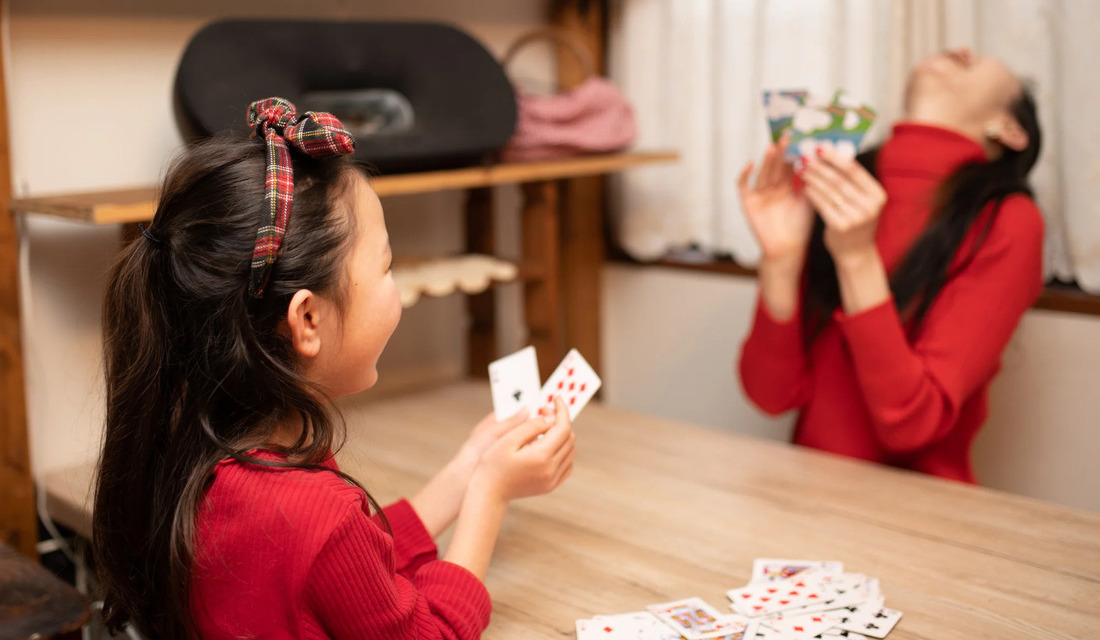
Maryland's math standards ask more of students than computation alone. Pattern recognition, flexible reasoning, and the ability to work through an unfamiliar problem from multiple angles are the skills that show up on the MCAP and carry students forward through every grade that follows.
Games are a practical, research-backed way for families to reinforce those skills at home.
We use them regularly in our sessions with students, so today, we're sharing our favorite games that help build math skills and reasoning, along with tips for our neighboring families on how to turn Maryland into a math exploration playground.
Why Games Are an Effective Form of Math Practice
There is solid research on the effect of games on early math learning.
An NSF-supported study of numerical card games with preschoolers found that four brief 15-minute play sessions led to lasting improvements in numeral identification and number comparison weeks later.
A review in the journal Early Years confirmed a similar pattern. Children ages 3–9 who played number-based board games regularly made significant gains in counting, addition, and numeral recognition.
At our center, we find that students engage longer and work through more problems when the activity feels like a game. That willingness to stay in it is what builds fluency, because the repetition happens without the pressure that makes math feel like a chore.
We are not saying games can replace instruction. What we are saying is that the concepts your child is learning in school and in sessions need room to settle, and games are one of the few formats where kids will seek out that repetition on their own.
📕 You May Also Like: 7 Multiplication Games to Build Times Tables Fluency
5 Games to Promote Your Child's Math Skills and Reasoning
Our instructors organized the games below by age and complexity, starting with the simplest card and board games for early learners and building toward games that bring in multiplication, probability, and number theory for older students.
Each one has a different angle, because different ages need different things from play.
1. Addition War (Grades K–2)
For this one, all you need is a standard deck of cards. No purchase, no setup, and no instructions to lose.
The basic version of the game is very straightforward: each player flips a card, and the higher number wins the round. We find it gives your youngest learners consistent, low-pressure practice with number comparison and greater than and less than, through dozens of repetitions in a single sitting.
The upgrade we recommend is Addition War. Each player flips two cards and adds them together, and the higher sum wins. That one rule change turns a passive game into active arithmetic practice on every single turn, and your child works through addition problem after addition problem without registering it as practice.
That repetition is the whole point. Fluency in early math builds through volume, and War delivers that volume in a format your child will ask to play again.
📕 You May Also Like: How to Teach Your Child the Alligator Method for Greater Than and Less Than
2. Sum Swamp™ (Grades K–2)
Sum Swamp™ by Learning Resources is a board game designed specifically to help young children practice addition and subtraction in a playful, low-pressure setting. The math is the whole engine of play.
The game uses three dice: two number dice and one operations die that lands on either plus or minus. Every move requires your young learner to add or subtract. They roll, they calculate, and their swamp creature moves forward.
The slightly silly swamp world keeps kids ages 5–7 invested in every turn, and we find they stay at the table far longer than they would with a worksheet.
3. Zeus on the Loose (Grades 2–4)
Zeus on the Loose is a fast-moving card game, and the pace is part of what makes it work.
Players take turns adding numbers to a running total, racing to be the one who hits 100. Every turn, your child is doing mental math under light pressure, and that combination helps build arithmetic fluency.
The mechanic we find most valuable is what the game calls Friends of Ten. Whenever the running total lands on a multiple of 10, that player steals Zeus. To pull that off, your child has to track the running total, identify the gap to the next multiple, and find the card that closes it.
The deck also includes special God cards that reverse the total or introduce subtraction, which adds a layer of complexity that keeps students in grades 3 and 4 on their toes.
We recommend Zeus on the Loose for learners ready to move beyond counting and into the kind of quick mental calculation the MCAP expects. Hitting a moving target in real time is exactly the type of number flexibility that shows up on that assessment.
4. Yahtzee (Grades 3–5)
There is a good chance you already own this one. Yahtzee has been a family staple for decades, and most parents and kids play it without noticing how much math is running underneath it the whole time.
A standard game covers:
-
Adding dice combinations on every turn
-
Multiplying for three-of-a-kind and four-of-a-kind scores
-
Tracking a running total across the scorecard
-
Making probability decisions each time your child chooses whether to re-roll or lock in a score
That last one is where the most interesting math happens. The question of whether to go for a full house or take the small straight is mathematical reasoning, and your child is doing it naturally.
The math range here is wider than most family games. Younger players in grade 3 get steady addition practice, while students in grades 4 and 5 are working with multiplication and early probability thinking.
One adjustment we always suggest is to let your child be the scorekeeper. When they own the scorecard, every round becomes an exercise in calculation and accuracy that they have a real stake in getting right.

A game of Yahtzee is also a math session your child will actually ask to play again.
5. Prime Climb (Grades 4–7)
Prime Climb was designed by mathematician Dan Finkel, and you can feel that in how the game is built. The board runs from 1 to 101, with every number color-coded by its prime factors.
Multiplication, division, and factoring are embedded in the board itself, visible on every turn.
Players use all four operations to move their pawns forward. On any given turn, your child is deciding whether to add, subtract, multiply, or divide, and the choice that gets them furthest requires them to actually think about how numbers relate to each other.
That is a different kind of math than filling in answers on a page.
We put Prime Climb last on this list because it is the one that grows with your child. A fourth grader will play it differently than a seventh grader, and both will be doing meaningful math.
For students who have moved past basic arithmetic and are ready to think about numbers more deeply, this is the game we reach for.
Maryland Parents: Turn Your State Into a Math Playground
Looking to take the play outdoors?
Maryland also has some exceptional spots for math in the wild, including:
-
Calvert Cliffs State Park is a favorite with kids who like getting their hands on things. Let them collect fossilized shark teeth, sort them by shape, measure lengths in centimeters, and sketch a quick bar graph in the sand. It's a full math lesson that doesn't feel like one.
-
Assateague Island turns estimation into an adventure. Kids can track wild horse sightings across sections of the beach, estimate herd size from a sample, or time wave intervals and calculate averages. The setting does most of the motivational work.
-
Brookside Gardens is an easy win for younger learners. Radial symmetry shows up everywhere, in sunflowers, pinecones, and leaf arrangements. Point it out once, and they'll start finding it on their own.
If you are looking for nearby activities that are more social in nature, start with your child’s school. For instance, they may already host Family Math Nights — events common across Montgomery, Baltimore, Howard, and Prince George's County schools, where kids play strategy and number games in a low-pressure, social setting.
These are fun and certainly worth watching for on your school calendar. They're one of the better ways to see what math engagement looks like outside a classroom.
For at-home resources, the Maryland State Department of Education's parent hub includes downloadable Family Guides with card games like "Go Fish to 10" and household math challenges tied directly to state standards.
None of these require a lesson plan. A little curiosity and the right questions are all you need.
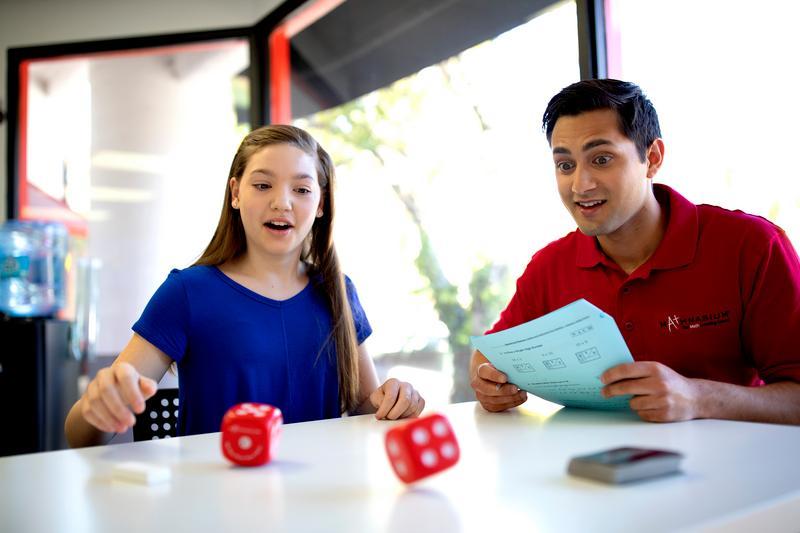
At Mathnasium, games are part of how we teach. The Mathnasium Method™ uses hands-on, engaging activities to help students build lasting math skills.
How We Make Math Learning Fun at Mathnasium
Mathnasium is a math-only learning center empowering students of all skill levels to excel in math.
Our teaching approach, the Mathnasium Method™, has helped thousands of students not only build skills but also transform how they think and feel about math.
It starts with a diagnostic assessment, a relaxed interaction that allows us to identify your child's strengths, knowledge gaps, and how they naturally think through problems. With those insights, we build a personalized learning plan tailored to their needs and goals.
From there, our specially trained instructors follow the plan closely, delivering face-to-face instruction in a caring and fun small-group environment. We teach for true understanding, using plain everyday language and a mix of verbal, visual, mental, tactile, and written techniques so each math concept lands.
When students get stuck, we break problems into manageable steps and walk them through both the how and the why. Gradually, they develop the problem-solving skills and critical thinking tools that carry well beyond math class.
Fun is a core part of how we work. Parents often tell us our sessions feel nothing like lectures, and that is by design. We use game-based activities, hands-on materials, and earned rewards, and we celebrate every milestone because confidence grows when progress gets noticed.
The results speak volumes:
-
94% of parents report an improvement in their child's math skills and understanding
-
93% of parents report their child's improved attitude toward math after attending Mathnasium
-
90% of students saw an improvement in their school grades
With over 1,100 learning centers, Mathnasium brings top-rated math instruction close to your community.
For families in or near Columbia, MD, Mathnasium of Columbia MD is a trusted local partner in building confident and flexible math thinkers.
If your child is looking to catch up, keep up, or get ahead in math, we’d love to help.
📅 Schedule a Free Assessment at Mathnasium of Columbia MD
Not located near Columbia, MD?
📍 Find a Mathnasium Learning Center Near You


 (410) 997-6284