When f(x) first appears in math class, it can feel like algebra suddenly switched to a foreign language. But behind the formal symbols and equations, the concept of a function is surprisingly straightforward.
Simply put, a function is a rule that connects an input to exactly one unique output. We can think of it like a recipe. If we put the same ingredient in, we’ll always get the same result out.
In this beginner-friendly guide, our Mathnasium tutors will explain what a function is, show how we write one with function notation, and test whether a table, a set of ordered pairs, or a graph can also be a function.

What Is a Function In Math?
A function in math is a special rule or relationship that connects an input value to exactly one unique output value.
We can think of a function like a vending machine that can sell us specific items:
If we insert 1 coin, we will get exactly one specific output, which is a soda. But if we insert 2 coins, we will get a completely different output, a candy bar.
Whenever we put in a specific amount of money, we’ll always get one exact item back.
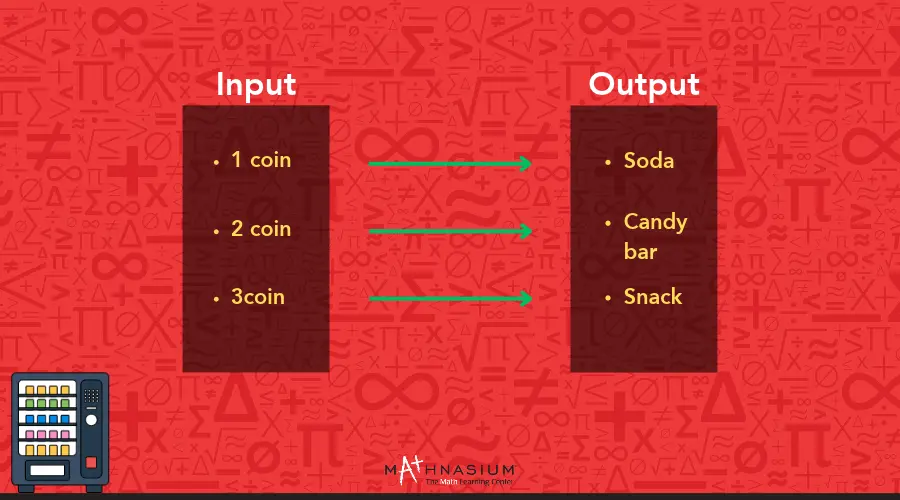
The same way a function works in math.
In an expression like y = x + 2, every time we plug a different number in for x, we’ll get one specific, unique result for y.
Let’s try it out and plug in 3 for x.
y = 3 + 2
y = 5
That means if our x = 3, y is always 5.
If an input can produce more than one output, it breaks the rule and is no longer a function.
Let’s see that in an equation like y2 = x. We can plug 4 in for x, and we could get two different results for y.
How?
Well, because y is squared here, both (-2)2 and 22 give us 4 as a result.
That means that this relationship is not a function since one input (4) leads to multiple outputs (2 and -2).

How Do We Write Functions?
Functions are commonly written using function notation, such as f(x).
Each part has its own meaning:
-
f names the function, and we can use any letter to represent it just like with variables.
-
x stands for the input.
-
f(x) represents the output.
Let’s look at function notation in action through an equation like f(x) = 2x + 1.
If we plug x = 3 into our function, we’ll get:
f(3) = 2 ⋅ 3+1
f(3) = 6 + 1
f(3) = 7
The input 3 gives us a single output of 7.
We call this evaluating a function in this case we evaluated the function at x = 3.
Functions don’t just live in algebraic equations. In math, we’ll see functions represented in a few different ways, but they all follow the same input-output rule.
📕 You May Also Like: What Is Function Notation and Why Does f(x) Replace y?
1. Function as a Table
A table lists inputs in one column and their matching outputs in the other. It is a quick way to see the input-output rule at work.
Here is the function f(x) = 3x - 1 as a table.
|
Input (x)
|
Output f(x)
|
|
1
|
2
|
|
2
|
5
|
|
3
|
8
|
|
4
|
11
|
Each row shows one input paired with exactly one output.
Let’s check the first row together.
f(1) = 3 ⋅ 1 - 1
f(1) = 3 - 1
f(1) = 2
The rule is the same for every row, so we can fill in the whole table the same way.
To check whether a table is a function, we scan the input column. If any input shows up twice with two different outputs, it is not a function.
📕 You May Also Like: Input-Output Table: How to Find the Rule It Follows
2. Function as Ordered Pairs
An ordered pair writes an input and its output together in parentheses as (input, output). The order matters, because the input always comes first.
Let’s see how to turn a function into ordered pairs, using f(x) = 4x - 3. We pick an input, find its output, and write the two numbers together.
Step 1: Choose an input.
Let’s start with x = 1.
Step 2: Find the output.
f(1) = 4 ⋅ 1 - 3
f(1) = 4 - 3
f(1) = 1
Step 3: Write the pair as (input, output): (1, 1).
We repeat the same steps for more inputs:
-
f(2) = 4 ⋅ 2 - 3 = 8 - 3 = 5, so we write (2, 5)
-
f(3) = 4 ⋅ 3 - 3 = 12 - 3 = 9, so we write (3, 9)
-
f(4) = 4 ⋅ 4 - 3 = 16 - 3 = 13, so we write (4, 13)
Together, our function gives us these ordered pairs:
(1, 1), (2, 5), (3, 9), (4, 13)
Each input appears once, and each has one output, so this is a function.
Now let’s look at this set: (2, 1), (2, 5), (3, 9).
The input 2 is paired with two different outputs, 1 and 5. That breaks the rule, so this set is not a function.
📕 You May Also Like: What Are Ordered Pairs? A Complete Overview
3. Function as a Graph
We can also represent a function visually on a graph. When we plot a function, the input x runs along the horizontal axis, and the output f(x) runs along the vertical axis.
Let’s graph f(x) = 4x - 3 using the ordered pairs we found previously: (1, 1), (2, 5), (3, 9), and (4, 13).
Here is how we plot each one:
-
Step 1: Start at the origin, where the two axes meet.
-
Step 2: Move right by the input. For (2, 5), we move 2 units to the right.
-
Step 3: Move up by the output. For (2, 5), we move 5 units up, and we mark the point.
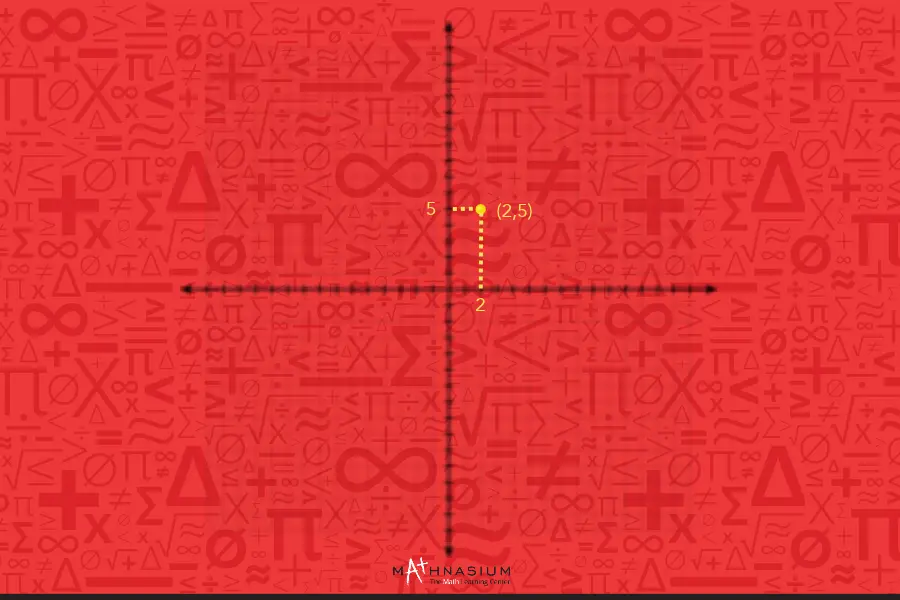
We repeat the same steps for the other pairs. Once all four points are marked, we can see that they line up in a straight line.
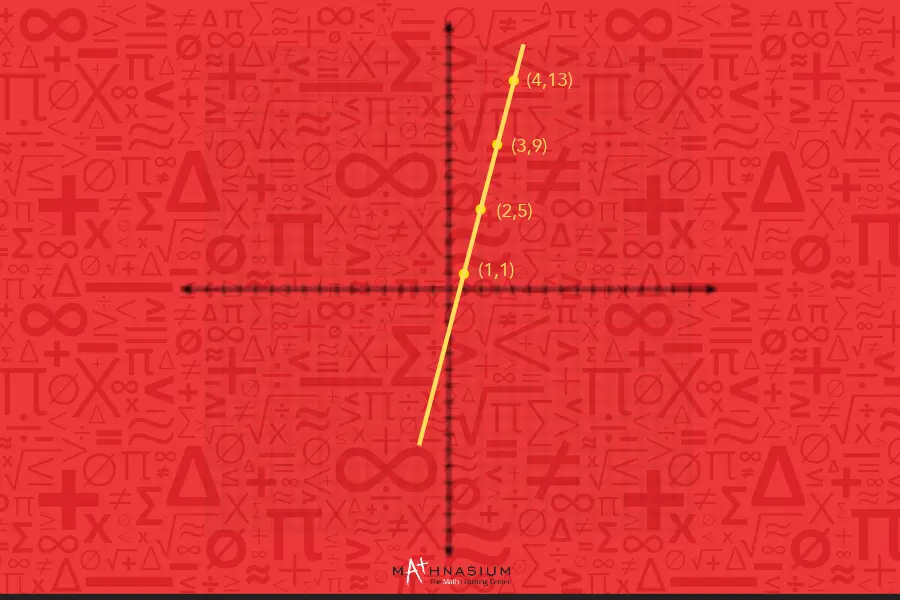
To check whether a graph is a function, we can use the vertical line test where we draw a vertical line across the graph. As long as that line never touches the graph more than once at any given point it tells us that the graph is a function.
Let’s test ours!
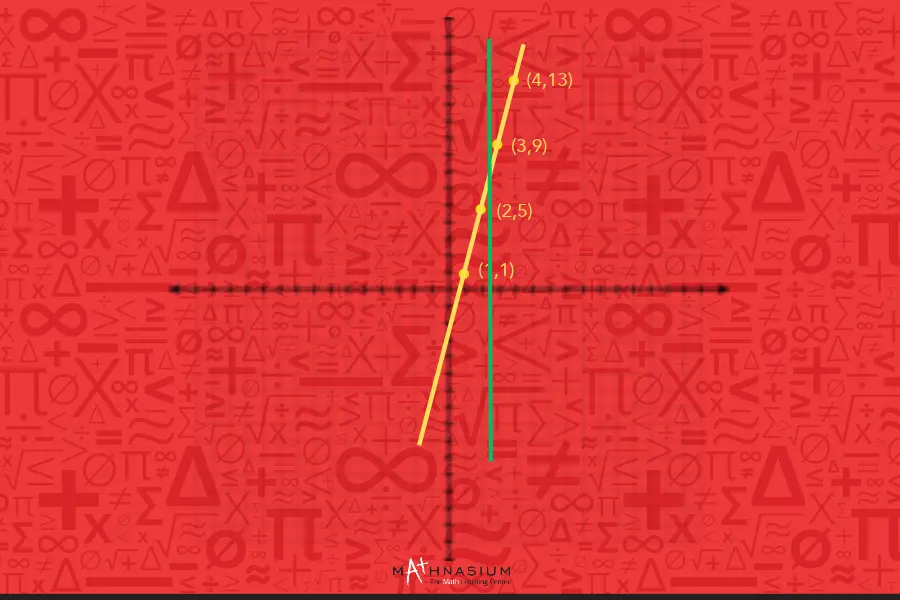
As we can see the vertical line doesn’t touch our graph more than once. That means that we have a function here.
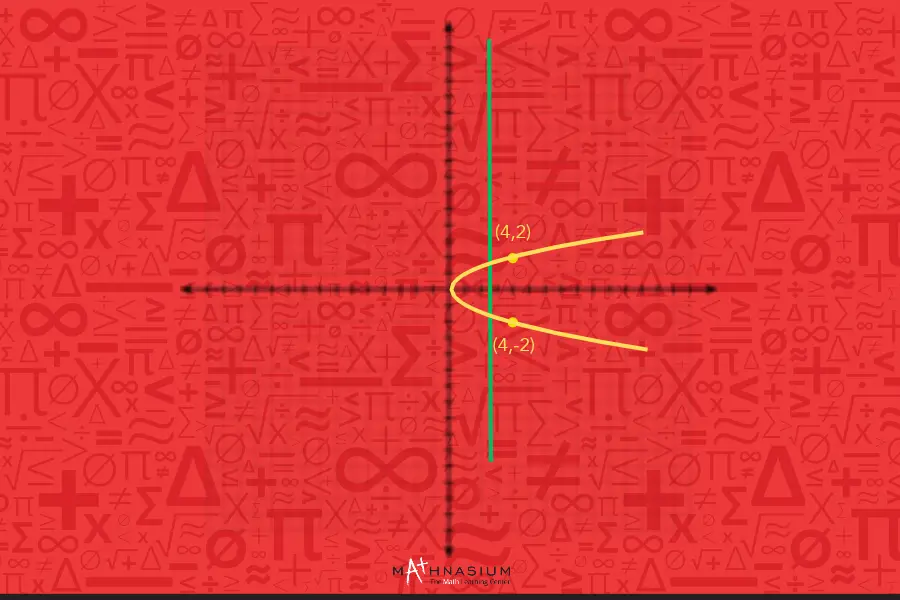
Now if we go back to our example from the beginning (y2 = x) and graph it out, we’ll see that the shape we get is a sideways parabola. This happens because squaring a number can yield both a positive and a negative result.
Due to this symmetry, a vertical line at x = 4 crosses the graph at two points: (4,2) and (4,-2).
Since a single input of 4 leads to two different outputs, this relationship is not a function.
📕 You May Also Like: What Is a Quadratic Function? A Beginner-Friendly Guide
Common Mistakes When Students Start To Learn Functions
In our work with students, we’ve noticed a few common mistakes that come up when they start to learn about functions. Many of them happen because the rules of input and output can feel abstract at first.
Let’s see some of them.
1. Reading f(x) as “f times x”
The notation looks like multiplication, so it can be an easy trap. We recommend saying “f of x” out loud every time until it becomes automatic.
Additionally, f(x) is just another way to write y. It represents the output, which is called the dependent variable because its value depends entirely on whatever input we plug in for x.
2. Thinking repeated outputs break the rule
Some students see the same output and say “not a function.” We should remember that for any relationship to be a function, every single input can only lead to one output.
|
|
Type of Relationship
|
What It Means
|
|
Function
|
Many-to-One
|
Different inputs can lead to the same output.
|
|
Not a Function
|
One-to-Many
|
One input leads to two or more different outputs.
|
3. Thinking a function must be an equation
A function can be written as an equation, but it can also be shown as a table, a list of pairs, a graph, or a sentence in words. The rule is what makes it a function, not the way it is written.
📕 You May Also Like: Function vs. Equation: What Is the Difference? A Kid-Friendly Guide
Quiz: How Well Do You Know Functions?
Let’s see how much you’ve picked up. Work through each question, then check your answers at the bottom of the guide.
Question 1: How many outputs does a function give for each input?
a) None
b) Exactly one
c) Exactly two
d) As many as we like
Question 2: Button B2 on a vending machine drops chips on Monday and cookies on Tuesday. Is the machine acting like a function?
Question 3: For f(x) = 3x + 1, what is f(4)?
Question 4: Is this a function? (1, 5), (2, 5), (3, 5)
Question 5: Is this a function? (2, 6), (2, 8), (3, 9)
Question 6: What does f(x) mean?
a) f times x
b) The output of function f when the input is x
c) f plus x
d) The input of the function

At Mathnasium, our tutors use personalized learning plans and hands-on techniques to help students make sense of concepts like functions.
How Mathnasium Helps Students Master Functions (and Any Math Concept)
Mathnasium is a math-only learning center dedicated to helping students of all skill levels learn and master math.
Whether a student is working on foundational skills like input-output tables and solving equations or is ready for function notation and graphing, we teach for deep understanding at every level.
We do that through the Mathnasium Method™, our proprietary teaching approach built around personalized learning and proven instructional techniques.
Here is what that looks like in practice:
-
Diagnostic Assessment and Personalized Learning Plans: Each student begins with a diagnostic assessment, a relaxed interaction that identifies strengths and knowledge gaps. From there, we build a personalized learning plan around their needs and goals. Students reach lasting math mastery at a pace that works for them.
-
Teaching for Understanding: Our specially trained tutors teach face-to-face in a supportive and fun setting. We use everyday language and a mix of verbal, visual, mental, tactile, and written techniques so concepts like functions make sense to each student.
-
Problem-Solving and Critical Thinking: When a concept feels unclear, we break it down into smaller steps and explain both the how and the why. In time, students build the problem-solving skills and critical thinking tools they can use in math and beyond.
-
An Engaging and Fun Learning Environment: Our activities are game-based and hands-on, and students earn rewards along the way. We track progress and celebrate every win, so confidence grows with every session.
The results reflect that approach:
-
94% of parents report an improvement in their child’s math skills and understanding
-
93% of parents report an improved attitude toward math after attending Mathnasium
-
90% of students saw an improvement in their school grades
We operate over 1,200 centers across North America, so there is likely a Mathnasium close by.
Families in Dacula and the surrounding area can visit Mathnasium of Dacula, a trusted local center that helps students become confident math thinkers.
Whether a student is looking to catch up, keep up, or get ahead in math, our local team is happy to help!
📅 Schedule a Free Diagnostic Assessment at Mathnasium of Dacula
Not near Dacula?
📍 Find a Mathnasium Learning Center Near You
Pssst! Check Your Answers Here
If you gave our quiz a try, here are the answers.
Question 1: b) Exactly one. A function gives one output for every input.
Question 2: No. The same button gave two different snacks, so it is not acting like a function.
Question 3: 13.
Question 4: Yes. Every input appears once, and repeating the output 5 is allowed.
Question 5: No. The input 2 has two outputs, 6 and 8.
Question 6: b) The output of function f when the input is x.
How did you do?


 (770) 273-9697