At first glance, a square number seems simple. Multiply a whole number by itself, like 4 × 4 = 16 or 5 × 5 = 25. But, beneath that basic arithmetic sits one of the most versatile building blocks in math.
Rather than isolated answers on a flashcard, square numbers function as visual patterns, geometric foundations, and building blocks for advanced algebra. From forming perfect grid shapes and lining up on multiplication tables to powering famous formulas like the Pythagorean theorem, square numbers appear everywhere.
To show how connected these concepts really are, our Mathnasium tutors picked seven places where square numbers appear across math.

Let's Review: What Are Square Numbers?
A square number, also called a perfect square, is the result of multiplying a whole number by itself.
Take 4. When we multiply it by itself, we get 16:
4 × 4 = 16
That gives us a square number: 16.
Let's try 5 next:
5 × 5 = 25
25 is a square number, too.
Not every whole number works this way, though. Take 6.
We can only reach 6 through 2 × 3 or 1 × 6 when working with whole numbers, and neither one multiplies a number by itself. So 6 is not a square number.
This distinction, whether we can reach a number by multiplying it by itself, is what separates square numbers from every other whole number. Once we know how to spot that pattern, we'll start noticing square numbers across many math concepts and topics.
Let's look at a few of those together.

1. Square Numbers as Geometric Shapes
Square numbers form an actual geometric shape from equal rows and columns of blocks arranged into a grid.
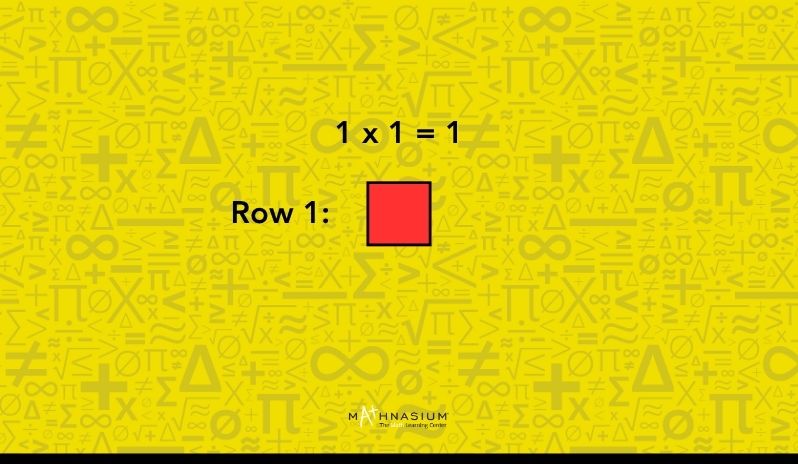
Let's start with a 1 × 1 square by using a single block:
1 × 1 = 1
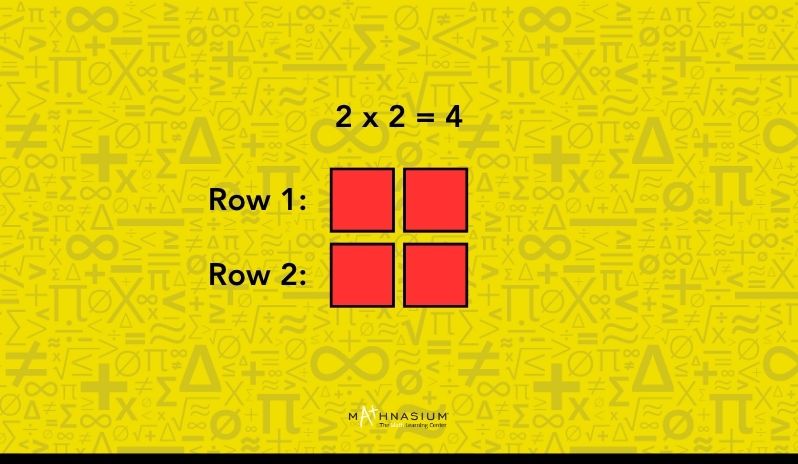
Let's move to a 2 × 2 square next. We can arrange 4 blocks into two rows and two columns:
-
Row 1: 2 blocks
-
Row 2: 2 blocks
2 × 2 = 4
Now let's build a 3 × 3 square:
-
Row 1: 3 blocks
-
Row 2: 3 blocks
-
Row 3: 3 blocks
3 × 3 = 9
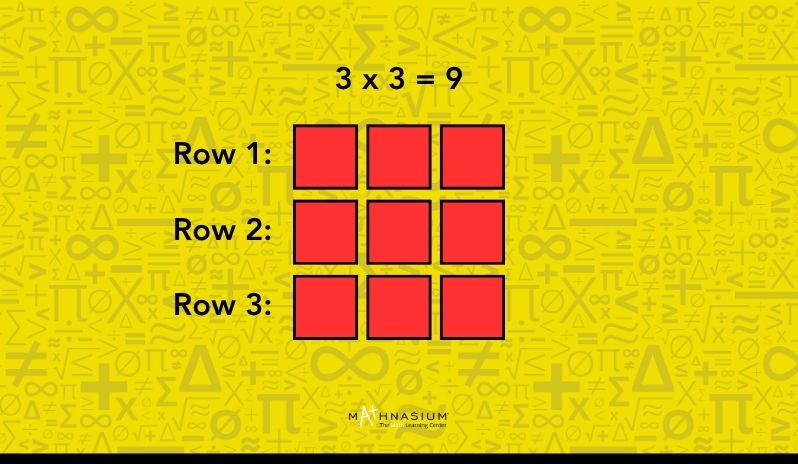
We can continue this pattern endlessly to make larger and larger squares!
Since the number of rows always equals the number of columns, all four sides of the grid stay exactly the same length. Instead of forming a long or tall rectangle, it builds a perfect square every time.
That’s where "square numbers" get their name!
📕 You May Also Like: What Does “Squared” Mean in Math? Explain It to a 10-Year-Old
2. Square Numbers and Multiplication Table
Square numbers line up along one particular diagonal inside the multiplication table.
If we run our finger down that diagonal, starting from the top-left corner and moving to the bottom-right. We land on 1, 4, 9, 16, 25, 36, 49, 64, 81, and 100.
Do you notice anything here? That’s right, every single one of those is a square number!
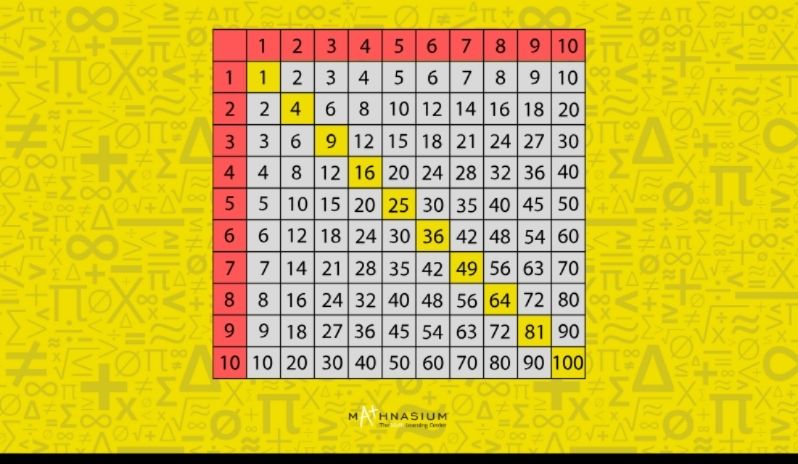
So, why does that diagonal hold every square number? Each spot on it marks a row and column that share the same number:
-
Row 1 meets column 1: 1 × 1 = 1
-
Row 2 meets column 2: 2 × 2 = 4
-
Row 3 meets column 3: 3 × 3 = 9
-
Row 4 meets column 4: 4 × 4 = 16
The same number multiplies itself at every one of those spots, and that repeated multiplication is exactly how we build a square number in the first place.
📕 You May Also Like: How to Help Your Child Memorize Multiplication Tables in 3 Simple Steps
3. Square Numbers in Odd-Number Patterns
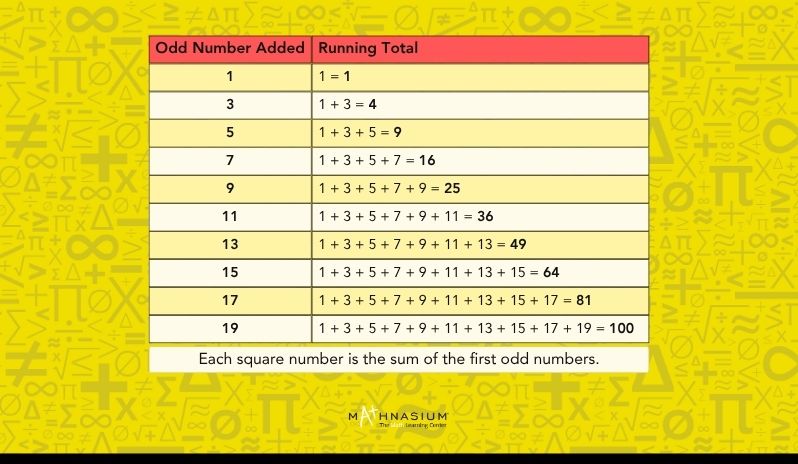
Square numbers in odd-number patterns build on a simple rule where adding consecutive odd numbers starting from 1 results in a square number every single time.
Let's start with just the number 1:
1 = 1
That's our first square number, sitting alone.
Let's add the next odd number, 3:
1 + 3 = 4
4 is a square number too. Let's keep going and add 5:
1 + 3 + 5 = 9
9 is also a square number. One more round, adding 7:
1 + 3 + 5 + 7 = 16
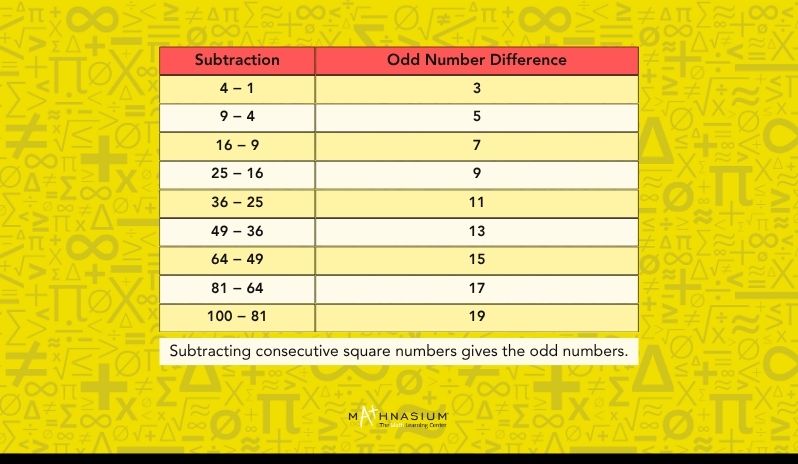
This pattern also works in reverse. Let's line up the square numbers in order, 1, 4, 9, 16, 25, and subtract each one from the square number right after it:
-
4 − 1 = 3
-
9 − 4 = 5
-
16 − 9 = 7
-
25 − 16 = 9
The differences between consecutive square numbers are odd numbers too.
📕 You May Also Like: How to Identify and Extend Number Patterns: A Guide for Middle Schoolers
4. Square Numbers and Exponents
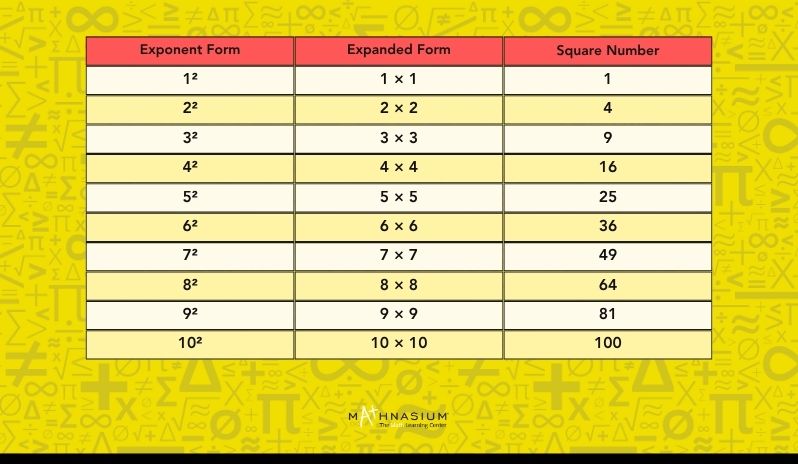
Square numbers give us a shorthand way to write repeated multiplication, using exponents.
Let's look at 4 × 4 = 16. We multiply the same number by itself, and exponents let us write that same multiplication in a shorter way.
We write "4 squared" as 4², with a small 2 sitting above and to the right of the 4. That small 2 tells us how many times we multiply 4 by itself.
Two times in this case:
4² = 4 × 4 = 16
Let's try another one. 5² tells us to multiply 5 by itself:
5² = 5 × 5 = 25
Any square number can be written using this same shorthand by raising the number to the power of 2.
Here are the first ten square numbers, written both ways.
📕 You May Also Like: The Kid-Friendly Guide to Exponents in Math
5. Square Numbers and Square Roots
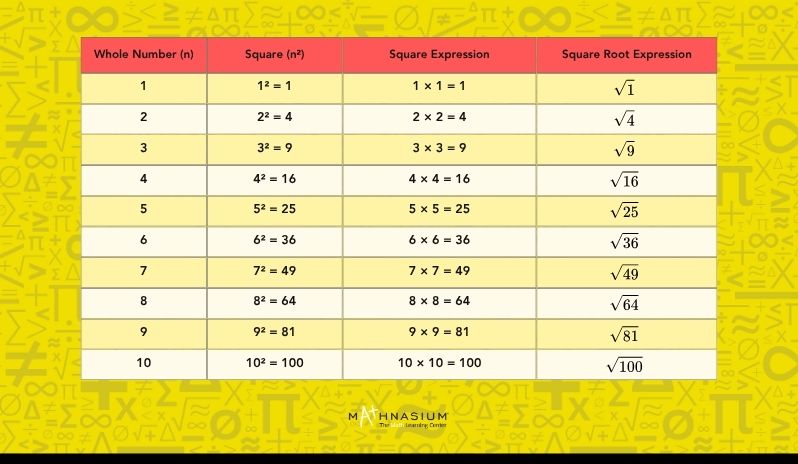
Square numbers pair up with an inverse operation called a square root, one that undoes squaring.
Consider 5² = 25. Squaring 5 gives us 25. A square root works backward from there and asks a different question: “Which number, multiplied by itself, gives us 25?”
We write a square root using the radical symbol, \(\sqrt{}\).
Therefore, \(\sqrt{25}\) asks us to find that number, and the answer takes us right back to 5:
\(\sqrt{25}\) = 5
We can connect all three forms together to see the relationship between them:
\(\sqrt{25}\) = 5 → 5² = 5 × 5 = 25
For another example, \(\sqrt{36}\) asks us which number, multiplied by itself, gives us 36:
\(\sqrt{36}\) = 6
We can combine these same three forms for 36:
\(\sqrt{36}\) = 6 → 6² = 6 × 6 = 36
Squaring and finding a square root work as opposite moves on the same number. One builds a square number from a smaller number, and the other breaks a square number back down to the number we started with.
📕 You May Also Like: What Is a Square Root? A Complete Overview
6. Square Numbers and Area of 2D Shapes
Square numbers connect to every 2D shape we measure, since area always comes out in square units, no matter which shape we're working with.
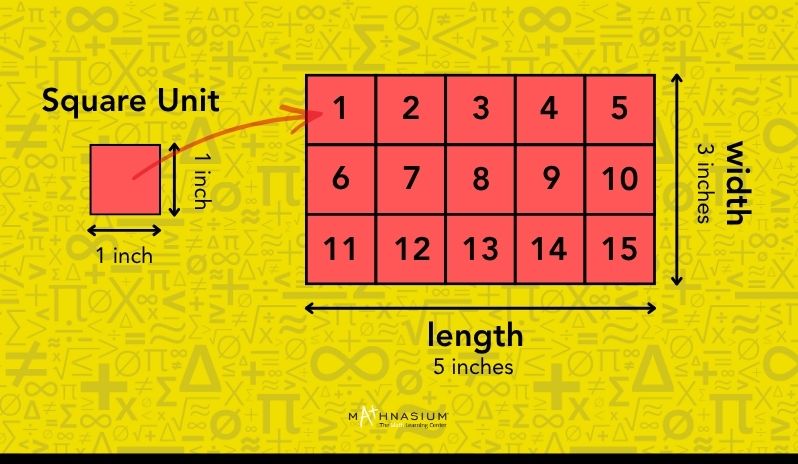
Area measures how many unit squares fit inside a shape. What do we mean by that?
Picture a small square with a side length of exactly 1 inch, called a unit square. Laying a bunch of those unit squares side by side, with no gaps and no overlaps, covers an entire shape. The number of unit squares it takes to cover that shape is the area.
That is why every area measurement carries a square unit label:
-
Inches → in²
-
Feet → ft²
-
Yards → yd²
-
Miles → mi²
Let’s find the area of a rectangle by multiplying its length by its width to see this in action:
Area = l × w
Imagine our rectangle had a length of 5 inches and a width of 3 inches. When we apply these to our formula, we get:
5 × 3 = 15 in²
Even though 15 isn't a square number, we still measure it in square inches, since we built that area out of 1-by-1 unit squares.
Whether we are measuring a circle or a sharp triangle, square numbers are built right into the very language of area.
📕 You May Also Like: What Is Area in Math? A Complete & Kid-Friendly Guide
7. Square Numbers and the Pythagorean Theorem
The Pythagorean theorem relies entirely on square numbers to connect the three sides of a right triangle.
The theorem states: a² + b² = c²
Here, a and b are the two shorter sides of the triangle, and c is the longest side, sitting opposite the right angle.
Do we notice anything about this formula? Every single term is a side length raised to the power of 2. Squaring a side length gives us the area of a square built on that side:
Area = s²
Each side of the triangle can act as the base of its own square, one square sitting on side a, one on side b, and one on side c. The formula tells us that the areas of the two smaller squares add up exactly to the area of the biggest square.
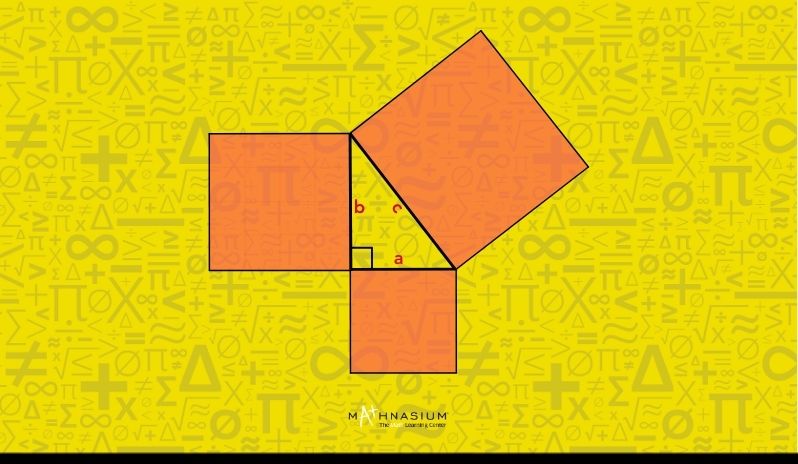
Let's see this in action with a triangle that has shorter sides of a = 3 and b = 4.
We square the first side:
3² = 9
Then, we square the second side:
4² = 16
Let's add those two square numbers together:
9 + 16 = 25
We find the actual length of the longest side, the hypotenuse, by working backward with a square root, the number that multiplies by itself to make 25:
\(\sqrt{25}\) = 5
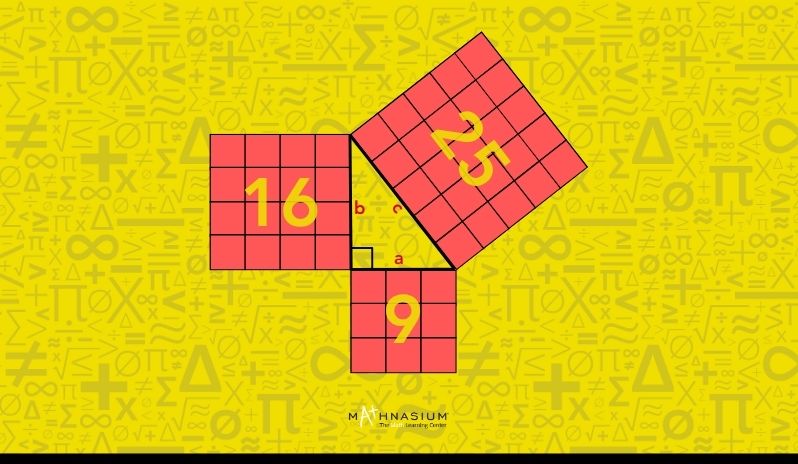
Let's check that answer using the formula itself:
a² + b² = c²
3² + 4² = 5²
9 + 16 = 25
Both sides match, so c = 5 is correct.
Square numbers gave this famous geometric relationship its entire foundation.
📕 You May Also Like: How to Find the Hypotenuse Using the Pythagorean Theorem

Mathnasium tutors help students see how square numbers connect across multiplication, exponents, geometry, and beyond.
How Mathnasium Builds Deep Understanding of Any Math Concept
Mathnasium is a math-only learning center dedicated to helping students of all skill levels learn and master math.
When students need support with topics like square numbers, exponents, or the broader family of concepts they connect to, the focus is always on deep understanding.
We do that through the Mathnasium Method™, our proprietary teaching approach designed around each student's individual learning needs.
Here is how it works in practice:
-
Diagnostic Assessment and Personalized Learning Plans: Every student begins with a diagnostic assessment that identifies both visible skill gaps and the reasoning patterns behind them. From that starting point, we build a personalized learning plan tailored to their needs and goals.
-
Teaching for Understanding: Our specially trained tutors use plain, everyday language and a mix of verbal, visual, mental, tactile, and written techniques so concepts like squaring make sense from more than one angle.
-
Problem-Solving and Critical Thinking: When a concept feels challenging, our tutors break it down into manageable parts and guide students through both the how and the why. That approach is what builds lasting independence.
-
An Engaging and Fun Learning Environment: Sessions stay hands-on and game-based, and we celebrate every bit of progress along the way. Over time, students build a stronger relationship with math and more confidence in their own abilities.
Families see measurable results:
-
94% of parents report an improvement in their child's math skills and understanding
-
93% of parents report an improved attitude toward math after attending Mathnasium
-
90% of students saw an improvement in their school grades
We operate over 1,200 centers across North America, bringing our proven approach to communities everywhere.
Families in and around Dacula, GA, can visit Mathnasium of Dacula, a trusted local center with a proven record of building confident math thinkers.
Whether your student is looking to catch up, keep up, or get ahead in math, our local team is happy to help!
📅 Schedule a Free Diagnostic Assessment at Mathnasium of Dacula
Not near Dacula?
📍 Find a Mathnasium Learning Center Near You


 (770) 273-9697