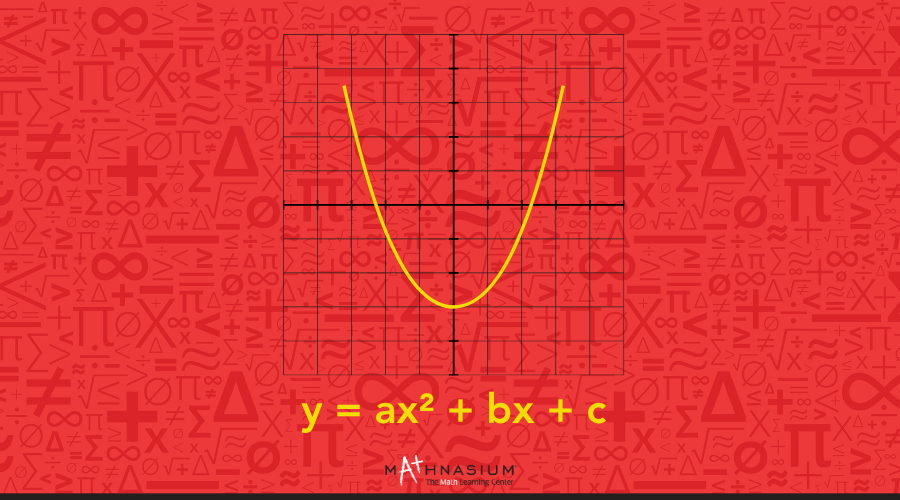
Up until now, most of the functions you've worked with have been linear, straight lines with a steady rate of change. Quadratic functions break that pattern, and seeing how they do will help you notice them everywhere in Algebra 2.
Today, our Mathnasium tutors cover what makes a function quadratic, how the parabola shape works, how to recognize one, and why quadratics show up so often in Algebra 2.

What Is a Quadratic Function?
A quadratic function is a function where the highest exponent on the variable is 2.
In simpler terms, it is a function that contains x2.
To see how a quadratic function behaves, it's best to compare it to a linear function, where the highest exponent is 1.
Let's see this in action with two real-life examples.
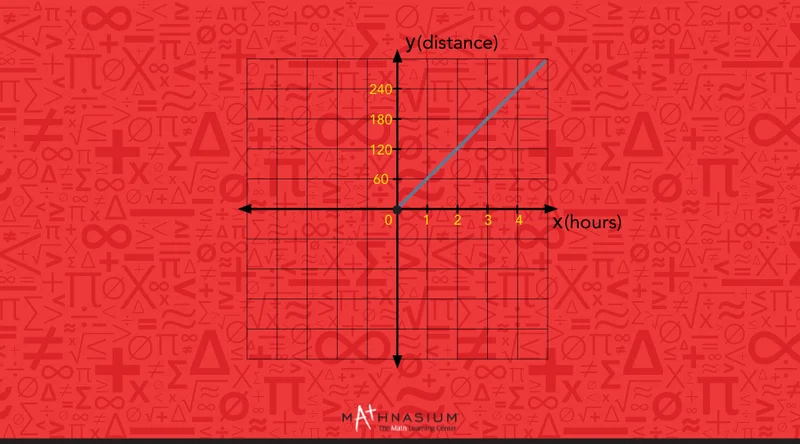
If a car goes at a constant speed of 60 mph, every hour adds the same distance.
-
1 hour = 60 miles
-
2 hours = 120 miles
-
3 hours = 180 miles
The increase is steady, +60 every time. Graphed against time, that steady climb forms a straight, rising line. That's what a linear function is.
When you shoot a basketball, gravity acts on it as it travels. Instead of moving in a straight line, its path forms an arch:
-
As it leaves your hand, it climbs fast.
-
It slows down near the top of the arc (apex).
-
It accelerates downward as it falls toward the hoop.
It forms a U-shaped curve called a parabola, making a basketball's path a perfect real-world example of a quadratic function.

📕 You May Also Like: Functions vs. Equations: What Is the Difference?
How to Recognize a Quadratic Function
To recognize a quadratic function, look for one defining feature. The highest power of x in any function must be x2.
We write quadratic functions in standard form as:
f(x) = ax2 + bx + c
-
The ax2 term is the part doing the squaring. It's the only part required to create a curve, and the value of a cannot be zero. If a = 0, the x2 term disappears.
-
The b and c terms change the position of the parabola
-
Variable a controls direction (up/down) and width (stretch/compress) of the parabola
Quadratic functions can look different depending on which terms are present.
-
f(x) = x2 is a quadratic function on its own, since the ax2 term is all that's required.
-
f(x) = x2 + 4 has an x2 term and a plain number, no x term at all.
-
f(x) = x2 − 3x has an x2 term and an x term, no plain number.
-
f(x) = 2x2 + 5x − 1 has all three parts, ax2, bx, and c, together.
Every one of these is still quadratic, since each has x2 as its highest power.
With all of this in mind, spotting a quadratic function comes down to one question. What's the highest power of x in the function?
Let's test that on a few examples through other functions.
-
y = x2 + 5 → Quadratic, x2 is the highest power.
-
y = 3x + 7 → Linear, the highest power of x is just x.
-
y = x3 + x2 − 4 → Cubic, even though x2 is present, x3 is a higher power.
-
y = 10 − 4x2 → Quadratic, x² is still the highest power, even listed last.
-
y = 8 − x → Linear, the highest power of x is just x.
📕 You May Also Like: What Is an Algebraic Expression? A Simple Guide
How the Parabola Shapes a Quadratic Function
Every quadratic function graphs as a parabola, a U-shaped curve that opens either upward or downward.
That direction depends on one number, a, the same a we've already seen in ax2 + bx + c.
-
If a is positive, the parabola opens upward, like a smile.
-
If a is negative, the parabola opens downward, like a frown.
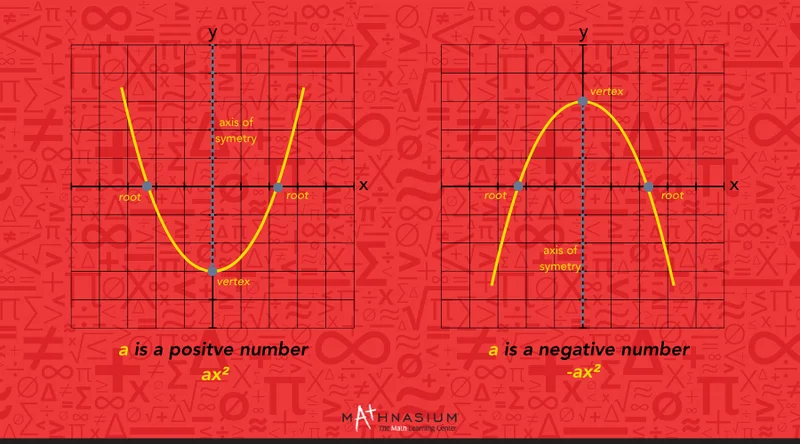
A parabola's shape comes with its own vocabulary, and each term points to something we can see directly on the curve.
|
Term
|
What It Is
|
|
Vertex
|
The tip of the curve, its highest or lowest point
|
|
Axis of Symmetry
|
An imaginary line running straight through the vertex, splitting the parabola into two matching halves
|
|
Root (or Zero)
|
A point where the curve touches or crosses the x-axis
|
A parabola can touch the x-axis twice, once, or not at all, depending on how many times the curve crosses it.
📕 You May Also Like: How the Coordinate Plane Works: Guide
Why Do Quadratic Functions Show Up Everywhere in Algebra 2?
Quadratic functions show up because so many real-world relationships involve two changing quantities multiplied together, or a changing quantity multiplied by itself.
These relationships appear across many different real-world problems, each modeling something slightly different.
|
Context
|
What the Quadratic Models
|
Example
|
|
Projectile motion
|
The height of an object over time, as gravity pulls it back down
|
A rocket launched into the air before falling back down
|
|
Area problems
|
How the area of a shape changes as one dimension changes
|
Finding the dimensions of a garden that uses the most area for a fixed amount of fencing
|
|
Revenue and profit
|
Total revenue when price and quantity sold both depend on the same variable
|
Raising a ticket price lowers how many tickets sell, so total revenue rises, peaks, then falls
|
|
Design and architecture
|
The height of an arch or cable at each horizontal position along a bridge or roof
|
The main cable of a suspension bridge, which follows a parabolic shape under uniform load
|
This is also why Algebra 2 keeps circling back to quadratics. Learning to graph one, factor one, and solve one gives students a skill set that applies to any situation where two changing quantities multiply together.
📕 You May Also Like: Is Algebra 2 Hard? Everything You Need to Know
FAQs About Quadratic Functions
Here are some of the most common questions our Mathnasium tutors hear from students about quadratic functions, along with answers to help clear up any lingering confusion.
1. Is a quadratic function the same thing as a quadratic equation?
No. A quadratic function describes a relationship, written as f(x) = ax2 + bx + c, that pairs every input with an output. A quadratic equation sets that same expression equal to a specific value, most often 0, so we can solve for the value of x.
Every quadratic equation grows out of a quadratic function, but on its own, a function is something we graph or evaluate, not something we solve.
2. Do all quadratic functions cross the x-axis?
No. A parabola can cross the x-axis twice, touch it once right at the vertex, or never touch it at all. Which one happens depends on where the vertex sits and which direction the parabola opens.
3. Why do we need the quadratic formula if we can find the vertex a different way?
The quadratic formula is a shortcut for finding a quadratic function's roots when factoring doesn't work easily. Since every quadratic function follows the same ax2 + bx + c pattern, the same formula solves for x every time, no matter which numbers take the place of a, b, and c.
4. What comes after quadratic functions in Algebra 2?
After quadratic functions, most students move into polynomial functions of higher degree, along with rational and radical functions. Since those build on the same graphing and factoring skills quadratics use, a solid handle on quadratics makes each new function type easier to pick up.

Mathnasium tutors help students master any math skill or course through personalized learning plans and proven, interactive teaching techniques.
How Mathnasium Helps Students Master Algebra (and Any Other Math Concept)
Mathnasium is a math-only learning center that helps K-12 students catch up, keep up, and get ahead in math.
Whether a student is meeting quadratic functions for the first time, working to graph and factor them with confidence, or preparing for a test that leans heavily on them, we build a path forward around exactly where that student is right now.
Each student begins their Mathnasium journey with a diagnostic assessment that helps us identify their current skills, knowledge gaps, and learning goals.
From there, we build a personalized learning plan tailored to their needs and pace.
Our specially trained tutors use the Mathnasium Method™, a proprietary teaching approach that combines verbal, visual, mental, tactile, and written techniques to help students truly understand the math they are working with, not just memorize the steps.
If a student gets stuck on a concept like vertex form or factoring a trinomial, we break it down into manageable parts and teach both the how and the why behind the answer.
Gradually, students learn to do this on their own, building the problem-solving skills and critical thinking tools they'll carry into precalculus and beyond.
Fun is part of how we work, too. Sessions often include game-based and hands-on activities that keep students engaged, and every bit of progress gets celebrated, so confidence grows alongside mastery.
The results speak for themselves:
-
94% of parents report an improvement in their child's math skills and understanding
-
93% of parents report their child's improved attitude toward math after attending Mathnasium
-
90% of students saw an improvement in their school grades
With over 1,100 learning centers across North America, Mathnasium brings top-rated instruction close to your home.
For families in and around Plano, TX, Mathnasium of Plano is a trusted local center with experience helping students build lasting confidence in Algebra 2 and beyond.
Whether your student needs to catch up, keep up, or get ahead in math, our team is happy to help.
📅 Schedule a Free Assessment at Mathnasium of Plano
Not near Plano?
📍 Find a Mathnasium Learning Center Near You


 (972) 393-6284