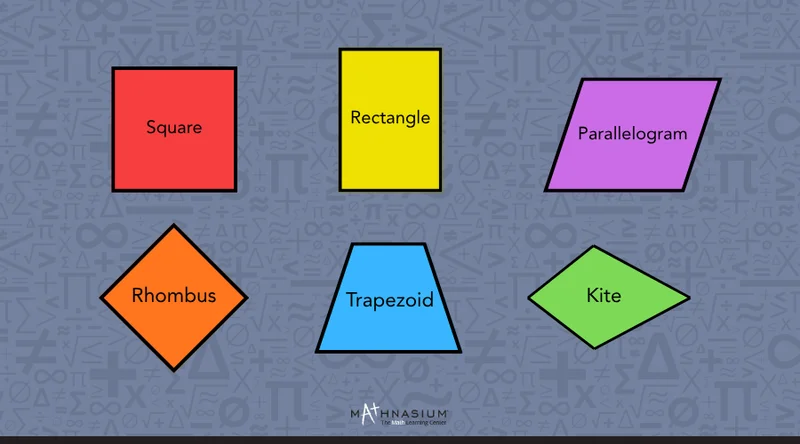
A trapezoid, a kite, and a square don’t look alike, yet all three belong to the exact same family, the quadrilaterals.
Because their sides, angles, and symmetries vary so much, it is easy for students to miss the underlying rules that connect them or get confused when comparing shapes like squares, rectangles, and rhombuses.
To help make sense of it all, we put together this guide. Mathnasium tutors will define what makes a shape a quadrilateral, walk you through the six core shapes step by step, and clear up the common comparisons that trip students up most.

What Is a Quadrilateral?
A quadrilateral is any polygon with four straight sides.
The word comes from the Latin quadri, meaning four, and latus, meaning side. Four sides are the whole test, no matter how different the shapes end up looking side by side.
Every quadrilateral, no matter how it is drawn, shares the same set of properties:
Where does that 360° come from? We can check it ourselves. Draw one diagonal across any quadrilateral, and it splits into two triangles. Each triangle's angles add up to 180°, so two triangles give us:
2 × 180° = 360°
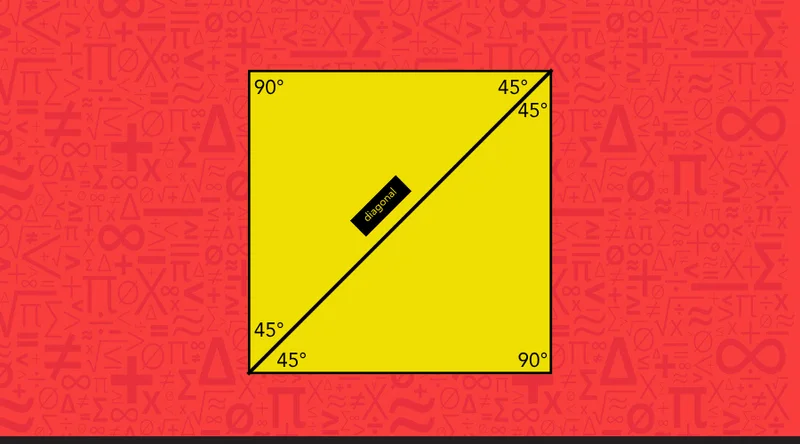
That's the same triangle-splitting logic that explains the angle sum of any polygon, just with fewer triangles than a hexagon, for example.

6 Core Quadrilateral Shapes
Six shapes make up the quadrilateral family, and we can recognize each one by a single defining rule.
1. The Trapezoid
A trapezoid is a four-sided shape with one pair of sides that run side by side and never meet, while the other two sides tilt inward, like a popcorn bucket.
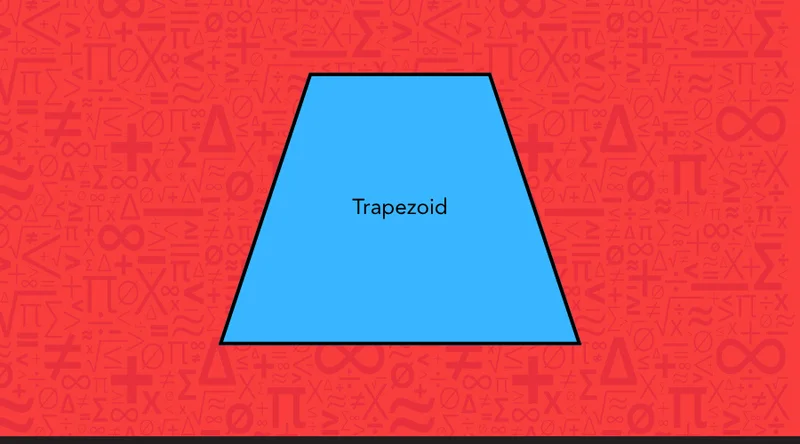
To spot a trapezoid, check for exactly one pair of parallel sides.
-
Four sides total
-
The parallel sides are called the bases
-
The non-parallel sides can be short, long, or slanted at different angles
We see trapezoids more often than we might think. A popcorn bucket at the movies is a trapezoid, and so is the trapezoid table many of us sat at back in elementary school. Even the roof of a barn traces the same shape from the side.
2. The Parallelogram
A parallelogram is a four-sided shape where both pairs of opposite sides run side by side and never meet, like a tilted picture frame.
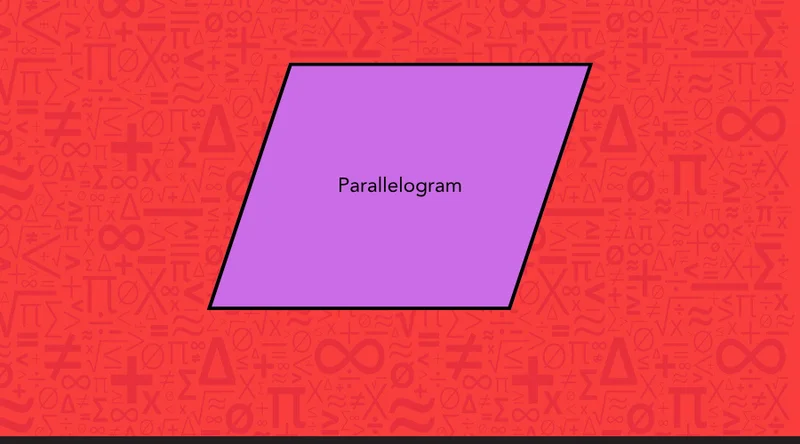
To spot a parallelogram, check for two pairs of parallel sides.
-
Opposite sides equal in length
-
Opposite angles equal in measure
-
Corners can lean in either direction and still count; a parallelogram doesn't need right angles to qualify
A tilted picture frame hanging slightly off-center on a wall is a parallelogram. So is the side panel of a skateboard ramp, leaning at an angle but still holding its shape.
3. The Rectangle
A rectangle is a parallelogram that straightened up. It keeps its parallel sides, but its corners lock into four perfect 90° angles, like the corners of a window pane.
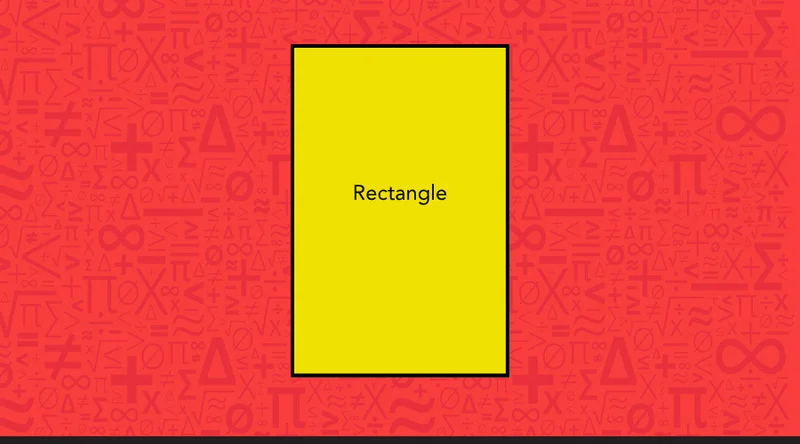
To spot a rectangle, check for four right angles.
-
Two pairs of parallel sides (it's a parallelogram)
-
Opposite sides equal in length
-
It meets every parallelogram rule, then adds this one of its own
A phone screen is a rectangle, and so is a door. We can find rectangles almost anywhere we look, from a slice of bread to the trampoline in a backyard.
4. The Rhombus
A rhombus is a parallelogram where all four sides stretch to the exact same length, while the corners stay free to lean one way or the other.
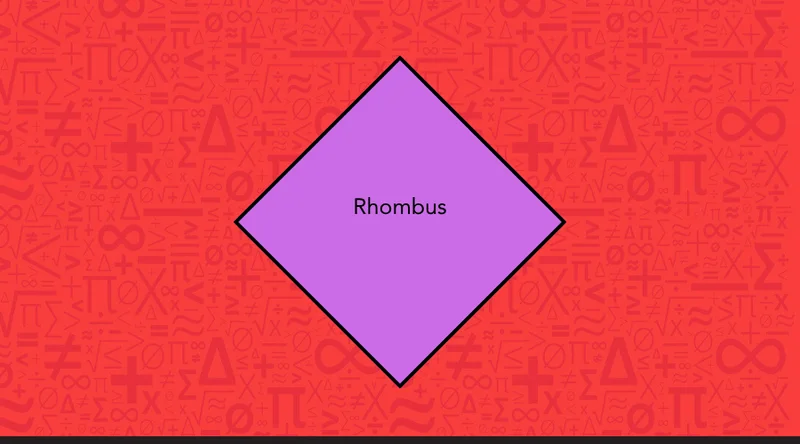
To spot a rhombus, check for four equal sides.
-
Two pairs of parallel sides (it's a parallelogram)
-
Opposite angles equal in measure
-
Where a rectangle locks in the angles at 90°, a rhombus locks in the side lengths instead
The diamond on a playing card is a rhombus, and so is the shape on a yield-style road sign. A baseball infield, viewed from above, traces one too.
5. The Square
A square is a parallelogram that locks in both the angles and the side lengths, so it belongs to the rectangle family and the rhombus family at the same time.
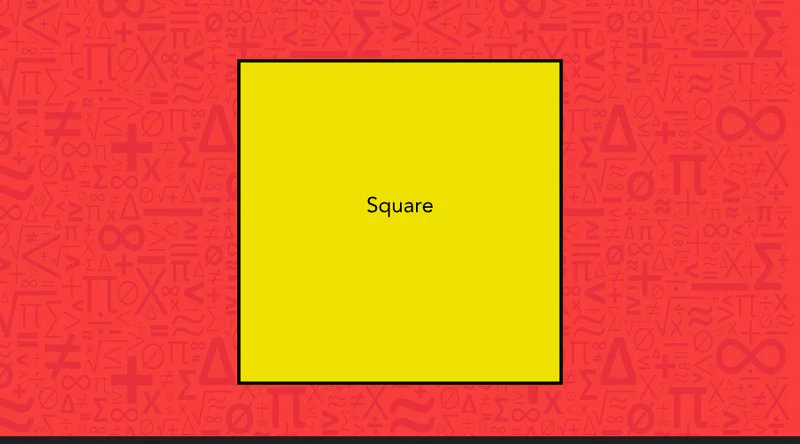
To spot a square, check for four right angles and four equal sides.
A floor tile is the clearest example. A chessboard is really just 64 squares lined up together, and a sticky note on a desk is one too.
📕 You May Also Like: How to Measure Angles with a Protractor: A Complete Guide
6. The Kite
A kite is a four-sided shape with no parallel sides, pointed at the top and bottom and wider through the middle, just like the toy.
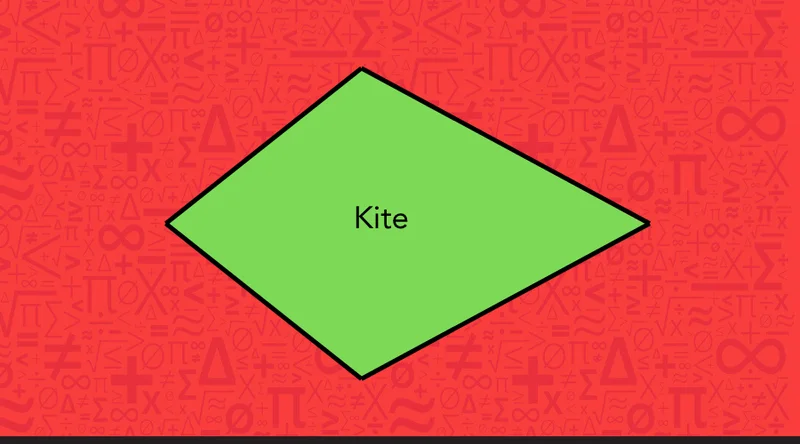
To spot a kite, check for two pairs of adjacent equal sides (sides next to each other, not across from each other).
A kite flying overhead on a windy day gives us the shape's namesake. We see the same outline in the paper kites that sometimes hang above a crib as a mobile.
📕 You May Also Like: 2D Shape Names: The Complete List from 3 to 12 Sides
How to Tell Quadrilaterals Apart at a Glance
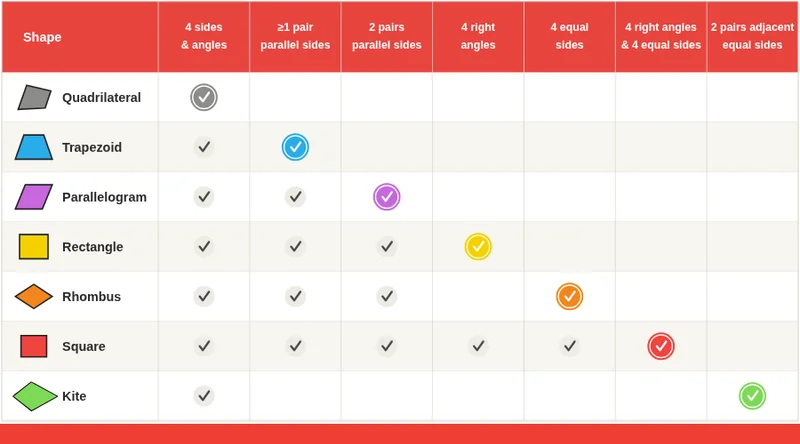
Every quadrilateral in this guide can be identified by which properties it checks off, and the table below lines them up side by side.
Follow the highlighted cell in each row; it marks the one property that makes that shape what it is.
Notice how each shape further down the table keeps every checkmark the one above it earned, then adds one more.
Putting it all together:
-
A rectangle checks four sides and angles, at least one pair of parallel sides, two pairs of parallel sides, and finally four right angles, its one defining property. It doesn't need equal sides, so that column stays blank.
-
A square checks every one of those same boxes, then adds four equal sides on top, since it's the only shape that needs both a rectangle's angles and a rhombus's sides to qualify.
-
A kite checks only two boxes: four sides and angles, and two pairs of adjacent equal sides. It skips every parallel-sides column entirely, which is what separates it from the rest of the family.
-
A trapezoid checks four sides and angles and at least one pair of parallel sides, then stops there. It never picks up a second parallel pair, four right angles, or equal sides, which is exactly what keeps it from becoming a parallelogram.
📕 You May Also Like: How Shape Learning Builds Your Child’s Foundation for Math
Quiz: How Well Do You Know Your Quadrilaterals?
Our tutors put together 4 questions to test what we covered in this guide. Work through each one carefully.
Question 1: What is the sum of the interior angles of any quadrilateral?
a) 180°
b) 270°
c) 360°
d) 450°
Question 2: Which statement about squares and rectangles is true?
a) Every rectangle is a square.
b) Every square is a rectangle.
c) No square is ever a rectangle.
d) Squares and rectangles share no properties.
Question 3: A quadrilateral has exactly one pair of parallel sides. What shape is it?
a) Parallelogram
b) Rhombus
c) Trapezoid
d) Kite
Question 4: A quadrilateral has no parallel sides, but it does have two pairs of adjacent equal sides. What shape is it?
a) Kite
b) Rhombus
c) Rectangle
d) Parallelogram
Check your answers at the end of this guide to see how well you know your quadrilaterals.

Mathnasium tutors help a student sort shapes by their properties, building geometry skills one shape at a time.
How Mathnasium Helps Students Master Any Math Concept
Mathnasium is a math-only learning center dedicated to helping K–12 students of all skill levels excel in math.
Whether students need support with foundational skills like geometry, specific concepts like quadrilaterals, or would like a challenge above their curriculum level, we can support them.
Our proprietary teaching approach, the Mathnasium Method™, is designed around each student's needs and learning style to help them learn and master math. Our approach includes:
-
Assessment and Personalized Learning Plans: Each student begins their Mathnasium journey with a diagnostic assessment that identifies their current skill level, learning goals, and how they learn best. From those insights, we build a personalized learning plan tailored to their needs, whether that means mastering shape properties, building fluency with angle relationships, or preparing for the geometry proofs that build on quadrilaterals in later grades.
-
Teaching for Understanding: Our specially trained tutors use natural language and a mix of verbal, visual, mental, tactile, and written techniques so each concept lands before we move forward.
-
Problem-Solving and Critical Thinking: We give students time to work through problems independently. That productive struggle helps them learn to trust their own reasoning. When we do step in, we explain both the how and the why behind each answer, so students build problem-solving and critical thinking skills they can use in math and beyond.
-
An Engaging and Fun Learning Environment: Sessions include games, earned rewards, and consistent celebration of progress. Students build confidence alongside fluency, and many develop a more positive relationship with math over time.
The impact extends beyond the classroom:
-
94% of parents report an improvement in their child's math skills and understanding
-
93% of parents report their child's improved attitude toward math after attending Mathnasium
-
90% of students saw an improvement in their school grades
With over 1,100 learning centers across North America, there is likely a Mathnasium close to you.
Families across Plano and nearby areas, including The Trails and Hunters Glen, trust Mathnasium of Plano to help their children build lasting confidence in geometry and every math topic that follows.
If quadrilaterals or any other math concept is giving your child trouble, our team is ready to help.
📅 Schedule a Free Assessment at Mathnasium of Plano
Not near Plano?
📍 Find a Mathnasium Learning Center Near You
Pssst! Check Your Answers Here
How did you do? Compare your answers here:
Question 1: c) 360°
Question 2: b) Every square is a rectangle.
Question 3: c) Trapezoid
Question 4: a) Kite


 (972) 393-6284