Think about a shoebox, a fish tank, a storage box, or even your bedroom. Each one takes up space, but it also has space inside it that we can measure. That inside space is called volume.
We can picture volume as the number of equal-sized cubes it would take to fill a three-dimensional shape with no gaps or overlaps.
If you play Minecraft, you already use a similar idea. Imagine building a room that is 5 blocks long, 4 blocks wide, and 3 blocks high. We can find its volume by working out how many equal-sized blocks would fill the whole space inside.
Every 3D shape has volume, and the way we find it depends on the shape.
Today, we’ll learn how to find the volume of a rectangular prism, how to tell volume apart from area, perimeter, and surface area, and where this concept shows up again later in math

Quick Review: What Is a Rectangular Prism?
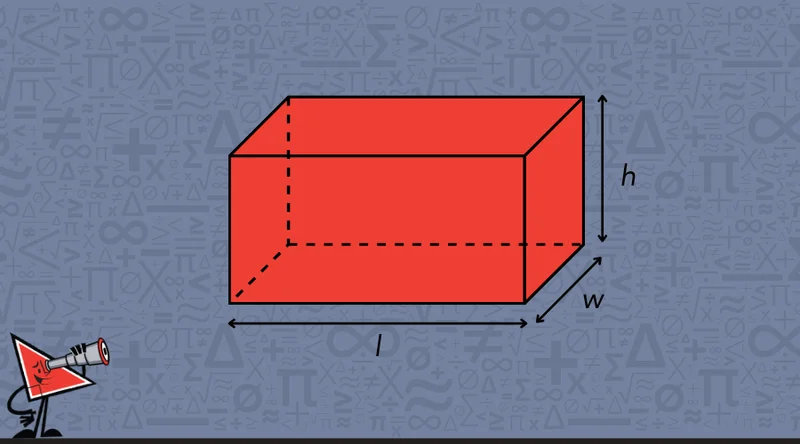
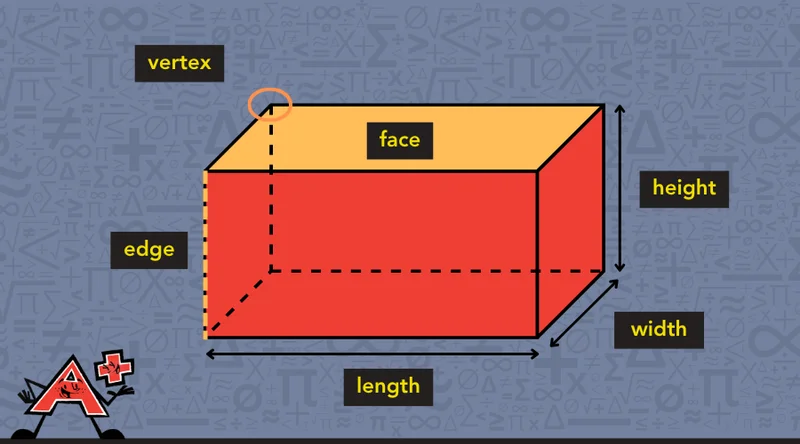
A rectangular prism is a three-dimensional, box-shaped figure with six flat rectangular surfaces. Opposite surfaces are the same size and shape.
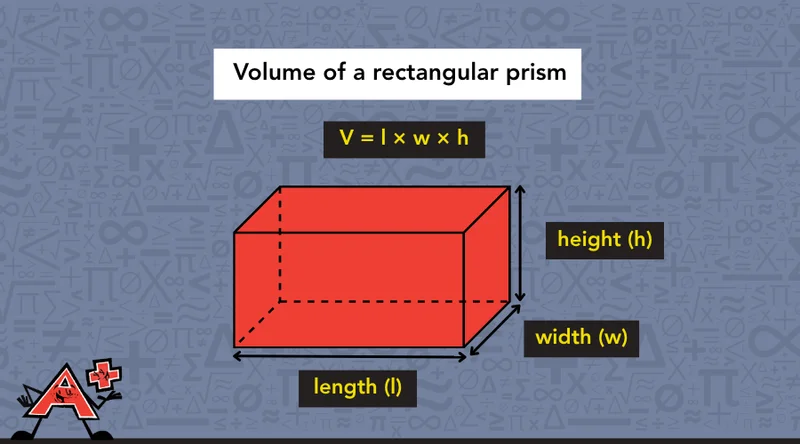
Let’s break the shape into its main parts:
We can spot rectangular prisms in plenty of everyday objects. For example:
-
a tissue box
-
a rectangular gift box
-
a drawer
-
a rectangular suitcase

How to Find the Volume of a Rectangular Prism
To find the volume of a rectangular prism, we need to multiply its length, width, and height.
Here is how it works. Picture filling the prism with unit cubes. Each cube measures 1 unit long, 1 unit wide, and 1 unit high.
First, we fill the base with one layer of cubes. If the prism is 8 units long and 4 units wide, that first layer contains:
8 × 4 = 32 cubes
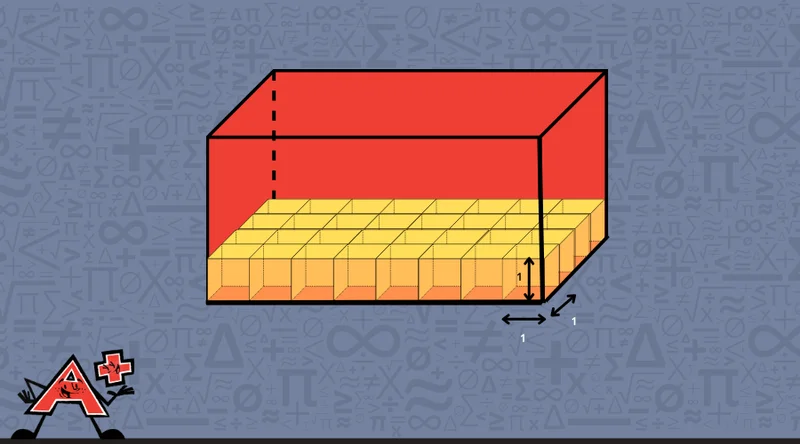
The height is 4 units high, so we need 4 layers of 32 cubes:
32 × 4 = 128 cubes
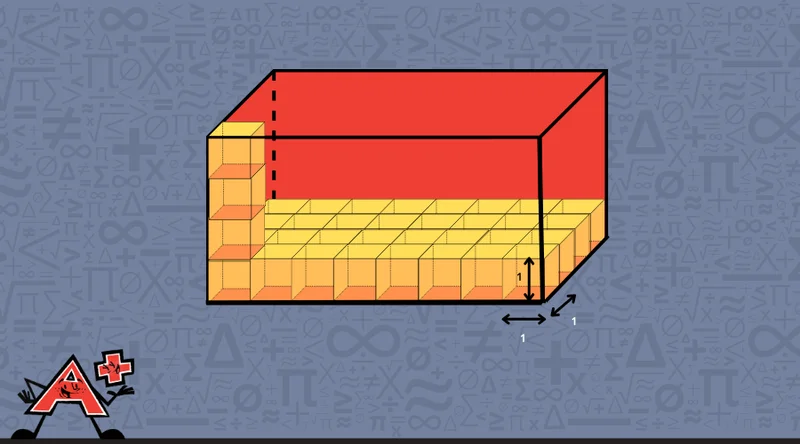
That gives us the formula:
V = l × w × h
Here, V stands for volume, l for length, w for width, and h for height.
At Mathnasium, we like to explain math topics through examples. So, let’s use the formula to find the volume of a rectangular prism that is 4 inches long, 2 inches wide, and 3 inches high.
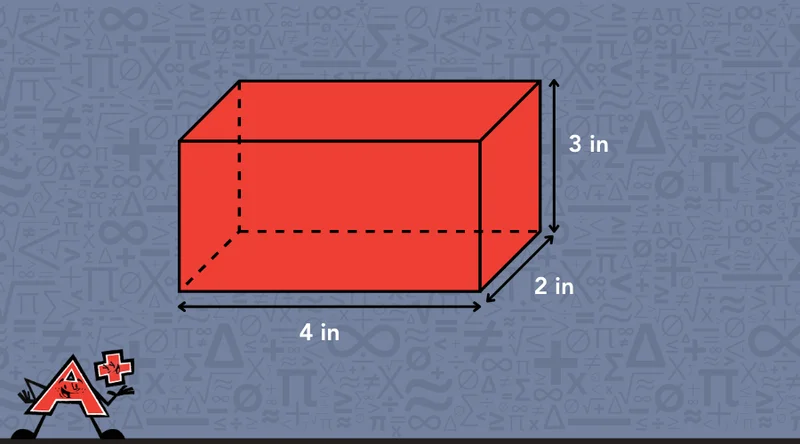
We substitute those three measurements into the formula:
V = l × w × h
V = 4 × 2 × 3
V = 24 in³
We write the answer as 24 cubic inches, or 24 in³, because volume measures three-dimensional space. Each cubic inch represents a cube that is 1 inch long, 1 inch wide, and 1 inch high.
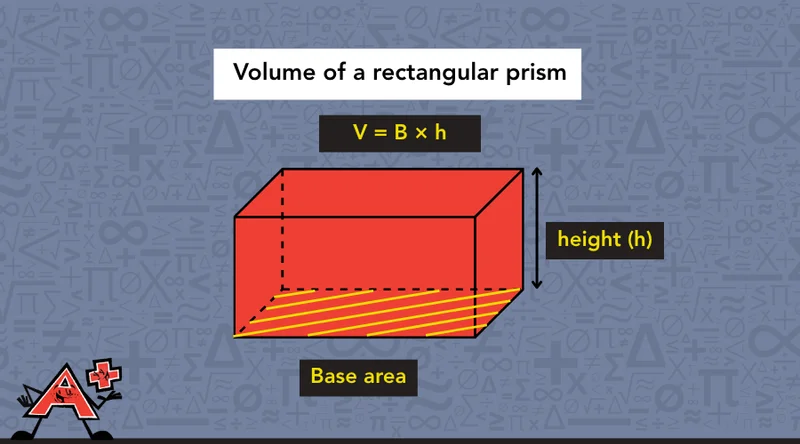
Now, look at the first part of our volume formula, length × width. That is also how we find the area of the rectangular base.
So, if we multiply the area of the base by the height of the rectangular prism, we can also find its volume. We write this as:
V = B × h
We use B for the area of the base and h for the height.
Say a rectangular prism has a base area of 10 square inches and a height of 4 inches.
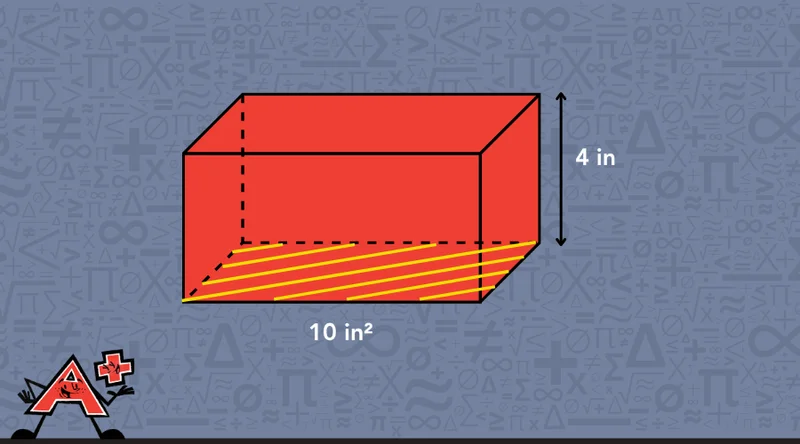
Since we already know the area of the base, we can substitute these values into the formula.
V = B × h
V = 10 × 4
V = 40 in³
Our answer is 40 cubic inches. We use cubic inches because we multiply an area measured in square inches by a height measured in inches, which gives us a three-dimensional measurement.
📕 You May Also Like: Surface Area vs. Volume: How to Tell Them Apart
Which Version of the Volume Formula to Use?
The volume formula for a rectangular prism can be written as V = l × w × h or V = B × h. Which version we use depends on the information the problem gives us.
|
What the problem gives us
|
Formula to use
|
Why
|
|
Length, width, and height
|
V = l × w × h
|
When we have all three dimensions, we can substitute them into the formula.
|
|
Area of the base and height
|
V = B × h
|
When we know how much space one layer covers, we only need to multiply it by the height.
|
How Is Volume Different From Area, Perimeter, and Surface Area?
In our work with students at Mathnasium, we noticed that learners tend to mix up volume with area, perimeter, and surface area, because they all involve measuring shapes. To help you keep them straight, our tutors put together a quick table.
In the formulas below, l stands for length, w for width, and h for height. For perimeter and area, we are measuring the rectangular base, so we use only its length and width.
|
Concept
|
What it means
|
Units
|
Formula (for a rectangular prism)
|
|
Perimeter
|
The distance around a flat shape
|
m, in
|
P = 2(l + w)
|
|
Area
|
The amount of flat space a shape covers
|
m², in²
|
A = l × w
|
|
Surface area
|
The total area of all the outside faces
|
m², in²
|
S = 2(lw + lh + wh)
|
|
Volume
|
The total space inside the object
|
m³, in³
|
V = l × w × h
|
If you still find it hard to tell the difference between perimeter, area, surface area, and volume, or if another geometry concept feels unclear, our Geometry tutors would be happy to help.
📕 You May Also Like: Surface Area of a Rectangular Prism – A Kid-Friendly Guide
Where Does the Volume of a Rectangular Prism Show Up Again in Math?
What we learn about the volume of a rectangular prism comes up again in later math topics:
-
You’ll use a similar setup to find the volume of other 3D shapes, including triangular prisms, cylinders, and pyramids. For some of these shapes, you might again start with the area of the base and use the height.
-
You may also be given the volume of a rectangular prism along with two dimensions, then asked to solve for the missing length, width, or height.
-
The concept also appears in standardized testing. In our home state of Colorado, for example, the Colorado Measures of Academic Success (CMAS) may ask you to read dimensions from a diagram, solve for a missing measurement, use volume as one step in a multi-step problem, or distinguish volume from area and surface area.
Find the Volume of a Rectangular Prism Yourself!
Now it’s your turn to put the volume formulas into practice. For each problem, decide which version of the formula fits the information you’re given. You can check your answers at the bottom of the page.
Task 1
A moving box has a length of 6 inches, a width of 4 inches, and a height of 5 inches. What is its volume?
Task 2
A fish tank has a base area of 24 square inches and a height of 10 inches. What is its volume?
📕 You May Also Like: 5 Ways Math Practice Impacts Brain Development + Benefits

Mathnasium tutors use different teaching techniques and hands-on activities to help students build a true understanding of math concepts, not just memorize procedures.
How Mathnasium Helps Students Make Sense of Volume (and Any Other Math Topic)
Mathnasium is a math-only learning center dedicated to helping K–12 students of all skill levels excel in math.
We aim to help students understand the why behind the how. For example, instead of treating a volume formula as a rule to memorize, we connect it to the reasoning that makes the formula work.
To build that kind of understanding, we use the Mathnasium Method™, our proprietary teaching approach, to meet students where they are and guide them forward step by step.
Each student begins with a diagnostic assessment that helps us understand their current skill level, knowledge gaps, goals, and how they think and feel about math.
Using these insights, we build a personalized learning plan focused on the skills the student needs most, whether that means revisiting the area concept, making sense of three-dimensional measurement, mastering volume, or preparing for more advanced geometry.
Our specially trained tutors follow that plan closely and provide live, face-to-face instruction in a caring and fun group environment. They use mental, verbal, visual, tactile, and written techniques to help students draw prisms, compare dimensions, work with unit cubes, and connect visual models to the formulas.
Students also get room to think through problems before tutors step in. Our tutors guide your child through the reasoning so they can work toward the answer themselves. This helps students develop critical thinking, problem-solving skills, and greater independence in math.
Fun is part of the approach, too. We use hands-on and game-based activities, rewards, and consistent encouragement to keep students engaged as they explore volume and other math concepts.
The impact is clear in our results:
-
94% of parents report an improvement in their child's math skills and understanding
-
93% of parents report their child's improved attitude toward math after attending Mathnasium
-
90% of students saw an improvement in their school grades
With over 1,100 learning centers across North America, there is likely a Mathnasium close to you.
For families in and near Highlands Ranch, CO, Mathnasium of Highlands Ranch brings that same approach close to home, with specially trained tutors who help students make sense of volume, geometry, and the skills those topics build on.
If your child is finding volume or any other math concept hard, a free diagnostic assessment is a great place to start. Using what we learn, we create a personalized learning plan focused on the skills they need next.
📅 Schedule a Free Assessment at Mathnasium of Highlands Ranch
Not near Highlands Ranch?
📍 Find a Mathnasium Learning Center Near You
Pssst…! Check Your Answers Here
Ready to see how you did? Here are the answers to the practice problems above.
Task 1
The problem gives us the length, width, and height, so we can use this formula:
V = l × w × h
V = 6 × 4 × 5
V = 120 in³
The moving box holds 120 cubic inches.
Task 2
We were given the area of the base and the height, so we choose this version of the formula:
V = B × h
V= 24 × 10
V = 240 in³
The fish tank holds 240 cubic inches.


 (303) 471-7501
 (303) 471-7501