Circumference is a math concept that shows up in 7th grade, and it comes up again and again from there. It connects to area, volume, arc length, and eventually trigonometry. We also see it all around us: the edge of a tire, the face of a clock, the rim of a fountain, the lane of a running track.
Once we get a solid understanding of circumference, we're holding one of the most consistent relationships in geometry.
Today, our tutors will walk you through what circumference means, how to calculate it using the formula, and how to work backwards from a circumference to find a missing measurement.

Let’s Quickly Review: What Is a Circle and Its Key Parts?
A circle is a set of all points in a plane that are at the same distance from a fixed center point. Simply put, it’s a two-dimensional shape that is perfectly round. Any circle has a radius and a diameter.
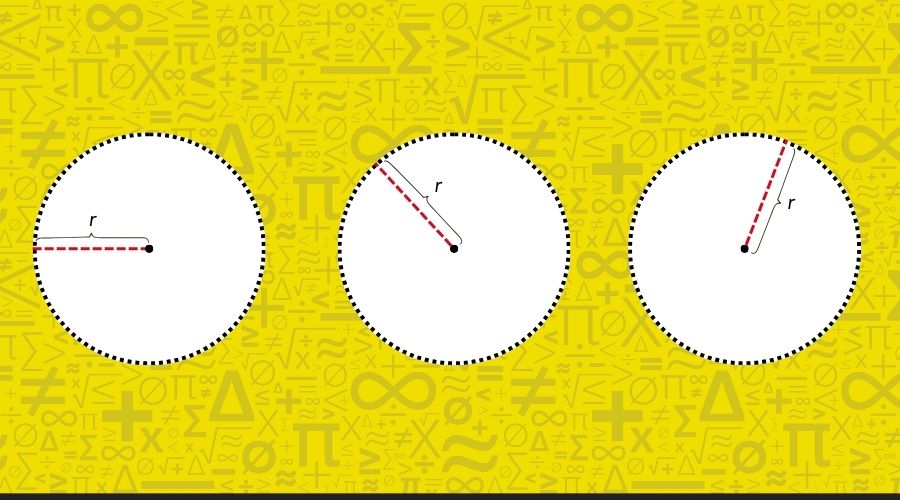
A. What’s the Radius of a Circle?
Radius is the distance from the center of a circle to its edge. Think of the spoke of a bicycle wheel: the thin part that connects the hub (the middle) to the rim (the outer edge). The spoke is the wheel’s radius. We write radius as r.
B. What’s the Diameter of a Circle?
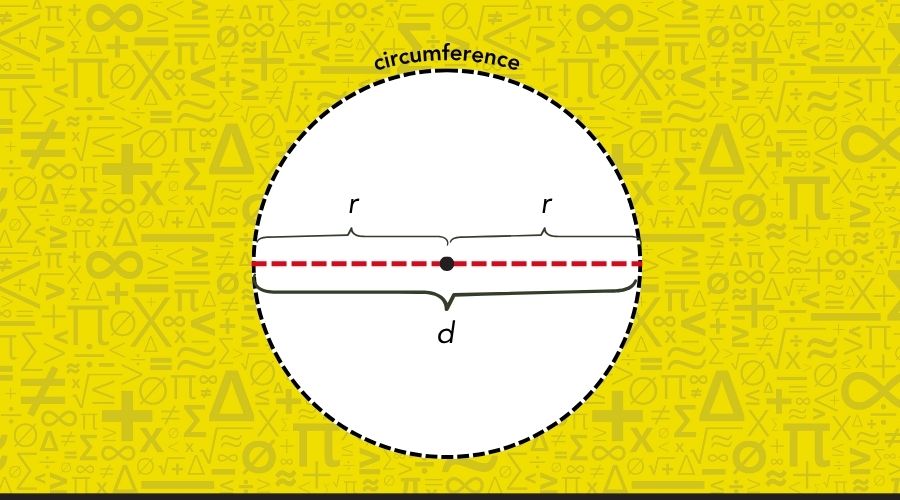
Diameter is the distance straight across a circle, measured through its center. It’s always exactly twice the radius: say the radius is 5 cm, the diameter will be 10 cm.
A real-life example of a diameter can be the width of a circular pizza measured from one edge to the other through the middle. We write diameter as d.
C. What’s 𝝿?
π (pi) is a special number, which equals approximately 3.14 or \(\Large\frac{22}{7}\). It describes the relationship between a circle’s circumference and its diameter.
No matter the size of the circle, the circumference is always the same multiple of the diameter, and that multiple is π.
Try wrapping a piece of string around several circular objects, such as a coin, a button, a hula hoop, or a dartboard, and measuring it each time. After that, find out each object’s diameter. For every object, its string’s length would be about 3.14 times its diameter. That consistent relationship is what π captures.
📕 You May Also Like: 7 Amazing Facts About PI Every Math Student Should Know
What Is the Circumference of a Circle
To fully understand what the circumference of a circle is, first, let’s remember what the perimeter of a shape is. The perimeter tells you the total distance around the outside of a flat shape. To find out the perimeter of a rectangle, for example, we add up all four sides.
But what about a circle? It has no straight sides to measure and add up. So how do we find the distance around it?
This distance all the way around the outside of a circle, or its perimeter, is its circumference. We write circumference as C.
Imagine the crust running around the edge of a circular pizza. If you pulled it off and laid it in a straight line, its length would be the circumference.
This is one way to calculate the circumference of a circle: to lay it flat. But that’s not always possible. We can't unroll the edge of a running track or peel the rim off a wheel.
How do we calculate the circumference then?
How to Find the Circumference of a Circle
We already know that every shape has a fixed, predictable relationship between its parts and its perimeter. For example, for a rectangle, the perimeter is always twice the sum of its length and width:
P = 2(l + w).
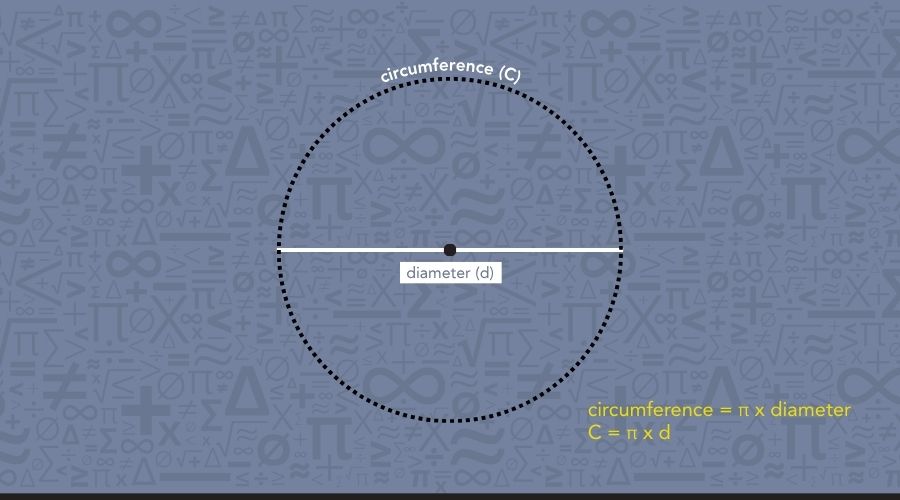
A circle works in a similar way, and we already know its key relationship: circumference is always π times the diameter.
So the formula writes itself:
C = πd
And since diameter is twice the radius, we can substitute 2r for d and get an equivalent version:
C = 2πr
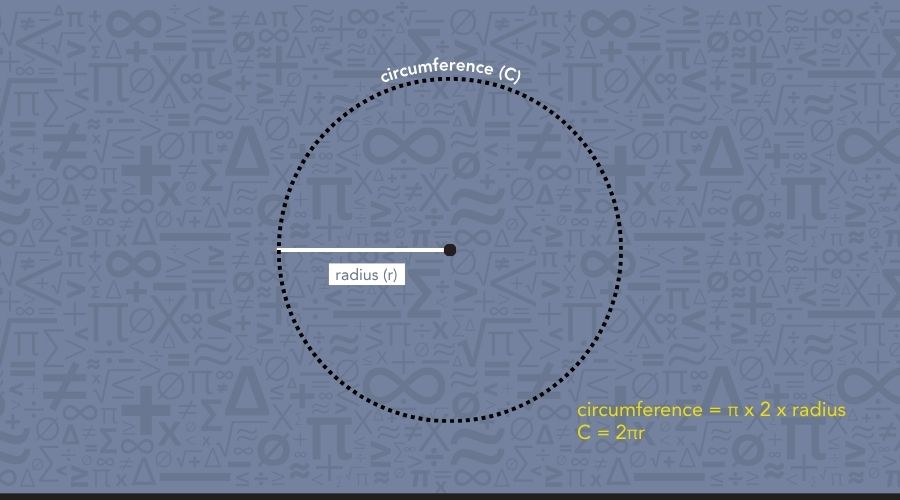
Both formulas describe the same relationship. Which one you use depends on what the problem gives you: when you know the diameter, use C = πd. When you know the radius, use C = 2πr.
Let’s put both to work.
Calculating Circumference From the Diameter: Worked Example
Imagine you’re helping plan a school field day and you need to mark out a circular running track. The track has a diameter of 40 meters. How much rope do you need to mark the full boundary? Here, we need to find the track’s circumference.
Since we know the diameter is 40 m, and π always equals approximately 3.14, we can use this formula:
C = πd:
C = π × 40
C ≈ 3.14 × 40
C ≈ 125.6 meters
This means you’d need about 125.6 meters of rope to mark out a circular running track.
Make sure that the answer carries the same unit as the measurement you started with: meters in, meters out. Now let’s work through a step-by-step example using the radius version of the formula.
Using Radius to Find Circumference: Worked Example
The minute hand of a circular clock face is 15 cm. How far does its tip travel in one full rotation?
The minute hand of a circular clock stretches from the clock's center to its edge. So, we can take the length of the minute hand as the clock face radius. One full rotation of the hand traces the circumference of the clock face.
This means, to answer the problem’s question, we need to calculate the circumference of the clock face. We know the radius is 15 cm and that π is about 3.14, so we should use the formula C = 2πr.
C = 2 × 3.14 × 15
C ≈ 6.28 × 15
C ≈ 94.2 cm
The tip of the minute hand travels around 94.2 cm in one full rotation.
📕 You May Also Like: 6 Activities to Strengthen Your Child’s Math Problem-Solving Skills
How to Work Back from Circumference to Radius or Diameter
We learned how to calculate the circumference of a circle, given its radius or diameter. But what if the problem gives the circumference of a circle and asks us to find its radius or diameter?
We don’t need new formulas; we just need to rearrange the ones we already know, using inverse operations to find the variable we're looking for.
An inverse operation undoes another operation. For example, addition and subtraction are inverses. So are the multiplication and division.
Circumference formulas use multiplication to find the distance around a circle. When we already know the circumference and need to find the radius or diameter, we can work backward by dividing.
We’ll start with the diameter formula: C = πd. Here, π is multiplying d to give C. To find d, we need to undo that multiplication by dividing both sides by π. This process is called isolation of the variable, in our case, of d:
-
C ÷ π = πd ÷ π
-
The π on the right cancels, leaving: C ÷ π = d, which we can rewrite as d = C ÷ π
The formula that we got after rearrangement is called the derived formula. Now, let’s apply a similar logic to figure out the derived formula for the radius.
-
Divide both sides of the formula C = 2πr, by 2π: C ÷ 2π = 2πr ÷ 2π
-
The 2π on the right cancels, leaving: C ÷ 2π = r, or r = C ÷ (2π)
You don’t need to memorize these as separate formulas. Once you understand what the original formula is saying, you can rearrange it yourself whenever you need to.
Now, let’s try to solve a problem using these derived formulas:
Finding Diameter From Circumference: Worked Example
A circular swimming pool has a circumference of 47.1 meters. What is its diameter?
Given that C is 47.1 m and π is approximately 3.14, we can find the diameter with this formula: d = C ÷ π:
d ≈ 47.1 ÷ 3.14
d ≈ 15 meters
We can check by putting back into the forward formula:
C = π × 15
C ≈ 3.14 × 15
C ≈ 47.1
The pool's diameter is 15 meters. Now, let’s try to solve a radius problem.
Using Circumference to Calculate Radius: Worked Example
A circular fountain has a circumference of 18.84 meters. What is its radius?
We know C is 18.84 m, π is about 3.14, and we need to calculate r. Let’s use this: r = C ÷ (2π).
r ≈ 18.84 ÷ (2 × 3.14)
r ≈ 18.84 ÷ 6.28
r ≈ 3 meters
Now, let’s check the answer by plugging it back into the forward formula:
C ≈ 2 × 3.14 × 3
C ≈ 18.84
The check confirms that the radius of the fountain is 3 meters. The reverse problems look harder than the forward ones, but they use the same formula and the same logic, just slightly differently.
📕 You May Also Like: Geometry in Arizona: 6 Nature Examples for Math Exploration
Common Mistakes to Avoid With the Circumference of a Circle
Even when the steps make sense, it is still easy to make some common errors with the circumference of a circle. Once we know what to watch for, we can avoid them more easily. Here are four common mistakes that students make when it comes to circumference problems.
-
Mixing up radius and diameter. If a problem gives you a diameter and you use it as a radius (or the other way around), your answer will be off by a factor of 2. How to avoid this: before writing anything, identify carefully which measurement the problem gives you and which formula you need to use.
-
Forgetting the 2 in C = 2πr. When you write C = πr, you're actually using the diameter formula with the radius plugged in. In this case, the answer will be again half what it should be. Not to fall into this trap, start from C = πd and swap in 2r for d. A diameter is twice the radius, remember? That way, you can see the 2 appearing naturally.
-
Dropping the units. Circumference is a length, so the answer must carry a unit: centimeters (cm), meters (m), inches, or whatever the problem uses. Without a unit, your answer is incomplete, and on an assessment, that's an easy way to lose points.
-
Rounding π too early or too roughly. Using 3 instead of 3.14 introduces an error that carries through the whole calculation. Unless the problem specifically says to use π = 3, always use 3.14 or the π button on your calculator. Save any rounding-off for the very last step.
📕 You May Also Like: Why Parents Should Teach Kids to Embrace Math Mistakes
Your Turn! Put the Circumference Formulas to Work
Here are two problems to try on your own: one forward and one reverse.
Use the same steps as the worked examples: identify what you know, choose the right formula, substitute, calculate, and write your answer with units. You can check your answers at the bottom of the page.
Problem 1: A circular garden has a diameter of 14 meters. What is its circumference?
Problem 2: A circular mirror has a circumference of 62.8 cm. What is its radius?

Mathnasium uses personalized learning plans and interactive teaching techniques to help students build a solid understanding of math concepts, including geometry topics like the circumference of a circle.
How Mathnasium Helps With Circumference of a Circle (and Any Other Math Topic)
Mathnasium is a math-only learning center that works with students of all skill levels to learn and master any math and geometry topic, including the circumference of a circle.
Our specially trained tutors use the Mathnasium Method™, our proprietary teaching approach that combines verbal, visual, tactile, and written techniques to help students understand each concept before moving on.
Students begin their Mathnasium journey with a diagnostic assessment that allows us to understand which skills are solid and which need support, including all the spatial thinking and number skills behind geometry concepts.
From there, we create a personalized learning plan that builds the missing pieces step by step, using the same clear, example-led approach we used today.
Our approach also includes game-based activities and plenty of rewards to keep students motivated and engaged. Students work in a fun and caring group environment where they feel comfortable asking questions, making mistakes, and trying again.
Our tutors give students room to think through a problem before stepping in. They know when to guide, when to ask a better question, and when to let the student work through the problem. That balance helps to build critical thinking and problem-solving skills, along with lasting independence in math.
The results speak for themselves:
-
94% of parents report an improvement in their child’s math skills and understanding
-
93% of parents report their child’s improved attitude toward math after attending Mathnasium
-
90% of students saw an improvement in their school grades
With over 1,100 centers, Mathnasium brings top-rated instruction close to your home.
For families in Jersey City, NJ, Mathnasium of Jersey City brings that same approach to your community, with specially trained tutors who know how to turn “I sort of get it” into “I actually understand this.”
If geometry concepts like circumference have been a sticking point, a free diagnostic assessment is the right place to start.
📅 Schedule a Free Assessment at Mathnasium of Jersey City
Not near Jersey City?
📍 Find a Mathnasium Learning Center Near You
Pssst! Check Your Answers Here
Here are the solutions to the two practice problems above.
Problem 1. A circular garden has a diameter of 14 meters. What is its circumference?
C = πd
C ≈ 3.14 × 14
C ≈ 43.96 meters
Problem 2. A circular mirror has a circumference of 62.8 cm. What is its radius?
r = C ÷ (2π)
r ≈ 62.8 ÷ (2 × 3.14)
r ≈ 62.8 ÷ 6.28
r ≈ 10 cm
Check: C 2 × 3.14 × 10 62.8
How did you do?


 (201) 434-6284