Math is built on connections. If you look closely, many new topics are just familiar ideas building on what came before. For example, multiplication is just repeated addition (2 x 3 is 2 + 2 + 2), and subtraction is just addition in reverse.
The connection between fractions and division works much the same way. They might look like two completely different math topics on paper, but a fraction is simply another way to represent a division problem.
That connection is our focus today. We’ll look at how division and fractions are connected, how to interpret division as fractions and vice versa, step-by-step through solved examples and practice.

A Quick Refresher: What Are Fractions?
A fraction shows a part of a whole. In other words, when we split an object or a group of items into equal pieces, a fraction tells us how many of those equal pieces we have.
Every fraction has two stacked numbers with a line between them called a fraction bar:
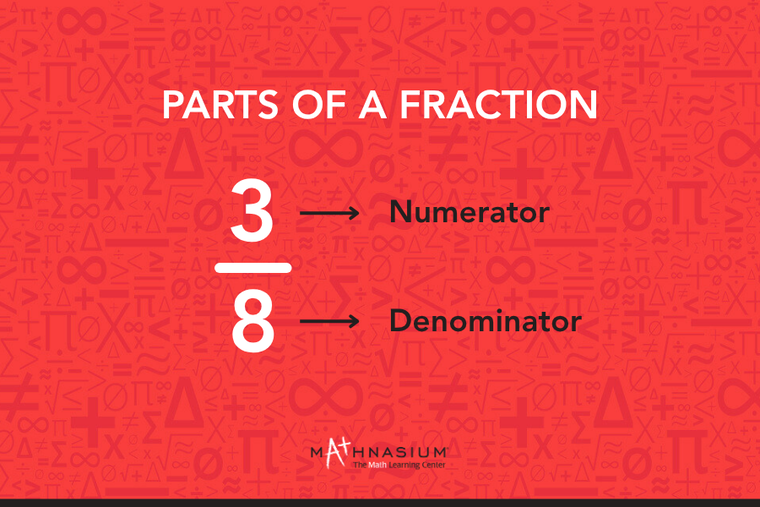
Now, let’s imagine slicing a pizza into 8 equal slices. If we eat 3 of those slices, we take 38 of the whole pizza. The bottom number (8) shows the total equal slices, while the top number (3) counts the slices we ate.
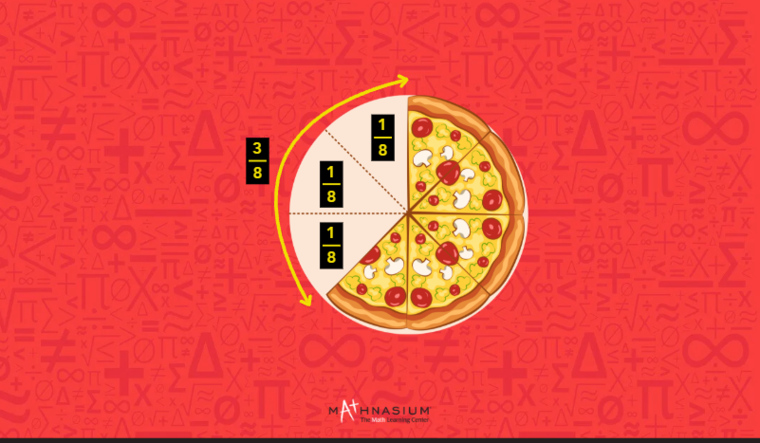
With a clear view of this part-to-whole relationship, we can explore the direct connection between fractions and division.
📕 You May Also Like: Types of Fractions—A Comprehensive, Beginner-Friendly Guide
How Do Fractions and Division Connect?
In early elementary school, we learn division as sharing or splitting whole numbers. For example, if we have 12 markers and want to share them among 4 students, each student receives 3 markers (12 ÷ 4 = 3).
As math progresses, we encounter problems where the numbers do not divide evenly, which brings us to remainders.
What does that look like? Let’s say we want to divide 7 cookies among 3 friends. That leaves each one with 2 whole cookies and 1 leftover cookie sitting on a table (7 ÷ 3 = 2 R1).
Fractions allow us to finish the sharing process. Instead of leaving that last cookie untouched, we divide it into 3 equal pieces as well so everyone gets an extra \(\Large\frac{1}{3}\). The fraction bar simply replaces the division sign to show that everything gets divided.
In math, we can write any division problem as a fraction, and to see how that works, let’s divide 3 granola bars equally among 4 students.
If we cut each of the 3 granola bars into 4 equal pieces (fourths), each student gets 1 piece from each bar. That gives each student three fourths of a granola bar.
\(\Large\frac{1}{4}\) + \(\Large\frac{1}{4}\) + \(\Large\frac{1}{4}\) = \(\Large\frac{3}{4}\)
Now, let’s write the division process as a fraction:
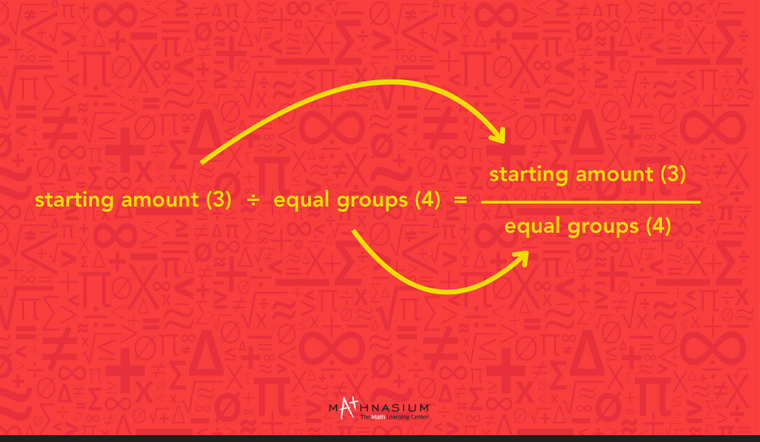
We can see that the starting amount (3 granola bars) moves to the top, while the number of groups (4 students) moves to the bottom.
If we look closely, even the division symbol (÷) looks like a tiny fraction. The top dot stands for the numerator, the horizontal bar means divide, and the bottom dot stands for the denominator.
Division expression rewritten as a fraction typically produces three common results:
-
Whole numbers: 10 ÷ 2 = \(\Large\frac{10}{2}\) = 5
-
Proper fractions: 2 ÷ 3 = \(\Large\frac{2}{3}\)
-
Improper fractions: 9 ÷ 4 = \(\Large\frac{9}{4}\)
Fractions allow us to divide any number by another except zero, even when the dividend is smaller than the divisor.

Let's See It in Action: Fractions as Division
Let’s work through a few simple examples to see how division and fractions connect in everyday life.
Example 1: The Dividend Is Smaller Than the Divisor
Let’s equally share 2 apples among 3 cousins. Since 2 is smaller than 3, nobody gets a whole apple.
To share fairly, we need to:
-
Cut each of the 2 apples into 3 equal slices (\(\Large\frac{1}{3}\) size each). That gives us 6 slices total.
-
Give each friend 2 slices (or two \(\Large\frac{1}{3}\) pieces)
-
That makes it \(\Large\frac{2}{3}\) for each cousin.
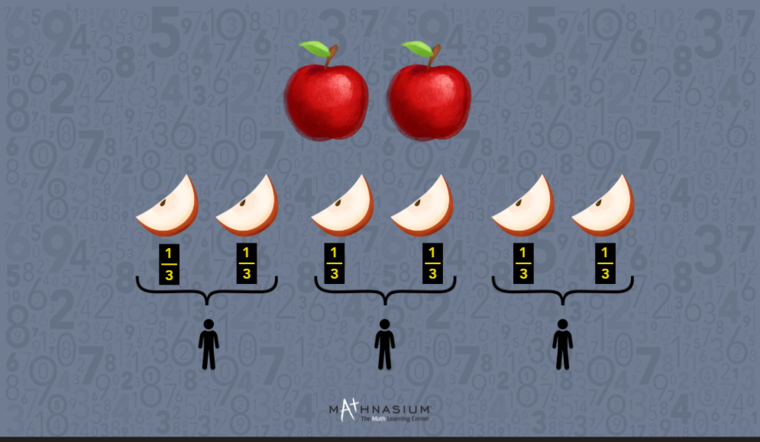
This shows that 2 ÷ 3 = \(\Large\frac{2}{3}\). The starting number (2) goes on top, and the number of friends (3) goes on the bottom.
Example 2: The Dividend Is Larger Than the Divisor
Now let’s divide 7 peaches equally between 2 friends. Since 7 is larger than 2, each friend gets whole peaches first.
To do this fairly, we:
-
Give 3 whole pieces of fruit to each friend. That uses up 6 wholes (2 × 3) and leaves 1 left over.
-
Cut the leftover one in half so each person gets an extra \(\Large\frac{1}{2}\).
-
In total, each friend gets 3 wholes (\(\Large\frac{6}{2}\)) and an extra \(\Large\frac{1}{2}\), which is in total \(\Large\frac{7}{2}\).
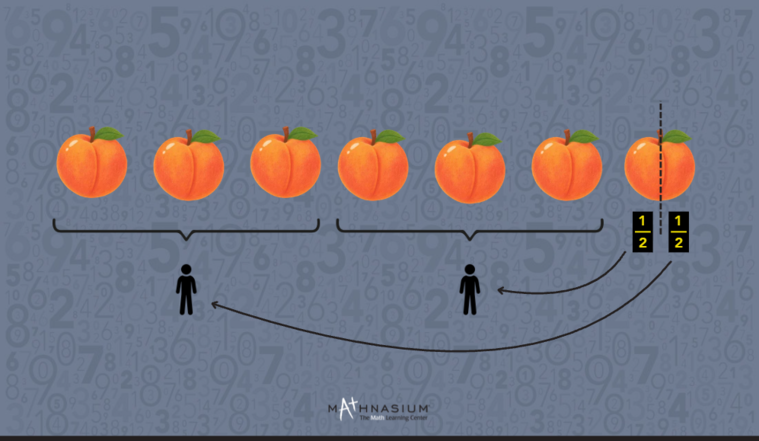
Since \(\Large\frac{7}{2}\) is an improper fraction, we can convert it into a mixed number. To do that, we ask ourselves how many times 2 fits into 7. So, we divide 7 by 2.
7 ÷ 2 = 3
It fits 3 whole times (2 × 3 = 6). However, there’s a remainder of 1. Then, the number 3 becomes a whole number in a mixed number. Since our original denominator is 2, we don’t change it. We only write a new numerator (remainder 1) on top of 2, and that creates a mixed number we need 3\(\Large\frac{1}{2}\).
Whether the starting number is smaller or larger than the group size, turning division into a fraction gives us the exact share every time.
📕 You May Also Like: A Simple Guide to Mixed Numbers and Improper Fractions
Solved Examples for Fractions as Division
Here are a few more math-focused examples we can solve together to put our knowledge into practice.
Example 1: Rewrite Division as Fractions
Let’s rewrite 7 ÷ 3 as a fraction.
Step 1: Rewrite
First, we place the dividend 7 in the numerator and the divisor 3 in the denominator position. Then, we write:
7 ÷ 3 = \(\Large\frac{7}{3}\)
Since \(\Large\frac{7}{3}\) is an improper fraction, there’s one more step we need to do, which is to convert it into a mixed number.
Step 2: Convert
To do this, we divide 7 by 3 and ask how many times 3 goes into 7.
7 ÷ 3 = 2
The answer is two times, and 2 times 3 equals 6 with a remainder of 1.
7 ÷ 3 = 2 R1
The quotient (2) becomes the whole number, and the remainder becomes the new numerator over the original denominator (3):
7 ÷ 3 = \(\Large\frac{7}{3}\) = 2\(\Large\frac{1}{3}\)
📕 You May Also Like: How to Convert Mixed Numbers to Improper Fractions (& Vice Versa)
Example 2: Unpack a Mixed Number into a Division Problem
We can also work in reverse with fractions and mixed numbers. So, let’s see what division problem hides behind 2\(\Large\frac{3}{5}\).
Step 1: Convert
First, we need to convert the mixed number into an improper fraction. To do that, we multiply the whole number (2) by the denominator (5) to find the total number of fifths (10), and then add the remaining numerator (3):
2 × 5 + 3 = 13 -> \(\Large\frac{13}{5}\)
Step 2: Rewrite
Now that we have the improper fraction, we just write the numerator back to the dividend and the denominator to the divisor:
\(\Large\frac{13}{5}\) = 13 ÷ 5
This tells us that the division behind 2\(\Large\frac{3}{5}\) is 13 ÷ 5.
Example 3: Solve a Word Problem Using Division as a Fraction
Word problems often ask us to split items equally, which is simply division in disguise. Let’s solve one. A container holds 5 liters of juice, which we want to pour equally into 8 glasses. How much juice goes in each glass?
Step 1: Identify
First, we have to identify the starting amount (dividend), which is 5 liters, and the number of groups (divisor). That’s 8 glasses.
5 ÷ 8
Step 2: Convert
Then, we place the starting amount (5) in the numerator and the equal groups (8) in the denominator:
5 ÷ 8 = \(\Large\frac{5}{8}\)
We solved it! Each glass contains \(\Large\frac{5}{8}\) liters of juice.
Your Turn! Check Your Knowledge of Fractions as Division
Ready to practice what we've covered? Give these practice problems a try and check your answers at the bottom of the guide.
-
Division to Proper Fraction: Rewrite 4 ÷ 9 as a fraction.
-
Division to Mixed Number: Rewrite 11 ÷ 3 as a fraction and convert it into a mixed number.
-
Fraction to Division Expression: Turn \(\Large\frac{6}{7}\) back into a division expression.
-
Mixed Number to Division Expression: Convert 1\(\Large\frac{4}{5}\) into an improper fraction, then write the division problem hiding behind it.
-
Real-World Sharing Problem: A baker has 7 pounds of dough to make 4 identical loaves of bread. How many pounds of dough go into each loaf? Write your answer as a mixed number.
 At Mathnasium, we help students build a deep understanding of how math concepts connect, one step at a time.
How Mathnasium Helps Students Master Fractions and Division (and Any Math Concept)
Mathnasium is a math-only learning center dedicated to helping K–12 students of all skill levels learn and master math.
At our centers, we help students build a deep understanding of any math concept, including fractions and division and how they connect to each other.
To support that understanding, we use the Mathnasium Method™, our proprietary teaching approach, to meet students where they are and guide them forward step by step.
Each student’s Mathnasium journey begins with a diagnostic assessment that helps us understand what their current skill level is and where knowledge gaps lie, as well as their goals and how they think and feel about math.
These insights help us create a personalized learning plan focused on what the student needs most, whether that means reinforcing any specific math concept, building fluency with it, or preparing for more advanced topics ahead.
Our specially trained tutors follow the plan closely and provide live, face-to-face instruction in a caring and fun group environment. We use mental, verbal, visual, tactile, and written techniques so math concepts can land. For example, these techniques help them see how fractions and division fit together.
Our students also get the freedom to think through problems before our tutors step in. hen guide students through the reasoning process instead of simply giving them the correct answer. This helps students build problem-solving skills and critical thinking they need in the math classroom and beyond.
Fun is part of how we approach math, too. We use game-based activities, rewards, and consistent encouragement to help students stay engaged as they build math fluency and become more comfortable with the concept they are currently learning and mastering.
The results speak for themselves is clear in our results:
-
94% of parents report an improvement in their child's math skills and understanding
-
93% of parents report their child's improved attitude toward math after attending Mathnasium
-
90% of students saw an improvement in their school grades
Whether your child needs to catch up, keep up, or get ahead, our team is ready to help. Start by scheduling a free diagnostic assessment. It helps us create a personalized learning plan that helps your child master math step by step.
📅 Contact Mathnasium of Ladera Ranch
Psst! Check Your Answers Here
Great job working through the practice problems! Here are the answers:
-
4 ÷ 9 = \(\Large\frac{4}{9}\)
-
11 ÷ 3 = \(\Large\frac{11}{3}\) = 3\(\Large\frac{2}{3}\)
-
\(\Large\frac{6}{7}\) = 6 ÷ 7
-
1\(\Large\frac{4}{5}\) = \(\Large\frac{9}{5}\) = 9 ÷ 5
-
7 ÷ 4 = \(\Large\frac{7}{4}\) = 1\(\Large\frac{3}{4}\)
How did you do?


 (949) 429-3020
 (949) 429-3020