Fifth grade is a transition year. The math it introduces, fraction operations, decimal fluency, and early algebraic thinking, builds directly into what students will see in middle school. Teachers enter the year assuming the 4th-grade foundations behind those skills are already solid.
Students who start 5th grade still catching up from the year before rarely have room to build on what’s new. Instead of growing into the new material, they spend energy trying to patch old gaps while keeping pace with a faster curriculum.
Summer is the window to prevent that before classroom pacing and new topics return.
At the same time, we know most students associate summer break with fun, freedom, and a less structured environment. Parents want to protect that feeling, not turn vacation into another version of school.
That’s why we turned to our education specialists at Mathnasium of Ladera Ranch for their insight into why summer is an ideal time to strengthen math foundations and how to do it in ways that fit naturally into summer routines without spoiling the break.

What 5th Grade Math in Ladera Ranch Expects
Fifth-grade math moves in a steady sequence, and local teachers plan their lessons hoping certain foundational math skills are already feeling comfortable.
Instead of worrying about a long checklist of everything fifth grade will cover, the most helpful question parents can ask is: 'Which skills does my child need in their toolbox to feel ready and confident for 5th grade math?"
Here is what that looks like in practice:
-
Fluent multiplication and division: This means recalling basic facts quickly and using them accurately in multi-digit problems, so that when larger-number multiplication or long division shows up, they can focus on the overall meaning of the problem rather than getting bogged down in each individual step.
-
Solid fraction foundations: Your learner needs to understand fractions as parts of a whole and parts of a set, comfortably naming, modeling, and comparing fractions and mixed numbers, and recognizing equivalence (like knowing that \(\Large\frac{1}{2}\) and \(\Large\frac{2}{4}\) represent the exact same amount) so later fraction operations feel like a natural extension.
-
Reliable place value and early decimal sense: Reading, writing, and comparing whole numbers through at least the thousands, knowing that a digit’s value depends on its place, and having a gentle, early grasp of decimals to tenths and hundredths, including how they connect to familiar everyday contexts like money and measurement.
-
Multi-step problem-solving habits: Your rising 5th grader should be able to tackle word problems that take more than one step by choosing operations, showing work in an organized way, and checking whether an answer makes sense, instead of shutting down as soon as a problem looks "long."
Where We See Gaps That Block 5th-Grade Progress
Math builds in layers, so a small gap from 4th grade rarely stays small. It resurfaces the moment 5th-grade content depends on the skill underneath it, and by then, it's harder to untangle.
Our tutors work with rising 5th graders throughout the summer, and the same handful of gaps tend to show up again and again. Here's what we see most often:
A. Incomplete fraction understanding
Many students know how to read and write a fraction but haven't fully grasped equivalence, comparing fractions or working with mixed numbers. Without that foundation, 5th-grade fraction operations feel confusing and overwhelming right from the start.
📕 You May Also Like: How to Help Your Child Make Sense of Wholes and Fractions
B. Weak multi-digit multiplication and division
Some students still rely on counting strategies or partial methods instead of multiplying and dividing fluently. Others forget steps partway through long division. In 5th grade, this slows students down on multi-step problems and chips away at their confidence when the work gets more complex.
📕 You May Also Like: How to Do Long Multiplication — A Complete Overview
C. Unsteady place value and decimals
Students often misread or miscompare decimals, mix up tenths and hundredths, or miss how decimals connect to fractions. Once 5th grade introduces measurement, money, and data problems, this gap becomes hard to avoid.
📕 You May Also Like: Decimal Place Value Made Easy: A Fun, Kid-Friendly Guide
D. Fluency fade
Students who kept pace just fine during the school year often lose speed and accuracy over the summer months. They still understand the underlying ideas, but they can't recall facts and procedures quickly enough to keep up once new content starts moving.
📕 You May Also Like: What Is the Summer Slide in Math & How to Prevent It
E. Math avoidance and anxiety
Students who felt behind or frustrated in 4th grade start to see math as something too hard for them, and they shut down the moment they hit a challenge. In 5th grade, that often looks like skipping multi-step problems, rushing through work, or giving up before they've really tried.
 If a child heads into 5th grade carrying math anxiety, it can block progress as new demands arrive.
Why Summer Is an Ideal Time to Address These Gaps
At our center, we consistently see math skills fade faster over the summer than reading, simply because math doesn’t get the same everyday, casual practice. That fade can be frustrating, but it also makes summer a calm, low-pressure window to catch learning gaps before they grow.
Here’s why our education specialists consider summer the ideal time to gently rebuild a child’s foundation:
1. No new curriculum competing for attention
During the school year, students juggle this week’s lesson alongside unfinished skills from the past. In summer, there’s no new classroom content competing for attention, so it’s easier to focus directly on the specific math skills that need to be strengthened without new material crowding them out.
2. No classroom pacing
Outside the regular school calendar, learning doesn’t have to keep pace with a daily syllabus. Your child can slow down, revisit steps they rushed through, and stay with a concept for as long as they actually need, instead of moving on just because the schedule says it’s time.
3. A lower-pressure environment
Without the pressure of tests, grades, or peers, students feel safe to try new strategies and learn from their mistakes. For a child who has started to feel anxious about math tasks, this supportive shift completely changes how they approach a challenge.
📕 You May Also Like: How to Support Math Learning Without Pressure
4. Early intervention
Addressing a learning gap over the summer keeps it from turning into a much bigger hurdle come fall. Instead of trying to catch up on old concepts while keeping up with new ones, your child walks into fifth grade on solid ground, ready and eager to learn.
📕 You May Also Like: What Is Math Intervention? A Parent's Guide
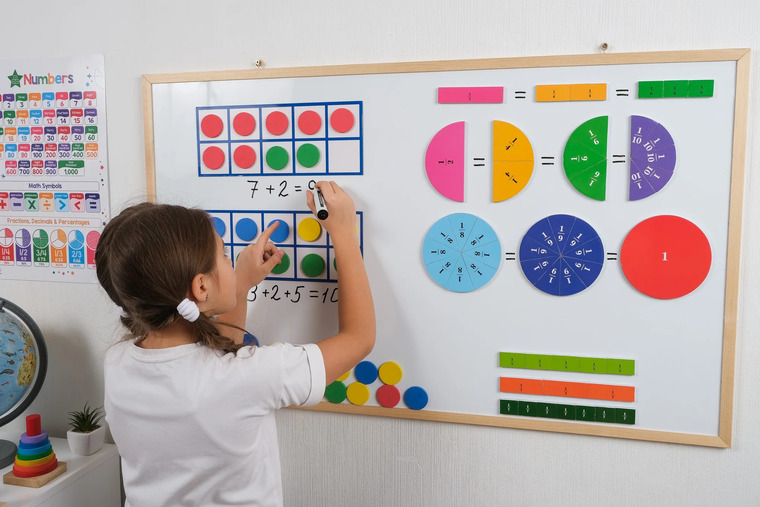 Although summer learning loss is common, the holidays also offer a valuable chance to address existing gaps.
A Summer Plan to Close Math Gaps Before 5th Grade Starts
Closing a math gap before 5th grade doesn't require a summer's worth of schoolwork. It takes a focused plan built around the one or two skills that matter most.
Here's how parents can build that plan:
1. Pinpoint the 4th grade skill most likely to affect 5th grade
Before a single session begins at Mathnasium, we run a diagnostic assessment to identify exactly which skills are solid and where gaps exist. You can take the same targeted approach at home before summer practice begins:
-
Look back at report cards and teacher comments from the past school year
-
Note which homework topics your child found most challenging or avoided
-
Ask them to solve a few problems from key 4th grade topics without help
-
Pay attention not just to whether they get the right answer, but to how confidently and efficiently they work through it
Once you have a picture of where the gaps are, focus practice there rather than reviewing everything equally. That targeted approach is what makes the difference between summer work that builds readiness and summer work that just fills time.
📕 You May Also Like: 4th Grade Checkup
2. Set a light, consistent practice routine that fits around summer
Short, frequent sessions protect fluency better than occasional long ones. Ten to twenty minutes a few days a week, worked in around camps, trips, and family time, keeps facts and procedures fresh without turning summer into another semester.
This kind of steady practice matters most for the skills 5th grade uses constantly: multiplication facts, fraction operations, and multi-step problem-solving strategies.
📕 You May Also Like: How to Use Spaced Practice to Help Math Stick
3. Use teach-back to check readiness for new 5th-grade demands
Ask your child to explain their thinking out loud. Have them walk you through a long division problem, compare two fractions, or talk through how they'd approach a multi-step word problem.
Wherever they stall, hesitate, or seem unsure, that's exactly where they need more targeted support before the school year starts.
4. Add structured support when gaps or anxiety are significant
If your child is noticeably behind on core 4th-grade skills, feels anxious about math, or you're not sure how to plan effective summer practice on your own, structured support can make a meaningful difference.
Rather than working through generic worksheets or repeating everything from the previous school year, structured support begins by identifying the specific skills a child needs to strengthen. From there, practice is tailored to those gaps, allowing children to rebuild their confidence and readiness step by step before September.
At Mathnasium, that's exactly the kind of support our learning center is designed to provide. Through personalized instruction and a targeted learning plan, we help children address the skills holding them back so they can start the new school year on a stronger mathematical foundation.
 At Mathnasium, specially trained tutors build on what your child already knows and fill the gaps before the next grade begins.
How Mathnasium Helps Kids Fill Math Gaps Before 5th Grade
Mathnasium is a math-only learning center dedicated to helping K-12 students of all skill levels excel in math.
We work with students throughout the school year and continue that support during the summer, whether through regular sessions or dedicated summer programs at participating centers. This includes rising 5th graders who want to head into the year prepared
Behind each of our programs is the Mathnasium Method™, a proprietary teaching approach designed around individual students’ needs and learning styles.
Each student starts their Mathnasium journey with a diagnostic assessment to identify exact strengths and knowledge gaps in the skills that matter most for the upcoming school year.
From these insights, we build a personalized learning plan tailored to their needs and goals.
With the plan in place, our specially trained tutors deliver face-to-face instruction in a supportive and engaging group environment. We use clear, everyday language and a mix of verbal, visual, mental, tactile, and written techniques so students can approach each concept from multiple angles and build understanding that holds up over time.
When a concept is not landing, we break it down into smaller steps and work through both the how and the why. Over time, students develop real problem-solving skills and critical thinking they can apply in math and beyond.
Fun is built into how we work. Sessions are often game-based, students earn rewards along the way, and we celebrate every bit of progress, growing confidence session by session.
Our results are measurable:
-
94% of parents report an improvement in their child's math skills and understanding
-
93% of parents report an improved attitude toward math after attending Mathnasium
-
90% of students saw an improvement in school grades
With over 1,100 learning centers nationwide, Mathnasium brings effective, targeted instruction to your neighborhood.
For families in Ladera Ranch, Rancho Mission Viejo, and Las Flores, Mathnasium of Ladera Ranch provides the focused, personalized environment students need to enter fifth grade prepared.
Whether your child needs to catch up, keep up, or get ahead, our team is ready to welcome and guide them to math mastery.
📅 Schedule a Free Assessment at Mathnasium of Ladera Ranch


 (949) 429-3020
 (949) 429-3020