When children first learn Roman numerals, one of the first roadblocks they often encounter is the number IV. Why? Because it challenges the mental model they’ve built around counting. They've just learned that I means 1, II means 2, and III means 3, so stacking one more I feels like the logical next step.
But instead of IIII, we write 4 as IV. That may look like a random exception, but it is actually part of a clever rule built into the number system.
Today, we walk through the rule behind IV, explain why it exists, and even peek at a place where the pattern breaks on purpose.

A Quick Review: How Roman Numerals Work
Roman numerals are a number system that uses letters instead of digits to represent values. Let's refresh the main symbols Roman numerals use. Each symbol stands for a different value.
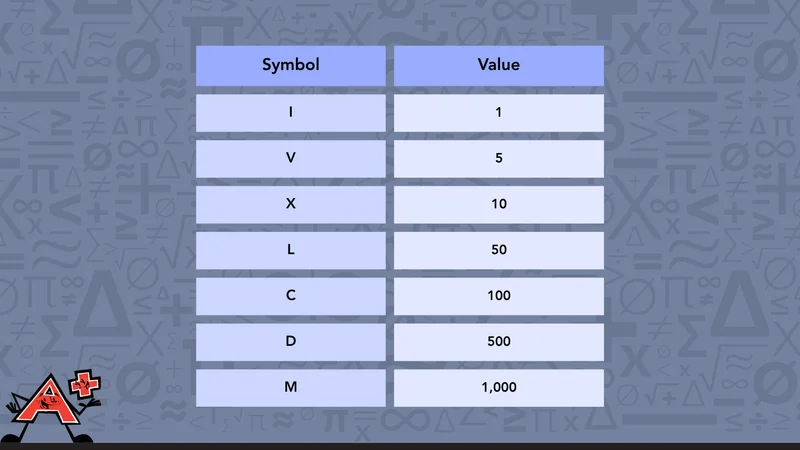
To write many Roman numerals, we add these symbols together.
Now, we’ll see this addition pattern in action.
-
III means 1 + 1 + 1, which gives us 3.
-
VI means 5 + 1, which gives us 6.
In both cases, we're just adding up the value of each symbol as we read left to right.
This add-it-up pattern works for lots of numbers. We see it in 1, 2, 3, 6, 7, 8, etc. But when we get to 4, Roman numerals use a different idea.
📕 You May Also Like: The History of Roman Numerals & Why They Still Matter
The Subtraction Rule Behind IV
In Roman numerals, when a smaller symbol shows up right before a larger one, we subtract it instead of adding it. That's why IV means “one less than five,” or (5 − 1), which gives us 4. This is the subtraction rule, or the subtractive principle.
We can see the same idea at work in IX, which means “one less than ten,” or 10 − 1 = 9. The same principle scales up to much bigger numbers too:
-
XL means “ten less than fifty,” or 50 (L) − 10 (X) = 40.
-
XC means “ten less than a hundred,” or 100 (C) − 10 (X) = 90.
📕 You May Also Like: Roman Numerals 1-100: Chart, Rules, and Real-World Examples
Why Roman Numerals Use the Subtraction Rule
Roman numerals use the subtraction rule to keep numbers shorter and easier to read.
Think about it this way. If we wrote 4 as IIII, we would need four symbols to do that. But when we write 4 as IV, we only need two.
The bigger the numbers get, the more helpful that shortcut becomes. Imagine writing 90 the long way, as LXXXX. That takes five symbols, while XC does the same job in just two. Pretty neat, right?
The subtraction rule also helps us read larger Roman numerals more quickly. Without it, we would have to pause and count long strings of symbols every time we came across a bigger Roman number.
Where Do We Still See 4 Written as IIII Instead of IV?
Even though IV is the standard way to write 4, many clock faces use IIII instead, right before V for 5. At first glance, it looks like these clocks are breaking the very rule we just learned.
But this is not a mistake. Clockmakers have used IIII on purpose for centuries, including on famous clocks like the one above the entrance to Grand Central Terminal in New York City.

Even though IV is the standard Roman numeral for 4, many clock faces use IIII instead.
Why Do Some Clocks Use IIII Instead of IV?
Historians and clockmakers have several different theories about why IIII shows up instead of IV on so many clock faces, and no single explanation has been accepted as the only answer.
-
One popular idea is visual balance. IIII balances the VIII on the opposite side of the clock face more evenly than IV would, because both numerals use the same number of symbols.
-
Another theory comes from the way clock numerals were made. When clockmakers used IIII instead of IV, they could create the needed I, V, and X symbols more efficiently and waste less material.
-
The third explanation ties back to mythology. In Latin, Jupiter, the king of the Roman gods, was written as IVPPITER, and some believe clockmakers avoided starting the number 4 with the same letters that began a god's name.
📕 You May Also Like: How to Tell Time on an Analog Clock: A Step-by-Step Guide

At Mathnasium, tutors help students make sense of number systems like Roman numerals by connecting patterns, rules, and real-life examples in a way that feels clear and engaging.
How Mathnasium Helps Students Make Sense of Roman Numerals (and Any Other Math Topic)
Mathnasium is a math-only learning center dedicated to helping K–12 students of all skill levels excel in math.
Number systems like Roman numerals are a great example of how math can feel playful, visual, and connected to the world around us. When students learn to decode symbols, notice patterns, and understand why IV means 4 while VI means 6, they are building the same kind of reasoning they use across many math topics. This kind of pattern-spotting we love to nurture.
That's the thinking behind the Mathnasium Method™, our proprietary teaching approach. We do not rely on rote memorization alone. Instead, we meet students where they are and help them build real understanding, step by step.
Each student begins with a diagnostic assessment that helps us understand what they know, how they think, and where they are ready to grow next. This gives us a clear picture of the number sense, pattern recognition, and problem-solving skills that are already solid, and the areas that may need more support.
Using these insights, we create a personalized learning plan focused on the skills the student needs most, whether that means building number sense and pattern recognition skills, improving problem-solving habits, or preparing for more advanced math topics.
Our specially trained tutors follow that plan closely, guiding students through face-to-face instruction in a caring and supportive environment where they feel comfortable asking questions, making mistakes, and trying again.
With topics like Roman numerals that are naturally visual and pattern-based, we use a mix of visual, verbal, tactile, written, and mental techniques to help concepts make sense. Students may decode symbols, compare number systems, look for patterns, or connect what they are learning to clocks, movie titles, sports events, and other real-world examples.
Fun is an important part of our approach, too. Many of our activities are hands-on or game-based, and students can earn rewards as they make progress. This keeps learning engaging while students build the confidence to explore math.
We also give students room to think through problems on their own before stepping in. Instead of simply giving answers, our tutors help students understand the how and why behind each step. This helps students develop problem-solving skills and critical thinking tools they can use in math and beyond.
Families see the results:
-
94% of parents report improvement in their child’s math skills and understanding
-
93% of parents report a more positive attitude toward math after attending Mathnasium
-
90% of students saw improvement in their school grades
Mathnasium operates over 1,100 learning centers across the U.S., bringing our proven approach close to your community.
For families in and near Pearland, TX, Mathnasium of Pearland East is a trusted source of focused math support.
If your child is ready to build math confidence and make sense of number systems like Roman numerals, a free diagnostic assessment is a great place to start. Using the results, we create a personalized learning plan that helps your child master the skills they need next.
📅 Schedule a Free Assessment at Mathnasium of Pearland East
Not near Pearland East?
📍 Find a Mathnasium Learning Center Near You


 (281) 465-4990