Many parents might associate math tutoring with one or two major milestones, like when report card grades suddenly drop or a high-stakes exam is right around the corner. Sure, those are clear indicators. But they aren't the only ones. Often, there are subtle moments that are much easier to miss.
We're a team of math educators right here in Pearland, Texas, and today we’ll dive into the obvious as well as less obvious moments when a student needs math tutoring, with local insights for our community and our state of Texas.

1. A Drop in Grades
A drop in grades is the most common reason parents look for math tutoring, and for good reason. You can spot it easily, and it’s usually the first sign your child is struggling.
To understand why grades drop, it helps to look at how math works. Math is cumulative. Each grade level builds directly on the previous one, so every new concept relies on the foundation underneath.
That is why a slight dip can quickly turn into a growing math gap.
Say your child's grasp of dividing fractions is a little shaky. That might cost them a few points on one test. A few weeks later, when equations with fractional coefficients arrive, that same shaky spot may resurface inside a more complex problem.
Behind most grade drops, we typically find one of two issues:
-
An older gap catches up: Middle school algebra quickly exposes earlier skills (like fractions or basic division) that were only 'good enough' at the time.
-
A missed unit creates a gap: If your child misses a few days of school or falls behind during a fast-moving unit, those missing pieces stay hidden until test day.
In both cases, the grade is only the symptom.
So what keeps the classroom from catching this? Pearland teachers do incredible work, but they manage full classrooms and tight pacing guides designed to move everyone forward together. They rarely have time to stop and reteach material from a few months or even a few grades ago.
That's where structure can help. At Mathnasium of Pearland East, we begin with a diagnostic assessment, which works like a map. It shows us exactly where your child lost their footing and what we need to address first.
From there, we build a personalized learning plan tailored to your child. We help them fill in those gaps, rebuild their foundation, and approach their next math test with complete confidence.

2. Homework Friction and Math Anxiety
Math anxiety triggers real tension and fear that interferes with your child's math performance, which you will likely notice most during homework time.
It affects top performers and struggling students alike. In fact, a review of math anxiety research shows that grades only partly predict how anxious a student feels.
At home, you might see math anxiety show up as:
-
Tears at the kitchen table: Homework time ends in frustration, sometimes before your child even finishes the first problem.
-
Avoidance and delay: Your child suddenly needs to grab a snack, sharpen a pencil, or clean their room before math can begin.
-
Physical complaints: Stomachaches or headaches appear right before math class or test day.
Children aren't born fearing math concepts like fractions. Math anxiety builds over time as negative experiences stack up, such as feeling embarrassed in front of classmates, feeling ashamed of a wrong answer, or racing the clock on a timed test. Each moment teaches your child that math is a place where they get judged.
Anxiety in math has both emotional and academic roots, so your child needs both types of support. Reassurance calms their fear, while targeted instruction fills the underlying learning gaps. If you address only one side, half the problem remains untouched.
Research points in the same direction. In a study of 3rd-grade children with high math anxiety, researchers ran an intensive one-to-one tutoring program. Once the children received structured, personalized support, their math anxiety dropped significantly.
At Mathnasium, our specially trained tutors teach in a patient, low-pressure environment. We pre-teach upcoming topics so your child enters the classroom with a firm foothold already in place.
We also offer positive reinforcement at every step, ensuring your child's effort gets recognized. Over time, small wins add up to confidence, and homework starts to feel like a task again rather than a battle.

📕 You May Also Like: 5 Strategies to Conquer Math Test Anxiety (Expert Tips)
3. Passing Grades, But Missing the "Why"
Passing grades can easily hide a missing understanding of why math works. A solid B on a report card gives you little reason to worry, but underneath, a learning gap can slowly grow for months.
Let’s see why.
Math skill comes in two layers:
-
Procedural skills (the how): The steps, algorithms, and formulas that produce a correct answer.
-
Conceptual skills (the why): The understanding of why those rules work and how math ideas connect.
Procedural skill can carry a grade a long way.
Say your child memorizes the area formula for a rectangle and plugs in the numbers.
Or take 3x + 2 = 11. Your child follows a fixed set of steps to reach x = 3 and has no idea what x represents. Both approaches produce correct answers and satisfying report cards.
Trouble might arrive with multi-step word problems and higher-level coursework. Those tasks call for flexible thinking, and a memorized pattern only covers problems that look like the practice set.
Informal checks at home can bring this gap to the surface.
Ask your child for more than the final answer. Have them explain why they chose a particular step, or what the numbers mean in a real-world setting.
A freeze at the question "why?" or the reply "That's just the rule my teacher gave us" signals that tutoring could help.
At Mathnasium of Pearland East, we give equal attention to procedural fluency and conceptual depth. We teach fraction operations through proportional reasoning and visual models, so your child sees why fractions need a common denominator and then practices the steps.
We bring concepts to life with a mix of verbal, visual, mental, tactile, and written techniques. Each technique gives your child another way into the idea, and the logic behind the rule comes into view.
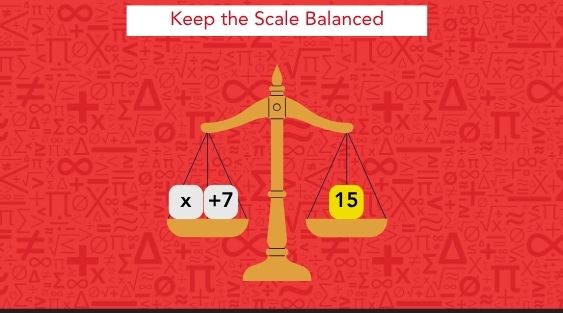
By seeing an equation visually as a scale first, your child grasps why both sides must remain equal.
📕 You May Also Like: Why a Good Grade Doesn't Mean Your Child Is Ready for Next Year’s Math
4. Major Grade Transitions in Math
As your child advances through school, major grade transitions force them to think about math in fundamentally new ways.
Our tutors see this jump happen in three major developmental leaps.
|
Transition
|
Typical grade band
|
What changes for your child
|
|
Fractions & Rational Numbers
|
Upper elementary to middle school
|
They leave basic counting behind to master dividing quantities and equal parts of a whole.
|
|
Arithmetic to Algebraic Thinking
|
Middle school
|
Simple missing-number problems like 3 + □ = 5 grow into equations with variables like 3x + 2 = 11. Unknown quantities replace the blanks.
|
|
Algebra I & High School Geometry
|
High school
|
Your child meets formal proofs, spatial reasoning, and multi-step equations for the first time.
|
Each of these steps can come with its own warning signs. Here are a couple to watch for at home:
-
Old rules are applied to new math: Your child adds numerators and denominators straight across and calls \(\Large\frac{1}{2} + \Large\frac{1}{3}\) equal to \(\Large\frac{2}{5}\).
-
They freeze at the sight of letters: Abstract variables replace familiar numbers, leaving your child confused about where to start.
-
A sudden dip in confidence: The shortcuts from earlier grades stop working on complex problems, and your child loses a tool they trusted.
Personalized tutoring can smooth these friction points. At our centers, we connect with what your child already knows to the new concept.
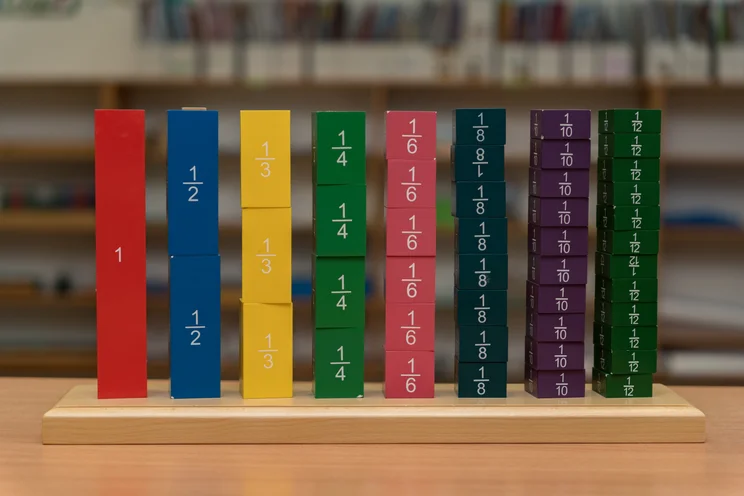
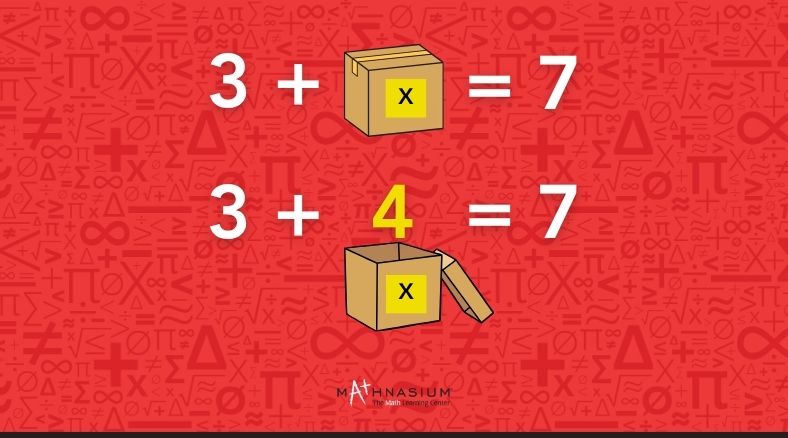
Targeted explanations and visual models give your child the materials to build the bridge independently and develop a deep understanding.
📕 You May Also Like: How to Help Your Child Transition from Elementary to Middle School Math
5. Preparing for Texas State Math Assessments
You likely mark Texas state assessments on your family's calendar long before testing week arrives.
Whether your child is preparing for the State of Texas Assessments of Academic Readiness (STAAR) in elementary or middle school, or tackling college readiness benchmarks like the SAT and ACT in high school, these dates shape the school year.
Fundamentally, state tests like STAAR are designed to measure the Texas Essential Knowledge and Skills (TEKS) your child covers in class.
When test day comes, the exam can feel much bigger than a regular unit quiz, and nervousness is completely normal.
This is because success on these high-stakes exams relies on more than math knowledge alone. Scores are also shaped by non-academic factors like:
-
Time management: Your child may need to find a steady pace to feel comfortable from the first question to the last.
-
Handling pressure: Standardized exam rooms can create a level of tension that regular classroom quizzes never match.
-
Maintaining focus: Fatigue can set in late in the exam, which causes focus to slip.
These factors can explain why a child with solid math skills can still feel test anxiety.
At Mathnasium of Pearland East, our support goes past drilling equations or re-teaching classroom material.
We teach efficient test-taking strategies, including how to break down complex word problems, pace through difficult sections, and check work systematically.

At our center, practicing real test formats removes the stress of the unknown and builds test-day confidence.
📕 You May Also Like: How to Prepare for a Math Test: The Complete Student Guide
6. When Bright Students Are Underchallenged
Bright students can easily become underchallenged in math despite earning straight A's on report cards. A top report card grade shows that your child has mastered grade-level material, but it doesn't mean the work actually stretches their thinking.
Watch for these signs if you think that your child needs a greater challenge:
-
Record-time homework: Your child finishes assignments in minutes with little visible effort.
-
Boredom in class: Standard math lessons move too slowly, leaving your child bored and unengaged.
-
Relying on talent over perseverance: Answers come easily, so your child gets little practice on problems that take several attempts.
Students miss the chance to build perseverance when they coast through early grades. Without coursework that pushes their limits, their first true academic hurdle arrives later in advanced high school or college math without prior experience overcoming difficulty.
At Mathnasium of Pearland East, we offer enrichment alongside catch-up support, and our program is called Mathnasium Plus.
It gives advanced learners in grades 1 through pre-algebra material above grade level, and each child follows a personalized plan that matches their strengths.
Topics include algebraic thinking, justification and reasoning, strategic problem solving, and flexible number sense. Sessions ask your child to explain why an answer works and to tackle problems that call for original strategies.
That challenge can build creative math thinkers and prepare your child for the advanced coursework ahead.

At Mathnasium, our personalized plans meet each student at their level, from filling gaps to going beyond grade level.
How Mathnasium of Pearland East Supports Students of All Skill Levels
Mathnasium of Pearland East supports students of all skill levels as a math-only learning center in Pearland, Texas. We belong to a network of over 1,200 learning centers across North America.
We work with students at every level, from those building confidence to advanced learners pushing their limits. Through the Mathnasium Method™, we customize instruction around each child's unique goals and learning style.
Every student begins with a diagnostic assessment, a low-stakes conversation that shows us current skills and potential learning gaps. With those insights, we develop a personalized learning plan tailored to your child's needs.
Our specially trained tutors then deliver face-to-face math instruction that follows the plan. We teach for understanding with natural language and a mix of verbal, visual, mental, tactile, and written techniques. This multi-faceted approach helps students build conceptual and procedural knowledge side by side.
Beyond math knowledge, our tutors understand the emotional side of learning. They give gentle support in moments of discouragement and an inspiring challenge at the right time.
Sessions include time for productive struggle before a tutor steps in. That time builds your child's trust in their own reasoning. Our guidance then covers both the how and the why. Over time, your child gains problem-solving skills and critical thinking tools for math and life beyond it.
Fun runs through every session. Game-based activities, earned rewards, and recognition of progress keep your child engaged and aware of how far they have come.
Our approach delivers results on both the academic and confidence fronts:
-
94% of parents report an improvement in their child's math skills and understanding
-
93% of parents report their child's improved attitude toward math after attending Mathnasium
-
90% of students saw an improvement in their school grades
Whether your student is looking to catch up, keep up, or get ahead in math, our team is ready to support them.
Ready to get started?
📅 Schedule a Free Diagnostic Assessment at Mathnasium of Pearland East
Not near Pearland?
📍 Find a Mathnasium Learning Center Near You


 (281) 465-4990