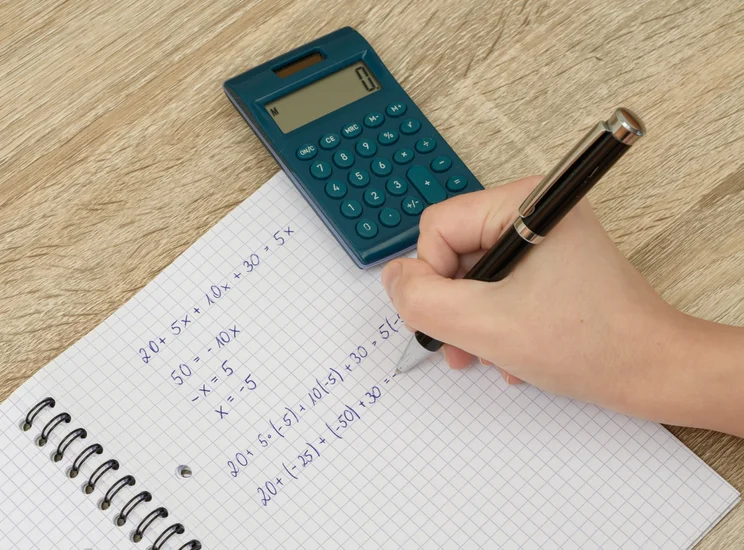
At its core, a variable is just a symbol standing in for an unknown number.
We see students handle this exact concept long before sixth grade. Elementary math problems often use an empty box to represent an unknown value. In sixth grade, we swap that empty box for a letter, but the goal stays the same. We are finding the number that makes the statement true.
Today, our Mathnasium tutors explain what a variable is, a few basic rules around it, and how it behaves differently depending on where it shows up.

What Is a Variable in Math?
In math, a variable is a symbol, usually a letter like x, y, or n, that stands for an unknown number or a value that can change.
The word comes from the Late Latin variabilis, meaning "changeable" or "capable of varying." That is what a variable does in math. It can represent different values depending on the situation.
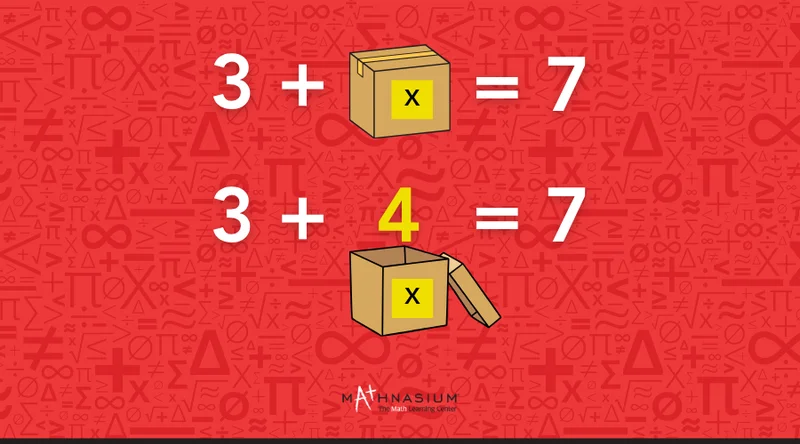
Let's picture a variable as a labeled box that holds a number. We don't know what's inside yet, so we mark the outside of the box with a letter to stand for whatever amount is hidden there.
We can mark that box with any letter we want. So let’s label it with the letter x.
If we're told that x + 3 = 7, we can open the box and find out what's inside.
If you guessed 4, you got it right!
The box was hiding the number 4 all along, which means x = 4.
So, if a variable always ends up as one specific number, why call it a variable at all? Why not just call it "the answer"?
The reason comes down to where we use it. In an example like this one, the variable usually settles on one value. In other settings, a variable can take on many different values.
📕 You May Also Like: Independent & Dependent Variables — Explained for 6th Grade
How Variables Work in Math: The Basic Rules
Variables follow consistent guidelines across every branch of math. In sixth grade, students begin working with formal expressions and equations together, which is why our Mathnasium tutors establish these core rules early on.
A. How to Name a Variable in Math
We can name a variable with any letter we want. A common approach is to use the first letter of the word for the real-world quantity it stands for, like d for distance or c for cost.
Picture a word problem about a car's distance. If we call the unknown x, we have to keep checking back to remember what x stands for. If we use d instead, the letter itself constantly reminds us what we're solving for.
Beyond this helpful habit, certain letters are standard across different areas of math. Let's see what those are.
B. Variables and Coefficients
A coefficient is the number sitting directly next to a variable, and it tells us how many of that variable we have.
Let's picture buying 3 candies, and we don't know the price of one candy yet.
We can call that price c. If we want to buy 3 of them, we can write that as 3 times c, or in algebra, as 3c.
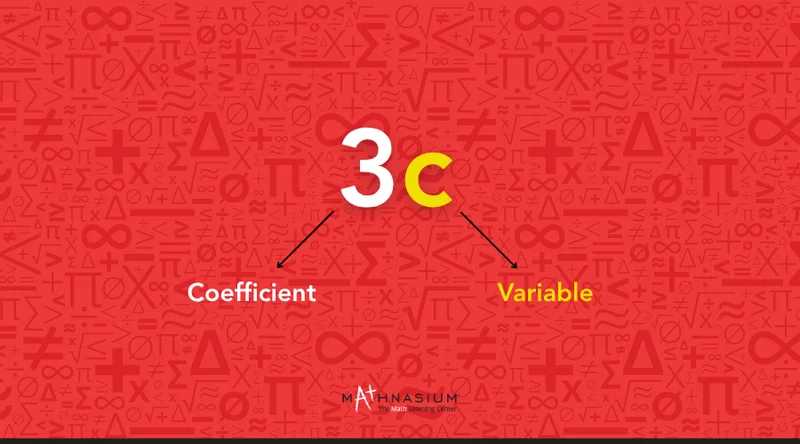
So, why do we drop the multiplication sign?
-
It avoids a mix-up. The multiplication symbol (×) and the letter x look almost identical, as we can see here.
-
It keeps the term unified. 3c holds the coefficient and the variable together as one single term.
📕 You May Also Like: A 4-Step Method for Solving Word Problems + Examples
C. Variables and Constants
A constant is a number that never changes in a math problem. It’s the exact opposite of a variable, whose value can shift depending on the situation.
Say we have $20 in our pocket, and we want to figure out how much we'll have left after buying 3 candies.
We can write that as 20 − 3c.
Here, 20 is our constant. It's the fixed amount we started with.
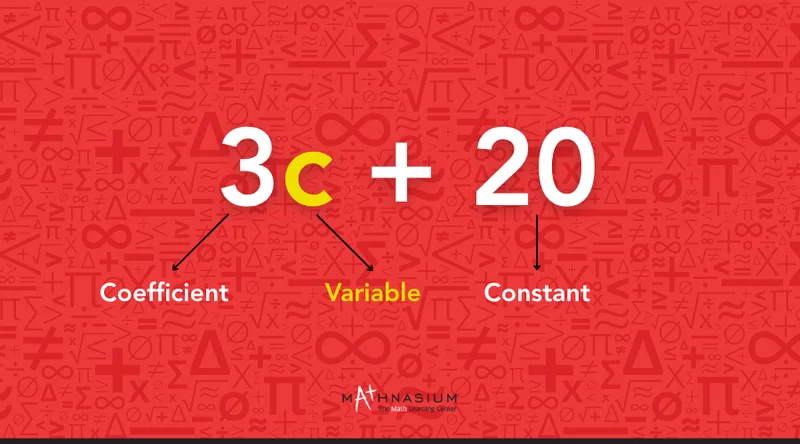
A constant is any value that stays the same, no matter what happens in the rest of the problem. It can be a plain number, like 20, or a fixed symbol used across all of math, like π, which always equals about 3.14.
📕 You May Also Like: What Is a Constant in Math? A Complete Overview [+Quiz]
D. Variables and Like Terms
Like terms share the same variable raised to the same power. We can combine them into one term by adding or subtracting their coefficients.
Let's go back to our $20 and our 3 candies. We had 20 − 3c. Now, say we find $5 more in our back pocket, and we decide to spend it on one more candy.
We can write the whole thing as 20 − 3c + 5 − c.
To simplify this expression, we can combine the like terms.
-
20 and 5 are both constants, so they combine into 25.
-
−3c and −c are both variable terms using c, so they combine into −4c.
That leaves us with 25 − 4c, the cost of 4 candies subtracted from our combined $25.
A variable can only combine with another term that shares the same variable and power. Here's what that looks like across a few examples.
| Expression |
Can We Combine?
|
Why
|
|
4x + 2x
|
Yes, we get 6x
|
Both terms share the variable x
|
|
4x + 2y
|
Noo
|
The terms use different variables, x and y
|
|
4x + 2x2
|
No
|
The powers don't match, 1 and 2
|

How a Variable Behaves in an Expression and an Equation
A variable behaves differently depending on where it shows up. An equation usually pins it down to one exact value, while an expression leaves it open to whatever we plug in.
Because an expression has no equals sign, there is no single "right" answer for the variable.
Take x + 5.
Nothing here pins x down to one number. We can plug in any value we want, and the expression just tells us what happens each time.
-
If x = 4, the expression becomes 4 + 5 = 9.
-
If x = 10, the expression becomes 10 + 5 = 15.
-
If x = 0, the expression becomes 0 + 5 = 5.
A variable behaves differently once an equals sign enters the picture.
An equation tells us that two sides carry the same value, and a variable is what helps us find the exact number that keeps both sides balanced. That's why a variable in an equation usually settles on one specific value.
Take the equation x + 5 = 9.
Only one number keeps both sides equal. So, we ask ourselves what number, added to 5, gives us 9. The answer is 4, so x has to be 4 here.
Here's how the two compare side by side.
|
Feature
|
Expression
|
Equation
|
|
Contains an equals sign
|
No
|
Yes
|
|
Goal
|
Simplify or evaluate
|
Find the unknown value
|
|
Variable's value
|
Can be anything we choose
|
Settles on one specific value
|
🙋 Need Extra Help? Get Algebra Support From Our Pearland East Tutors
Quiz: How Well Do You Know Variables?
Our tutors put together six questions about variables, straight from what we covered in this guide. Choose the best answer for each one.
Question 1: What is a variable in math?
-
A number that never changes
-
A symbol that stands for an unknown or changing value
-
A sign that means multiply
-
A shape with equal sides
Question 2: In the term 5x, what do we call the 5?
-
The variable
-
The constant
-
The coefficient
-
The exponent
Question 3: A variable's value can change from problem to problem. What always stays the same instead?
-
A coefficient
-
A constant
-
An equation
-
An expression
Question 4: Which pair of terms shares the same variable and the same power, so we can combine them?
-
4x and 2y
-
4x and 2x²
-
4x and 2x
-
4x and 2
Question 5: In the equation x + 5 = 9, how many values can x take?
-
Any number we choose
-
Exactly one value, and only one
-
Two possible values
-
No value at all
Question 6: In the expression x + 5, with no equals sign, how many values can x take?
-
Exactly one
-
None at all
-
Any value we choose to plug in
-
Only 0
When you're done, scroll all the way down to check your answers.

Mathnasium tutors use personalized learning plans and clear, step-by-step instruction to help students make sense of variables.
How Mathnasium Helps Students Master Algebra (And Beyond)
Mathnasium is a math-only learning center serving K–12 students, focused on building confident, independent math thinkers through personalized instruction and targeted support.
Sixth graders come to us at different points in their algebra journey. Some need extra support with core skills like factors and operations. Others are ready to work with expressions and equations at a more advanced level. Wherever a student is starting from, we build a path forward from that exact point.
We do this through the Mathnasium Method™, our proprietary teaching approach built around personalized learning and proven instructional techniques.
Here's what that looks like in practice:
-
Diagnostic Assessment and Personalized Learning Plans: Each student begins with a diagnostic assessment that identifies both visible skill gaps and the reasoning patterns behind them. From that starting point, we build a personalized learning plan tailored to their needs and goals, helping them build lasting math mastery at a pace that works for them.
-
Teaching for Understanding: Our specially trained tutors use plain, everyday language and a mix of verbal, visual, mental, tactile, and written techniques so concepts like variables and expressions land in a way that makes sense to each student.
-
Problem-Solving and Critical Thinking: Our tutors know when to offer support and when to let a student work through a problem on their own. That balance is what builds lasting independence.
-
An Engaging and Fun Learning Environment: Sessions are designed to keep students motivated and enjoying the process. We celebrate every bit of progress, and that consistent recognition builds confidence with each session. Over time, students develop a more positive relationship with math and greater confidence in their own abilities.
The results reflect that approach:
-
94% of parents report improvement in their child's math skills and understanding
-
93% of parents report an improved attitude toward math after attending Mathnasium
-
90% of students saw improvement in their school grades
We operate over 1,100 centers across North America, bringing our proven approach to communities everywhere.
Families across Pearland and the surrounding area can visit Mathnasium of Pearland East, a trusted local center with a proven record of building confident math thinkers.
Whether your student is looking to catch up, keep up, or get ahead in math, our local team is happy to help!
📅 Schedule a Free Diagnostic Assessment at Mathnasium of Pearland East
Not near Pearland East?
📍 Find a Mathnasium Learning Center Near You
Pssst! Check Your Answers Here
If you've given our quiz a go, check your results here.
-
Question 1: B
-
Question 2: C
-
Question 3: B
-
Question 4: C
-
Question 5: B
-
Question 6: C


 (281) 465-4990