For seventh and eighth graders in Pearland Independent School District, math can bring new challenges, even if they felt comfortable with earlier coursework. Your child may recognize a calculation but feel less certain about choosing an approach or explaining why it works.
The difficulty may come from a new concept or an earlier skill that needs more attention. When you know which part feels unclear, you can focus your support on that specific difficulty.
At Mathnasium of Pearland East, we help students identify what feels unclear and develop the understanding they need to move forward. Today, our tutors share what junior high math looks like, explore four skill areas students may find challenging, and share four proven tips to help your child.
What Do Junior High Students Learn in Math in Pearland ISD?
Pearland ISD’s math curriculum follows the Texas Essential Knowledge and Skills (TEKS). These standards outline what students should understand and be able to do at each grade level.
In seventh and eighth grade, students:
-
Connect calculations to mathematical relationships.
-
Learn to choose an approach to solve a problem.
-
Explain their reasoning.
-
Check whether an answer makes sense.
While a correct calculation is part of the work, students also need to understand what that calculation tells them about the problem.
To help you get a clear picture, we’ve created a table that summarizes the standard grade-level expectations rather than every topic or lesson.
|
Math topic
|
What Grade 7 students work on
|
What Grade 8 students work on
|
|
Numbers and operations
|
Calculate with rational numbers, including positive and negative fractions and decimals, to solve problems.
|
Expand their understanding to real numbers, including irrational numbers, and use scientific notation.
|
|
Proportional relationships
|
Use ratios, rates, and percentages to describe relationships and solve practical problems.
|
Connect rates to slope and distinguish proportional relationships from nonproportional relationships.
|
|
Algebraic reasoning
|
Represent linear relationships and write and solve two-step equations and inequalities.
|
Explore functions and solve equations with variables on both sides.
|
|
Geometry and measurement
|
Use scale drawings and calculate measurements such as area, surface area, and volume.
|
Study transformations and apply the Pythagorean theorem and geometric formulas.
|
|
Data and probability
|
Use samples to draw conclusions, compare data, and calculate probabilities.
|
Examine relationships between paired measurements and use trend lines to make predictions.
|
|
Personal financial literacy
|
Apply math to budgets, taxes, interest, and purchasing decisions.
|
Compare borrowing costs and savings options and explore financial planning for college.
|
While these topic summaries reflect the seventh- and eighth-grade TEKS, problem-solving and explaining mathematical reasoning run throughout both grades.
Students in Pearland ISD’s advanced math pathway cover some topics earlier as they work toward taking Algebra 1 in eighth grade.
As students work with these topics, some skills may need extra attention. In the next part of this guide, we explore four areas junior high students may find challenging and share ways you can support your child at home.
Math Skills Junior High Students May Find Challenging + Support Tips
In Pearland ISD, junior-high math asks students to choose how to solve a problem and explain why their approach works. Earlier gaps in understanding can also make new coursework harder to follow.
Our math tutors at Mathnasium of Pearland East share four skill areas students may find challenging, each paired with a practical tip you can use at home.
1. Fraction Operations in Word Problems
In seventh grade, students add, subtract, multiply, and divide positive and negative fractions to solve word problems. Eighth graders build on that foundation as their work expands to real numbers and more advanced mathematical relationships.
The challenge can be understanding which operation fits the problem, rather than simply remembering how to calculate. Your student may know how to find a common denominator but feel unsure which operation to use in a word problem.
Let’s illustrate this with an example. A science experiment requires \(\Large\frac{3}{4}\) liter of solution, and a student has already poured in \(\Large\frac{2}{5}\) liter. How much more does the student need to add?
Although the question uses the word “add,” your child needs to recognize that it asks for the difference between the required amount and the amount already poured:
\(\Large\frac{3}{4}\) - \(\Large\frac{2}{5}\)
In this particular example, finding a common denominator is part of the work, but first, your student needs to explain why subtraction answers the question.
📕 You May Also Like: 7 Common Mistakes Students Make in Math Word Problems
Help Your Student Choose the Right Operation in Fraction Word Problems
If your child starts calculating before deciding what a problem asks, we suggest pausing to talk through the situation together.
Let’s use the science example we already covered. Before any calculation is done, here’s what you can ask:
-
“How much solution does the experiment need altogether?”
-
“How much has the student already poured?”
-
“What are we trying to find?”
-
“Why would subtraction help us find that amount?”
If your child chooses addition because the question says “add,” return to what the two fractions represent. The \(\Large\frac{3}{4}\) liter is the target amount, rather than an additional amount to pour while the \(\Large\frac{2}{5}\) liter is the amount already poured.
When they explain their choice, let them complete the calculation. Then ask, “How could we check that the amount already poured and the amount still needed make the required total?”
Try the same discussion with a fraction problem from their classwork. Keep the emphasis on understanding the situation and explaining the operation before working through the calculation.
2. Proportional Reasoning
Proportional reasoning helps students understand how two quantities change together. In a proportional relationship, one quantity is always the same multiple of the other. For example, if notebooks cost $2 each, the total cost remains twice the number of notebooks purchased.
The challenge lies in identifying the relationship before deciding how to calculate. Your student may recognize that both quantities increase but miss how they increase together.
To illustrate, let’s suppose three notebooks cost $6. They may reason that six notebooks cost $9 because they added 3 to both numbers. In a proportional relationship, both quantities change by the same factor. If the number of notebooks doubles, the cost doubles too, so six notebooks would cost $12.
While working with students at Mathnasium of Pearland East, we usually notice a few patterns:
-
They add the same amount to both quantities instead of multiplying both by the same factor.
-
They can complete a calculation when someone explains the approach but struggle to choose it independently.
-
Students find a relationship easier to recognize in a table than in a graph or equation.
In a classroom, your student is expected to connect these different representations, so the work involves more than remembering a procedure.
Help Your Student See How Two Quantities Relate
To help your junior high student see how two quantities relate, we suggest putting the information into a simple table before reaching for a formula. The table gives you a shared starting point for discussing what changes and what stays consistent.
Use the notebook example and work through it together:
-
Make two columns labeled “Number of notebooks” and “Total cost.”
-
Enter three notebooks and $6. Ask, “What would one notebook cost?”
-
Add rows for two and six notebooks. Let your child calculate the costs, then explain how each pair fits the $2-per-notebook relationship.
When the table is complete, ask, “If we double the number of notebooks, what happens to the cost?” Give your child time to describe the relationship in their own words.
If your eighth grader is studying nonproportional relationships, add a $3 delivery fee to each order:
Ask, “We doubled the number of notebooks. Why didn’t the total cost double?” The notebook cost doubles, but the delivery fee stays at $3 per order. The quantities still follow a rule, but they no longer have a proportional relationship.
You should focus on how the quantities relate, rather than how quickly they fill in the table. After you work through the example together, try a similar problem from their classwork and let your child explain how the quantities relate.
📕 You May Also Like: 6 Ways to Help Your Child Understand Proportionality
3. Algebra
Algebra uses symbols to represent unknown or changing quantities and describe mathematical relationships. Students need to explain what those symbols mean, rather than treat an equation as a set of instructions to follow.
Research by McNeil and colleagues on middle-school students’ understanding of the equals sign highlights one source of confusion. Students may interpret it as “write the answer” instead of “both sides have the same value.
To illustrate, your student may feel comfortable with 3 + 4 = 7 but be unsure about 3 + 4 = 5 + 2 . While both statements are true, the second simply shows a calculation on each side rather than a single answer on the right.
Students must treat both sides as equal to understand why an operation applied to one side must also be applied to the other.
Instructional guidance from the Institute of Education Sciences recommends explaining what happens to both sides of an equation, rather than using shortcuts such as “move it across and change the sign.”
To illustrate where the challenge lies for students, here are a few observations from our daily work:
-
Students follow a familiar example but become unsure if the equation looks different.
-
They change one side without making the corresponding change to the other.
-
They find an answer but cannot explain why it makes the original equation true.
Help Your Child Keep Both Sides Equal
If your child remembers equation-solving steps but cannot explain them, we suggest treating the equation as a balanced scale. Both sides have the same value, so any change must preserve that balance. Start with a simple example, such as 3x + 5 = 20.
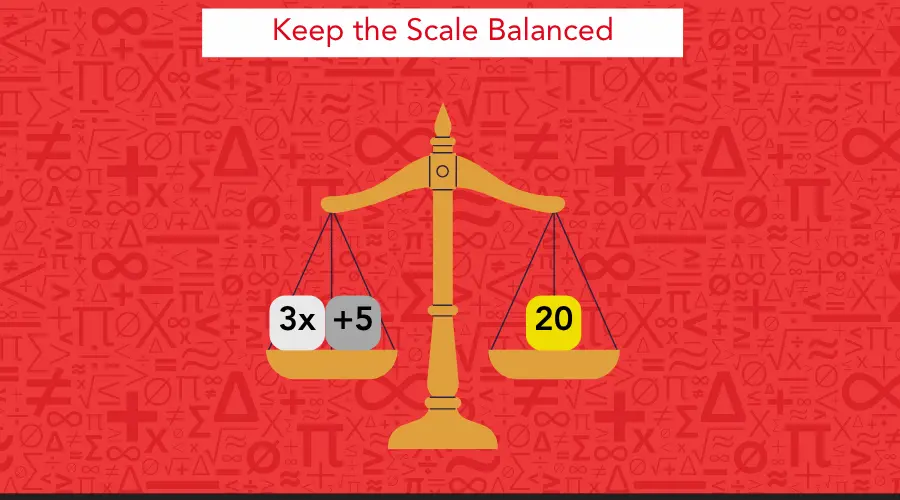
Explain that 3x means three equal groups of an unknown amount, then work through the equation together:
-
Ask, “If we subtract 5 from the left side, what must we do to the right side?” As you subtract 5 from the right side as well, write the new equation 3x=15
-
Ask, “If three equal groups total 15, how much is in one group?” Divide both sides by 3 to get x = 5.
-
Put 5 back into the original equation together and calculate 3 × 5 + 5 = 20. Both sides now show the same value.
For an eighth grader working with variables on both sides, use the same balance idea with 3x + 5 = x + 15.
-
Subtract x from both sides to get 2x + 5 = 15.
-
Then, subtract 5 from both sides to get 2x = 10.
-
Finally, divide both sides by 2. The solution is x = 5.
-
Check it together. The left side becomes 3 × 5 + 5 = 20, and the right side becomes 5 + 15 = 20, which makes both sides balanced.
After each step, you can stop and ask, “Why are the two sides still equal?” Your child does not need a polished explanation. Give them time to describe the change in their own words, and return to the balance idea if they are unsure.
Once they can explain the example, try the same conversation with an equation from their classwork. Keep the emphasis on why each step works before asking them to complete more problems.
4. Geometry and Measurement
Geometry helps students understand shapes and their relationships. Measurement gives them ways to describe a figure’s size, which includes the distance around it, the area it covers, or the space it holds.
For junior high students, the challenge can be connecting a question to the right measurement. Your child may remember how to calculate surface area and volume but feel unsure which one a problem requires.
For example, a question about covering a box with wrapping paper requires them to recognize that they are measuring its outside surfaces, rather than the space inside.
After they identify what they need to measure, students also need to connect the formula to the figure. For example, eighth graders are expected to explain a cylinder’s volume formula using its base area and height.
These skills help students connect a shape’s dimensions to the formula they use to measure it.
Help Your Student Connect the Shape to the Formula
In our work with students, we help students connect mathematical ideas to the calculations they use. You can do the same at home by helping your child identify what each part of a geometry formula represents in the diagram before they start calculating.
For example, use a cylinder problem from their classwork. Start with the volume formula:
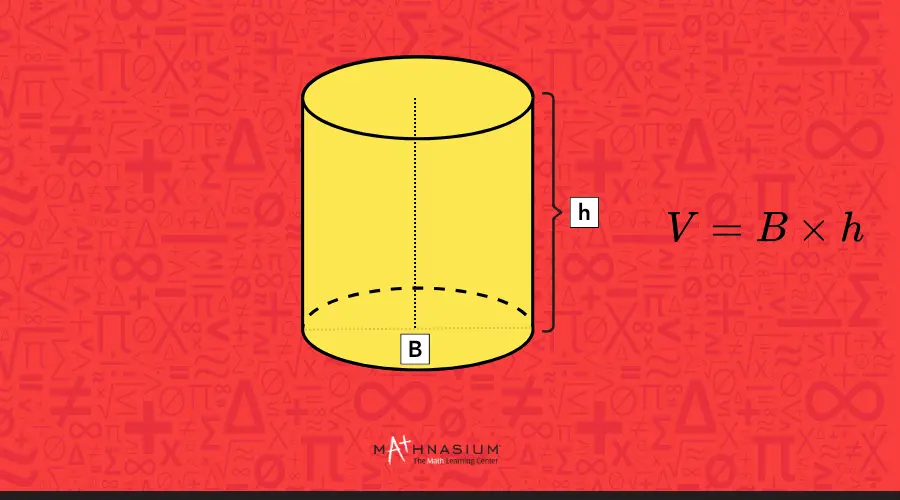
Explain that B represents the area of the base, while h represents the cylinder’s height. Then work through the diagram together:
-
Ask your child to point to a circular base and identify its radius. If the diagram gives the diameter, ask how they can use it to find the radius.
-
Write B = π × r2 and connect it to the circle they identified. Explain that π × r2 gives the area of that circular base.
-
Ask them to identify the height or the distance between the two circular bases.
-
Imagine the cylinder as a stack of thin circular layers with the same base area. Explain that multiplying the base area by the height measures the space those layers fill.
Now connect the two forms of the formula:
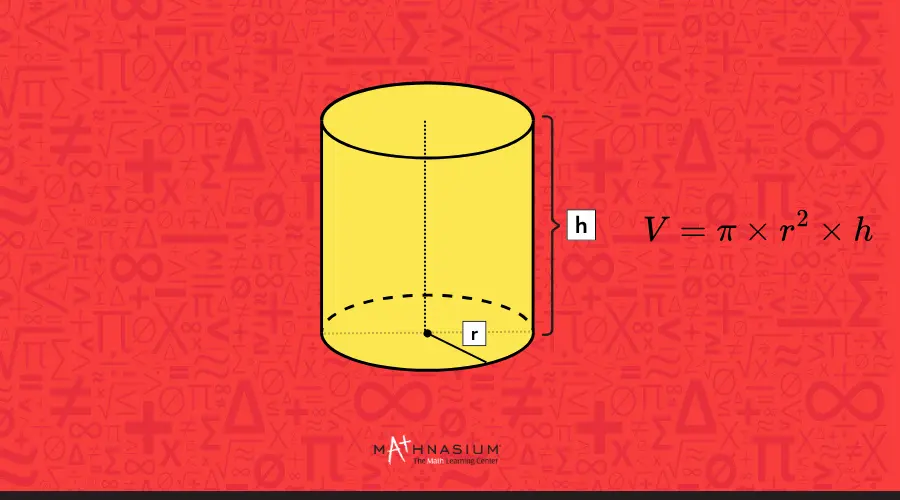
Before your child substitutes the measurements, ask, “Which part gives us the base area, and which part tells us how far that base extends through the cylinder?”
If they are unsure what the question asks them to measure, return briefly to the visual prompts
-
Trace a boundary for perimeter,
-
Shade a surface for area, or
-
Identify the space inside for volume.
Then return to matching the figure’s measurements to the formula.
The moment those connections feel clearer, let your child complete the calculation. Keep the focus on explaining how the formula describes the shape, rather than simply placing numbers into it.
📕 You May Also Like: Cylinder, Cone, and Sphere Volume Explained (with Examples)

How Mathnasium of Pearland East Helps Students Overcome Any Math Challenge
Mathnasium of Pearland East is a math-only learning center dedicated to helping K-12 students of all skill levels learn and master math.
We proudly serve students from Pearland East and neighboring communities, including Green Tee, Terrace, Lakes of Highland Glen, Province Village, and Riverstone Ranch. We help them overcome any challenge junior high math may bring.
Our center personalizes each student’s learning experience through the Mathnasium Method™, a proprietary teaching approach designed around individual student needs and learning styles.
Here’s how it works.
Each student begins with a diagnostic assessment that gives us a clear picture of their current skills and learning gaps. From there, we build a personalized learning plan tailored to their needs, pace, and goals.
Our specially trained tutors follow the plan closely and deliver face-to-face math instruction in a caring and fun small-group environment.
We teach math for understanding, using natural language and a combination of mental, verbal, visual, tactile, and written techniques.
If a concept feels tricky, we break it down into manageable steps, which allows students to see both the how and the why behind the answer. In time, they develop problem-solving skills and critical thinking tools to use both in math class and beyond.
Fun is an important part of the Mathnasium Method™. Our activities are often game-based and hands-on. We let students earn their rewards and celebrate each step of progress together, so their confidence grows with each session.
The results speak for themselves:
-
94% of parents report an improvement in their child's math skills and understanding
-
93% of parents report an improved attitude toward math
-
90% of students saw an improvement in their school grades
Whether your student is looking to catch up, keep up, or get ahead on their math journey, our local team is happy to help! Start by scheduling a free diagnostic assessment with our center. We’ll use it to create a personalized learning plan for your student and set them on the best path to math mastery.
📅 Schedule a Free Assessment at Mathnasium of Pearland East
Not near Pearland East?
📍 Find a Mathnasium Learning Center Near You


 (281) 465-4990