Families who come to Mathnasium of Rolling Hills Estates for math support often tell us their child did fine in math right up until Algebra 1.
This is not unusual. And the reason? Algebra asks students to work with abstract concepts and relationships between numbers instead of standard computation, so earlier success doesn't always guarantee a smooth transition.
Our local Palos Verdes Peninsula Unified School District (PVPUSD) math pathway reflects this jump, offering support options like Bridge to Algebra 1 and readiness diagnostics once students reach middle and high school.
Today, we will break down why the jump to algebra may feel difficult, what math gaps may stand behind the struggle, and what you can do to help.
Why the Jump to Algebra Can Be Hard for Your Child
Your child may feel less confident once they start learning algebra because they are asked to think in a new way. In arithmetic, they usually worked with known numbers. In algebra, they must reason about unknowns and relationships between quantities before a single value is known.
The National Mathematics Advisory Panel (2008) underlines the importance of moving from computation with specific numbers to reasoning about general relationships as part of preparation for algebra.
Take a look at how familiar arithmetic thinking differs from algebraic one:
|
Arithmetic thinking
|
Algebraic thinking
|
Example
|
| Find a specific numerical answer. |
Generalize a pattern across all cases. |
Instead of 3 + 5 = 8, your child now works with n + 5, where n stands for any number. |
| Work with one known quantity. |
Reason about several related quantities. |
In a linear relationship, they may need to keep track of x, y, the rate of change, and how all three are connected. |
| Follow a familiar procedure. |
Plan and manage several steps. |
A multi-step equation asks them to choose a first step, carry out the operation, keep the equation balanced, and check whether the final answer works. |
That change in mathematical thinking is also built into the curriculum. So let’s find out which earlier math skills are likely to affect how your child handles Algebra 1.
📕 You May Also Like: Algebraic Reasoning: What It Is and How to Develop It
5 Math Skills to Check for Algebra 1 Readiness
California’s 2023 Mathematics Framework highlights several middle-school skills that support the transition to Algebra 1.
From our work with students at Mathnasium, we see those same foundations come up repeatedly when a child starts getting stuck. Drawing on the Framework and our classroom experience, these are the areas we recommend checking first.
A. Fraction Sense
Pay extra attention to your student’s fraction sense. Fractions appear inside algebraic expressions and equations, so your learner needs a reliable sense of fraction size and how fractions compare, rather than depending on a procedure every time.
For example, in equations such as, \(\Large\frac{3}{5}\)x + \(\Large\frac{1}{4}\) = \(\Large\frac{7}{8}\), your child has to manage the algebra while keeping track of how the fractions relate to one another.
In their 2012 research of middle-school students, Booth and Newton found that fraction-magnitude understanding was related to measures of algebra readiness.
To check whether the skill is secure, you can try asking your child which is greater, \(\Large\frac{3}{5}\) or \(\Large\frac{3}{8}\), and how they know. Then try \(\Large\frac{7}{8}\) and \(\Large\frac{5}{6}\). If they can use a common denominator but cannot also explain the comparison using fraction size, equal numerators, equal denominators, or closeness to 1, their fraction sense may still need support.
📕 You May Also Like: How to Do Algebra With Fractions? A Simple Guide
B. Math Equivalence: What “=” Means
Another math skill that may affect your student’s algebra performance is how they understand the “=” sign.
According to a 2006 study by Knuth et al., middle-school students who saw the “=” sign as a relationship, rather than a command to calculate, tended to perform better on equation-solving tasks.
We also notice in our work that learners get lost because they expect “=” to simply come before an answer.
Powell’s research (2012) helps us explain why this misunderstanding may develop. It found that the examined elementary math curricula usually present equations in forms such as “3 + 5 = ___,” a pattern that may reinforce the idea that the equals sign signals that an answer should come next.
Make sure your student has a solid sense of math equivalence by giving them two non-standard equations, such as 6 = 2 + 4, or 3 + 5 = 4 + 4. Ask them whether it’s true, and why.
Their confusion around these examples may suggest that your child still sees “=” mainly as an instruction to calculate, while a secure understanding treats it as a statement that both sides have the same value.
C. Variables
Algebra 1 asks your child to use letters in a more flexible way. They need to understand that a letter such as n represents an unknown or generalized number and that its value may change depending on the problem.
Say your student is working with this expression 2n+3n. They can combine the terms once they understand that n represents the same numerical quantity in each term, rather than the name of an object.
You can explore this idea at home by asking your learner what n + 3 means. They may explain that n can stand for different numbers, such as 2, 5, or 10. That shows a solid understanding of variables.
However, they may need more practice with the concept if they think of n as one specific number or a letter that stands for the name of something.
📕 You May Also Like: How to Make Sure Your Child Is Ready for Algebra?
D. Ratios, Rates, and Proportional Reasoning
How comfortable your child is with ratios, rates, and proportional relationships lays much of the groundwork they need for slope and linear functions.
The National Mathematics Advisory Panel (2008) names proportional reasoning and fluency with rational numbers among the critical foundations for algebra.
Here is what you can do to find out if these skills are mastered:
Ask them to work through this example: 3 cups of flour make 12 cookies; how many cups make 20 cookies? Listen to how they set up the relationship between the quantities.
Your learner may show solid proportional reasoning when they use the relationship between the two quantities to find the answer, instead of guessing an operation.
E. Procedural Fluency
When students can quickly recall familiar procedures, they have more working memory available during multi-step problems and can devote more attention to the reasoning the problem demands, as per Ding et al.’s study (2017).
To get a sense of your child’s procedural fluency, watch how they handle familiar calculations such as:
-
Fractions: Ask them to add \(\Large\frac{1}{3}\) + \(\Large\frac{1}{4}\). Your student should be able to work through the calculation accurately without having to reconstruct the process from scratch each time.
-
Positive and negative numbers: Try calculations such as (−3 + 5) and (−5 + 3). Repeated sign errors or uncertainty about the operations may signal that these skills need attention.
These calculations may seem simple compared with Algebra 1, but your learner often has to carry them out in the middle of a longer equation.
But fluency should not be confused with memorized procedures alone. Your child should be able to use a familiar procedure efficiently while still understanding why it works.
That’s why, at Mathnasium, we help learners build fluency through understanding, so they can apply the same idea confidently in a more complex Algebra problem.
 Fluency in algebra means using familiar procedures efficiently while understanding why each step works.
How to Close Math Gaps That Cause Algebra Problems
After you identify the math skills your child needs to work on, focus practice on those areas rather than reviewing everything at once.
We use a similar focused approach in our learning center. Each child starts with a diagnostic assessment that helps us identify the math concepts that require support. From there, we craft a personalized learning plan tailored around these specific learning needs.
1. Practice fractions with a number line
To develop your student’s sense of fractions, we recommend using a number line. It is one of the tools used most frequently at Mathnasium, and we see its value both during sessions and in research.
For instance, longitudinal research by Resnick et al. (2016) found that students with better skills in estimating fractions on a number line showed better math achievement later on.
You do not need any special equipment. A pen and a piece of paper are enough:
-
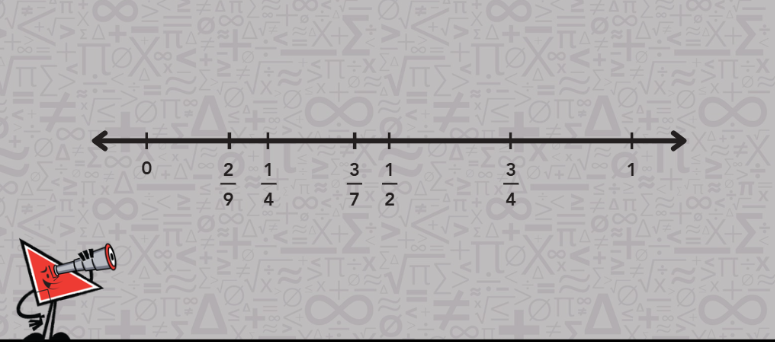
Draw a number line from 0 to 1.
-
Together with your learner, place these fractions, \(\Large\frac{1}{4}\), \(\Large\frac{2}{9}\), \(\Large\frac{3}{7}\), and \(\Large\frac{3}{4}\) on the number line.
-
Then, discuss which one is closer to \(\Large\frac{1}{2}\) and why.
You can later extend the same activity to a number line from 0 to 5 so your child can practice reasoning about fraction size beyond a single whole.
📕 You May Also Like: How Number Lines Improve Math Understanding (Grades 1-5)
2. Use worked examples to make the “=” sign clear
Worked examples may be a very useful learning tool when your child does more than copy the steps. Have them explain why each step works and how each move keeps both sides of an equation equal. Nathan et al. (1994) reported that this kind of self-explanation can support deeper conceptual understanding.
You can put this into practice with a solved equation such as 3x + 5 = 17. After your child reviews the steps, ask:
-
Why do we subtract 5 from both sides?
-
What property lets us do the same thing to both sides and keep the equation true?
-
Why do we divide both sides by 3 next?
-
How can you check that x = 4 is correct?
3. Explore variables with different values
Help your learner see a variable as a number whose value can change by giving the letter several values and asking them to describe what changes in each example.
Try it this way:
-
Start with n + 3.
-
Ask your child what the expression becomes when n = 2, n = 5, and n = 10.
-
Then ask what stays the same across all three examples. This can make the meaning of the variable more concrete.
You can take the idea further with 2n + 3n. Have your student substitute several values for n into both 2n + 3n and 5n, then compare the results.
📕 You May Also Like: How to Spot and Overcome Early Algebra Gaps
4. Build proportional reasoning with multiple representations
Use different formats to show the same proportional relationships. This can help your student see how the quantities are connected.
The idea is also supported in Brenner et al.’s research (1997), which showed that, within a 20-day prealgebra unit, multiple representations can improve how students represent problems and, on some measures, how they solve them.
This aligns with what we do at Mathnasium. Our tutors use a variety of teaching techniques and different representations to help learners make sense of a concept. You can bring this idea home, too.
For example, your child works on this problem: 4 notebooks cost $12. How much would 7 notebooks cost at the same rate?
Our tutors would start with a table showing the number of notebooks and the total cost to help your student see how the two quantities change together:
| Notebooks |
Cost |
| 1 |
$3 |
| 2 |
$6 |
| 3 |
$9 |
| 4 |
$12 |
| 7 |
$21 |
Next, we would use the table to guide your child toward an equation that represents the relationship:
C = 3n, where n is the number of notebooks and C is the total cost.
Then your learner can sketch the corresponding graph and explain how the table, equation, and graph all represent the same proportional relationship.
5. Improve procedural fluency through short practice
If limited procedural fluency is getting in the way of your child’s Algebra progress, focus on calculations that appear often inside Algebra problems, fraction operations and work with positive and negative numbers.
To build that fluency, use short practice with small variations. Start with one procedure your learner already understands. After that, change one part of the problem at a time so they can apply the same reasoning in a slightly different situation.
-
For instance, you might move from \(\Large\frac{1}{3}\) + \(\Large\frac{1}{4}\) to \(\Large\frac{1}{3}\) + \(\Large\frac{2}{4}\) and then to \(\Large\frac{2}{3}\) + \(\Large\frac{1}{6}\).
-
With positive and negative numbers, you could move from −3 + 5 to −3 + 7 and then to -3 - 7.
This kind of variation gives your child repeated practice without turning the procedure into a memorized script. The steps gradually become more automatic because they understand the pattern behind them.
As soon as the procedure feels more secure, mix different types of calculations together so your learner has to decide which method to use instead of simply repeating the same steps.
If you feel that closing these math gaps at home is becoming too much to manage, our algebra tutors at Mathnasium of Rolling Hills Estates can help your child master the skills they need.
📕 You May Also Like: 4 Tips to Help Your Student Get Better in Algebra This Year
 Mathnasium tutors use mental, verbal, visual, tactile, and written techniques to help students make sense of math ideas.
How Mathnasium of Rolling Hills Estates Helps Students With Math Gaps (and Beyond)
Mathnasium of Rolling Hills Estates is a math-only learning center dedicated to helping K–12 students of all skill levels excel in math.
We help students build a true understanding of any math concepts, including the ones they need for Algebra 1, like fraction sense, integer operations, proportional reasoning, and early work with variables.
To support that understanding, we use the Mathnasium Method™, our proprietary teaching approach, to meet students where they are and guide them forward step by step.
Every student begins with a diagnostic assessment that helps us understand their current skill level, knowledge gaps, goals, and how they think and feel about math. For students approaching Algebra 1, that may include looking closely at how they reason about fraction size, the meaning of the equal sign, proportional relationships, and unknown values.
Using these insights, we build a personalized learning plan focused on the skills the student needs most, whether that means reinforcing earlier foundations, making sense of variables and equations, or preparing for the pace and reasoning Algebra 1 requires.
Our specially trained tutors follow that plan closely and provide live, face-to-face instruction in a caring and fun group environment. They use mental, verbal, visual, tactile, and written techniques to help students explain what each step means and connect equations to the relationships they represent.
Students also get room to think through problems before tutors step in. Our tutors guide them to explain their reasoning, check whether an answer makes sense, and try another approach when a strategy is not working. This way, learners build the critical thinking, problem-solving skills, and independence they need for Algebra 1 and later math.
Fun is part of the approach, too. We use game-based activities, rewards, and consistent encouragement to keep students engaged as they practice foundational skills and take on increasingly complex algebraic thinking.
The impact is clear in our results:
-
94% of parents report an improvement in their child's math skills and understanding
-
93% of parents report their child's improved attitude toward math after attending Mathnasium
-
90% of students saw an improvement in their school grades
If your child is finding the jump to algebra difficult, a free diagnostic assessment is a great place to start. Using what we learn, we create a personalized learning plan focused on the skills they need next to make better sense of Algebra and move forward with greater independence.
📅 Schedule a Free Assessment at Mathnasium of Rolling Hills Estates
Not near Rolling Hills Estates?
📍 Find a Mathnasium Learning Center Near You


 (424) 383-6284