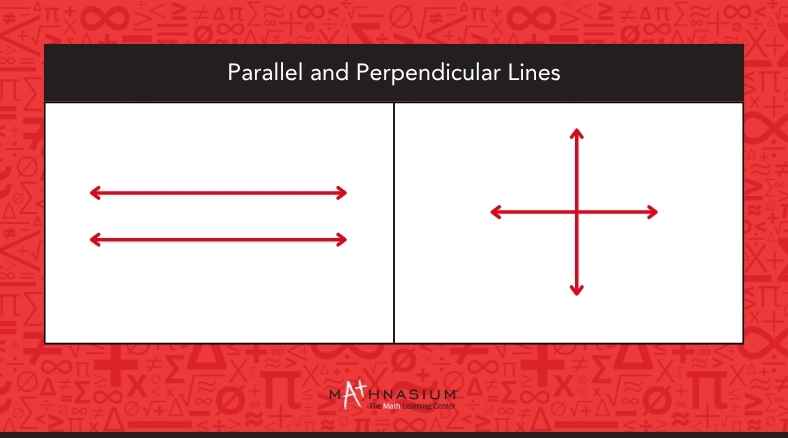
Geometry concepts like parallel and perpendicular lines are foundational building blocks in school, and learning them comes naturally through simple visual patterns.
With the right hands-on tools and real-world connections, these ideas quickly become second nature.
Today, our Mathnasium tutors explain what makes lines parallel or perpendicular, how to tell the difference for certain, and where we spot both in everyday life.

What Are Parallel Lines?
Parallel lines are two or more lines that run in the same direction and never meet, no matter how far we extend them.
Even if the lines have different lengths, they can still be parallel. As long as they share the same slope or slant, they will point in the same direction and never cross.

In math notation, we show that two lines are parallel with a small arrow marking, or by writing it out with the symbol ||.
So if line a is parallel to line b, we write:
a || b
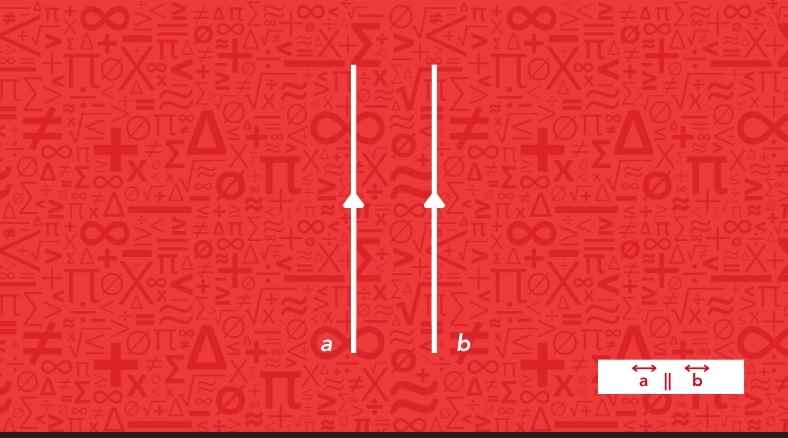
Do you notice anything special about the symbol || ? It actually looks like two parallel lines! The symbol itself shows us exactly what it represents.
So, two lines are parallel if they run side-by-side and never cross paths. As simple as that!
📕 You May Also Like: 10 Different Lines in Math: A Complete Guide
What Are Perpendicular Lines?
Perpendicular lines are two lines that meet at a single point and form a perfect 90° angle where they cross.
It doesn't matter which way the lines are tilted or how long they are. As long as they meet or intersect at a right angle, they are perpendicular.

On a drawing, we indicate a right angle by placing a small square at the intersection.
To mark perpendicular lines, we use the symbol ⊥.
For example, if line a and line b are perpendicular, we express it as:
a ⊥ b
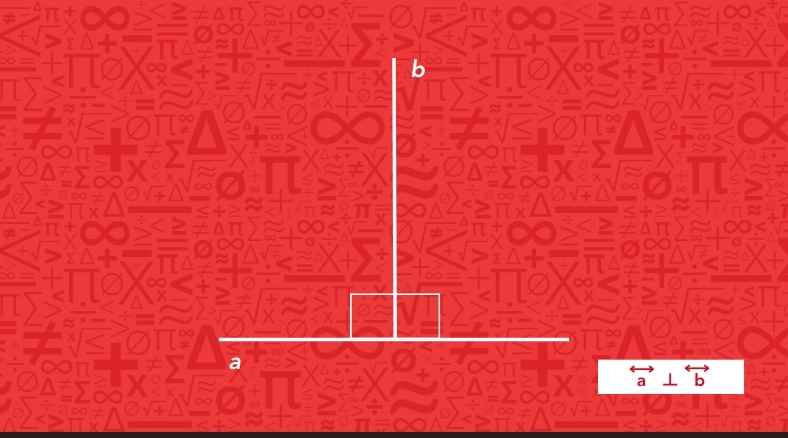
You might have already noticed this, too. If not, take a look again at the ⊥ symbol! It draws two perpendicular lines meeting at a right angle.
📕 You May Also Like: What Does Perpendicular Mean? A Complete Overview
How Can We Spot Parallel and Perpendicular Lines
Parallel and perpendicular lines seem easy to tell apart on paper. We can spot the difference by looking at how they intersect and the angles they create. However, double-checking our work to make sure we're right can take a little extra effort.
Let's practice with a couple of examples together.
Consider two lines that clearly aren't parallel. They lean toward each other and cross. But how can we be so sure they are perpendicular?

We could reach for a protractor and measure the angle right where they meet. Let’s do that.
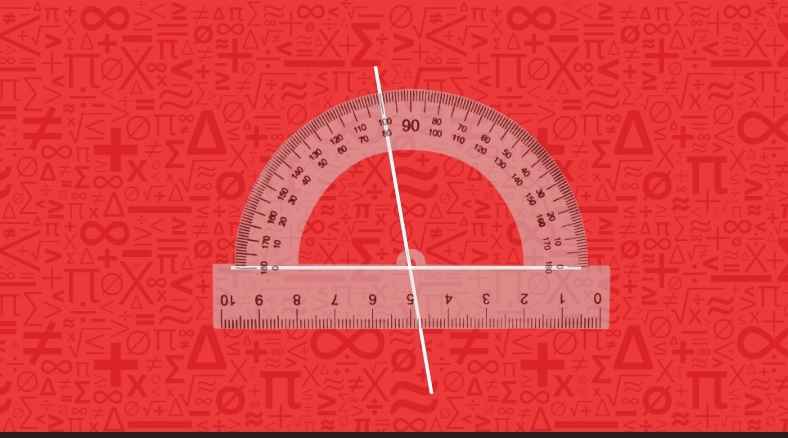
The angle measures 80°.
An 80° angle is an acute angle, less than 90°. So even though these two lines cross, they are not perpendicular. We need a clean, right angle for that, and 80° simply doesn't make the cut.
Let's check another pair.

When we place our protractor over the intersection, we can measure the exact angle where the lines cross.
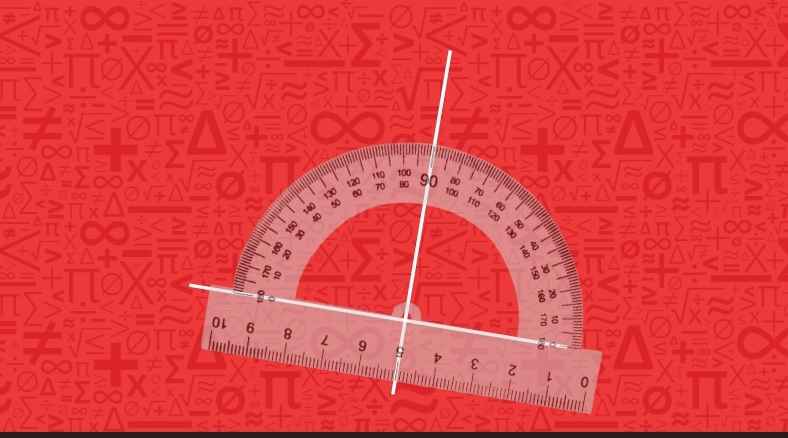
This time, the protractor reads exactly 90°. Which means that these two lines are perpendicular.
Now let's flip to parallel lines.
Here is an interesting thought. How can we be so sure that two lines running across from each other will never touch, even if we can't extend them forever on a page?
To answer this, we are going to work through an example.
Let's draw two lines, line a and line b, running side by side.

To check if they're parallel, we can draw a third line that crosses straight through both of them.
We’ll call this line c.

Our line, c, is called a transversal, and it creates matching sets of angles at both intersections.
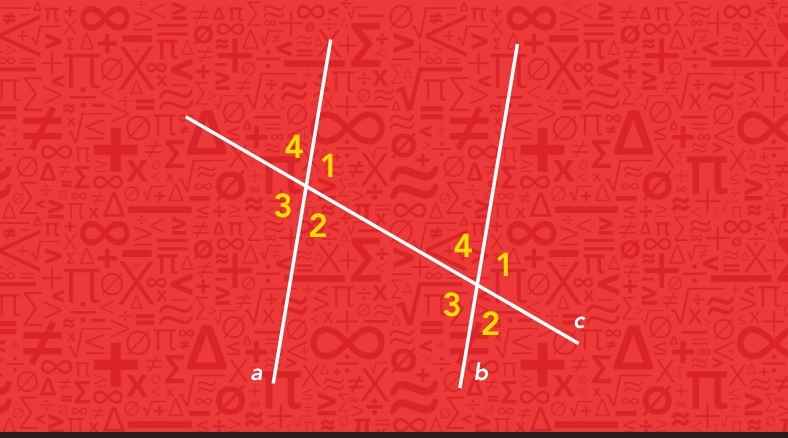
One of the best ways to test for parallel lines is by comparing these corresponding angles.
To prove that lines a and b are parallel, those corresponding angles must measure the same number of degrees.
We can use a protractor to check the first angle! Let’s check:
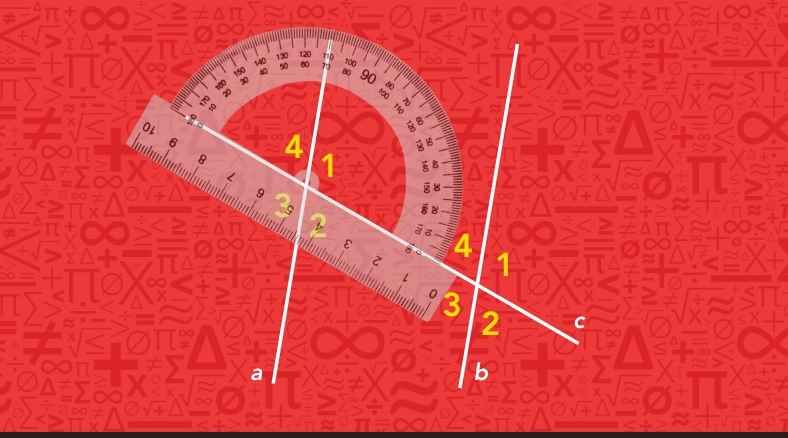
The first one is at 110°.
Now we can check the other one.
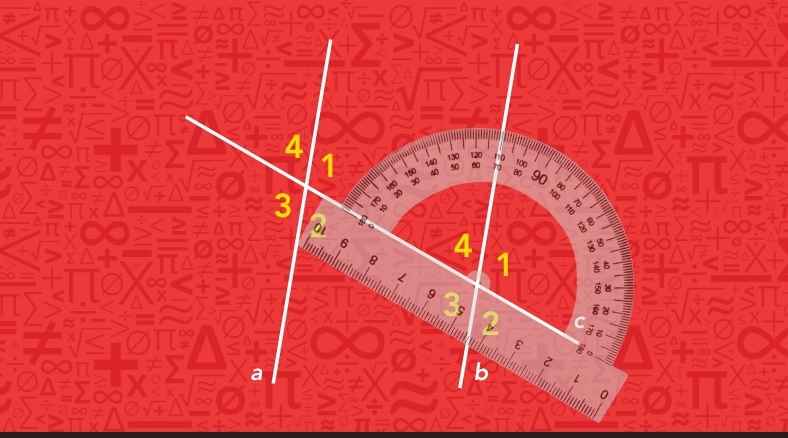
Both corresponding angles measure exactly 110°. Since these angles are identical, lines a and b tilt in the same direction and will never cross.
That means our lines are parallel! How awesome is that?
Now that we know how to spot both, let's review the comparison between parallel and perpendicular lines.
|
Everyday Situation
|
Number
|
Perpendicular Lines
|
|
Do they cross?
|
Never.
|
Yes, exactly once.
|
|
Angle formed
|
None, they run in the same direction.
|
Exactly 90°
|
|
Symbol
|
||
|
⊥
|

Parallel and Perpendicular Lines: Real-Life Examples
Our tutors picked out a few everyday examples where parallel and perpendicular lines show up, some in places we'd never think to look.
A. Math Symbols
Two symbols we use every day when doing math. The plus and equal signs are both built entirely out of the lines we just learned about.
-
The plus sign (+) is two lines crossing at a perfect right angle, making it perpendicular.
-
The equal sign (=) is two lines stacked one above the other, running in the same direction and never touching, making it parallel.

B. Rectangles
If we look at any rectangle, we'll find both relationships show up at once.
-
The top and bottom sides run parallel to each other, and so do the left and right sides.
-
At every corner, the meeting lines form a right angle, which makes them perpendicular.

📕 You May Also Like: Properties of a Rectangle vs. a Square: How Do They Differ?
C. Roads and Intersections
Think about a four-way intersection. Crossing at a sharp angle would make traffic hard to see, so most roads are designed to intersect at 90°. The right angle makes the streets perpendicular, giving drivers a clear, predictable view in every direction
The two sides of the very same street run parallel to each other, stretching for blocks without ever touching.

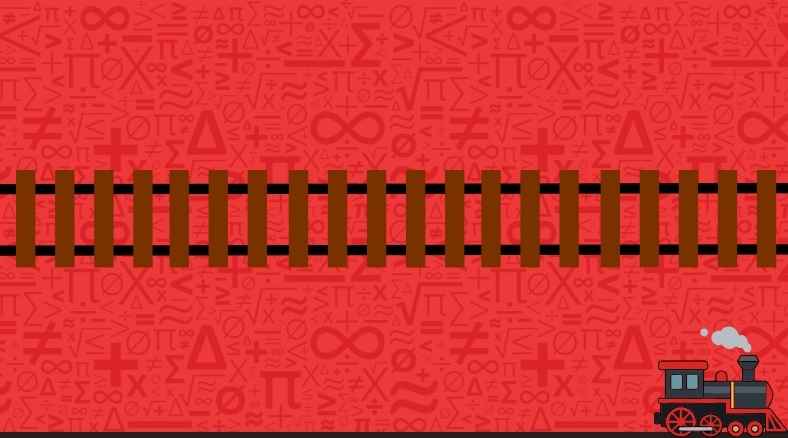
D. Railroad Tracks
The two rails of a train track stay the same distance apart for miles at a time, running parallel the entire way.
Beneath them, the wooden ties lie perpendicular to both rails, connecting them at a right angle and holding the tracks in place.
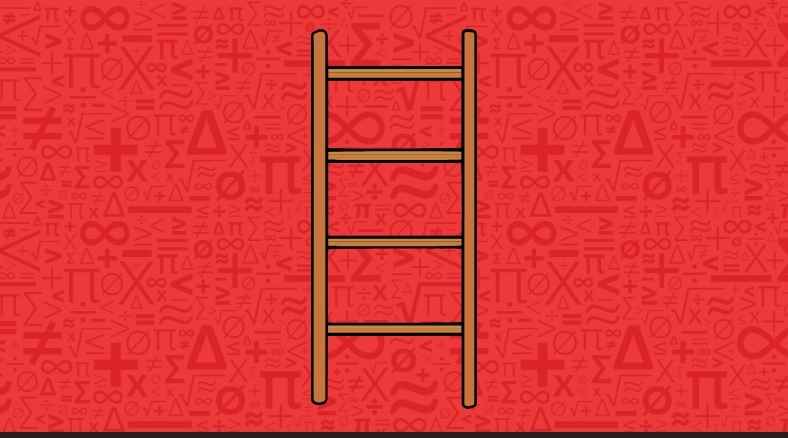
E. A Ladder
A ladder leaning against a wall gives us both relationships in one object, too.
-
Every rung runs parallel to the rung above and below it, evenly spaced from top to bottom.
-
At the same time, each rung meets the ladder's side rail at a right angle, making every rung perpendicular to the rails holding it up.
Parallel and perpendicular lines sit in plain sight, holding up ladders, guiding traffic, and framing the shapes we draw every day.
If you are ready to dig deeper, our geometry tutors at Mathnasium of South Arlington are ready to help!

Mathnasium tutors use personalized learning plans and hands-on techniques to help students make sense of geometry concepts like parallel and perpendicular lines.
How Mathnasium Helps Students Master Geometry
Mathnasium is a math-only learning center dedicated to helping K–12 students of all skill levels learn and master math.
Whether a student needs help telling parallel and perpendicular lines apart, wants to build a solid foundation in geometry basics, or is ready to move into more advanced topics like angle relationships and proofs, Mathnasium offers a personalized path forward.
We build that path through the Mathnasium Method™, our proprietary teaching approach designed around each student's individual learning needs and style.
Here is how it works in practice:
-
Diagnostic Assessment and Personalized Learning Plans: Every student begins with a diagnostic assessment that uncovers both visible skill gaps and the reasoning behind them. From that starting point, we build a personalized learning plan tailored to their needs and goals.
-
Teaching for Understanding: Our specially trained tutors use plain, everyday language and a mix of verbal, visual, mental, tactile, and written techniques so concepts like parallel and perpendicular lines make sense the first time.
-
Problem-Solving and Critical Thinking: When a concept feels tricky, we break it down into manageable parts and guide students through both the how and the why. Over time, this builds the problem-solving skills and critical thinking they use in math and beyond.
-
An Engaging and Fun Learning Environment: Our sessions are often game-based, and students earn rewards along the way, keeping them motivated and genuinely enjoying the process. We celebrate every bit of progress, so confidence grows with each session.
Families see measurable results:
-
94% of parents report an improvement in their child's math skills and understanding
-
93% of parents report an improved attitude toward math after attending Mathnasium
-
90% of students saw an improvement in their school grades
We operate over 1,100 centers across North America, bringing our proven approach to communities everywhere.
Families across South Arlington, and the surrounding areas can visit Mathnasium of South Arlington, a trusted local center with a proven record of building confident math thinkers.
Whether your student is looking to catch up, keep up, or get ahead in math, our local team is happy to help!
📅 Schedule a Free Diagnostic Assessment at Mathnasium of South Arlington
Not near South Arlington?
📍 Find a Mathnasium Learning Center Near You


 (833) 579-6284