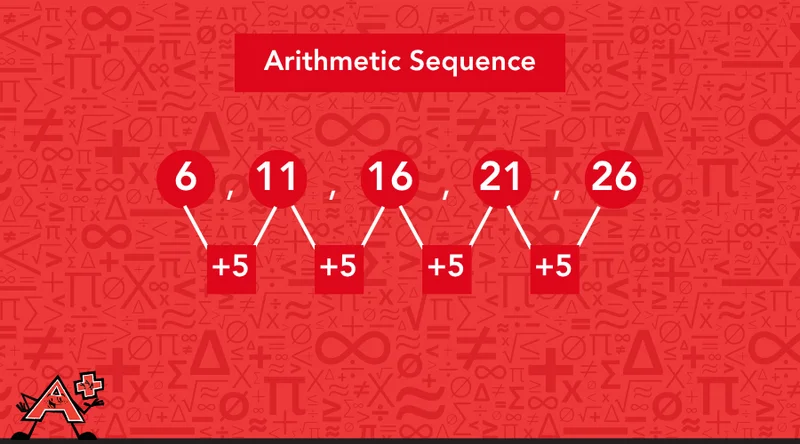
Arithmetic sequences usually first appear in pre-algebra or early algebra, and they give us a new way to think about patterns. Instead of only spotting what comes next, we learn how to describe the relationship between the terms and use it to jump to any term we need.
We’ll see the same idea later in functions and series. Beyond the classroom, arithmetic sequences show up whenever a cost, distance, or quantity changes by the same fixed amount each time, like a membership fee that increases by the same amount every year.
Today, our tutors will break down what an arithmetic sequence is and show you how to find any term without listing every term along the way.

What Is an Arithmetic Sequence?
An arithmetic sequence is a list of numbers where we add or subtract the same amount each time to get the next term.
Picture a bookshelf where you add 3 books every week. You start with 2 books, then have 5, then 8, then 11.
Written as a sequence, that looks like:
Each term is 3 more than the one before it. That repeated amount, 3, is called the common difference.
We can find the same pattern in plenty of everyday situations:
-
The number of seats in each stadium row, with 2 more seats than the row before it.
-
The balance in a savings account, with the same amount added every month.
-
Your game score, with the same number of points added each round.
-
The number of pages you’ve read when you read 10 more pages each day.
What Is Not an Arithmetic Sequence?
During sessions, we’ve noticed that students may mistake other number patterns for arithmetic sequences, as some of them can look similar at a glance. Our tutors put together this quick table to help you spot the difference:
|
Sequence
|
Why it’s not arithmetic
|
|
2, 4, 8, 16, ...
|
The differences keep changing: +2, +4, +8. We are not adding the same amount each time, so the sequence is not arithmetic.
|
|
5, 8, 5, 8, 5, 8, ...
|
The terms change back and forth. The differences switch between +3 and −3 instead of steadily increasing or decreasing.
|
|
1, 4, 9, 16, 25, ...
|
These are square numbers: 12, 22, 32, 42, 52, .... The difference keeps changing: +3, +5, +7, +9, so the sequence is not arithmetic.
|
|
4, 7, 10, 14, 17, ...
|
At first, we might think the pattern is +3 each time. But when we reach 10 to 14, the difference changes to +4. The pattern breaks, which tells us the sequence is not arithmetic.
|
Now, we can tell whether a sequence is arithmetic before we try to find a term farther down the list. Let’s find out how to do that without listing every term that comes before it.

How to Find Any Term in an Arithmetic Sequence Without Listing Them All
We can find any term in an arithmetic sequence by starting with the first term and adding the common difference enough times to reach the position we want.
Take this sequence:
Here, the first term is 4, and the common difference is 5. Say we want to find the 5th term. We could keep extending the sequence until we get there:
The 5th term is 24.
But what if we need to know the 50th or even 100th term in the sequence? It would take too much time to add the common difference this many times. Luckily, there is a quicker way.
Look at what happens when we go from the 1st term to the 5th term. We add the common difference 4 times, not 5, as you might expect. The first term is already there, so we only need to count the steps after it:
-
From term 1 to term 2, we add the common difference once.
-
From term 1 to term 3, we add it twice.
-
From term 1 to term 4, we add it three times.
-
From term 1 to term 5, we add it four times.
So the number of times we add the common difference is always 1 less than the position of the term we want. In other words, to reach term n, we add the common difference (n − 1) times.
This means, instead of writing the same addition again and again, we can multiply the common difference by the number of steps:
(n − 1)d
This gives us the total amount the sequence has increased or decreased from the first term by the time we reach term n. We then add that change to the first term because the first term is our starting value.
Put together, we get a formula for finding any term in arithmetic sequence, without listing anything in between:
aₙ = a₁ + (n − 1)d
Here:
-
aₙ is the term we’re trying to find
-
a₁ is the first term in the sequence
-
n is the position of the term we want
-
d is the common difference
📕 You May Also Like: 7 Tips to Help Your Child Memorize Math Formulas
Calculating a Term in an Arithmetic Sequence: Worked Example
Let’s see the formula at work and find the 20th term of this sequence step by step:
Before we substitute anything into the formula, we identify the values we need:
-
The first term of the sequence is 4, so a₁ = 4.
-
Each term is 5 more than the one before it, so the common difference is d = 5
-
We want to find the 20th term, so n = 20.
Now we substitute these values into the formula:
aₙ = a₁ + (n − 1)d
a₂₀ = 4 + (20 − 1)5
Then, we simplify:
a₂₀ = 4 + (19 × 5)
a₂₀ = 4 + 95
a₂₀ = 99
So, the 20th term of the sequence is 99.
📕 You May Also Like: Equations With Parentheses: When to Distribute First
Common Mistakes to Avoid With Arithmetic Sequences
From our experience, learners often run into the same few mix-ups when they first start working with arithmetic sequences. Use this table to catch them early:
|
Mistake
|
How to avoid it
|
|
Using n instead of (n − 1) in the formula
|
Remember that we only add the common difference after the first term, so that count is always one less than the term number.
|
|
Losing track of a negative common difference
|
When a sequence decreases, write d as a negative number from the start (for example, d = −5), and keep that sign through every step.
|
|
Mixing up a₁ and aₙ
|
a₁ always refers to the first term in the sequence; aₙ refers to whichever term we’re solving for. Label each value before substituting.
|
|
Stopping after finding (n−1)d
|
(n−1)d only tells us how much the sequence has changed from the first term. We still need to add a₁ to get the term itself.
|
|
Assuming negative terms mean the sequence is decreasing
|
Look at the common difference rather than the signs of the terms. A sequence can start below zero and still increase if d > 0. For example, −12, −8, −4, 0, ... increases because d = 4.
|
📕 You May Also Like: Why Parents Should Teach Kids to Embrace Math Mistakes
Try Finding a Term in an Arithmetic Sequence Yourself!
Now it’s your turn. Use the formula to find each term below.
-
Find the 10th term of the sequence 6, 11, 16, 21, ...
-
Find the 15th term of the sequence 50, 45, 40, 35, ...
-
Find the 8th term of the sequence 1, 4, 7, 10, ...
-
Find the 25th term of the sequence 100, 90, 80, ...
-
Find the 12th term of the sequence −3, 0, 3, 6, …
📕 You May Also Like: 5 Ways Math Practice Impacts Brain Development + Benefits

At Mathnasium, we use a diagnostic assessment to pinpoint each child’s learning needs and help them build math mastery step by step from there.
How Mathnasium Helps Students Make Sense of Arithmetic Sequences (and Any Other Math Topic)
Mathnasium is a math-only learning center dedicated to helping K–12 students of all skill levels excel in math.
We teach math in a way that helps build a deeper understanding of math concepts, like arithmetic sequences, that goes beyond memorized steps and formulas.
To build that kind of understanding, we use the Mathnasium Method™, our proprietary teaching approach, to meet students where they are and guide them forward step by step.
Each student begins with a diagnostic assessment that helps us understand their current skill level, knowledge gaps, goals, and how they think and feel about math. For sequences, that may include looking at how comfortably they recognize number patterns, compare terms, work with signed numbers, and connect repeated changes to algebraic expressions.
Using these insights, we build a personalized learning plan focused on the skills the student needs most, whether that means identifying common differences, extending arithmetic sequences, finding a specific term, or preparing for more advanced algebraic patterns.
Our specially trained tutors follow that plan closely and provide live, face-to-face instruction in a caring and fun group environment. They use mental, verbal, visual, tactile, and written techniques to help students compare terms, identify how the sequence changes, connect repeated addition to a formula, and explain what each part of the rule represents.
Students also get room to think through problems before tutors step in. Our tutors guide them through the problem rather than simply giving the correct answers. This helps students build critical thinking, problem-solving skills, and greater independence as they move into sequences and later algebra.
Fun is part of the approach, too. We use game-based activities, rewards, and consistent encouragement to keep students engaged as they spot patterns, test rules, and work through increasingly complex sequences.
The impact is clear in the results:
-
94% of parents report an improvement in their child's math skills and understanding
-
93% of parents report their child's improved attitude toward math after attending Mathnasium
-
90% of students saw an improvement in their school grades
With over 1,100 learning centers across North America, there is likely a Mathnasium close to you.
For families in and near St. George, Utah, Mathnasium of St. George brings that same approach close to home, with specially trained tutors who help students make sense of sequences, patterns, and the algebraic reasoning that builds from them.
If your child is finding arithmetic sequences or any other math topic hard, a free diagnostic assessment is a great place to start. Using what we learn, we create a personalized learning plan focused on the skills they need next.
📅 Schedule a Free Assessment at Mathnasium of St. George
Not near St. George?
📍 Find a Mathnasium Learning Center Near You
Pssst…! Check Your Answers Here
Did you calculate all the terms? Here are the answers to the practice problems above.
-
a₁₀ = 51. The main values: a₁ = 6, d = 5, n = 10. The equation reads: a₁₀ = 6 + (10 − 1)5 = 6 + 45 = 51.
-
a₁₅ = −20. Our main values: a₁ = 50, as the sequence is decreasing, d = −5, n = 15. We plug them into the formula: a₁₅ = 50 + (15 − 1)(−5) = 50 − 70 = −20.
-
a₈ = 22. The main values: a₁ = 1, d = 3, n = 8. Our equation looks like this: a₈ = 1 + (8 − 1)3 = 1 + 21 = 22.
-
a₂₅ = −140. As the sequence is the decreasing we have: d = −10, a₁ = 100, n = 25. We substitute the values into the formula and get: a₂₅ = 100 + (25 − 1)(−10) = 100 − 240 = −140.
-
a₁₂ = 30. Although our sequence starts with a negative number, it’s still increasing. Our values are: a₁ = −3, d = 3, n = 12. This gives us: a₁₂ = −3 + (12 − 1)3 = −3 + 33 = 30.


 (435) 767-0335
 (435) 767-0335