




















The First Half-Term Check-In: How Is Your Child Really Getting On With Maths?
Oct 23, 2026 |
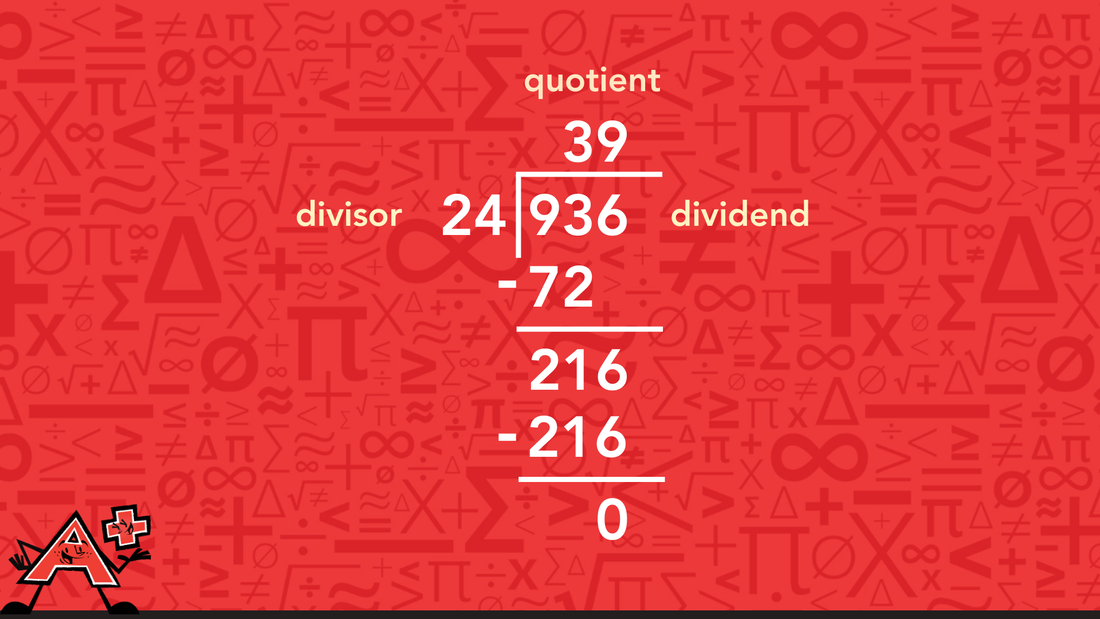
When we hear the word “long,” we usually think of something that takes a while. So, does the same idea apply to long division?
Not quite. The name refers to the written method, which lets us break a larger division problem into smaller calculations and record each step as we work.
We can then follow the calculation on the page instead of trying to keep track of all the numbers mentally.
Today, we’ll learn how to do long division step by step, see how to handle remainders and answer some common questions along the way.

Long division is a formal written method that breaks a division calculation into a series of smaller steps. We divide, multiply and subtract as we work through the calculation, recording our work underneath.
At our maths centres, we like to start with the “why” behind a method before getting into the steps. So, why do we use long division? It transforms a complex division problem into arithmetic tasks that are easy to solve and track step by step.
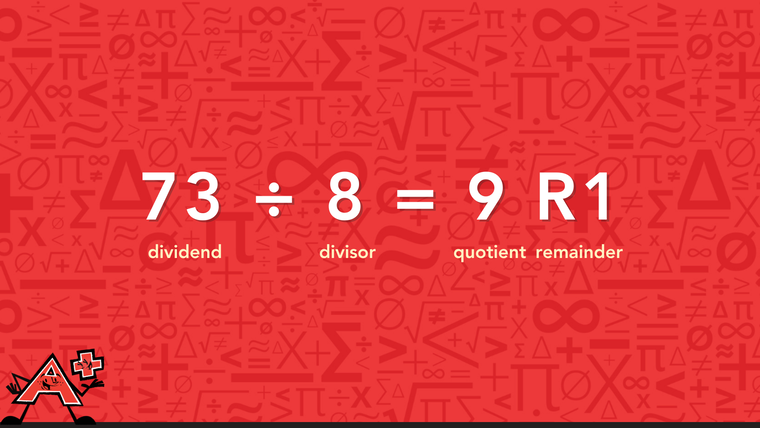
Before we start learning the method, let’s revisit some basic division vocabulary, using the example 73 ÷ 8 = 9 R1:
Dividend: Quantity being divided (73).
Divisor: Number we divide the dividend by (8).
Quotient: Result of the division (9).
Remainder (R): Amount left over when the division does not come out evenly (1).
Written division methods are taught across the UK, although each country organises its curriculum differently.
England is particularly specific about long division, with the National Curriculum for mathematics expecting Year 6 students to divide numbers of up to four digits by a two-digit whole number using formal long division and interpret remainders appropriately.
Scotland, Wales and Northern Ireland also develop division with larger numbers, but organise this learning through their own curriculum stages and progression frameworks.
📕 You May Also Like: Mathnasium #MathsTricks: Number Sense (Division Part 1)
Long division follows a set sequence of four steps that we repeat until the calculation is complete. Here’s how each one works:
Divide to find how many times the divisor fits into the number we are working with.
Multiply that number by the divisor.
Subtract the result to find what is left.
Bring down the next digit of the dividend to form the next number we will divide.
We follow the same method as we work through the dividend, bringing down the next digit whenever there is one. After the final subtraction, we either reach 0 or have a remainder left over.
For our step-by-step walkthrough, we’ll use a two-digit divisor and solve 1,435 ÷ 35.
Long division arranges the parts of the calculation in a written layout called the long division bracket (⟌). Place the dividend, 1,435, inside the bracket and the divisor, 35, outside it. We will write the quotient above as we work.
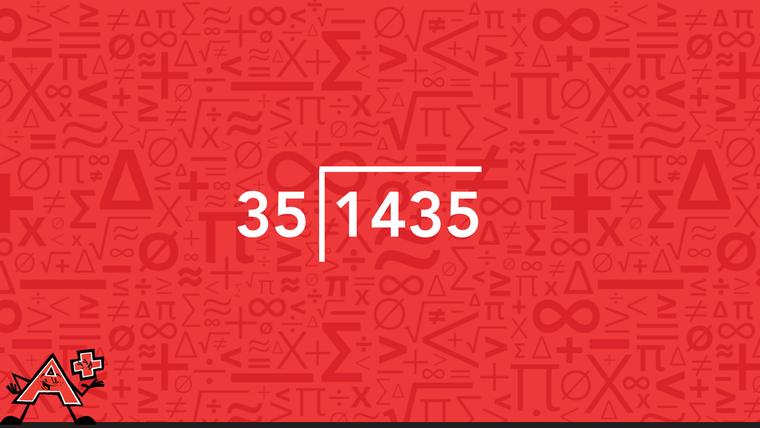
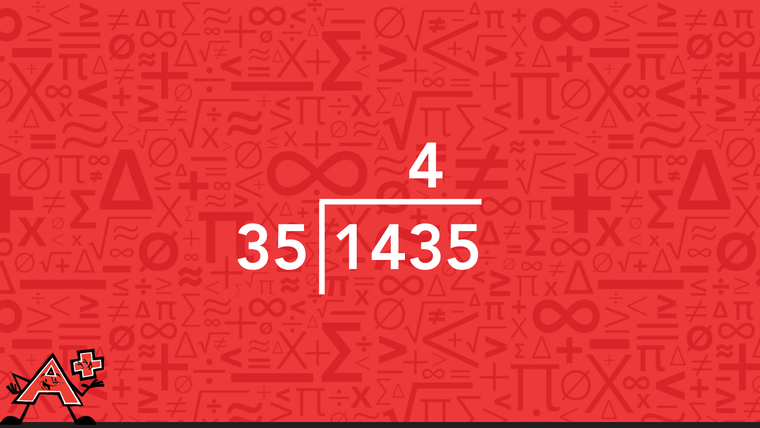
First, we need to divide 1,435 by 35, starting from the left. Since 35 does not go into 1 or 14, we divide 143 by 35. 35 goes into 143 four times.
We have reached the tens digit of the dividend, so the 4 represents 4 tens in the quotient. This is why we write 4 above the 3 in the tens place.
Next, we know that 143 contains four groups of 35. To find how much those four groups make altogether, we multiply 4 × 35 = 140.
We write 140 underneath 143, then subtract it from 143 to find what is left: 143 − 140 = 3.
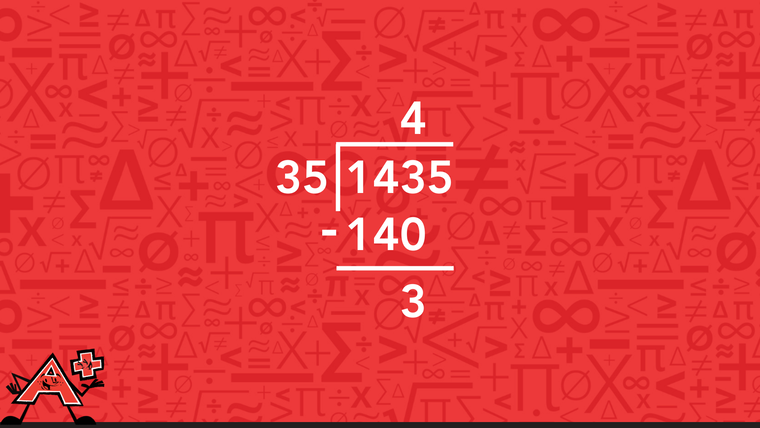
Now we bring down the next digit of the dividend, 5, beside the 3. This gives us 35 to divide next.
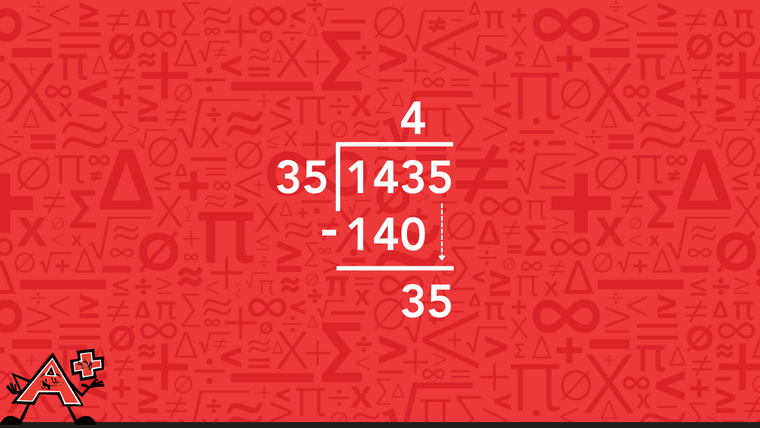
This time, 35 goes into 35 we got to in our previous step once, so we write 1 next to the 4 in the quotient at the top.
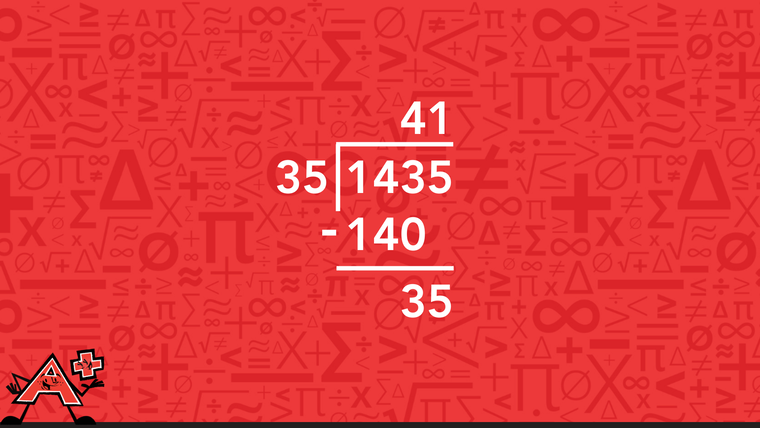
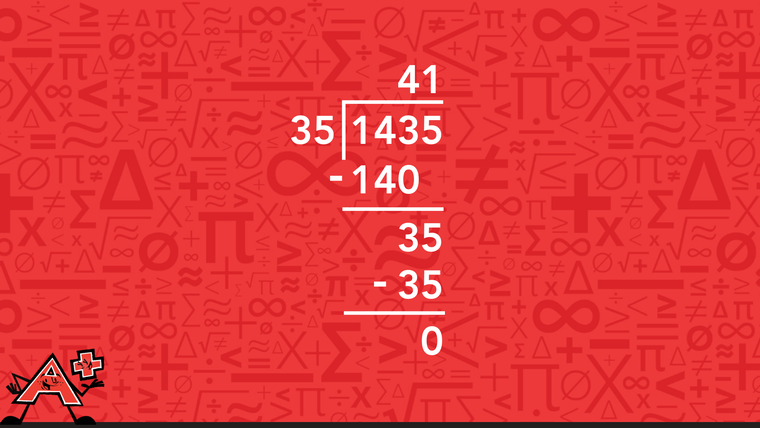
We multiply the 1 we added to the quotient by 35 to get 35. Then we subtract 35 from 35 to get 0. There are no more digits to bring down, so the calculation is complete and the quotient is 41.
So, 1,435 ÷ 35 = 41.
📕 You May Also Like: Mathnasium #MathsTricks: Number Sense (Division Part 2)
After we have worked through every digit of the dividend, if the final subtraction does not give us 0, we have a remainder.
We’ve already seen an example that divided evenly, so this time we’ll use the same divide, multiply, subtract and bring down steps to work through 583 ÷ 24 and see how they lead us to a remainder.
Place the dividend, 583, inside the long division bracket and the divisor, 24, outside it.
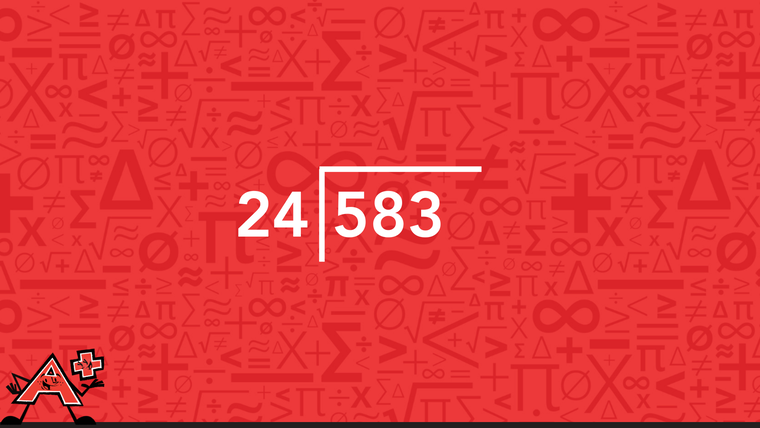
First, we need to divide 583 by 24, starting from the left. Since 24 does not go into 5, we divide 58 by 24. 24 goes into 58 twice.
We have reached the tens digit of the dividend, so the 2 represents 2 tens in the quotient. We write 2 above the 8, in the tens place.
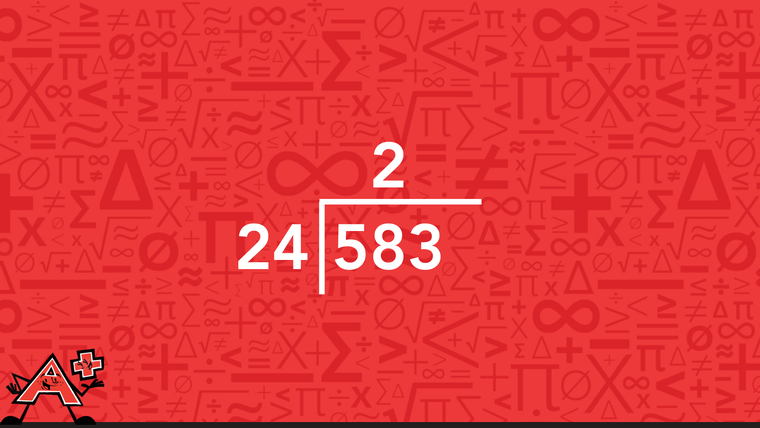
Next, we know that 58 contains two groups of 24. To find how much those two groups make altogether, we multiply 2 × 24 = 48.
We write 48 underneath 58, then subtract it from 58 to find what is left: 58 − 48 = 10.
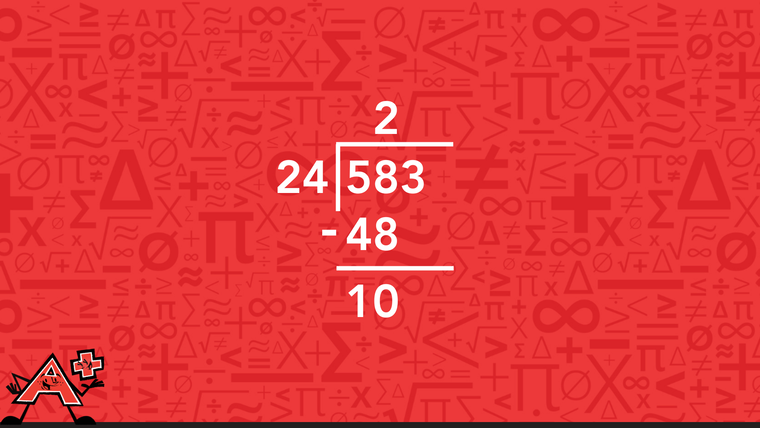
Now we bring down the next digit of the dividend, 3, beside the 10. This gives us 103 to divide next.
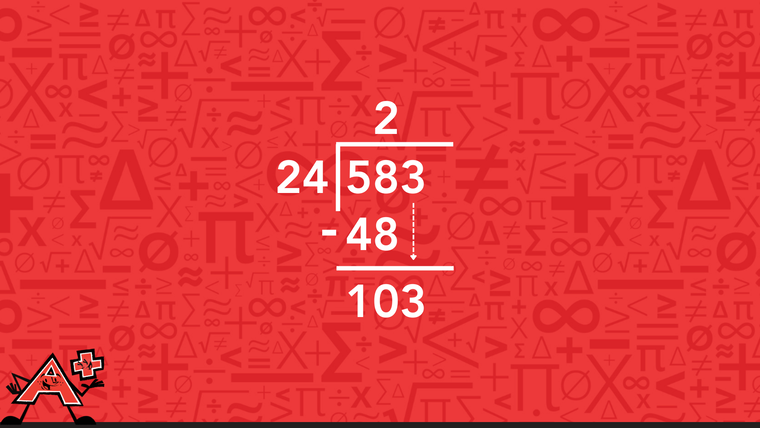
This time, 24 goes into 103 four times, so we write 4 next to the 2 in the quotient.
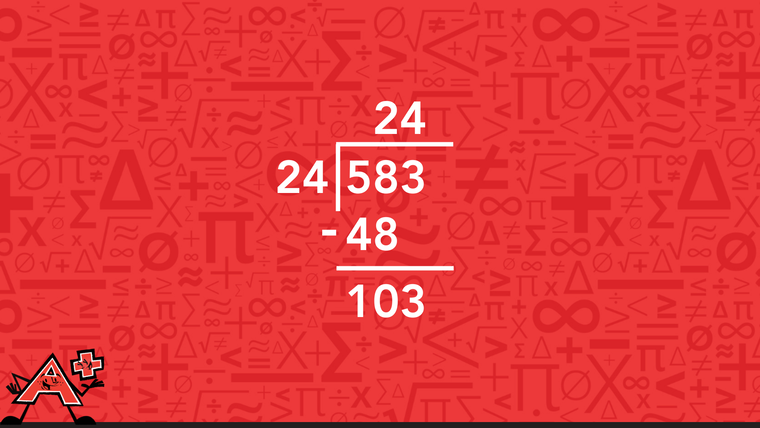
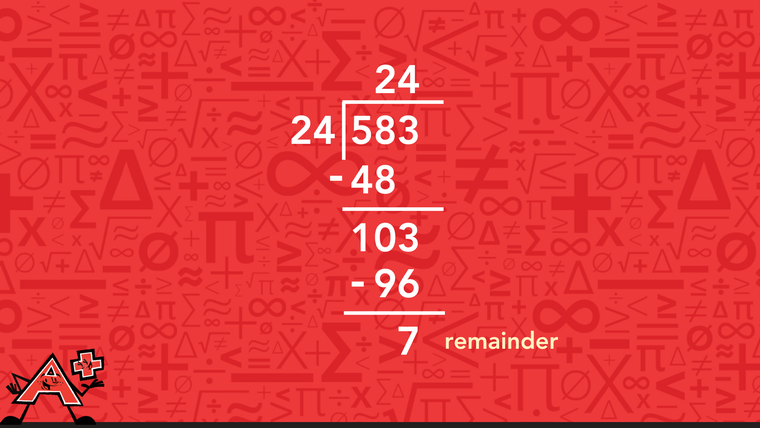
We multiply 4 by 24 to get 96. Then we subtract 96 from 103 to get 7.
There are no more digits to bring down, so 7 is our remainder. We write the answer as 583 ÷ 24 = 24 R7.
📕 You May Also Like: How to Help Your Child Through Their Maths Homework Without the Stress
Students usually make long division errors within one of the smaller calculations that make up the method. Let’s look at three trouble spots you may encounter as you work through a long division.
Incorrect multiplication or subtraction can change every step that follows. The National Foundation for Educational Research (NFER) found arithmetic errors to be particularly common in long division, with students more likely to struggle as the numbers involved became larger and the calculations more demanding.
So, the takeaway is to build a consistent check into each stage before carrying the numbers forward to the next step.
Every digit in the dividend needs to be included as we work from left to right. Students sometimes complete a subtraction and forget to bring down the next digit before continuing the division.
If 4,536 is the dividend and we have already worked with 453, the 6 still needs to be brought down before we can complete the calculation. Before you finish, check the original dividend to make sure you have used every digit.
A remainder must always be smaller than the divisor. If it is equal to or greater than the divisor, another whole group can still fit, so the quotient is not complete.
Suppose we divide by 5 and get a remainder of 7. Since 5 still fits into 7 once, 7 cannot be the final remainder. The quotient needs to increase before we record the remainder.
📕 You May Also Like: Mathnasium #MathsTricks: Divisibility (powers of 2)
We’ve worked through the method together, but you may still have some questions about long division. Let’s answer some of the most common ones.
Short division and long division are both written methods for dividing numbers, but the main difference is how much work we record on the page.
Short division usually involves less written work and is often used with one-digit divisors, such as 73 ÷ 8.
On the other hand, long division records each multiplication and subtraction step in more detail and is useful for larger calculations, including those with two-digit or larger divisors, like we’ve seen with 1,435 ÷ 35.
We can use multiplication to check a long division answer because multiplication and division are inverse operations. Division separates a quantity into equal groups, while multiplication can put those equal groups back together.
To check our answer, we multiply the quotient by the divisor and add the remainder, if there is one. We should arrive back at the original dividend.
For 583 ÷ 24 = 24 R7, we check:
24 × 24 + 7 = 583
We have returned to our original dividend, so the division is correct.
We write 0 in the quotient to hold the correct place value when the divisor does not fit into the number we are working with at that stage.
We can see this in 2,436 ÷ 12:
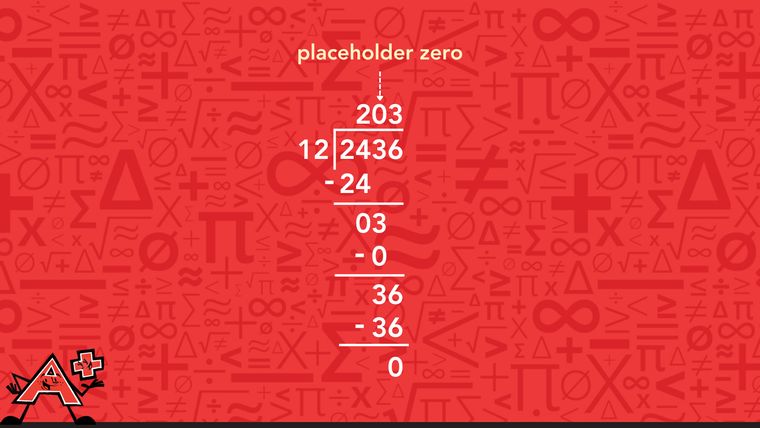
Here, the 0 sits in the tens place of the quotient because there are no tens in the answer. It keeps the 2 in the hundreds place and the 3 in the ones place, which gives us 203.
If we left the 0 out, we would get 23, which has a different value and gives an incorrect answer.
If the dividend is smaller than the divisor, the divisor cannot go into it even once as a whole number, so the quotient begins with 0. For example, in 3 ÷ 8, there are 0 whole groups of 8 with 3 remaining.
How we express the result depends on what the problem asks us to find. We can give the answer as 0 remainder 3, express the remainder as the fraction \(\Large\frac{3}{8}\) , or continue the division into decimal places.
If we continue dividing 3 ÷ 8, we eventually reach 0.375 and the division ends. We call 0.375 a terminating decimal because it has a finite number of decimal digits.
📕 You May Also Like: Mathnasium #MathsTricks: Divisibility (rule for 7's)
 At Mathnasium, we provide targeted instruction that helps students grow with confidence no matter where they start.
Mathnasium is a maths-only learning centre dedicated to helping students of all skill levels excel in maths.
Whether your child is learning long division, needs help with another maths topic or is ready for more challenging work, we can support them.
Our instructors break maths concepts down into clear, manageable steps so students can understand how they work and increase their knowledge gradually. To do so, we use the Mathnasium Method™, our proprietary teaching approach designed to build maths mastery through deep understanding.
Our approach includes:
Assessment and customised learning plans. Every student begins their time at Mathnasium with a diagnostic assessment that identifies their current skills, strengths and knowledge gaps. We use those insights to create a bespoke learning plan around their individual needs and goals.
Teaching for understanding. Our specially trained instructors use mental, verbal, visual, tactile and written techniques. Different ways of presenting a concept give students more than one path to understanding, whether they benefit from visual tools, hands-on activities or verbal explanations.
Face-to-face instruction. Students learn in a fun and supportive environment, working with instructors face-to-face at the pace that's right for them, both in-centre and online.
Confidence and engagement. Sessions include games, earned rewards, and consistent celebration of progress, so students actively participate, solve problems, and engage with maths instead of simply listening to a lesson. They build confidence alongside fluency and many develop a more positive relationship with maths over time.
The results show what this approach can achieve:
94% of parents report an improvement in their child's maths skills and understanding
93% of parents report their child's improved attitude towards maths after attending Mathnasium
90% of students saw an improvement in their school grades
With over 1,250 centres worldwide, including over 40 across the UK, there is likely a Mathnasium centre near you.
Whether your student is looking to catch up, keep up or get ahead in maths, your local Mathnasium centre can help.

Answer a few questions to see how it works
My Child is:


Mathnasium meets your child where they are and helps them with the customised program they need, for any level of mathematics.
We have over 1,100 centres and we're expanding rapidly in the UK. Get started now.