




















The First Half-Term Check-In: How Is Your Child Really Getting On With Maths?
Oct 23, 2026 |
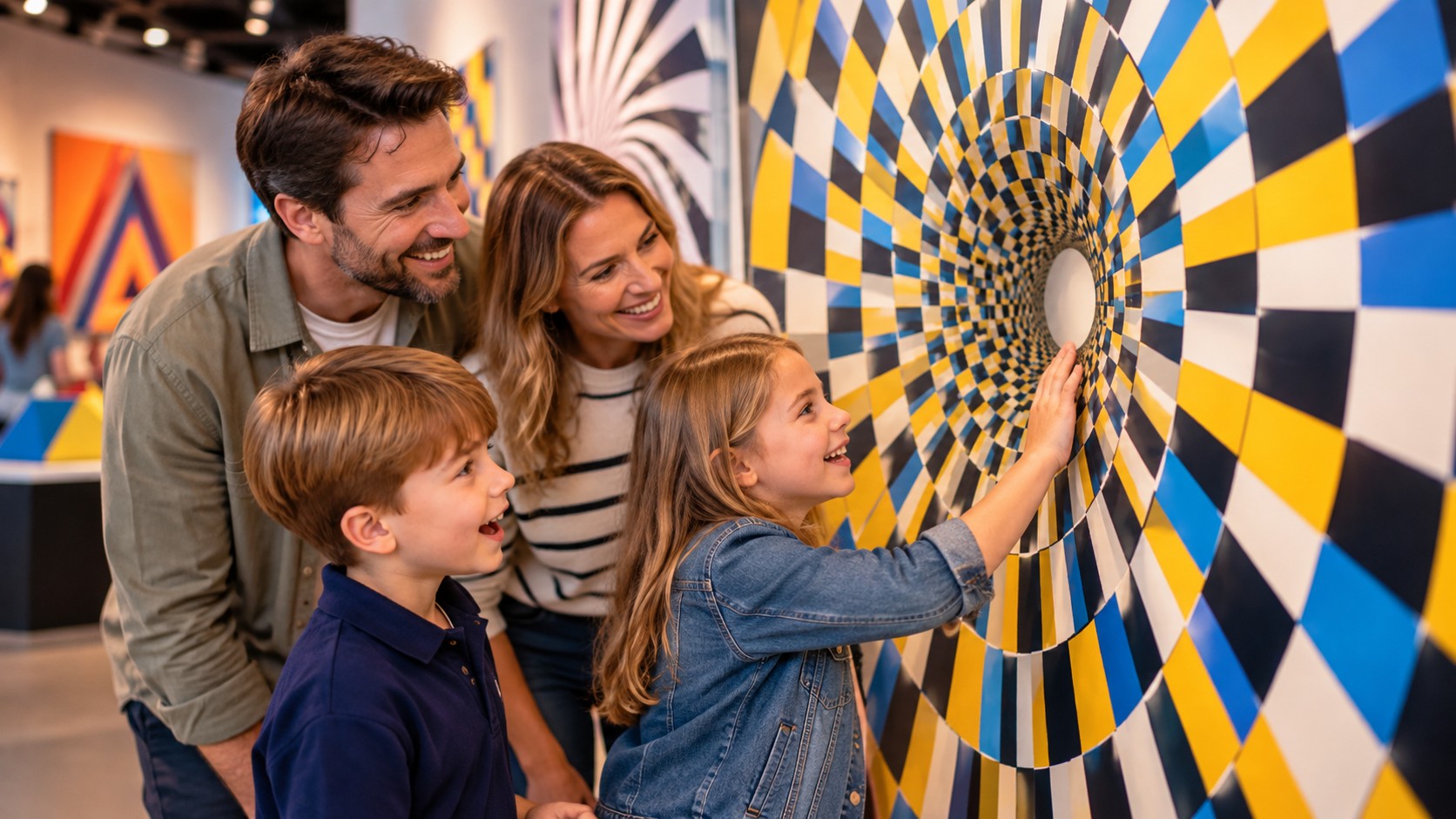
Have you ever looked at two lines the exact same length and been certain one was longer? Or watched someone appear to shrink as they walked across a room? Your eyes aren't lying to you, but they're not showing you the whole picture either. What you're actually looking at is maths: angles, ratios and perspective, all working together to trick your brain in wonderfully predictable ways.
It's exactly why we're excited to announce that Mathnasium UK has partnered with Twist Museum, London's original home of illusions. Developed in collaboration with artists and scientists, Twist offers over 80 fun hands-on exhibits designed to challenge the way we see the world around us. Visitors enjoy playing with optical illusions and learning together, going through immersive rooms and capturing the best mind-bending family photos.
As part of this partnership Families who enrol with Mathnasium during the promotional period will receive a free family ticket to Twist and existing Mathnasium families will get 20% off. But before you go, we thought we'd let you in on the secret: almost every illusion you'll see there is really a maths problem in disguise.
An optical illusion happens when your brain takes a shortcut. Millions of years of evolution have trained your visual system to make fast assumptions about depth, size and distance, assumptions that usually serve you well, but that certain shapes and arrangements can hijack. Strip away the artistry and most illusions come down to three mathematical ideas: angles, proportion and perspective.
1. The Ponzo Illusion - Draw two converging lines, like train tracks vanishing into the distance, then place two identical horizontal bars across them. The bar nearer the "vanishing point" will look longer, even though both are exactly the same length. Your brain is applying the rules of linear perspective the same maths an artist uses to make a flat painting look three-dimensional and concluding that the top bar must be further away and therefore actually bigger, to appear the same size on the page.
2. The Müller-Lyer Illusion - Two lines of identical length look different simply because of the arrowheads at their ends pointing inward makes a line look shorter, pointing outward makes it look longer. It's a simple trick of angles, but it's so consistent across cultures that researchers have used it to study how much our environment (lots of straight edged buildings, for most of us) shapes the way we judge geometry.
3. Forced Perspective (the "Ames Room" effect) - This is the illusion behind those famous photos where someone appears giant compared to a friend standing just a few feet away. The trick relies on a distorted, trapezoidal room built to a precise set of non-obvious angles and proportions, viewed from one exact spot. Get the geometry right, and the room looks like a normal rectangular space while the people inside it appear to be wildly different sizes.
One of our favourite illusions isn't really an optical illusion at all. It's a pure maths puzzle. Rearrange the same set of triangular and geometric pieces two different ways and one arrangement seems to have a square shaped hole that simply vanishes in the other, with no piece added or removed. Nothing is really missing; the shapes' edges aren't perfectly straight, so a tiny sliver of area is spread invisibly along a diagonal line each time the pieces move. It's a brilliant, hands-on example of how area, proportion and geometry can be hidden in plain sight.
At Mathnasium, we spend a lot of time helping children see that maths isn't just a subject in a workbook, it's a way of understanding the world around them. Optical illusions are one of the most engaging ways to prove that point. When a child works out why an illusion works, they're not just being entertained, they're reasoning about angles, ratios, proportion and spatial relationships, the same core ideas we build on in the centre every week.
That's what makes Twist such a natural partner for us. It's a museum built entirely around the idea that seeing differently and thinking mathematically go hand in hand, which is exactly what we aim for with every child who walks into a Mathnasium centre.
Experience our favorite illusions in real life at Twist Museum.
As part of our partnership:
[Book your free assessment with Mathnasium]
[Learn more about Twist Museum]
Is Twist Museum suitable for young children? Yes! Twist is designed as a hands-on, walk-through experience suitable for families with children of all ages, with plenty of interactive rooms to explore together.
What's the maths behind optical illusions? Most optical illusions rely on geometry and perspective, your brain making assumptions about angles, proportion and distance based on visual cues, which certain shapes and arrangements can exploit to create a mismatch between what's really there and what you perceive.
How do I claim my free Twist family ticket? New Mathnasium families who enrol during the Back to School promotional period will receive a unique redemption code by email, redeemable on the Twist Museum website.
Answer a few questions to see how it works
My Child is:


Mathnasium meets your child where they are and helps them with the customised program they need, for any level of mathematics.
We have over 1,100 centres and we're expanding rapidly in the UK. Get started now.