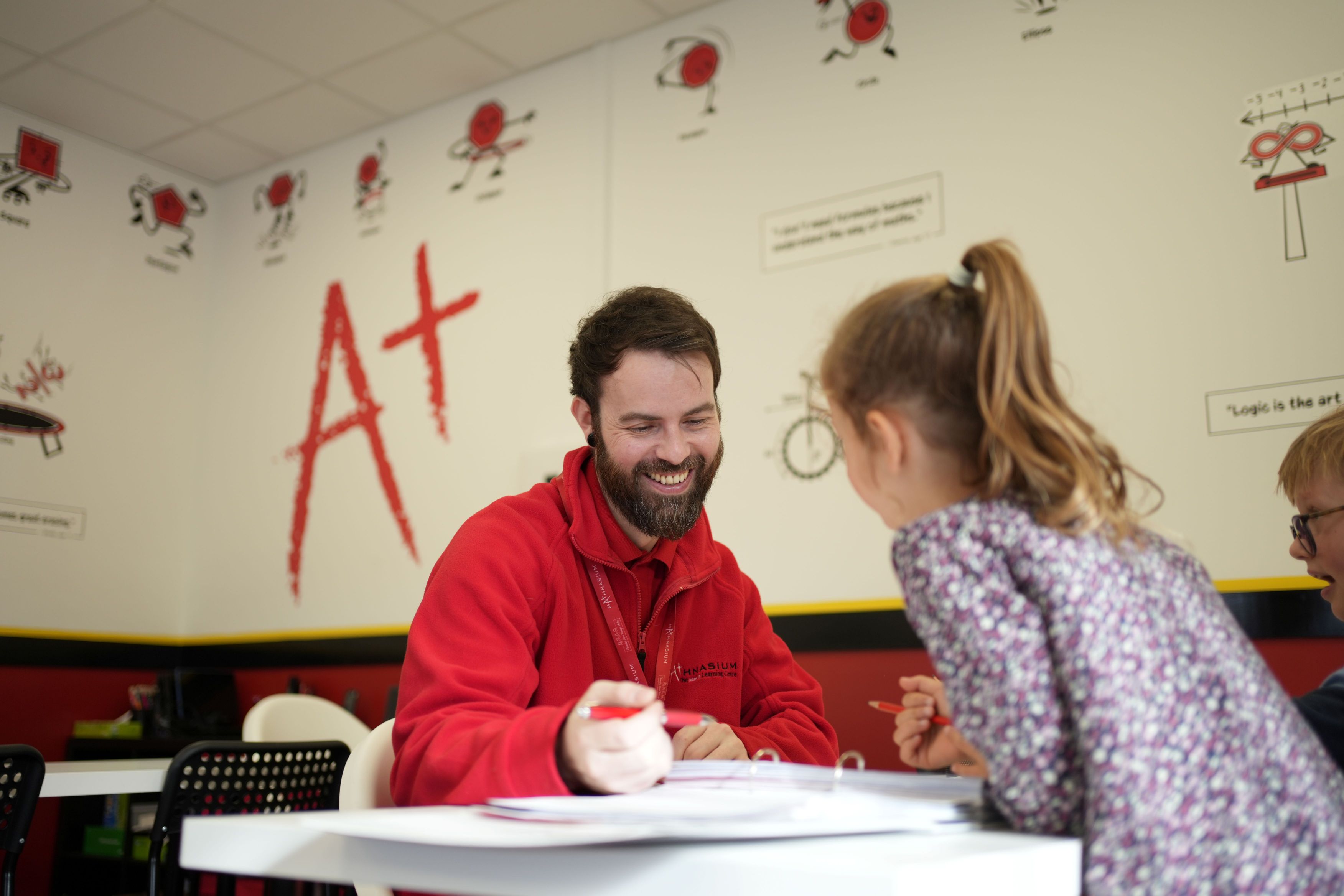
Finding the right maths tutor in Milton Keynes is one of those decisions that feels simple on the surface and complicated the moment you start looking into it. There are plenty of options available to local families: private tutors, online platforms, school catch-up programmes, homework clubs, and specialist maths centres. They vary enormously in how they work, what they cost, and most importantly, what they actually achieve for a child over time.
This guide is for any parent who's weighing up those options and trying to make sense of them. It looks honestly at what different types of maths support offer, what to look for when choosing, and why we believe the approach at Mathnasium of Milton Keynes East gives local children something most other options don't. If your child has been struggling to engage with maths at home, our guide on what to do when a child says "I hate maths" is also worth reading alongside this one.
What Milton Keynes Parents Are Usually Looking For?
More Than Just a Better Grade
Most parents who start looking for maths support aren't just chasing a number on a test. They want their child to stop dreading maths lessons. They want homework time to feel less like a battle. They want their child to arrive at the next stage of school, whether that's secondary, sixth form or beyond, with the foundations properly in place rather than patched together at the last minute.
That distinction matters, because it changes what you should be looking for in a maths support provider. A short-term boost in confidence before a test is useful. But a child who genuinely understands the material, at the level they're working at right now, is building something that compounds year on year.
The Risk of Starting Too Late
One of the most common things we hear from Milton Keynes parents is that they wish they'd started sooner. Maths is a subject where gaps accumulate quietly. A child who misses a concept in Year 4 may manage well enough for a while, relying on workarounds or memorisation, until a later topic exposes the gap and suddenly everything feels much harder. By that point, the gap is often two or three years old, and closing it takes longer than it would have done at the time.
The Education Endowment Foundation's research found that structured, regular tutoring can produce meaningful additional progress in maths, with children who received focused support making several months of additional progress compared to those who did not. The earlier that support begins, the more of those gains compound through school. National Numeracy
What the Different Types of Maths Support Actually Offer?
Private Tutors
Private tutoring is the option most Milton Keynes parents reach for first, and for good reason. A good private tutor offers flexibility, personalised attention, and a familiar face for a child who may feel self-conscious about their gaps. Quality varies considerably, however. A tutor who is strong at GCSE maths may not be experienced in teaching younger children, or in identifying where a child's foundational understanding has broken down rather than simply what topic they're stuck on.
The other practical consideration is continuity. Private tutors move, change jobs, take on other commitments, and aren't always available when your child needs them most, such as during revision periods or at short notice before an assessment. For some families this is manageable; for others it becomes a recurring disruption to the support their child relies on.
Online Platforms
The growth of online maths platforms over the past several years has given Milton Keynes families another option, often at a lower cost than in-person support. Many of these platforms are well designed and can be genuinely useful, particularly for children who are self-motivated and work well independently.
The limitation is that a screen cannot easily see when a child is confused. It can flag a wrong answer, but it can't always identify why it's wrong, which approach the child took, or which foundational concept they may be missing several levels back. EEF research into adaptive online tutoring found that personalised learning pathways and real-time feedback do have the potential to improve maths attainment, but the evidence is strongest when a human element remains involved in monitoring progress and adapting the approach.
School Catch-Up Programmes
Many Milton Keynes schools offer some form of maths intervention, particularly for children who are falling behind in a specific year group. These programmes are valuable, and parents should absolutely engage with them when they're available. Their scope is necessarily limited, however: they are designed to bring a child up to the expected level for their year, not to go deeper into understanding, not to stretch a child who could be doing more, and not to carry a child consistently through every stage of school.
School-based support is reactive, stepping in when a gap becomes visible. It's a safety net, and a necessary one, but it's not the same as the proactive, ongoing investment in your child's maths development that changes their relationship with the subject altogether.
What to Look for When Choosing Maths Support in Milton Keynes
Before committing to any form of support for your child, it's worth asking a handful of questions that will quickly separate options that look similar on the surface.
Does It Start With a Proper Assessment?
Any provider worth considering should identify exactly where your child's understanding sits before prescribing any approach. Not just what year group they're in, but where specifically their knowledge is secure and where it isn't.
Is the Plan Built Around Your Child, or Around a Fixed Curriculum?
A child working through a pre-determined syllabus at a pace set by someone else isn't receiving personalised support: they're receiving a slightly smaller class. The two are very different things.
Does It Build Understanding, or Just Practice?
Drilling a child on past papers improves familiarity with exam formats. It doesn't close a conceptual gap. The Education Endowment Foundation consistently distinguishes between approaches that build deep understanding of concepts and those that focus on surface-level practice, and the evidence firmly favours the former for lasting improvement.
Is the Support Consistent and Ongoing?
Progress in maths is cumulative. A child who attends sessions inconsistently, or who moves between providers every year, will always be starting again rather than building forward.
Is the Focus Exclusively on Maths?
Providers who cover maths alongside English, science and other subjects are useful in some contexts, but maths-specific expertise, training, and curriculum design are different from general tutoring competence.
Why the Mathnasium Approach Is Different
It Starts With Understanding, Not Assumptions
Every child who joins Mathnasium of Milton Keynes East begins with a full diagnostic assessment. This isn't a quick test to see which year group they belong in. It's a careful process designed to map exactly what a child already knows, where the gaps are, and how they approach problems, so that their learning plan starts in precisely the right place.
As the Mathnasium Method describes it, the goal is to build from what a child already knows, address the gaps in sequence, and then expand their mathematical thinking progressively. That sequencing is critical, because maths gaps don't exist in isolation: they sit in a chain of understanding, and closing them in the right order is what makes the difference.
It's Personalised in the True Sense of the Word
The learning plan created after assessment is specific to your child. It evolves as they progress, and sessions are paced around where they are, not around a schedule designed for an average student at their year level. The Mathnasium Method combines personalised learning plans with mental, verbal, visual, tactile, and written techniques, building maths knowledge level by level. For children who struggle in a conventional classroom setting, having a range of ways to approach the same concept is often what finally makes it click. Loughborough University
It's Maths, and Only Maths
Mathnasium is a specialist maths centre. Our instructors are trained specifically in mathematics teaching, and every element of what we do, the curriculum, the assessment tools, the teaching techniques, is designed for maths and nothing else. That focus means the expertise in our centre is deep rather than broad, and your child's time with us is never diluted by a generalist approach.
It Builds Confidence Alongside Capability
The National Numeracy charity has consistently highlighted that maths confidence and maths ability are closely linked: children who feel capable approach problems differently, persist longer, and make faster progress than those who approach every question expecting to fail. Mathnasium's approach is designed to make that shift happen. Children come in believing they're "not a maths person," and leave with a fundamentally different view of what they can do with numbers.
It Works Across the Whole of School
We work with children from age 4 through to 16, which means we're not just a resource for a particular exam or a particular crisis point. A child who starts with us in Year 2 builds on that foundation all the way through primary school and into secondary, with a learning plan that adapts at every stage. That continuity, one centre and one trusted approach across the entirety of a child's school career, is genuinely rare among maths support providers in Milton Keynes.
It Sits Alongside School, Not Instead of It
The Department for Education and Ofsted both emphasise the importance of children developing fluency and deep understanding in mathematics, consistent with what Mathnasium's method is designed to deliver. We don't replace school: we reinforce and extend what school is doing, filling the gaps that classroom time can't always address, and building the conceptual fluency that makes future learning easier.
For Milton Keynes Families: What This Looks Like in Practice
Our centre is based at Unit 13a Bodmin Place, Broughton Gate, Milton Keynes MK10 7DP, within easy reach of families across Milton Keynes. Sessions are structured around what works for your family, with the frequency and timing of attendance built into your child's personalised plan from the start.
Whether your child is in Year 1 and just beginning to develop a relationship with numbers, in Year 6 working on core concepts, or in Year 9 needing to shore up the foundations before GCSE content accelerates, the first step is always the same: a free assessment that tells us, and you, exactly where to begin.
GCSE maths help and 11+ prep are two areas where families often approach us, and we're well placed to help with both. But they're examples of what we do within a much broader purpose, which is building children's mathematical confidence and capability right across their school years.
The Bottom Line
There is no shortage of maths support in Milton Keynes. The question is never simply whether a child is getting some support, but whether the support they're getting is actually addressing the right things, in the right order, with enough consistency to make a lasting difference.
The Mathnasium approach is built specifically to answer that question. A proper diagnosis, a plan that's genuinely personal, a specialist focus on maths, and a programme that grows with your child from Reception to Year 11. That's what we offer at Mathnasium Milton Keynes East, and it's why we believe it stands apart from the alternatives available to families across Milton Keynes.
Frequently Asked Questions About Maths Support in Milton Keynes
What Age Does Mathnasium of Milton Keynes East Work With?
We work with children from age 4 through to 16, covering primary, secondary, and everything in between.
How Is Mathnasium Different From a Private Tutor?
Mathnasium uses a structured diagnostic assessment to build a fully personalised learning plan for each child. Unlike many private tutors, our instructors are specifically trained in the Mathnasium Method, and sessions are delivered in a dedicated maths learning environment with a consistent, proven approach.
Where Is Mathnasium of Milton Keynes East Located?
Our centre is at Unit 13a Bodmin Place, Broughton Gate, Milton Keynes MK10 7DP, easy to reach for families across the Milton Keynes area.
How Do I Get Started?
Book a free assessment by calling 01908 990 005 or visiting our centre. The assessment is the first step and carries no obligation.
Does Mathnasium Help With SATS Preparation and GCSE Maths?
Yes. We offer focused SATS prep and GCSE maths help as part of personalised learning plans, alongside general maths confidence building at every stage of school.
Book a Free Assessment Today
The best way to understand what Mathnasium can do for your child is to start with a free assessment at Mathnasium of Milton Keynes East. There's no commitment involved, and you'll come away with a clear picture of exactly where your child's maths understanding stands and what would help them most. Call us on 01908 990 005 or visit us at Unit 13a Bodmin Place, Broughton Gate, MK10 7DP.


 01908 990 005
 07572660137