One-step equations introduce students to finding an unknown value using an inverse operation. Two-step equations add another operation to undo, while multi-step equations involve more work down the road. The central idea stays the same, which is to keep both sides equal while isolating the variable.
At Mathnasium, we hear our students ask these questions often:
-
Which operation do we undo first?
-
Why do we need to apply it to both sides?
-
How can we tell whether the answer is correct?
With that in mind, our tutors created this guide to help students understand one-step and two-step equations. We’ll walk you through worked examples and explain common mistakes to watch for. In this guide, we also included equation practice for you to try on your own.

Quick Review: What Is an Equation?
In math, an equation is a statement that says two expressions have the same value. The equals sign (=) separates the equation into a left and a right side. Let’s look at a simple example:
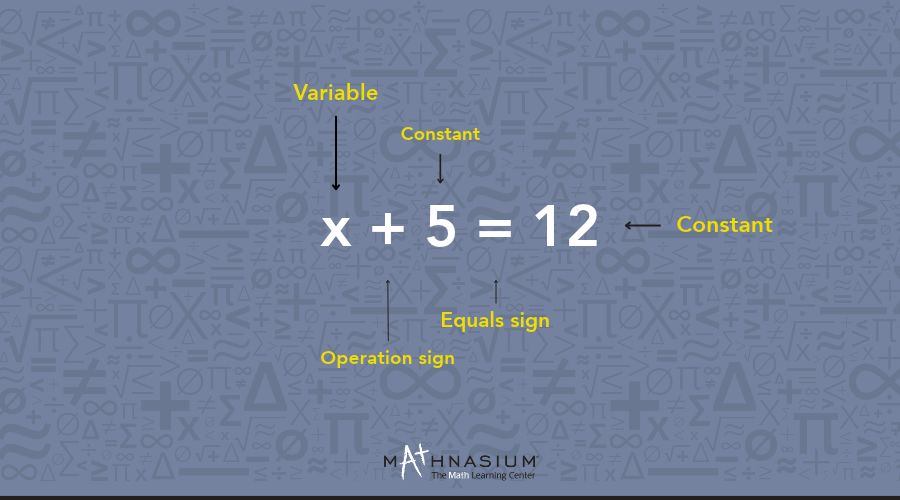
In this equation, each part tells us something about it:
-
The variable (x) represents the unknown value we want to find. In equations, a variable can be any other letter (a, b, c, y, z, etc.)
-
The constants (5 and 12) are fixed numbers. Unlike variables, constants stay as they are.
-
The operation sign (+) tells us what happens on the left side of the equation. The plus sign, in this case, sets the steps for solving this equation.
-
The equals sign states that the left side, x + 5, has the same value as the right side, 12.
This example illustrates one-step equations because it takes one step to isolate x. On the other hand, a two-step equation, such as 3x + 5 = 20 takes one additional step.
In this second example, we can see an additional element. Can you spot it? The number 3 is the coefficient of x. It multiplies the variable, so 3x means 3 times x. The numbers 5 and 20 are still constants, and the equals sign still tells us that both sides have the same value.

How to Solve One-Step and Two-Step Equations
While one- and two-step equations follow the same logic, the two-step ones add another step. Let’s work through a one-step equation first, then a two-step one. We’ll explain each step and show how to check the answer.
Example 1: Solve a One-Step Equation With Addition
Let’s find the value of x in x + 8 = 19. We need to leave x on its own while keeping both sides equal. Before we do the actual step, we need to identify the operation on the left side and decide which inverse operation we need to perform to isolate the variable.
As we can see, the equation adds 8 to x. To undo that addition, we need to do subtraction, as it’s the inverse operation to addition. So, we subtract 8 from both sides. Remember, we are keeping both sides equal.
-
x + 8 − 8 = 19 − 8
-
x = 11
With subtraction applied to both sides, we isolate the variable and get our answer, which is 11.
In case we want to check whether we solved the equation properly, we can plug the answer (11) back into the original equation.
As both sides have the same value, x = 11 is the correct solution.
📕 You May Also Like: What Are Inverse Operations? A Complete Overview
Example 2: Solve a One-Step Equation With Multiplication
Let’s now solve 4y = 28. Before we start, we need to mention that coefficients are also present in one-step equations such as this one.
Do we notice anything else here? Our variable is now y instead of x.
As with the previous example, we first identify the operation on the left side. We know that 4y is the same as 4 times y. So, we are dealing with multiplication here. What undoes multiplication? It’s division.
Let’s divide each side by 4 so that the two sides remain equal.
The division helped us isolate the variable y, and the right side becomes 7, which is the answer we were looking for.
To check our work, we substitute 7 for y in the equation we started with:
With both sides balanced, we did a great job.
📕 You May Also Like: How to Solve Basic Equations — A Parent and Student Guide
Example 3: Solve a Two-Step Equation With Subtraction and Multiplication
Let’s move on to a two-step equation: 5y − 7= 33.
As we can see, there are two operations here instead of one, so we’ll need an additional step to isolate the variable and solve the equation.
In 5y − 7, y is multiplied by 5, and then 7 is subtracted. We undo these operations in the reverse order, which means we start with subtraction. Its inverse operation is addition.
Step 1: Undo Addition or Subtraction
Then, we add 7 to each side to keep the equation balanced:
-
5y − 7 + 7 = 33 + 7
-
5y = 40
The subtraction is undone. We still have multiplication on the left (5 times y) and 40 on the right. To undo it, we choose division.
Step 2: Undo Multiplication or Division
Let’s divide both sides by 5:
The variable is on its own, and our answer is 8.
The way we check our work doesn’t change here. We just plug the 8 back in and calculate:
-
5 × 8 − 7 = 33
-
40 − 7 = 33
-
33 = 33
As both sides have the same value, that tells us y=8 is the correct solution.
📕 You May Also Like: How to Solve Two-Step Equations Using the Undo Method
Example 4: Solve a Two-Step Equation With Addition and Division
For our final example, we’ll solve \(\Large\frac{x}{3}\) + 4 = 10.
In comparison to the previous two-step equation example, the operations have changed, but we can follow the same steps as before.
Before we do the actual first step, we need to analyze what we have in front of us. The operations on the left are division and addition. We’ll then go in reverse and start with the 4 added to \(\Large\frac{x}{3}\). Subtraction undoes addition.
Step 1: Undo Addition or Subtraction
We always want to keep the equation balanced so the subtraction applies to both sides.
In our current equation, the fraction bar means division. To undo this division, we need to multiply.
Step 2: Undo Multiplication or Division
We multiply both sides by 3.
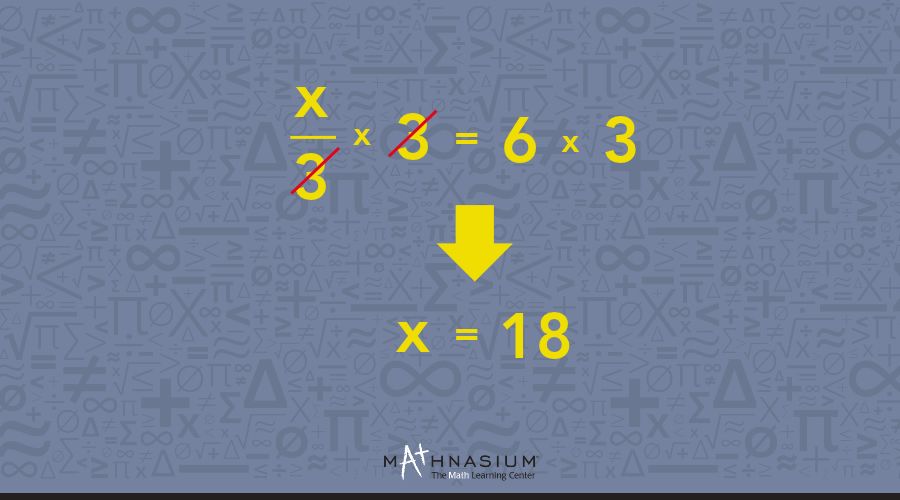
This leaves x on its own with the value of 18.
The final thing we can do here is to confirm whether 18 makes our original equation true. We put 18 back into the original equation and calculate.
As both sides equal 10, that confirms that our work and answer are correct.
📕 You May Also Like: What Is a Fraction as Division? A Kid-Friendly Guide
Practice Time! Check Your Knowledge of One- and Two-Step Equations
It’s your turn now. Give these one- and two-step equations a go and check the answers at the bottom of the guide.
Example 1: x − 9 = 7
Example 2: \(\Large\frac{y}{4}\) = 3
Example 3: 5x = 3
Example 4: \(\Large\frac{y}{2}\) + 6 = 13
Example 5: 3x + 8 = −4
Example 6: 4y− 3 = 2
3 Common Mistakes When Solving One-Step and Two-Step Equations
Mistakes are part of the learning process!
With that in mind, let’s look at a few common mistakes to keep in mind as you’re solving one- and two-step equations.
1. Applying an Operation to Only One Side
Let’s say we’re solving x + 6 = 15. If we subtract 6 from the left but leave the right unchanged, we get x = 15. If we plug 15 back into the original equation, we get:
The two sides are no longer equal.
Whatever operation we apply, it must keep both sides equal.
📕 You May Also Like: Properties of Equality: How They Help Us Solve Equations
2. Using the Wrong Inverse Operation
In this equation (x − 8 = 13), we have subtraction. If we, by any chance, subtract 8 instead of adding, we get:
-
x − 8 − 8 = 13 − 8
-
x − 8 − 8 = 5
-
x − 16 = 5
This does not cancel the -8 on the left and instead gives us -16. What we need to do instead is add 8 to both sides.
3. Losing a Negative Sign
Let’s look at x + 7 = –6. Students may overlook the negative sign and calculate 6−7, which gives −1. The calculation starts at −6, rather than positive 6, so subtracting 7 goes seven more units below zero
-
x + 7 − 7 = –6 − 7
-
x = –13
We can check the work by substituting −13 into the original equation:
–13 + 7 = –6
–6 = –6
 At our centers, we use personalized learning plans and proven teaching techniques to help students master solving one- and two-step equations and math beyond with confidence.
How Mathnasium Helps Students Master One- and Two-Step Equations (and Any Other Math Topic)
Mathnasium is a math-only learning center dedicated to helping K–12 students of all skill levels learn and master math.
For each math topic, we help students understand how the math works instead of treating it as a separate set of rules to memorize. With one- and two-step equations, in particular, we explain how and why each operation works and how applying it to both sides keeps the equation balanced.
To help students build that kind of understanding, we use the Mathnasium Method™, our proprietary teaching approach, to meet students exactly where they are and guide them forward step by step.
Each student begins their Mathnasium journey with a diagnostic assessment that gives us a clear picture of their current skill level, potential knowledge gaps, goals, and how they think and feel about math.
With the help of these insights, we create a personalized learning plan focused on the skills the student needs most, whether that means more practice with inverse operations or support with keeping both sides of an equation balanced.
Our specially trained tutors follow the plan closely and provide live, face-to-face instruction in a caring and fun group environment. They use mental, verbal, visual, tactile, and written techniques to help students understand each step in solving both one- and two-step equations and why it works.
Before tutors step in, students get room to think through problems. Tutors guide them through the reasoning, which helps them build critical thinking, problem-solving skills, and greater independence they need both in the classroom and beyond.
Fun is an important part of how we work. Sessions often include game-based and hands-on activities that keep students engaged and make learning more enjoyable. Students earn rewards along the way, and we celebrate every bit of progress, so confidence grows alongside mastery.
The results speak for themselves:
-
94% of parents report an improvement in their child's math skills and understanding
-
93% of parents report their child's improved attitude toward math after attending Mathnasium
-
90% of students saw an improvement in their school grades
With over 1,200 learning centers, Mathnasium brings top-rated math instruction close to your community.
For families in and around Denver, Mathnasium of Denver Highland is a trusted local center with years of experience helping students build the math skills and confidence they need to succeed at every grade level.
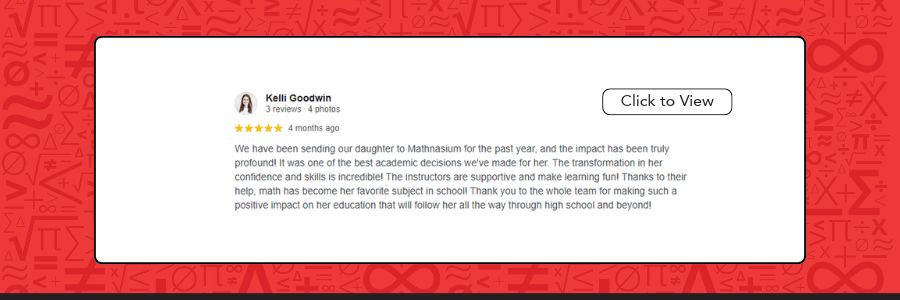
Here’s what one Denver parent shared about their experience with Mathnasium:
If your child needs support with equations (one- or two-step or both) or any other math topic, a free diagnostic assessment is a great place to start. From what we learn, we create a personalized learning plan that helps your child master the current math topic and sharpen the skills they need next.
📅 Schedule a Free Assessment at Mathnasium of Denver Highland
Not located near Denver?
📍 Find a Mathnasium Learning Center Near You
Psst! Check Your Answers Here
Here are the answers to the practice examples.
Example 1: x = 16
Example 2: y = 12
Example 3: x = \(\Large\frac{3}{5}\)
Example 4: y = 14
Example 5: x = −4
Example 6: y = \(\Large\frac{5}{4}\)
How did you do?


 (720) 524-4763
 (720) 524-4763