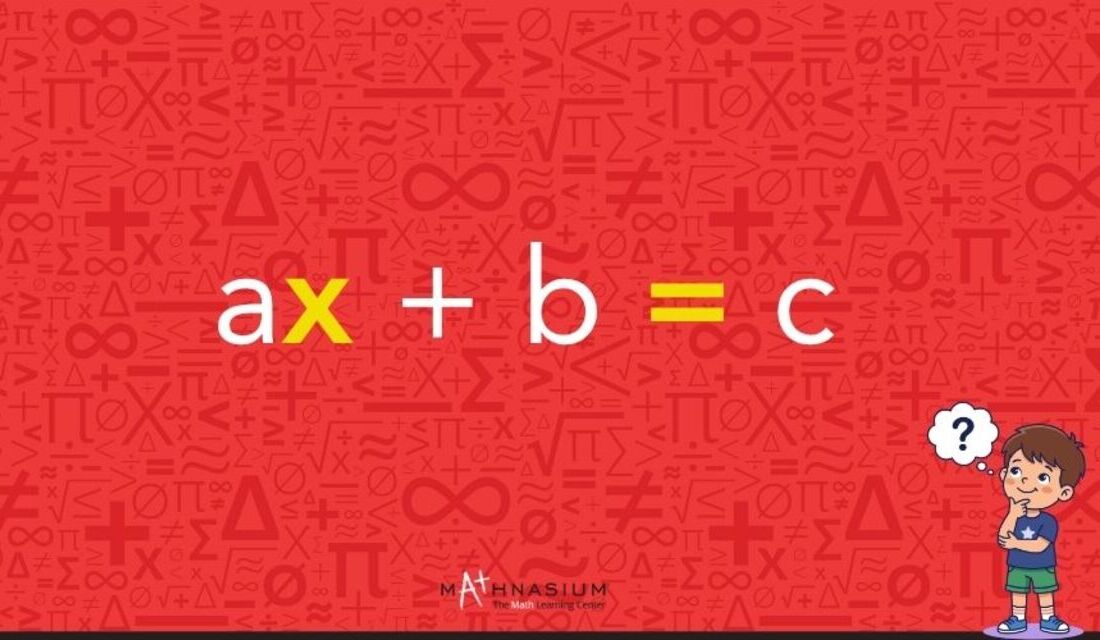
Algebraic mastery develops one step at a time. If one-step equations are the foundation, two-step equations are the first real test of a student's algebraic toolkit.
These problems require both inverse operations and strategic thinking, teaching students how to unpack equations rather than memorizing steps blindly.
Today, our Mathnasium tutors will explain what two-step equations are, show how to solve any two-step equation, and work through practical examples.

What Are Two-Step Equations?
Two-step equations are algebraic equations where we need exactly two mathematical operations to isolate the variable and find the missing value.
The two operations can pair up in several ways, which changes how the equation looks.
Let’s look at some examples and name the operations in each form:
-
3x + 5 = 17, uses multiplication (3x) and addition (+ 5)
-
\(\Large\frac{y}{2}\) − 4 = 6, uses division (\(\Large\frac{y}{2}\)) and subtraction (− 4)
-
2 (x + 3) = 14, uses addition (x + 3) and multiplication (the 2 outside the parentheses)
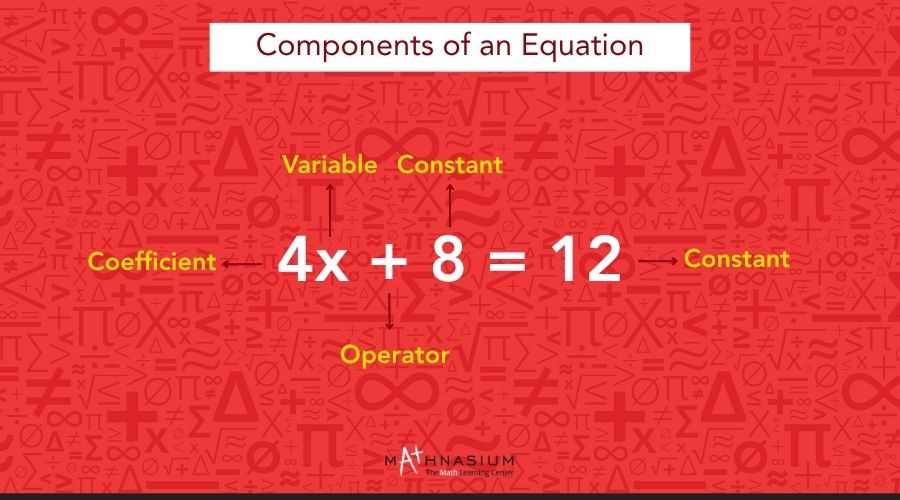
The forms above look a bit different, yet each one contains the same foundational components. They all work together across the equal sign, and each plays its own role in the equation.
-
A variable is the unknown letter (like x or y) that we need to solve for.
-
A coefficient is the number attached directly to the variable that multiplies or divides it.
-
Constants are the fixed numbers that stand alone.
-
Operators are the mathematical signs (such as +, −, ×, or ÷) that show which operation to perform.
We left the equal sign on purpose because it deserves a closer look.
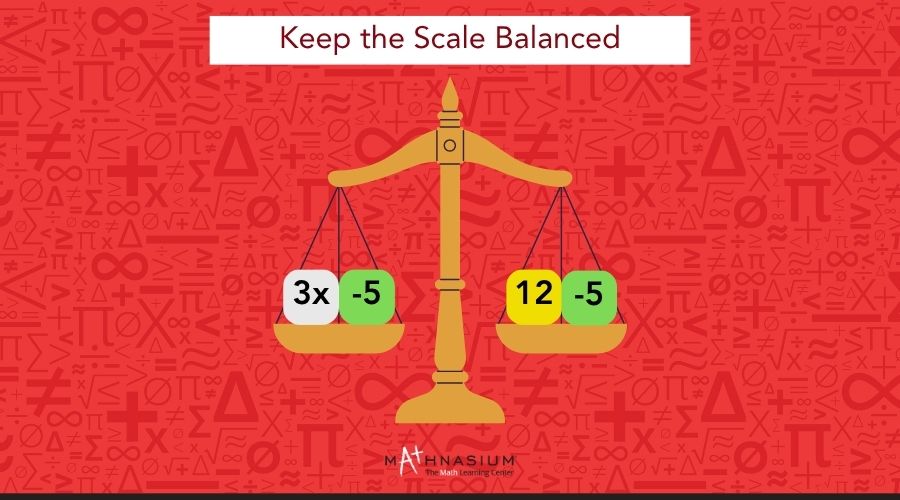
At Mathnasium, we like to say that at the heart of any equation is an equal sign, which acts like a balance scale.
So, what do we mean by that?
Both sides must always stay equal in any equation, which means whatever we do on one side, we must also do the same on the other, or the scale tips.
If, for example, we decide to subtract 5 from the left side of the equal sign, we need to do it on the right, too, to keep the equation balanced.
Now that we know the pieces and how the scale works, let’s dig deeper into how to solve any two-step equation.

How to Solve Any Two-Step Equation
To solve any two-step equation, we need to undo its two operations one at a time until the variable stands alone.
So how do we do that?
The first thing we need to know is that each operation has an inverse operation that undoes it.
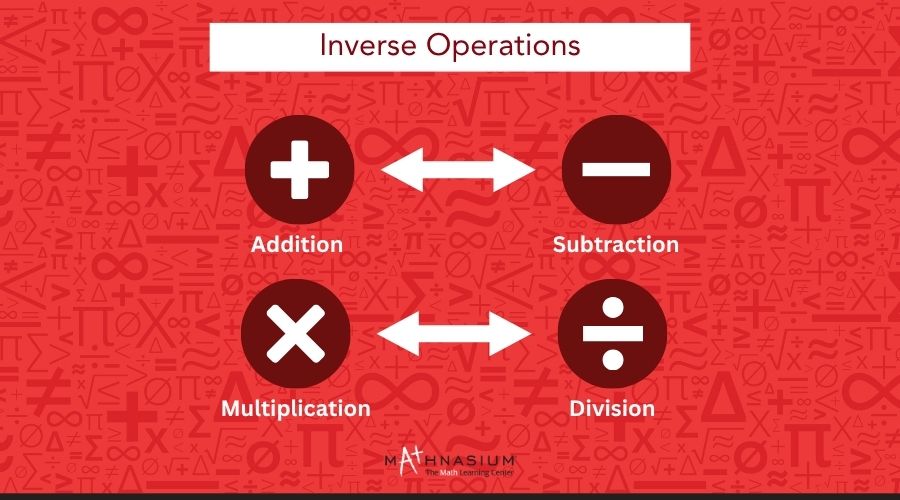
In a two-step equation like 4x − 7 = 21, we have multiplication (4x) and subtraction (− 7), so we need to undo both with their inverse operations.
But which one do we undo first?
We can find that out by using PEMDAS in reverse. When we evaluate 4x − 7 = 21, the order of operations tells us that multiplication comes before subtraction here.
So, when we reverse that order, we need to undo subtraction first by applying addition to both sides of the equation.
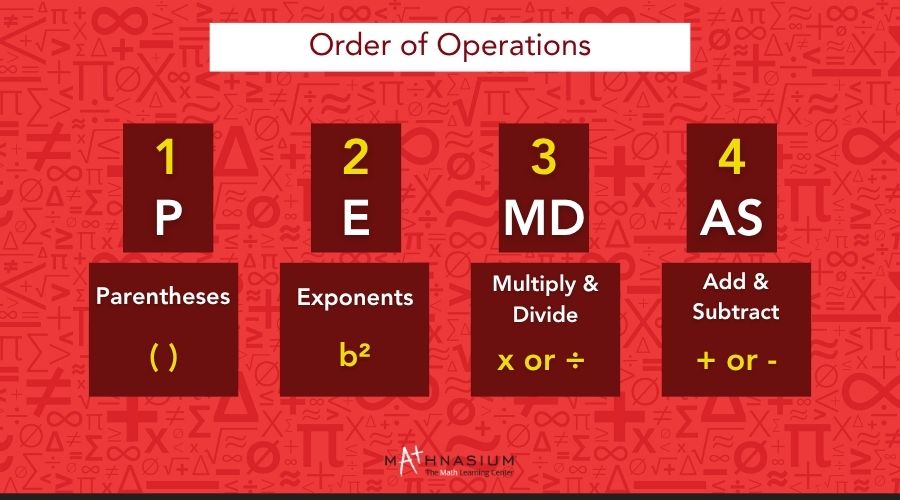
Let’s do exactly that.
If we add 7 to both sides, we’ll get:
4x − 7 + 7 = 21 + 7
4x = 28
Now we are left with multiplication only, and we can undo it by applying division to both sides to isolate the variable:
4x ÷ 4 = 28 ÷ 4
x = 7
Let’s substitute x = 7 back into the original equation to check if we did this correctly.
4 (7) − 7 = 21
28 − 7 = 21
21 = 21
Both sides match, so x = 7 is correct.
So, to solve any two-step equation, we can follow these steps:
-
Identify the two operations in the equation.
-
Use PEMDAS in reverse to decide which operation to undo first.
-
Apply the inverse operation to both sides to undo the first operation.
-
Apply the inverse operation to both sides again to isolate the variable.
📕 You May Also Like: How to Solve One-Step Equations: A Step-by-Step Guide
Worked Examples: Two-Step Equations
Our tutors have noticed that a few specific types of two-step equations tend to trip students up, so we will tackle those together next. We can apply the same steps we established today to every one of them.
Let’s dig right in.
Example 1: Variable on the Right Side
In 23 = 3x + 8, the variable sits on the right side of the equal sign. This layout can throw students off, since we expect to see the variable on the left.
Let’s remember our balanced scale. Both sides hold the exact same weight, so we can switch them and the scale stays level.
That means 23 = 3x + 8 says the same thing as 3x + 8 = 23, and now we can follow our steps as usual.
Step 1: Identify the operations
In 3x + 8 = 23, we have multiplication (3x) and addition (+ 8).
Step 2: Use PEMDAS in reverse
Since we are working backward from PEMDAS, we need to undo the addition first.
Step 3: Undo the addition
To undo the addition, we subtract 8 from both sides:
3x + 8 − 8 = 23 − 8
3x = 15
Step 4: Undo the multiplication
Now, we just divide both sides by 3 to isolate the variable:
3x ÷ 3 = 15 ÷ 3
x = 5
📕 You May Also Like: What Is a Variable in Math? A Complete Overview
Example 2: Negative Coefficient
In − 2x + 7 = 1, the coefficient of x is negative.
The negative sign belongs to the 2, so the variable is multiplied by − 2. Students can sometimes forget to apply the negative sign when they use the inverse operation of multiplying or dividing.
Step 1: Identify the operations
In − 2x + 7 = 1, we have multiplication (− 2x) and addition (+ 7).
Step 2: Use PEMDAS in reverse
Since multiplication comes before addition, working backward means we undo the addition first.
Step 3: Undo the addition
Next, we subtract 7 from both sides to clear the addition.
− 2x + 7 − 7 = 1 − 7
− 2x = − 6
Step 4: Undo the multiplication
With only multiplication left, we divide both sides by −2 to get the variable by itself.
Since a negative divided by a negative gives a positive, we cancel out the negative sign on both sides of the equation:
− 2x ÷ (− 2) = − 6 ÷ (− 2)
x = 3
📕 You May Also Like: Solving Multi-Step Equations with Variables on Both Sides
Example 3: Variable as a Fraction
In \(\Large\frac{x}{3}\) + 2 = 7, the variable is written as a fraction. The fraction bar means division, so \(\Large\frac{x}{3}\) says x divided by 3.
Whenever you see a fraction bar with a variable on top and a number on the bottom, think of it as a division problem!
Now, let’s get back to solving our equation.
Step 1: Identify the operations
In \(\Large\frac{x}{3}\) + 2 = 7, we have division (\(\Large\frac{x}{3}\)) and addition (+ 2).
Step 2: Use PEMDAS in reverse
Division takes priority over addition, so working in reverse means we tackle the addition first.
Step 3: Undo the addition
We subtract 2 from both sides to undo the addition.
\(\Large\frac{x}{3}\) + 2 − 2 = 7 − 2
\(\Large\frac{x}{3}\) = 5
Step 4: Undo the division
For the final step, we get the variable completely by itself by multiplying both sides by 3.
\(\Large\frac{x}{3}\) × 3 = 5 × 3
x = 15
📕 You May Also Like: What Is a Fraction as Division? A Kid-Friendly Guide
Example 4: Parentheses in a Two-Step Equation
In 5 (x + 2) = 35, the parentheses hold a group, x + 2, and the 5 outside that multiplies the whole group.
Sometimes, students see parentheses and automatically feel like they must use the distributive property first. While distributing isn't a mistake by itself, doing it here would add an extra step.
Because the entire group is multiplied by 5, we can treat (x + 2) as a single block and use inverse operations to solve it in just two clean moves.
Step 1: Identify the operations
In 5 (x + 2) = 35, we have addition (x + 2) and multiplication (the 5 outside the parentheses).
Step 2: Use PEMDAS in reverse
Parentheses take priority over multiplication, so working in reverse means we tackle the multiplication first.
Step 3: Undo the multiplication
To undo the multiplication, we need to divide both sides by 5:
5 (x + 2) ÷ 5 = 35 ÷ 5
x + 2 = 7
The outside number is gone, so the group no longer needs parentheses.
Step 4: Undo the addition
Now we are left with addition only. We undo it with its inverse operation and subtract 2 from both sides to isolate the variable:
x + 2 − 2 = 7 − 2
x = 5
📕 You May Also Like: Early Middle School Algebra Problems (With Worked Examples)
Your Turn: Can You Solve Two-Step Equations?
Our Mathnasium tutors put together 5 problems that cover everything we did today. For each one, apply our steps to isolate the variable, then check your answer in the original equation.
-
6x − 9 = 33
-
31 = 4x + 7
-
− 5x + 3 = − 22
-
\(\Large\frac{x}{4}\) − 3 = 2
-
3 (x + 5) = 24
Check your answers at the bottom of the guide.
 At Mathnasium, we build understanding from the ground up, so concepts like two-step equations make sense to every student.
How Mathnasium Helps Students Master Algebra (and Any Math Concept)
Mathnasium is a math-only learning center serving K-12 students of all skill levels. We build confident, independent math thinkers through personalized instruction and targeted support.
Whether a student needs support with foundational skills like inverse operations and the order of operations or is ready to move into multi-step equations and inequalities, we teach for deep understanding.
We do that through the Mathnasium Method™, our proprietary teaching approach built around personalized learning and proven instructional techniques.
Here is what that looks like in practice:
-
Diagnostic Assessment and Personalized Learning Plans: Each student begins with a diagnostic assessment, a relaxed interaction that identifies strengths and knowledge gaps. From there, we build a personalized learning plan tailored to their needs and goals, so they can reach lasting math mastery at a pace that works for them.
-
Teaching for Understanding: Our specially trained tutors teach face-to-face in a supportive and fun setting. We use everyday language and a mix of verbal, visual, mental, tactile, and written techniques so concepts like two-step equations make sense to each student.
-
Problem-Solving and Critical Thinking: When a concept feels unclear, we break it into smaller steps and explain both the how and the why. Our tutors know when to offer support and when to let a student push through alone, and that balance builds problem-solving skills and independence for math and beyond.
-
An Engaging and Fun Learning Environment: Our activities are game-based and hands-on, and students earn rewards along the way. We track progress and celebrate every win, so confidence grows with every session.
The results reflect that approach:
-
94% of parents report an improvement in their child’s math skills and understanding
-
93% of parents report an improved attitude toward math after attending Mathnasium
-
90% of students saw an improvement in their school grades
We operate over 1,200 centers across North America, so there is likely a Mathnasium close to you.
Families in Foothill Ranch and the surrounding area can visit Mathnasium of Foothill Ranch, a trusted local center that helps students become confident math thinkers.
Whether your student is looking to catch up, keep up, or get ahead in math, our local team is happy to help!
📅 Schedule a Free Diagnostic Assessment at Mathnasium of Foothill Ranch
Not near Foothill Ranch?
📍 Find a Mathnasium Learning Center Near You
Pssst! Check Your Answers Here
Here are the answers. How did you do?
-
x = 7
-
x = 6
-
x = 5
-
x = 20
-
x = 3


 (949) 868-6480