Whether we're scaling up a favorite recipe, reading a distance on a map, or splitting ticket prices for a group of friends, we're already using proportions without realizing it.
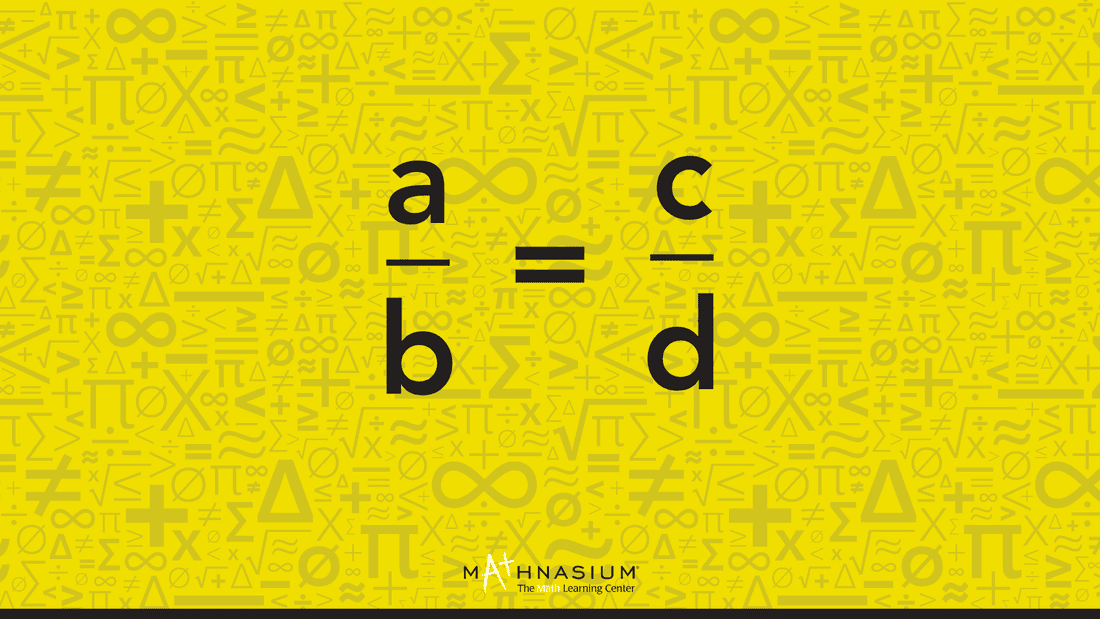
In math, a proportion is simply a statement that two ratios are equal.
While solving for an unknown number in a proportion can look intimidating at first, it all comes down to finding the single "scale factor" that connects them.
Today, our Mathnasium tutors explain how proportions work, walk through how to solve them step by step using scale factors, and share real-world examples we run into every day.

What Is a Proportion in Math?
A proportion in math is a statement showing that two ratios are equal to each other.
Even if two pairs of numbers look completely different, a proportion shows that they share the exact same relationship.
To help us picture this, let's think about a quick real-world example.
If 1 movie ticket costs $10, then it makes total sense that 2 movie tickets will cost $20. The total price changes, but the relationship (the cost per ticket) stays the same.
Let's look at how this constant relationship looks when we organize it into a ratio table.
| Number of Tickets |
Total Cost ($) |
| 1 |
10$ |
| 2 |
20$ |
| 3 |
30$ |
| 4 |
40$ |
Every single row represents an equivalent ratio. Whether we compare 2 to 20 or 4 to 40, they all simplify down to the same value of 1 to 10, which makes them a proportion.
In short, they show us how two quantities scale up or scale down together without changing their relationship. As long as both numbers grow or shrink by the same factor, the baseline ratio stays unchanged.

How Do We Write a Proportion?
We write a proportion by placing two equivalent ratios side by side with an equal sign between them. When solving a math problem, we can write it in two different ways.
1. Fraction Form
This is the format we will use most often when we want to solve a math problem.
When writing a proportion as a fraction, we should be aware that each position has a specific role:
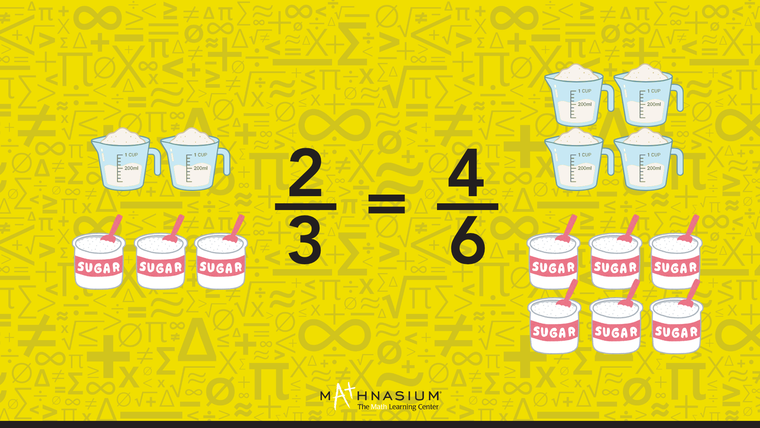
For example, if a recipe uses 2 cups of flour for every 3 cups of sugar, making a double batch means using 4 cups of flour for 6 cups of sugar.
We can write the relationship like this:
\(\Large\frac{2}{3}\)=\(\Large\frac{4}{6}\)
📕 You May Also Like: Equivalent Fractions Explained: A Kid-Friendly Guide
2. Colon Form
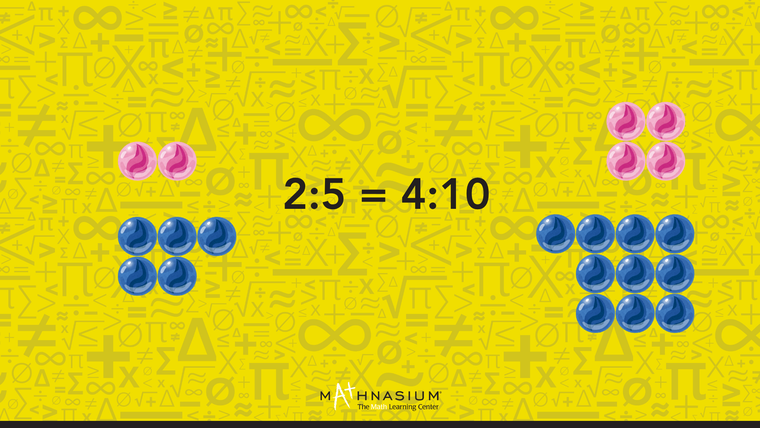
Sometimes, we want to write a math sentence on a single line of text. Imagine we are comparing two different jars of marbles that have the same color mix.
-
The first jar has a tight group of 2 blue marbles paired up with 5 red marbles.
-
The second jar scales things up, matching 4 blue marbles with 10 red marbles.
We can write this proportion by using colons.
2 : 5=4 : 10
Some textbooks might use a double colon :: instead of an equal sign. Don't let that confuse you. It means the same thing!
2 : 5 :: 6 : 15
📕 You May Also Like: Ratio vs. Proportion Difference: A Kid-Friendly Guide
How Do We Solve a Proportion?
The most natural way to solve a proportion is to find the scale factor, the number that connects one ratio to the other.
Let's put that into practice. Say a recipe calls for 3 cups of flour for every 4 cups of sugar. We want to scale the recipe up so we use 9 cups of flour. How much sugar do we need?
First, we need to set up the proportion by using fractions, keeping flour on top and sugar on the bottom for both ratios:
\(\Large\frac{3}{4}\)=\(\Large\frac{9}{x}\)
We look at the two numerators, 3 and 9. To find the scale factor, we divide the larger by the smaller:
9 ÷ 3 = 3
The scale factor is 3.
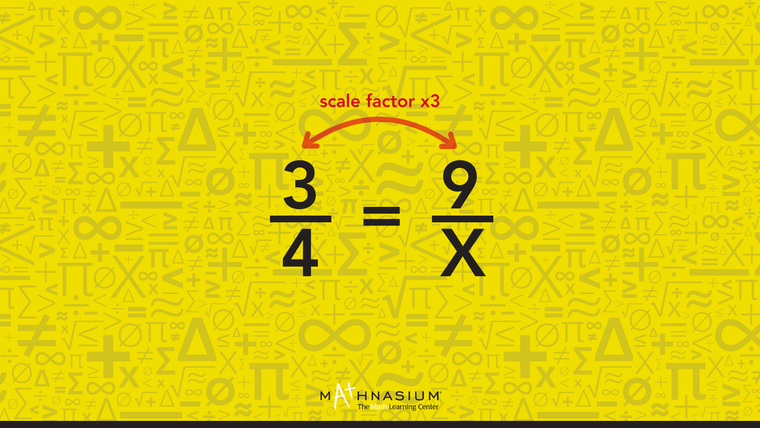
Because the two ratios are equal, that same scale factor connects the denominators, too. Now we need to multiply the denominator we know by 3:
4 × 3 = 12
x = 12
We need 12 cups of sugar.
Let's check our answer. If we go back to the original ratio of 3 cups of flour for every 4 cups of sugar and scale it up by 3, we get 9 cups of flour for every 12 cups of sugar.
Our answer holds up!
Now, let's try a proportion where the scale factor isn't so easy to spot right away.
A school has 10 classrooms in one building, and 6 of them have smart boards installed. Another building has 15 classrooms, with the same proportion of smart boards. How many classrooms with smart boards does the second building have?
As we did before, we need to set up the proportion first, keeping smart board classrooms on top and total classrooms on the bottom for both ratios:
\(\Large\frac{x}{15}\)=\(\Large\frac{6}{10}\)
At first glance, 15 and 10 share no obvious multiplier.
Let's look at the fraction on the right instead.
\(\Large\frac{6}{10}\)
Both 6 and 10 divide evenly by 2:
\(\Large\frac{6}{10}\) ÷ 2=\(\Large\frac{3}{5}\)
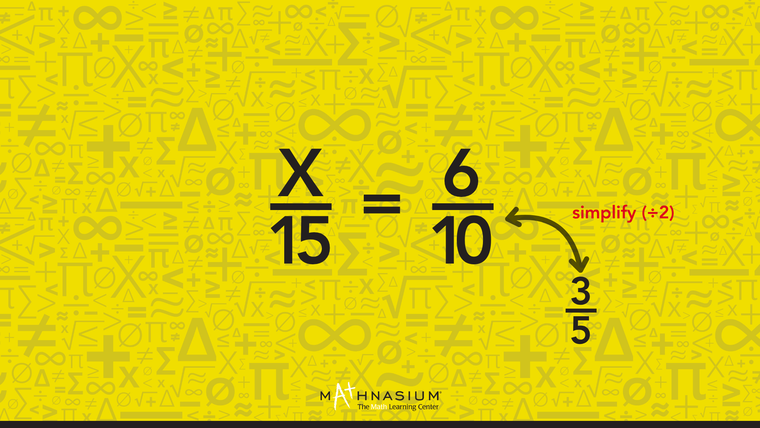
We can now rewrite the proportion using that simplified fraction:
\(\Large\frac{x}{15}\)=\(\Large\frac{3}{5}\)
Now the scale factor is easy to see. So, our next step is to divide the larger denominator by the smaller:
15 ÷ 5 = 3
The scale factor is 3.
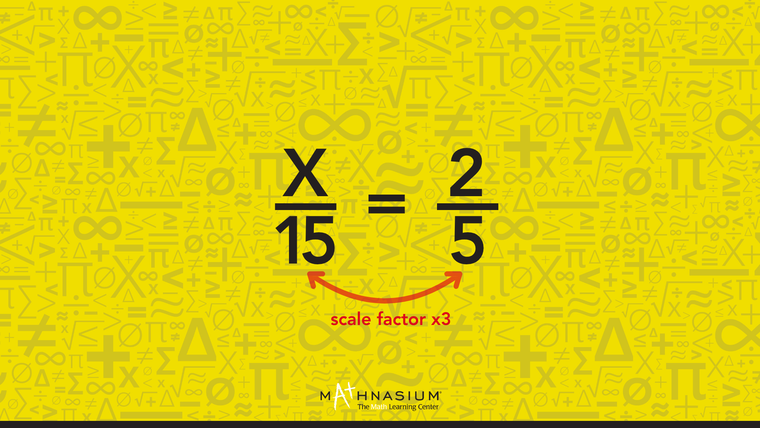
We apply it to the numerator we know:
3 × 3 = 9
x = 9
The second building has 9 classrooms with smart boards.
Simplifying first turned a proportion with hidden numbers into one we could solve right away.
📕 You May Also Like: How to Solve Proportions: Four Methods and When to Use Each
Where Do We See Proportions in Real Life?
Proportions show up anywhere we scale something up or down while keeping the same relationship between two amounts.
-
Recipes: Every time we double a recipe or cut it in half, we use a proportion. A recipe with 2 eggs for every 3 cups of flour needs both numbers scaled by the same amount to keep the taste exactly right.
-
Maps: A map uses a small distance on paper to represent a much larger distance in the world around us. Two inches on the map might stand for 10 real miles, and that relationship holds true no matter which direction we measure.
-
Models and scale toys: Model cars and dollhouses follow a fixed scale compared to the full-size objects they represent. A model built at 1 inch for every foot of the real car shrinks every part by that same amount.
-
Mixing paint: Paint colors and cleaning solutions often come with a mixing ratio, like 1 part concentrate for every 4 parts water. A bigger batch needs both parts scaled up together, or the mix loses its balance.
📕 You May Also Like: Ratios: What They Are and How They're Used in Real Life
Practice: How Well Do You Know Proportions?
Now it's your turn to try. Our Mathnasium tutors put together three proportions for you to solve using the scale factor method we just covered. Simplify first if the numbers call for it.
Problem 1
\(\Large\frac{5}{8}\)=\(\Large\frac{x}{24}\)
Problem 2
\(\Large\frac{x}{9}\)=\(\Large\frac{10}{15}\)
Problem 3
\(\Large\frac{7}{x}\)=\(\Large\frac{21}{27}\)
Check the answers at the bottom of the guide.
 Mathnasium tutors use hands-on examples and visual techniques to help students see how proportions work in the real world.
How Mathnasium Helps Students Learn and Master Any Math Concept
Mathnasium is a math-only learning center serving K–12 students, focusing on building confident, independent math thinkers.
Students come to us at different points in their understanding of proportions, ratios, and the algebra that connects them. Effective support starts with knowing where each student stands, what gaps might be holding them back, and how they naturally approach a problem.
We do that through the Mathnasium Method™, our proprietary teaching approach built around personalized learning and proven instructional techniques.
This is how it comes together for every student:
-
Diagnostic Assessment and Personalized Learning Plans. Each student begins with a diagnostic assessment that identifies both visible skill gaps and the reasoning patterns behind them. From that starting point, we build a personalized learning plan tailored to their needs and goals, helping them build lasting math mastery at a pace that works for them.
-
Teaching for Understanding. Our specially trained tutors use plain, everyday language and a mix of verbal, visual, mental, tactile, and written techniques so concepts land in a way that makes sense to each student.
-
Problem-Solving and Critical Thinking. Our tutors know when to offer support and when to let a student push through on their own. That balance builds lasting independence.
-
An Engaging and Fun Learning Environment. Sessions are designed to keep students motivated and enjoying the process. We celebrate every bit of progress, and that consistent recognition builds confidence with each session. Over time, students develop a more positive relationship with math and greater confidence in their own abilities.
Families see the impact firsthand:
-
94% of parents report improvement in their child's math skills and understanding
-
93% of parents report an improved attitude toward math after attending Mathnasium
-
90% of students saw improvement in their school grades
We operate over 1,100 centers across North America, bringing our proven approach to communities everywhere.
Families across Lake Forest and the surrounding area can visit Mathnasium of Lake Forest, a trusted local center with a proven record of building confident math thinkers.
Whether your student is looking to catch up, keep up, and get ahead in math, our local team is happy to help!
📅 Schedule a Free Diagnostic Assessment at Mathnasium of Lake Forest
Pssst! Check Your Answers Here
Here are the answers. How did you do?
Problem 1: x = 15.
Problem 2: x = 6.
Problem 3: x = 9.


 (949) 868-6488