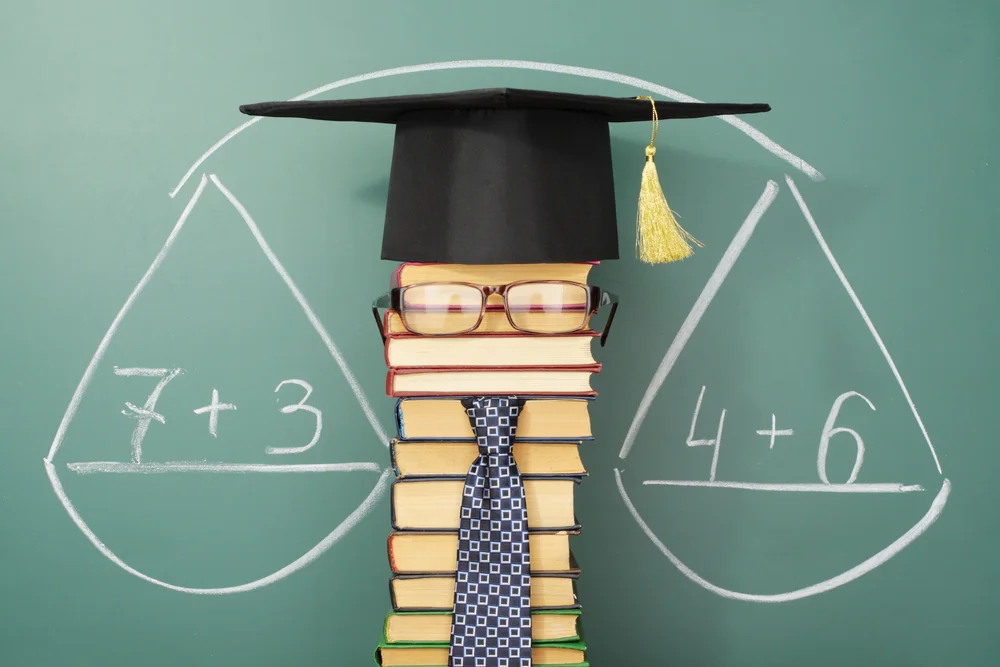
When students in New City first study equations (typically starting around 6th and 7th grade), they are introduced to a whole new way of mathematical thinking.
As they get to know this new logic, it is completely normal for them to develop a few common misconceptions along the way. Through our algebra tutoring sessions at Mathnasium, we see these exact stumbling blocks every day.
Today, our tutors highlight the most common equation struggles you might encounter and share a few of our teaching strategies for overcoming them with confidence.

1. Treating the Equal Sign as an "Answer Box" (Grade 6)
Many young learners view the equal sign as an "answer box," reading = as a prompt to calculate and write down a total. This habit starts in the early grades, where years of simple problems like 3 + 4 = 7 teach your child that the symbol simply announces an answer.
Sixth-grade equations break that pattern.
A problem like x + 5 = 12 - 3 features operations on both sides of the = sign.
When your child expects the answer on the right side, they might simply add every number they see like this:
5 + 12 - 3 = 14
We see this happen at our center. Operational misconceptions of the equals sign actively persist into the middle school years for some students, heavily impacting pre-algebra success, as highlighted in a 2022 study.
At Mathnasium of New City, we like to present every equation as a balanced scale. Both sides of the scale need to carry the same amount, or the scale tips. Weights on the left pan and weights on the right pan make the meaning of "=" visible before any procedural rule enters the lesson.
By grounding the concept visually, your child can build an intuitive understanding of balance that makes solving multi-step equations feel simple and natural.
Let's look at x + 5 = 12 - 3 again, and see how our tutors approach this.
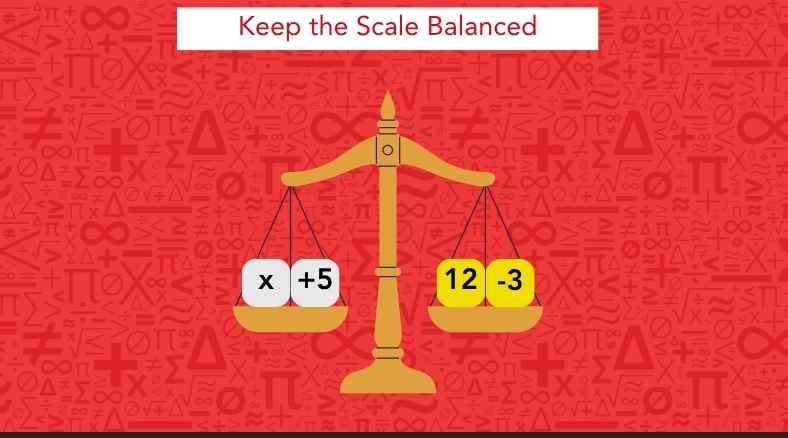
First, we start with the right side and ask, "What is 12 - 3"?
12 - 3 = 9
The right side of the scale shows 9, so the equation now reads x + 5 = 9.
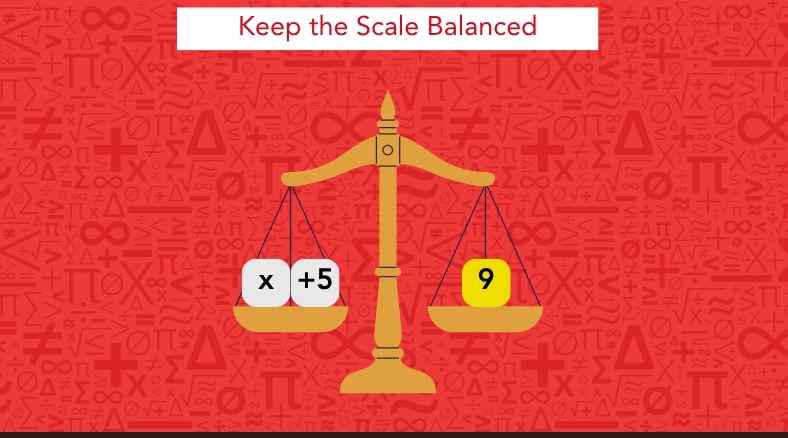
Next, we ask, "If we have 5 weights plus our unknown box on the left and 9 weights on the right, what must we remove from both sides to keep the scale balanced?"
We take 5 from each side.
x + 5 - 5 = 9 - 5
x = 4
That leaves us with x = 4.
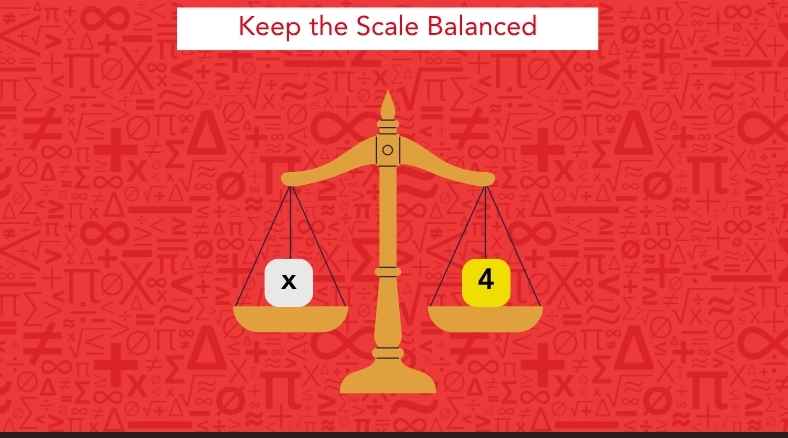
We then check the answer together.
Left side: 4 + 5 = 9
Right side: 12 - 3 = 9
9 = 9
Both pans hold the same weight. Which means our equation is correct!
2. Memorizing Operations Without Recognizing Inverse Relationships (Grade 6–7)
If your child memorizes math steps without seeing how inverse operations connect, they might follow "do the opposite" as a mechanical rule without a clear picture of why it works.
This might help them solve basic one- and two-step equations for a short while, like this: 3x + 4 = 19.
Under this rule, your child might explain that +4 simply "turns into -4 on the other side." They memorize this shortcut without realizing they are actually using a zero pair, which means new or unfamiliar equations can quickly leave them stuck.
At Mathnasium of New City, we give our students tactile counters and visual tiles to build zero pairs right in front of them. A positive tile and a negative tile cancel each other out to zero, turning an abstract rule into a concept your child can easily understand.
Let's look back at 3x + 4 = 19.
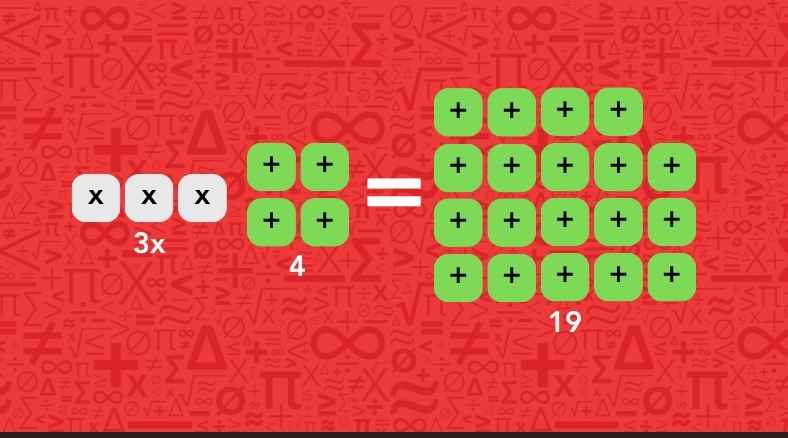
We point to the +4 attached to the variable term and ask, "How do we return this part of the scale back to zero?"
Then we see that adding −4 (or subtracting 4) neutralizes the positive 4, because +4 − 4 = 0. To keep the scale balanced, we apply that same −4 to the 19 on the right.
3x + 4 - 4 = 19 - 4
That leaves us with 3x = 15.
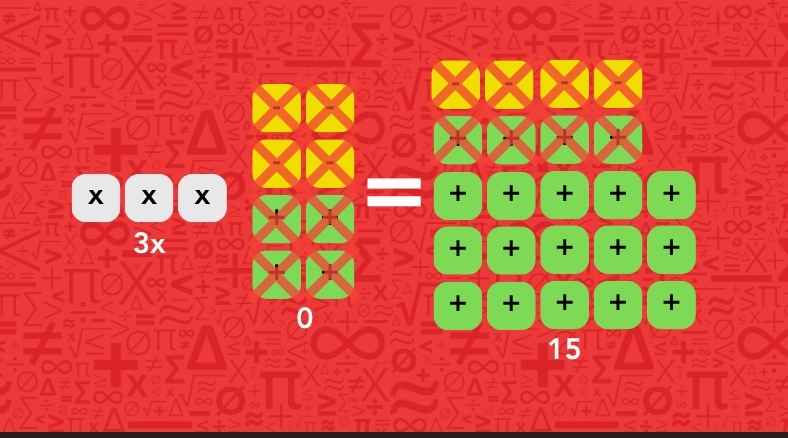
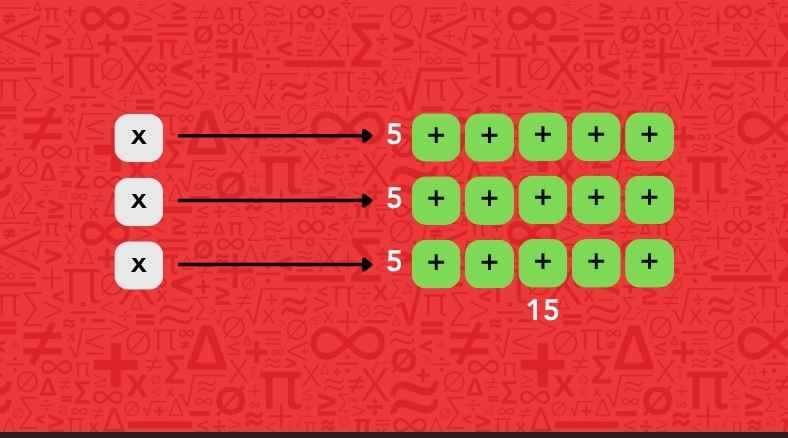
Next we ask, "If 3 boxes hold a total of 15, how do we find out what is inside just 1 box?"
That question gives us something to count in place of "divide by 3 because the rule says so."
We then divide 15 into 3 equal groups, so x = 5.
Then we check it together.
3(5) + 4 = 19
15 + 4 = 19
19 = 19
📕 You May Also Like: What Are Inverse Operations?
3. Mishandling Negative Signs Across Terms (Grade 7–8)
A mishandled negative sign across terms often slips away between the first step and the last. Equations with negative coefficients or distribution leave plenty of room for this mistake, since the outer sign must distribute to every term inside the parentheses.
Take -2(x -3) = 8. Your child might correctly multiply 2 by x and by 3, but write 2x - 6 = 8.
This dropped negative sign on the -2 carries the error into every step that follows.
That’s why we use hands-on directional chips and color-coded grouping to make negative integers concrete. A sign becomes a color or a direction your child can see, which gives them something to check against in place of a memorized sign rule.
Let's look at −2(x − 3) = 8 again.
When we work with our students, we ask them to read the expression aloud: "We have two opposite groups of (x − 3)."
Each group is a visual chunk holding one x and a negative 3, and the −2 tells us to take the opposite of every chunk.
Then we ask, "What happens when we take the opposite of a negative 3?"
The opposite of a negative 3 is a positive 3, and we have two of those groups. We distribute the −2 to each term inside the parentheses.
−2(x − 3)
(−2)(x) + (−2)(−3)
−2x + 6
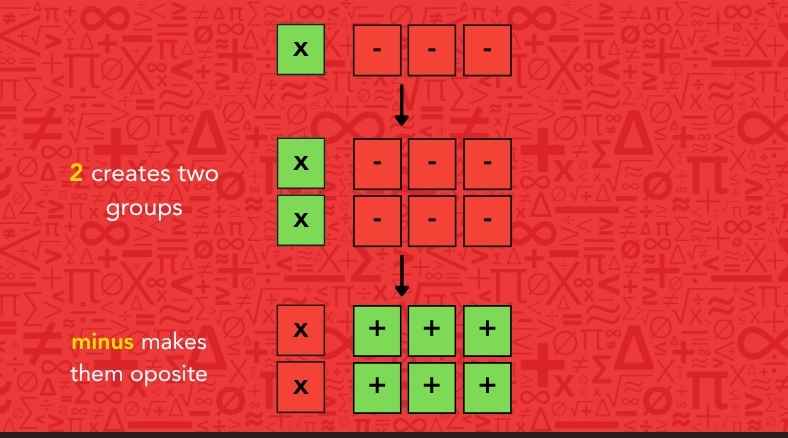
The −2 times x gives us −2x, and −2 times −3 resolves to +6, because the opposite of a negative is a positive.
The equation now reads as follows:
−2x + 6 = 8
From there, we neutralize the +6 with a zero pair on both sides. We add −6 to each side.
−2x + 6 − 6 = 8 − 6
−2x = 2
We divide both sides by −2.
−2x ÷ (−2) = 2 ÷ (−2)
x = −1
In the end, we check it together.
−2(−1 − 3) = −2(−4) = 8
2 + 6 = 8
8 = 8
Both sides match.
📕 You May Also Like: Early Middle School Algebra Problems (With Worked Examples)
4. Treating Fractional Coefficients or Division as Procedural Shortcuts (Grade 7–8)
When your child treats fractional coefficients or division as memorized shortcuts, they often reach for a rule like cross-multiplication before reading what the fraction bar actually means. While that move feels safe, it quickly falls apart.
Faced with equations like \(\Large\frac{x}{4}\) = 5 or \(\Large\frac{3}{4}x\) = 9, your child might freeze or cross-multiply incorrectly without a fraction on both sides.
In a multi-step equation like \(\Large\frac{x+2}{3}\) = 6, they might add or subtract numbers before clearing the denominator.
To avoid this confusion, our tutors return to the core meaning of division as the inverse of multiplication.
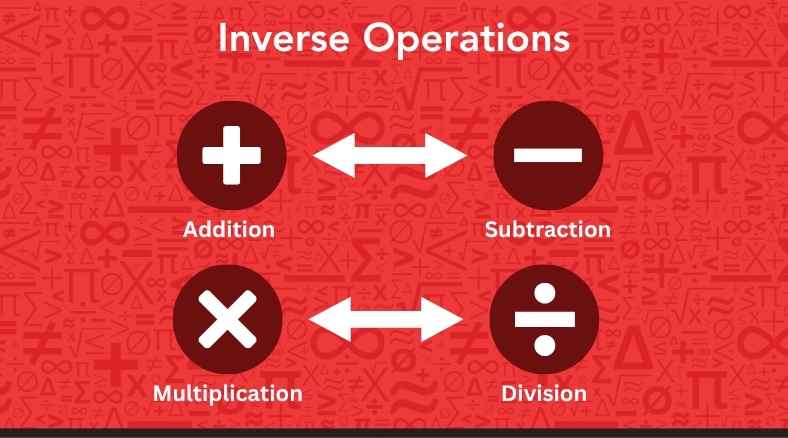
In our session, we use proportional reasoning to show that a fraction bar indicates division, so \(\Large\frac{x}{4}\) reads as "x divided by 4."
Let's look at the first equation.
\(\Large\frac{x}{4}\) = 5
We ask, "What is currently happening to x?" Together, we spot that x is being divided by 4.
Next comes the question, "How do we undo division?" The answer is multiplication, so we multiply both sides by 4.
\((\Large\frac{x}{4})\) × 4 = 5 × 4
x = 20
For a fractional coefficient like \((\Large\frac{3}{4})x\) = 9, we clear the denominator first.
\((\Large\frac{3}{4})x\) = 9
We multiply both sides by 4.
\((\Large\frac{3}{4})x\) × 4 = 9 × 4
3x = 36
Then we divide both sides by 3.
3x ÷ 3 = 36 ÷ 3
x = 12
📕 You May Also Like: How to Divide a Fraction by a Fraction (+ Tips & Visual Aid)
5. Managing Variables on Both Sides of the Equation (Grade 8 / Algebra 1)
Equations with variables on both sides ask your child to decide what to do with an x appearing in two places at once. This setup can easily lead them to collect terms haphazardly or guess numbers.
Take 7x − 4 = 3x + 16. With x appearing in two separate places, your child might try to combine every number and variable into a single expression.
We return to the balance scale model to make the structure obvious. By turning variable terms into physical weights, our tutors show that 7x is simply seven unknown boxes resting on one side.
Let's look at the equation.
7x − 4 = 3x + 16
We frame it as a comparison and ask, "We have 7 unknown boxes and a deficit of 4 on the left, and 3 unknown boxes and 16 units on the right. How do we clear the smaller variable side first?"
Together, we decide to remove 3x from both sides.
7x − 3x − 4 = 3x − 3x + 16
4x − 4 = 16
That move turns a complex two-sided problem into a familiar two-step equation.
We add 4 to both sides.
4x − 4 + 4 = 16 + 4
4x = 20
Next, dividing both sides by 4 isolates x:
4x ÷ 4 = 20 ÷ 4
x = 5
We check it together by placing 5 on both pans.
7(5) − 4 = 31
3(5) + 16 = 31
Both pans hold 31.
📕 You May Also Like: What Is a Variable in Math? A Complete Overview
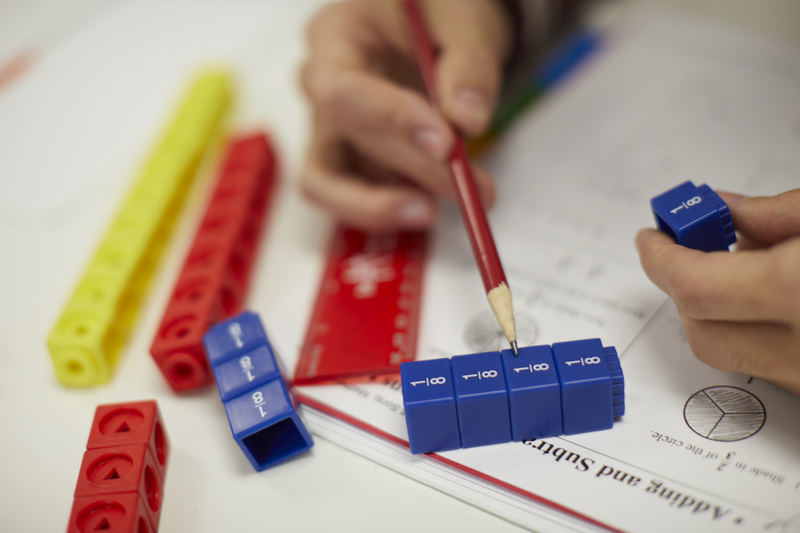
At Mathnasium, personalized learning plans and hands-on teaching help students understand equations and solve them with confidence.
How Mathnasium of New City Helps Students Master Any Math Concept
Mathnasium of New City is a math-only learning center serving PreK-12 students in New City, Bardonia, Congers, and West Nyack. Our center is part of a network of over 1,200 learning centers across North America.
We’ve helped many local students overcome math struggles like equations and algebra while building a more positive relationship with math.
Behind these results is our proprietary teaching approach, the Mathnasium Method™.
Here’s how it unfolds:
Each student begins their enrollment with a diagnostic assessment. This low-pressure interaction helps us see a student’s current skills and potential learning gaps, but also how they think about math. With these insights, we create a learning plan customized to their needs.
Once the plan is in place, our specially trained tutors follow it closely, providing face-to-face math instruction in a supportive and dynamic environment.
We teach math for deep understanding. Our approach strips away heavy math jargon and uses a mix of verbal, visual, mental, tactile, and written techniques to help every concept truly land.
During sessions, we allow time for students to work independently after we join them to check their thoughts and processes. When we do step in, we show them both the how and why behind a method. By learning to trust their reasoning and seeing both the mechanics and the underlying logic, they form problem-solving skills and critical thinking tools they can use in math and beyond.
Last but not least, fun is woven into our approach. Our activities are often game-based, and we use ample rewards whenever a student makes progress. This keeps them engaged and growing in confidence with each new session.
Our approach brings results on both the academic and confidence fronts:
-
94% of parents report an improvement in their child's math skills and understanding
-
93% of parents report their child's improved attitude toward math after attending Mathnasium
-
90% of students saw an improvement in their school grades
Whether your student is looking to catch up, keep up, or get ahead in math, our team is ready to support them.
📅 Schedule a Free Diagnostic Assessment at Mathnasium of New City
Not near New City?
📍 Find a Mathnasium Learning Center Near You


 (845) 990-9019