Third grade is the year our tutors at Mathnasium most often see students struggle unexpectedly, even those who did well in earlier grades.
For the first time, math moves away from concrete operations that can be counted, touched, and drawn. Your child now meets relationships and abstractions: multiplication as scaling, fractions as partitions, area across two dimensions, and word problems that layer reading comprehension on top of the arithmetic.
These four areas arrive together, in the same year, as one combined shift in how your child needs to think about math.
With this in mind, our education specialists break down each of those four areas, explain what the transition actually requires of your child, and give you specific things to look for at home.

What Makes 3rd Grade Math Different
In 1st and 2nd grade, your child built fluency with things they could see and touch. Addition meant combining objects. Subtraction meant removing them. A correct answer was always a count of something real.
Third grade changes that entirely. Under Texas Essential Knowledge and Skills (TEKS), this is the year multiplication, fractions, area, and multi-step word problems are formally introduced, and each one asks for a fundamentally different kind of thinking than anything that came before.
-
Multiplication becomes a relationship between quantities, not a faster way to add. Six groups of seven is a scaling operation, and your child needs to grasp what that means, not just retrieve the answer.
-
Fractions introduce a number that is neither a count nor a whole. The symbol 14 represents a part-to-whole relationship — one part of a whole divided into four equal parts — and that is an entirely different kind of number from anything your child has worked with before.
-
Area connects measurement to multiplication across two dimensions simultaneously. For a child still consolidating multiplication facts, these two demands arrive together, and each one makes the other harder.
-
Word problems add a reading layer on top of the arithmetic. Your child now has to identify what the question is actually asking before selecting an operation and they can know every multiplication fact and still answer the wrong question if that reading step is skipped.
Each of the four sections below addresses one of these areas directly: what 3rd grade requires, what mastery looks like, and what to watch for at home.
📕 You May Also Like: 6 Math Concepts to Master in 3rd Grade (+ Skills Check Quiz)
The 4 Math Areas That Define 3rd Grade
Each of the four areas we cover below follows the same structure: what TEKS expects at this grade level, what mastery actually looks like in practice, and what a gap tends to look like before it becomes visible in grades.
1. Multiplication and Division
Fact fluency is the foundation of 3rd-grade math, and TEKS sets a clear target. Your child should be able to recall multiplication facts within 100 automatically and understand division as the inverse of multiplication.
In 2nd grade, your child could solve "3 groups of 4" by adding 4 + 4 + 4. That approach was correct, and it built the right conceptual foundation.
Third grade expects that reasoning to become instantaneous and generalized.
A student with a solid understanding of multiplication retrieves 6 × 7 automatically, explains what it means in terms of groups, and recognizes that 28 ÷ 4 is the other side of 4 × 7 rather than a separate fact to memorize.
If your child can retrieve the answer but cannot explain the grouping behind it, they could be showing a procedural gap that tends to surface again in division and fractions.
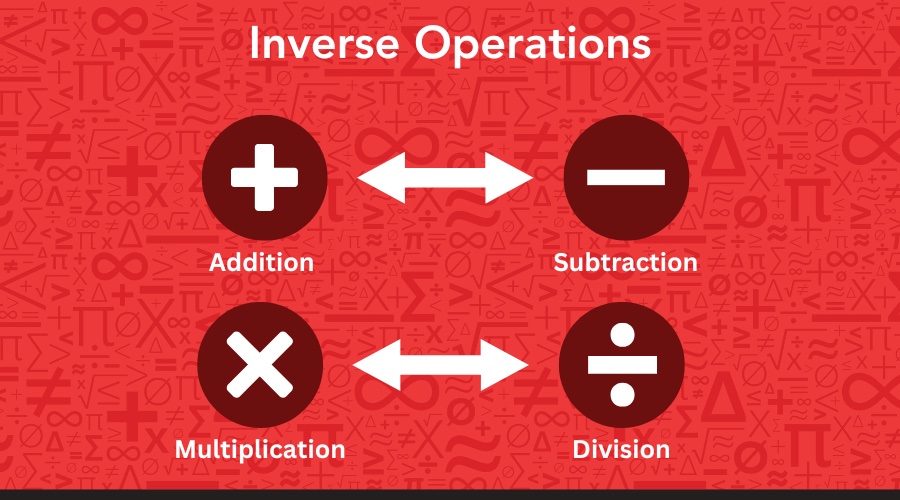
In 3rd grade, multiplication and division are two sides of the same relationship, and TEKS expects your child to understand both.
2. Fractions
Fractions are the first time your child encounters a number that is not a count of anything and TEKS requires 3rd graders to understand fractions as equal parts of a whole, place them on a number line, and compare fractions that share a numerator or denominator.
Your child has built that understanding when they can look at \(\Large\frac{3}{4}\) and \(\Large\frac{1}{4}\) and explain immediately which is larger and why, not because they memorized a rule, but because they can picture what each fraction represents as a portion of the same whole.
They should also be able to place both on a number line and explain why \(\Large\frac{3}{4}\) sits closer to 1 than to 0.
If your learner compares fractions by looking at the size of the digits alone, concluding that \(\Large\frac{1}{8}\) is larger than \(\Large\frac{1}{2}\) because 8 is bigger than 2, that gap follows them directly into equivalent fractions and ratio work in later grades.
📕 You May Also Like: Equivalent Fractions Explained: A Kid-Friendly Guide
3. Area and Measurement
Area is where geometry and multiplication meet for the first time. TEKS requires 3rd graders to understand area as the number of square units covering a flat surface, calculate it by multiplying side lengths, and distinguish it from perimeter.
What makes this transition particularly demanding is that your child is being asked to master two things simultaneously: a new geometric concept and the multiplication facts that calculate it.
A 3rd grader who understands area can look at a 4 × 6 rectangle, explain that it contains 24 square units, and tell you why that number is different from the 20 units that make up its perimeter.
If your child can produce the right answer but cannot explain what that number actually represents or consistently confuses which formula belongs to which measurement, the concept hasn't fully landed yet.
📕 You May Also Like: Perimeter vs. Area: Why Kids Mix Them Up
4. Word Problems
Word problems in 3rd grade are the first place where reading comprehension and mathematical reasoning have to work together.
TEKS requires students to solve one- and two-step problems using addition, subtraction, multiplication, and division, including problems that contain extra or irrelevant information.
Your child has developed this process when they can pause before writing anything down, name what the problem is asking in their own words, filter out irrelevant information, and check afterward whether their answer actually fits the question.
If they tend to grab the first numbers they see and apply a familiar operation without reading to the end, that habit becomes harder to correct as problems grow more layered in 4th and 5th grade.
📕 You May Also Like: Why 3rd Grade Math Feels So Hard, and How to Help Your Child Succeed
How to Support 3rd Grade Math at Home
Our tutors recommend these strategies for supporting each of the four areas at home.
1. Multiplication and Division: Build Meaning and Fluency Together
Fluency without understanding is fragile. These approaches build both at the same time:
-
Ask for "story versions" of facts. Instead of only checking "What is 6 × 7?", ask "Tell me a quick story that shows 6 groups of 7." This connects the fact to the grouping behind it, not just the answer.
-
Mix in "missing piece" questions. Try division without naming it: "If 28 stickers are shared equally between 4 friends, how many does each friend get?" Then follow up: "Which multiplication fact did you just use?" This helps your child see 28 ÷ 4 and 4 × 7 as the same relationship.
-
Keep practice short and targeted. Five to ten facts at a time, repeated over a few days, beats a long drill page. Focus on a small set your child almost knows and circle back until they can answer quickly and calmly.
2. Fractions: Make "Part of a Whole" Visible
Fractions land faster through physical experience than through explanation. To make this land, try:
-
Using real objects, but always name the whole. When you cut a sandwich, say "This whole sandwich is 1. We cut it into 4 equal parts, so each piece is one-fourth." Naming the whole and the equal parts reinforces the fraction as a relationship, not just a piece.
-
Comparing fractions with the same whole. Draw or fold two identical rectangles. Shade 1 out of 4 parts in one and 3 out of 4 in the other. Ask "Which is more? How do you know?" Then connect the pictures to the symbols \(\Large\frac{1}{4}\) and \(\Large\frac{3}{4}\).
-
Using quick number line talks. On a simple line from 0 to 1, ask your child to mark where \(\Large\frac{1}{2}\) goes, then \(\Large\frac{1}{4}\) and \(\Large\frac{3}{4}\). Ask "Why is \(\Large\frac{3}{4}\) closer to 1 than to 0?" This builds the idea that fractions are numbers.
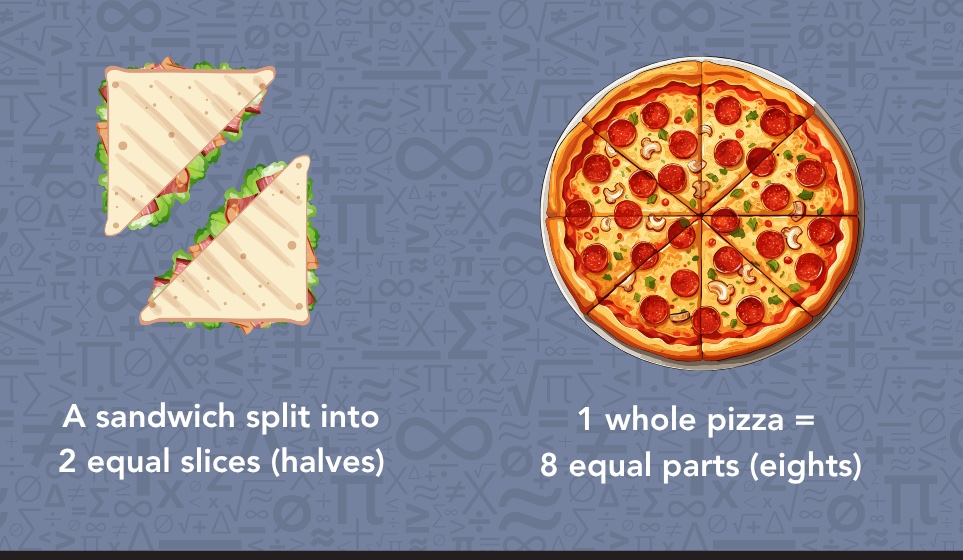
Every fraction starts with a whole. A sandwich cut into 2 equal slices, a pizza into 8 — the whole is always 1, and the parts only make sense in relation to it.
3. Area and Measurement: Connect Arrays, Units, and Formulas
The most common confusion at this stage is treating area as a formula rather than a concept. The tips we gathered can help your child see what the number actually means:
-
Turn rectangles into arrays your child can see. Look at a rug or table and ask "If this were covered with squares, how many squares long and how many squares wide would it be?" It helps your child see area as rows of equal groups rather than just a formula.
-
Separate area from perimeter on purpose. Draw one rectangle and ask for its area, then its perimeter. Use two colors, one for the inside, one for the border, so your child sees these as two different measurements tied to the same shape.
-
Ask your child to explain the number. When they say "The area is 24," follow with "What does 24 mean here?" A solid answer sounds like "24 square units that cover it," which shows they understand more than just the multiplication.
4. Word Problems: Slow Down the Reading, Not the Math
Most word problem errors happen before the math begins. Slowing down the reading step is where to start:
-
Make "What is the question?" the first step. Before your child writes any numbers, ask them to restate the question in their own words. This prevents the "grab the first two numbers and do something" approach.
-
Practice ignoring extra information. Give simple problems that include a detail not needed to solve them, like a color, a date, a name. Ask "Which parts matter for the math? Which parts don't?" This is exactly what 3rd-grade multi-step problems require.
-
Encourage a quick "Does this make sense?" check. When your child finishes a problem, ask "Is this answer too big, too small, or reasonable?" If they say 6 pencils shared by 3 students is 18 each, they can spot that without redoing every step.

Mathnasium tutors work with 3rd graders on the exact four areas covered in this guide, using personalized plans built from a diagnostic assessment.
How Mathnasium Helps Students Build Solid Math Foundations
Mathnasium is a math-only learning center dedicated to helping K–12 students of all skill levels learn and master math.
We've worked with many 3rd graders, whether they're looking to keep up with the new demands of the curriculum or are ready for an additional challenge.
We support our students not with a one-size-fits-all curriculum but with the Mathnasium Method™, our proprietary teaching approach designed around each student's individual needs and learning style.
When a 3rd grader joins us, we start with a diagnostic assessment that identifies their strengths and areas for improvement. With those insights, we create a personalized learning plan tailored to their needs and goals.
With the plan in place, our specially trained tutors follow it closely, teaching math face-to-face in a supportive and engaging group environment. We use clear, everyday language and a mix of verbal, visual, mental, tactile, and written techniques so each concept lands in a way that makes sense.
When a concept is tricky, we break it down into manageable steps and work through both the how and the why. Over time, students build real problem-solving skills and critical thinking tools they can carry into math and beyond.
Fun is built into how we work. We use game-based activities, let students earn rewards, and celebrate every bit of progress, keeping them engaged and growing in confidence with each session.
The results speak for themselves:
-
94% of parents report an improvement in their child’s math skills and understanding
-
93% of parents report an improved attitude toward math after attending Mathnasium
-
90% of students saw an improvement in their school grades
With over 1,100 learning centers across North America, there is likely a Mathnasium near you.
Families across Round Rock, Pflugerville, Hutto, Georgetown, and surrounding communities trust Mathnasium of Round Rock East to help their children build solid foundations for math mastery.
If your child is working through functions and equations or any other math challenge and needs more targeted support, our team is ready to help.
📅 Schedule a Free Diagnostic Assessment at Mathnasium of Round Rock East
Not near Round Rock?
📍 Find a Mathnasium Learning Center Near You


 (512) 246-6284