Working with elementary school students, we sometimes notice that as children move into 3rd grade, their math performance may begin to lag, and confidence can dip alongside it.
This drop isn’t random; it coincides with a notable transition in how math is taught. In 3rd grade, students are introduced to multi-step word problems, early multiplication and division, and less visual support.
When families come to us for help during this period, Mathnasium starts with a diagnostic assessment and a personalized learning plan that identifies gaps early and helps rebuild confidence.
But we also know that meaningful progress doesn’t only happen in learning centers.
That’s why today, our tutors are sharing what contributes to confidence loss after 2nd grade, what signs to watch for, and what practical strategies truly make a difference.
Why Confidence Sometimes Drops After 2nd Grade
Around 3rd grade, it’s not uncommon to see a student caught off guard by the changes in how math is taught and experienced.
Rather than attributing this to ability, it’s important for parents to consider the more realistic factors that often contribute to these changes.
1. The Rise of Word Problems
At this stage, math stops being just about numbers and starts leaning heavily on language. Students are expected to read, interpret, and translate written scenarios into math operations.
A typical 3rd-grade question might ask: “Lena has 24 apples. She puts them into bags with 6 apples in each. How many bags does she need?”
For children still developing reading comprehension or processing speed, the challenge often has less to do with math itself and more to do with decoding the problem.
Research shows that reading ability and math performance become increasingly linked starting around 3rd grade, especially in problem-solving tasks.
This added layer of language can make math feel unfamiliar, even for students who previously felt secure with numbers.
📕 You May Also Like: Why Math Gets Harder in Grades 3–6 (and What Parents Can Do About It)
2. Multi-Step Thinking Becomes the Norm
Earlier grades focus largely on single-step problems. After 2nd grade, students are expected to use sequence and hold multiple steps in working memory. This places new demands on executive function skills like attention, organization, and cognitive flexibility.
Even when students grasp the math concepts, juggling several steps at once can feel overwhelming.
Think of this example: Find the perimeter of a rectangle with sides measuring 7 cm and 9 cm.
To solve it, a student must recall what perimeter means, recognize that opposite sides are equal, compute 7 + 9 + 7 + 9, or use the shortcut (7 + 9) × 2, all before even writing the final answer.
Each step builds on the last, and for a third grader, coordinating those steps while keeping track of what they’re doing can be a real challenge.
📕 You May Also Like: How to Help Kids Build Math Stamina for Challenging Problems
3. Timed Fluency Tests Ramp Up
Timed drills are meant to build fluency, but for many students, they do the opposite, which is to trigger stress.
Studies have consistently linked timed math tests with increased math anxiety, particularly in younger students who are still solidifying their understanding. Children begin to equate being “good at math” with being fast, even though speed and understanding are not the same thing.
This pressure can cause otherwise capable students to freeze up, second-guess themselves, or rush through problems and make avoidable mistakes.

Timed tests often create pressure, causing students to rush, freeze, or doubt what they know.
4. Less Visual, More Abstract
Math becomes less concrete in third grade. There are fewer pictures and manipulatives overall, yet far more symbols like ×, ÷, and /.
Concepts like multiplication (e.g., 4 × 3 as four groups of three apples), division (e.g., 12 ÷ 3 to share cookies equally), and fractions (e.g., \(\Large\frac{1}{2}\) as half a pizza) require students to mentally visualize relationships.
Without strong conceptual grounding from earlier grades, this abstraction can feel like math has suddenly become confusing, even when the ideas are not too complex.
5. The Class Moves Faster
Curriculum pacing accelerates in 3rd grade, leaving little time to revisit foundational skills. According to Common Core standards, students at this level are expected to:
-
Multiply and divide within 100
-
Understand unit fractions and place them on number lines
-
Solve two-step word problems using all four operations
-
Measure and estimate using standard units
-
Understand area as a measurable attribute of shapes
For students who haven’t fully mastered number sense or place value in earlier grades, these expectations can feel like a steep climb. Without a solid foundation, even well-taught lessons may not stick.
📕 You May Also Like: 7 Tips to Help Your Child Build Number Sense
Signs Your Child Is Losing Confidence in Math
Math confidence tends to fade quietly, often showing up in subtle changes in language and behavior. Paying attention to these early signals allows parents to step in before frustration turns into long-term math anxiety.
A. They say, “I’m just bad at math.”
This statement signals a shift from effort-based thinking (“this is hard”) to identity-based thinking (“this is who I am”).
Research on learning mindset shows that when children believe ability is fixed, they’re more likely to give up after difficulty and less likely to improve over time.
This kind of self-labeling can begin as early as 2nd or 3rd grade.
B. They avoid math homework, or rush to finish it.
Common signs include procrastinating, frequent breaks, or completing work as fast as possible with little care.
Avoidance is a stress response, not laziness. Children try to escape tasks that make them feel anxious or inadequate.
Studies link early avoidance behaviors to the development of math anxiety, even before test scores decline.
📕 You May Also Like: How to Ease Back-to-School Math Anxiety for Elementary Students
C. They shut down after small mistakes.
A single error leads to tears, anger, or giving up entirely.
Brain imaging studies show that math anxiety increases emotional reactivity to mistakes, which disrupts working memory and problem-solving.
Instead of seeing mistakes as part of learning, children begin to view them as proof they “don’t get it.”
D. They ask for help on problems they used to do alone.
Children may refuse to start without reassurance or insist on constant checking.
For example, a student who managed two-digit addition with regrouping in 2nd grade might now ask for help when working through three-digit addition or multi-step problems in 3rd grade, though the underlying process is similar.
This often reflects decreased self-trust rather than decreased ability.
E. They stop showing their work or leave problems blank.
Skipping steps, writing only answers, or leaving questions empty often stems from fear of being wrong.
Avoidance is protective: Children would rather not try than try and “prove” they can’t do it.
Key Takeaway for Parents
The early signs of fading confidence, hesitation, avoidance, or second-guessing familiar skills, often appear before test scores change or report cards arrive. Noticing these patterns early gives parents a valuable window to respond.
When addressed with the right support, students can regain a sense of clarity, rebuild trust in their own thinking, and stay on track as math becomes more complex.

For parents, watching for signs of struggle before test grades or report cards come home can make all the difference.
How to Rebuild Math Confidence at Home and Beyond
Rebuilding math confidence doesn’t mean turning your home into a classroom. A few well-placed changes in how you talk about and approach math can reshape your child’s experience in lasting ways.
1. Reframe Mistakes as Learning Moments
When a child makes an error, their emotional response matters more than the mistake itself.
Educational psychology research explains that when students see mistakes as learning moments rather than failure, they tend to engage more deeply with the problem, increase their effort, and persist in the face of difficulty.
With this in mind, how can you support that mindset at home?
Start by slowing down your response. Instead of correcting right away, ask open-ended questions like:
-
“What part didn’t feel right?”
-
“Is there another way we could try it?”
-
“How can we figure out where this went off?”
If your child solves a problem incorrectly—say, they subtract 189 – 57 and write 142—they may have rushed regrouping or misread a digit. Instead of pointing out the mistake, ask them to estimate first: “Does 189 – 57 seem closer to 130 or 140?” Then have them rework it using base-ten blocks or sketching out place value.
📕 You May Also Like: Why Parents Should Teach Kids to Embrace Math Mistakes
2. Use Visual Tools to Make Abstract Ideas Concrete
As math becomes more symbolic, visuals act as a bridge between understanding and abstraction.
A recent study found that using visuals for third-grade multiplication facts led to significantly greater gains in fluency, reasoning strategies, and multiplicative understanding compared to traditional curricula.
This aligns with what we see in our centers. Those “a-ha” moments often happen when we bring out visual tools like number lines, bar models, place-value charts, or arrays to make abstract concepts easier to grasp.
To support your third or fourth grader at home, visuals can help in the following ways:
-
Make multiplication more concrete by showing equal groups or arrays (e.g., drawing 4 rows of 6 instead of memorizing 4 × 6).
-
Clarify place value using base-ten blocks or place-value charts when working with multi-digit addition and subtraction.
-
Support fraction understanding by shading parts of shapes or using number lines to compare fractions like \(\Large\frac{1}{3}\) and \(\Large\frac{3}{4}\) .
-
Break down multi-step problems using bar models or tape diagrams to visually separate each step.
-
Reinforce area concepts by having students build or draw rectangles on graph paper and count the squares to find total area.
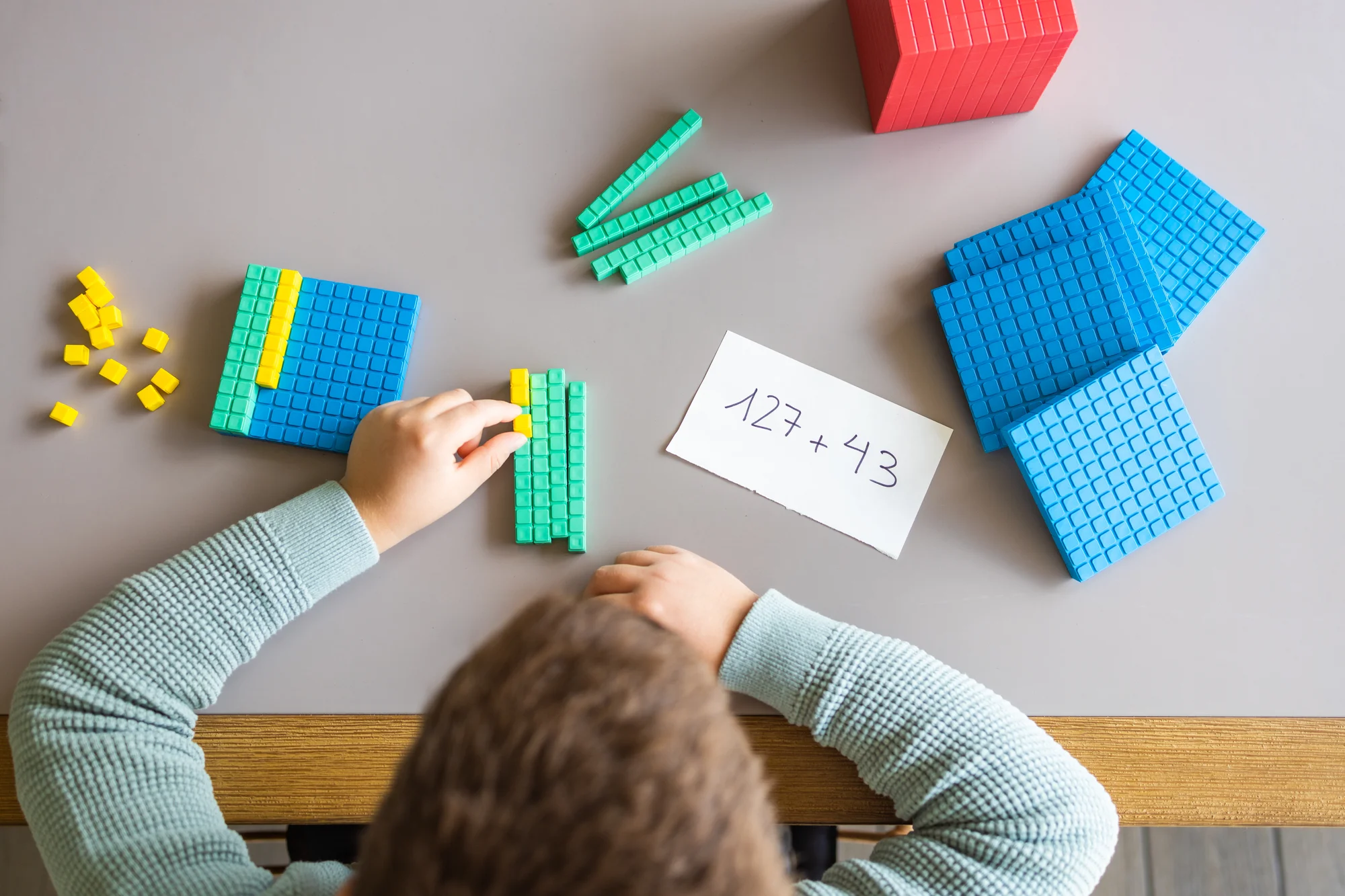
Visuals, real-world activities, and other representations of math problems can greatly aid in math comprehension among early learners.
3. Break Multi-Step Problems into Manageable Parts
Multi-step problems place heavy demands on working memory. Always keep that in mind.
To overcome this challenge, encourage your 3rd grader to slow down and separate each part of the problem before solving. This helps reduce mental overload and gives them a clear path forward.
How does that look in practice?
Let’s look at a typical example: “Lena buys 3 packs of markers for $5 each and a notebook for $4. How much does she spend in all?”
Here’s how you can walk through it together:
-
Ask, “What do we know?” We know she’s buying 3 packs of markers at $5 each, and a notebook that costs $4.
-
Ask, “What do we need to find?”The total amount of money Lena spent.
-
Now break it into steps: First, multiply to find the cost of markers: 3 × 5 = 15. Then, add the notebook: 15 + 4 = 19
Talking through each step keeps the task organized and manageable. Instead of rushing or guessing, students stay anchored in what the problem is asking and how to move through it logically.
4. Focus on How They Think, Not Just the Answer
In math, the thinking process often reveals more than the final result. To understand how your child is approaching a task, try this:
-
Have them teach you a concept on a small whiteboard. This gives them space to explain their reasoning and shows where their understanding is solid, or where it needs support.
-
Ask, “How did you get that?” instead of “What’s the answer?” Their explanation can uncover skipped steps, misconceptions, or a strategy worth reinforcing.
-
Use incorrect answers as a starting point. Invite them to find and fix the mistake. This builds reasoning skills and shifts the focus from right vs. wrong to how math works.
📕 You May Also Like: How to Nurture Math Thinkers, Not Just Answer-Getters
5. Know When to Seek Expert Help
If math consistently triggers stress, avoidance, or tears, outside support can make a meaningful difference.
A Stanford study highlights that personalized, targeted instruction is one of the most effective ways to close learning gaps and reduce math anxiety.
This is where a structured program, like Mathnasium, can help. It begins with a diagnostic assessment, followed by a customized learning plan and consistent, face-to-face instruction. The goal isn’t just to catch up on missed skills, but to rebuild how a student engages with math altogether.

At Mathnasium, we go beyond quick fixes, rebuilding both skills and the way students approach math.
How Mathnasium Helps Students Thrive After 2nd Grade
At Mathnasium, we often work with students who find the transition into 3rd grade challenging. Whether a child needs to solidify core skills or adjust to the increased complexity of multi-step problems, our approach is never one-size-fits-all. Each student’s path is personalized.
We rely on the Mathnasium Method™, a proprietary, time-tested approach designed to help students build a deep understanding of math, while growing their confidence along the way.
Our method supports math mastery through:
-
Personalized learning: Each student begins with a diagnostic assessment that helps us identify their current skills, potential knowledge gaps, and how they naturally approach math. We use these insights to create a custom learning plan tailored to their needs.
-
Teaching for understanding: Our instructors explain math in clear, natural language and use a blend of verbal, visual, mental, tactile, and written techniques. This helps students connect with what they’re learning, not just memorize it.
-
Caring, responsive tutors: Our tutors are specially trained in both the technical and emotional aspects of teaching. They know when to offer support, when to challenge, and how to help students regain trust in their thinking.
-
Independent problem-solving and critical thinking: We allow space for students to work through challenges on their own, then rejoin them to check their reasoning. Instead of just giving the answer, we explore the how and why—so students learn to think through problems independently.
-
A singular focus on math: We specialize in math and only math. Our robust, continually refined curriculum includes thousands of pages designed around how students learn, absorb, and retain mathematical concepts.
-
A supportive, engaging environment: Many of our activities are hands-on or game-based. We use reward systems and consistent encouragement to help students stay focused and enjoy the process. And we celebrate progress, big or small, because confidence grows through every win.
Our approach brings measurable results:
-
94% of parents report an improvement in their child's math skills and understanding
-
93% of parents report an improved attitude towards math after attending Mathnasium
-
90% of students saw an improvement in their school grades
With a network of more than 1,100 centers across the U.S., Mathnasium brings top-rated math tutors close to your community.
For families located in or near Meridian, ID, Mathnasium of Meridian is a trusted local center with years of experience helping students excel in math.
Whether your child is looking to catch up, keep up, or get ahead, our team is ready to assist!
Ready to get started?
📅 Schedule a Free Diagnostic Assessment at Mathnasium of Meridian!
Not near Meridian?
📍 Find Mathnasium Learning Centers Near You


 (385) 342-3098
 (385) 342-3098