You’ve probably seen visual illusions where two line segments look like they have different lengths, even though they are actually the same. Small details, like arrowheads at the ends, can change what we think we see.
Our eyes can be convincing, but they don’t always give us the full picture. That’s why, in geometry, we use geometric proofs to show why something must be true instead of relying only on how a figure looks.
We build a proof step by step using facts, definitions, properties, and other reasons we can check.
Today, we’ll look at what proofs are and why we need them, what counts as a valid reason in a proof, and how to work through a two-column proof step by step.

What Are Proofs in Geometry?
A geometric proof is a logical argument that shows why a statement must be true. Each step is supported by a reason we already accept, such as given information, a definition, or a theorem that has already been proved.
You can think of a proof a little like a courtroom case. Lawyers build an argument step by step and support each claim with evidence to show that something is true beyond a reasonable doubt. In math, we use a proof to show that a statement must be true in every case where the conditions apply.
So why do we need proofs?
-
Diagrams can be misleading. Two angles may look equal even if they differ slightly. Two lines may look parallel even if they are not. A diagram helps us understand the problem, but it cannot prove what is true.
-
Examples can show a pattern, but they cannot prove it always works. We might measure several pairs of vertical angles and find that each pair is equal. That gives us evidence, but there are infinitely many other pairs we have not checked. A proof explains why the relationship works for all of them.
-
The reasoning skills carry over beyond geometry. When we build an argument step by step and support each step with a reason, we practice the same kind of logical thinking used in programming, science, and law.
In a geometry proof, we often record each step as a statement paired with a reason:
|
Everyday Situation
|
Number
|
|
∠1 is a right angle.
|
Given
|
|
m∠1 = 90°
|
Definition of a right angle
|
That basic pattern stays with us throughout a proof. We make a statement and then explain why we are allowed to make it. Next, we’ll find out which reasons we can use.

What Counts as a Valid Reason in a Proof?
In a geometric proof, we can only use reasons that are already accepted as true. These usually come from five places:
-
given information
-
definitions
-
postulates
-
properties
-
theorems
Before we look at each one, let’s quickly review a few symbols that will come up in the examples:
-
≅ means “is congruent to.” We use it when two figures, segments, or angles have the same size and shape.
-
= means two numerical values are equal, so we use it with measures and lengths.
-
m∠1 means “the measure of angle 1.”
If two angles are congruent, we write ∠1 ≅ ∠3. If we are comparing their measures, we write m∠1 = m∠3.
Now, we’ll look at each type of reason and see when we can use it in a proof.
A. Given
Given information is what the problem tells us is true from the start. It gives us the information we use to begin building our proof.
Suppose a problem says, “Given: M is the midpoint of segment AB.” Because the problem already has stated this fact, we don’t need to prove it first. We can use it right away and build our next steps from there.
B. Definitions
A definition tells us what a geometry term means. We may use a definition in two directions:
Take the definition of perpendicular lines. Perpendicular lines are lines that intersect to form right angles.
-
When two lines are perpendicular, the definition tells us that they form right angles.
-
The same idea works in reverse. Two lines that intersect to form a right angle can be identified as perpendicular.
C. Postulates
A postulate is a basic statement geometry lets us use without proving it first. Think of them as agreed-upon starting points that we can build other ideas on.
For example, we accept that one line passes through any two points.
The Angle Addition Postulate works the same way. When a point lies inside an angle, the measures of the two smaller angles add up to the measure of the whole angle. We accept this relationship as a basic fact and use it to reason about larger and smaller angles in proofs.
From these starting points, mathematicians use definitions and logic to prove other geometric statements. Different starting assumptions can even lead to different systems of geometry.
You may notice that textbooks do not always label the same facts as postulates or theorems. When that happens, use the name your class or textbook uses.
D. Properties of Equality and Congruence
Properties help us work with equal or congruent quantities. You’ve already used many of them when solving equations, even if you didn’t always stop to name them.
Here are a few that come up often in geometry proofs:
-
Reflexive property: Any quantity or geometric object is equal or congruent to itself. It’s called reflexive because the relationship “reflects back” to the same object. For instance, 5 = 5 or ∠A ≅ ∠A.
-
Transitive property: When two quantities match the same quantity, they match each other. If AB ≅ CD and CD ≅ EF, then AB ≅ EF.
-
Substitution: When two quantities are equal, we can replace one with the other. If m∠1 + m∠2 = 180° and m∠2 = 50°, we can write m∠1 + 50° = 180°.
-
Addition and subtraction properties of equality: We can add or subtract the same amount on both sides of an equation without changing the equality.
We already use these properties every time we solve an equation. In a geometry proof, we make the reasoning visible by naming the property that justifies each step.
E. Theorems
A theorem is a statement that has already been proved, and we can use it as a reason in new proofs.
Say two lines intersect and create a pair of vertical angles. Instead of measuring the angles, we can use the Vertical Angles Theorem to state that they are congruent.
Or, when we’re working with a triangle and need to relate its three angles, the Triangle Angle Sum Theorem tells us that their measures add up to 180°.
Every theorem we use was once proved with givens, definitions, postulates, properties, and earlier theorems. Later in this guide, we’ll prove one ourselves.
What Doesn’t Count as a Reason in Geometry Proofs
From our experience, we know that some ideas can seem like valid reasons when students are just starting to work with proofs, even though they don’t hold up. To help you spot them, our tutors put together a few common examples that may seem reasonable at first but don’t belong in a proof:
-
“It looks like it.” We can use a diagram to understand the problem, but appearance alone cannot prove anything. As we saw with visual illusions, what we see is not always enough to know what is true.
-
Measuring with a protractor or ruler. Measurements can help us check a figure, but they only describe that particular drawing and may not be perfectly exact. In a proof, we need reasoning that works beyond one measurement.
-
Using the statement we’re trying to prove. We cannot use the conclusion as evidence for itself. That would mean assuming the answer before we have shown how we reached that conclusion.
To avoid using invalid reasons, we recommend pausing at each step and asking what fact, definition, property, postulate, or theorem supports what you’re saying.
📕 You May Also Like: Geometry Vocabulary: 59 Terms for Students in Grades 1-8
Quick Overview: Types of Reasons in a Proof
Every valid reason in a proof falls into one of five types. You can keep this quick reference handy while working through proofs:
|
Type of reason
|
What It Does
|
Example
|
|
Given
|
Provides information stated in the problem
|
AB ≅ CD
|
|
Defitinition
|
Tells us what a geometry term means
|
Perpendicular lines are lines that intersect to form right angles.
|
|
Postulate
|
Gives us a basic statement we accept without proof
|
One line passes through any two points.
|
|
Property
|
Lets us work logically with equal or congruent quantities
|
Transitive Property: If AB ≅ CD and CD ≅ EF, then AB ≅ EF. (Transitive Property)
|
|
Theorem
|
Gives us a statement that has already been proved
|
Vertical Angles Theorem: Vertical angles are congruent.
|
Proofs can be written in several ways, including paragraphs and flowcharts. Here, we’ll focus on the two-column proof.
📕 You May Also Like: Who Was Euclid? The Mind Behind Modern Geometry
How a Two-Column Proof Works
A two-column proof lists each statement in the left column and the reason that supports it in the right column. We move step by step from what we’re given to what we need to prove.
Every two-column proof includes:
-
Diagram: a figure labeled to match the problem.
-
Given: the facts the problem gives us.
-
Prove: the statement we need to show is true.
-
Plan: the ideas or facts we can use to connect the given information to what we need to prove.
Now let’s put this into practice with this problem.
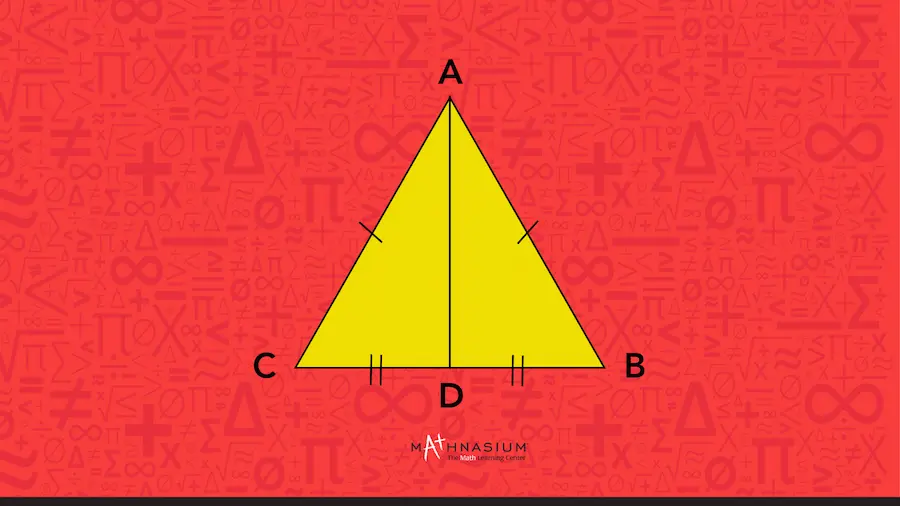
Given: AB ≅ AC and BD ≅ DC.
Prove: ∠BAD ≅ ∠DAC.
Plan: We want to compare the two smaller triangles, △ABD and △ACD. We already know that two pairs of their sides are congruent, and they share side AD. If we can show that the triangles are congruent, we can use their matching parts to compare the two angles.
|
Statement
|
Reason
|
|
1. AB ≅ AC.
|
Given
|
|
2. BD ≅ DC.
|
Given
|
|
3. AD ≅ AD.
|
Reflexive Property
|
|
4. ABD ≅ ACD.
|
Side-Side-Side (SSS) Congruence Theorem: If all three sides of one triangle are congruent to the three corresponding sides of another triangle, then the two triangles are congruent.
|
|
5. ∠BAD ≅ ∠DAC.
|
Theorem: Corresponding parts of congruent triangles are congruent (CPCTC).
|
Here’s how the reasoning develops:
-
Step 1: We start with the two pairs of sides the problem gives us as congruent, AB ≅ AC and BD ≅ DC.
-
Step 2: The two triangles share side, AD, so AD ≅ AD by the Reflexive Property.
-
Step 3: We now have three pairs of corresponding sides that are congruent, so we can use the SSS Congruence Theorem to show that △ABD ≅ △ACD.
-
Step 4: As we know, the triangles are congruent, so their corresponding parts are congruent too. That gives us ∠BAD ≅ ∠DAC by CPCTC.
📕 You May Also Like: Triangle Angle Sum and Exterior Angle Theorems Explained
Your Turn: Proof or Not?
Try spotting the difference between evidence that looks convincing and reasoning that actually proves something.
Read each argument and decide whether it is enough to support the conclusion. When it falls short, identify what would still need to be justified.
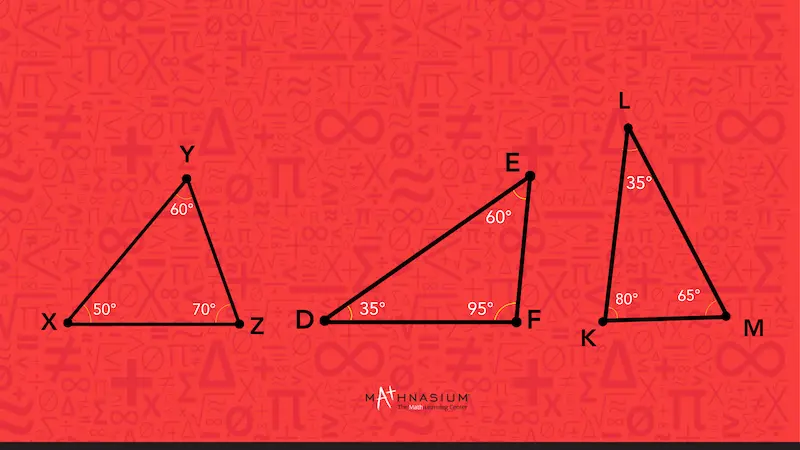
1. The angles in every triangle add up to 180°. Three triangles were drawn and measured, and the angles in each one added up to 180°.
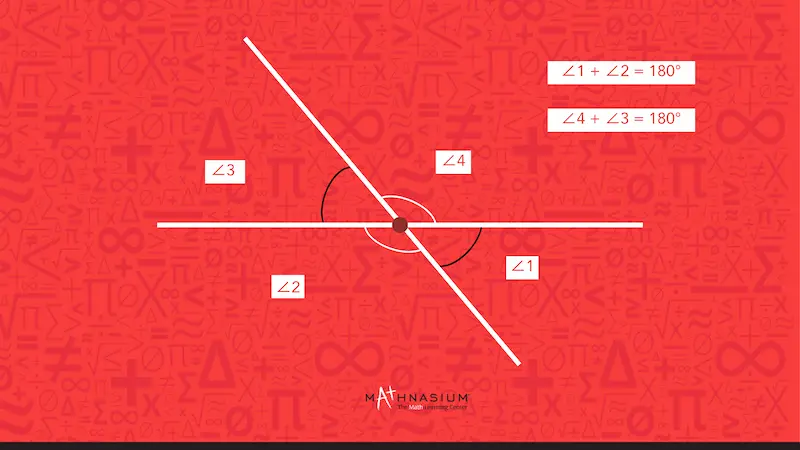
2. Vertical angles are congruent because both are supplementary to the same angle, so their measures are equal.
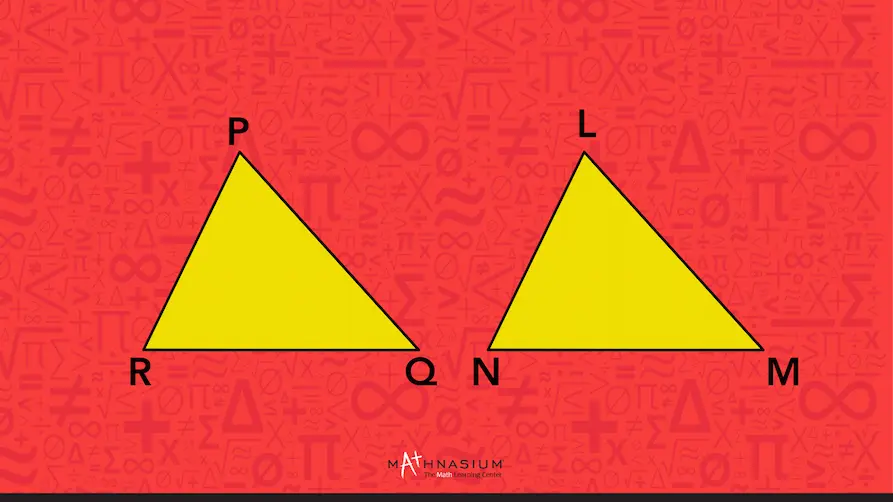
3. These two triangles are congruent because they look like they have the same size and shape.
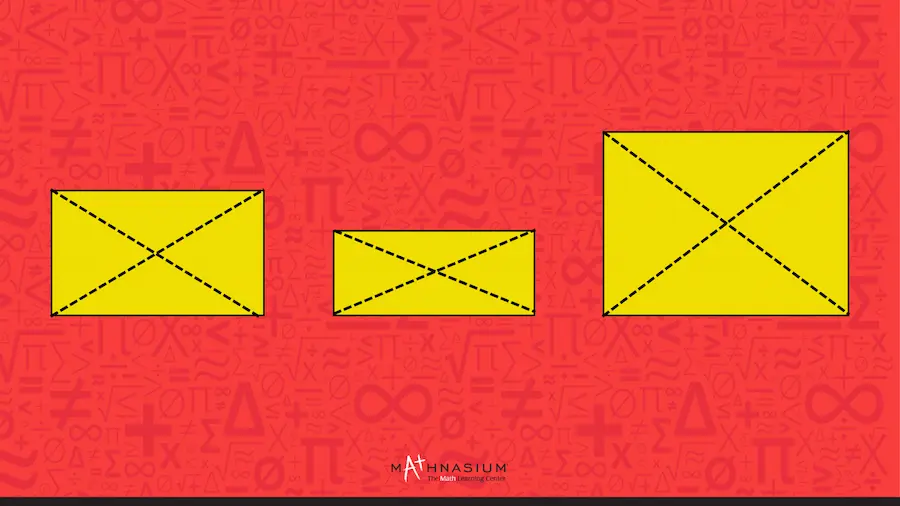
4. The diagonals of a rectangle are congruent. Four rectangles were tested using geometry software. As the corners were moved, the diagonals stayed equal.
You can check your answer at the bottom of the page.

Mathnasium tutors help students explain their reasoning, building the step-by-step thinking that geometry proofs require.
How Mathnasium Helps Students Make Sense of Geometry
Mathnasium is a math-only learning center dedicated to helping K–12 students of all skill levels excel in math.
When students turn to us for support, we help them build a deep understanding of math. With geometry proofs, that means learning to explain why each step follows from the one before it, rather than simply arriving at the right answer. That kind of reasoning supports work with angle relationships, theorems, equations, and more advanced geometry.
This is all part of our proprietary teaching approach, called the Mathnasium Method™. We meet students where they are and guide them forward step by step.
Each student begins with a diagnostic assessment that helps us understand their current skill level, knowledge gaps, goals, and how they think and feel about math. For students working with proofs, we may look at how comfortably they use angle relationships, solve equations, interpret diagrams, and explain their reasoning.
Using these insights, we create a personalized learning plan focused on the skills the student needs most.
Our specially trained tutors follow the plan closely and provide live, face-to-face instruction in a caring and fun group environment. They use mental, verbal, visual, tactile, and written techniques to help students organize their thinking, connect statements to reasons, and explain why each step is valid.
Students also get room to think through problems before tutors step in. Our tutors guide them to justify their reasoning and connect new conclusions to facts they already know. This helps students build critical thinking, logical reasoning, and greater independence in geometry.
Fun is part of the approach, too. We use game-based activities, rewards, and consistent encouragement to keep students engaged as they work through increasingly complex reasoning and geometry problems.
The results? True, measurable progress:
-
94% of parents report an improvement in their child's math skills and understanding
-
93% of parents report their child's improved attitude toward math after attending Mathnasium
-
90% of students saw an improvement in their school grades
With over 1,200 learning centers across North America, there is likely a Mathnasium close to you.
For families in and near Suwanee, GA, Mathnasium of Suwanee brings that same approach close to home, with specially trained tutors who help students make sense of proofs, angle relationships, and the geometry skills that build from them.
If your child needs support with geometry proofs or any other math topic, a free diagnostic assessment is a great place to start. Using what we learn, we create a personalized learning plan that helps your child strengthen the skills they need next.
📅 Schedule a Free Assessment at Mathnasium of Suwanee
Not near Suwanee?
📍 Find a Mathnasium Learning Center Near You
Check Your Answers Here
How did you do? Here’s which arguments are enough to prove the conclusion and which ones still fall short:
-
Not enough to prove it. Three measurements give us examples, but they don’t show that every triangle must work the same way.
-
Enough to prove it. The reasoning uses accepted facts about supplementary angles and equality to show that the vertical angles have the same measure. Each step is supported, so the conclusion follows logically.
-
Not enough to prove it. The triangles may look identical, but appearance alone doesn’t tell us for certain that their corresponding sides and angles are congruent.
-
Not enough to prove it. Testing rectangles with geometry software can help us notice a pattern, but it only checks the cases we try. It doesn’t explain why the diagonals must be congruent in every rectangle.


 (770) 273-9697