Think about editing a photo on your phone. You tap a button or drag your fingers across the screen, and the image changes. You might move it, flip it, rotate it, or resize it.
In geometry, we call these changes transformations. Today, we’ll look at the four main types of geometric transformations, see how each one changes a figure, and explore how they connect to later topics in geometry.

What Is a Geometric Transformation?
A geometric transformation changes a figure by moving each of its points to a new position. We call the original figure the pre-image and the transformed figure the image.
Imagine pressing a rubber stamp onto paper. Every point on the stamp lands on a matching point on the page. The design on the stamp is the pre-image, and the print it leaves behind is the image.
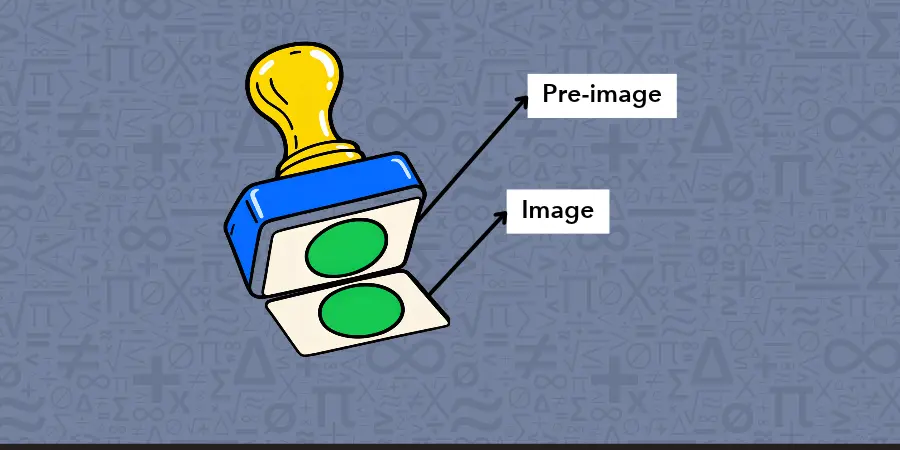
On a coordinate plane, we can describe a transformation by tracking how each point moves from its original position to its new one.
To keep track of matching points, we use prime notation. If point A is on the pre-image, its corresponding point on the image is written A′, read “A prime.” In the same way, B matches B′, and C matches C′.
At Mathnasium, we like connecting math concepts to everyday life to make them easier to understand. So here are a few more real-life examples of geometric transformations:
|
Real-life example
|
What happens to the figure
|
|
Trees reflected in a still lake
|
The image appears flipped across the water’s edge.
|
|
A clock hand moving around the center of a clock
|
The hand turns around a fixed point while keeping the same length and shape.
|
|
Zooming in on a map
|
Everything becomes larger, while the shapes keep the same proportions.
|
|
The same T-shirt design printed in different sizes
|
The design becomes larger or smaller without changing its overall shape.
|
Each example shows a figure changing in a different way. In geometry, we group these changes into four main types.

What Are the Types of Transformation in Geometry?
The four main types of geometric transformations are:
-
translation
-
reflection
-
rotation
-
dilation
We can also sort them into two groups, rigid and non-rigid transformations, depending on whether they keep the figure’s size and shape. Next, we’ll see which transformation types belong to each group.
To make the differences between the transformation types clearer, we’ll take the same triangle through each of them. Point A of the triangle is at (1,3), point B is at (1,1), and point C is at (4,1).
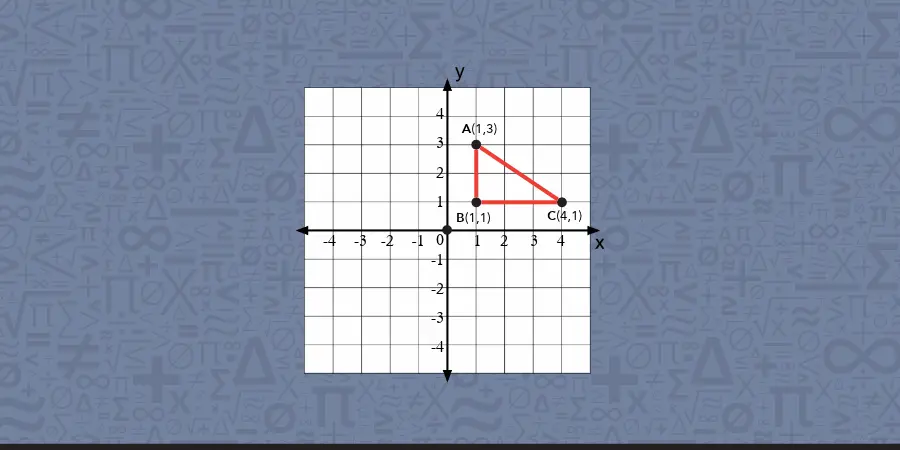
What Are Rigid Transformations?
Rigid transformations keep a figure’s size and shape the same. Its side lengths and angle measures do not change, so the image is the exact copy of the pre-image, even if it appears in a different position or orientation.
There are three main rigid transformations:
-
Translation
-
Reflection
-
Rotation
Let’s look at each one.
A. Translation
A translation slides every point of a figure the same distance, keeping its size, shape, vertex order, and the way it faces, in other words, its direction. The figure simply slides to a new position.
Suppose we want to move the point 3 units to the right and 2 units up. We add 3 to the x-coordinate and 2 to the y-coordinate:
(x, y) → (x + 3, y + 2)
If a represents the number of units a point moves horizontally and b represents the number of units it moves vertically, the translation follows this rule:
(x, y) → (x + a, y + b)
The signs of the a and b tell us the direction:
-
A positive a moves the point right, while a negative a moves it left.
-
A positive b moves the point up, while a negative b moves it down.
We’ll translate triangle ABC 4 units to the left and 1 unit up. We have three points to move: A(1, 3), B(1, 1), and C(4, 1).
To move each point 4 units left, we subtract 4 from its x-coordinate. To move it 1 unit up, we add 1 to its y-coordinate:
-
A(1, 3) → A′(1 -4, 3 + 1) → A′(-3,4)
-
B(1, 1) → B′(1 -4, 1 + 1) → B′(-3,2)
-
C(4, 1) → C′(4 -4, 1 + 1) → C′(0, 2)
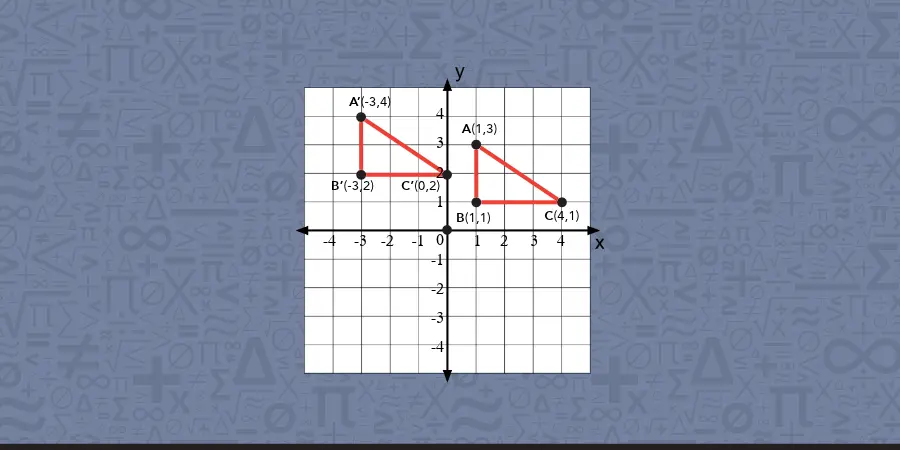
Triangle A′B′C′ is the translated image of triangle ABC. It faces the same direction as the original triangle but is in a new position.
B. Reflection
A reflection flips a figure across a line called the line of reflection. You can think of that line as a mirror. Each point on the image appears on the opposite side of the line, the same distance away as its matching point on the pre-image. The size and the shape of the figure stay the same.
On a coordinate plane, the line of reflection tells us which coordinates change. Let’s use our triangle ABC, with vertices A(1, 3), B(1, 1), and C(4, 1), to see what happens when we reflect it across three common lines.
|
Line of reflection
|
What happens to the coordinates?
|
Coordinate change
|
Our triangle becomes
|
|
x-axis
|
The x-coordinate stays the same, while the y-coordinate changes sign.
|
(x, y) → (x, -y)
|
A′(1, −3)
B′(1, −1)
C′(4, −1)
|
|
y-axis
|
The y-coordinate stays the same, while the x-coordinate changes sign.
|
(x, y) → (-x, y)
|
A′(−1, 3)
B′(−1, 1)
C′(−4, 1)
|
|
y = x
|
The x- and y-coordinates switch places.
|
(x, y) → (y, x)
|
A′(3, 1)
B′(1, 1)
C′(1, 4)
|
Here’s how each reflection looks on a coordinate plane.
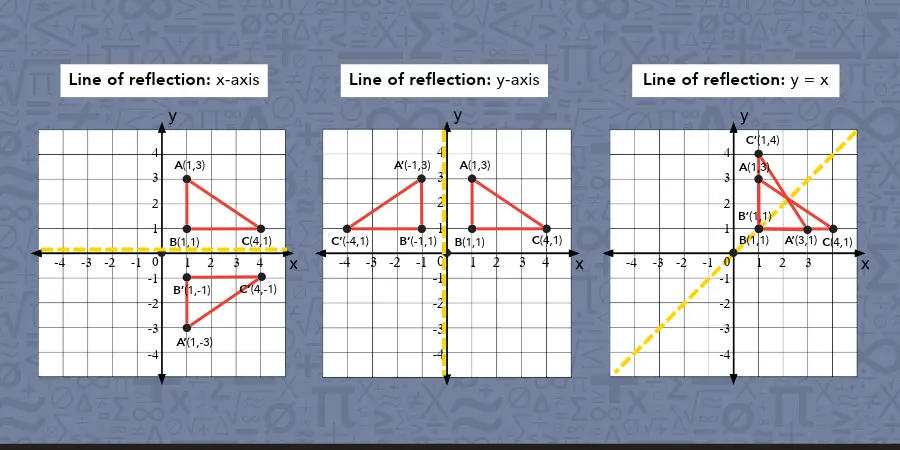
Notice that each reflected triangle keeps the same size and shape as the original, and each vertex stays the same distance from the line of reflection as its matching vertex on the other side.
What changes is the triangle’s orientation. By orientation, we mean the order in which the vertices go around the figure, clockwise or counterclockwise. After a reflection, that order reverses, which is why the figure looks flipped.
C. Rotation
A rotation turns a figure around a fixed point called the center of rotation. The figure keeps its size and shape, but its position and direction change as it turns.
To describe a rotation, we need three pieces of information:
-
the center of rotation, which tells us what point the figure turns around
-
the angle of rotation, which tells us how far it turns
-
the direction, either clockwise or counterclockwise. In geometry, counterclockwise rotations are usually considered positive because that is the direction we use for positive angle measures. Clockwise rotations go the opposite way, so we treat them as negative.
As a point rotates about the origin, its distance from the origin stays the same, but its horizontal and vertical directions change. To help you see how those changes affect the coordinates, our tutors put together the table below using triangle ABC, with vertices A(1, 3), B(1, 1), and C(4, 1).
|
Rotation
|
What happens to the directions?
|
What happens to the coordinates?
|
Coordinate change
|
Our triangle becomes
|
|
180°
|
Right becomes left; up becomes down.
|
Both coordinates stay in the same order but change signs.
|
(x, y) → (-x, -y)
|
A′(-1, -3)
B′(-1, -1)
C′(-4, -1)
|
|
90° counterclockwise
|
Right becomes up; up becomes left.
|
The coordinates switch places, and the original y changes sign.
|
(x, y) → (-y, x)
|
A′(-3, 1)
B′(-1, 1)
C′(-1, 4)
|
|
270° counterclockwise (same as 90° clockwise)
|
Right becomes down; up becomes right.
|
The coordinates switch places, and the original x changes sign.
|
(x, y) → (y, -x)
|
A′(3, -1)
B′(1, -1)
C′(1, -4)
|
Now, let’s see how those rotations show up on the coordinate plane.
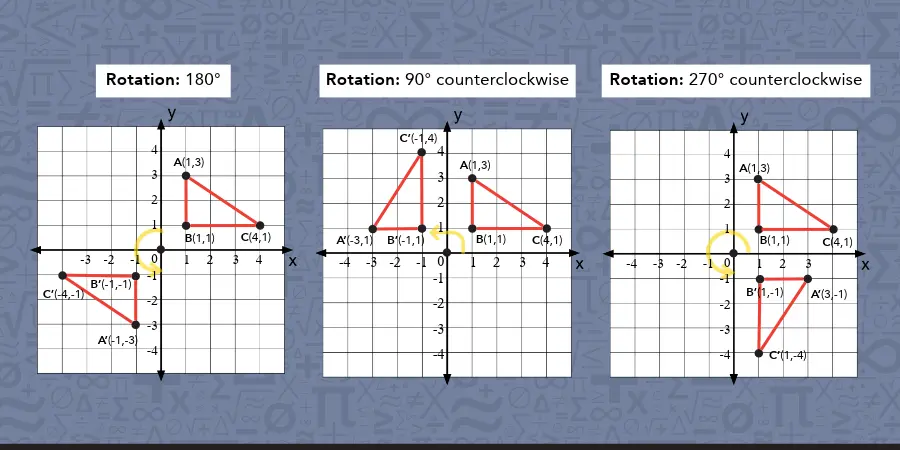
When we follow the vertices around the original triangle in order, the matching vertices still go around the rotated triangle in the same counterclockwise direction. This means the triangle’s orientation stays the same.
That’s the main difference between a rotation and a reflection: a rotation turns the figure but keeps the order of its vertices the same, while a reflection reverses that order and changes the figure’s orientation.
We’ve explored the three transformations that keep a figure’s size and shape the same. Next, we’ll look at the fourth transformation, which changes the figure’s size.
📕 You May Also Like: How to Use Origami to Teach Geometry - Kid-Friendly Guide
What Are Non-Rigid Transformations?
In a non-rigid transformation, the image can change its size or shape or both. Today, we’ll focus on dilation, which is the only non-rigid transformation among the four main types.
Dilation
A dilation makes a figure larger or smaller from a fixed point called the center of dilation, without changing its shape. The amount the figure changes is determined by a scale factor, we can write it as k.
-
If k > 1, the figure gets larger.
-
If 0 < k < 1, the figure gets smaller.
When the center of dilation is the origin, we multiply both coordinates of each point by the scale factor:
(x, y) → (kx, ky).
We’ll dilate triangle ABC by a scale factor of 2, with the origin as the center of dilation. A scale factor of 2 means every point will end up twice as far from the origin, so we multiply both coordinates of each vertex by 2:
-
A(1, 3) → A′(1 × 2,3 × 2) → A′(2, 6)
-
B(1, 1) → B′(1 × 2,1 × 2) → B′(2, 2)
-
C(4, 1) → C′(4 × 2,1 × 2) → C′(8, 2)
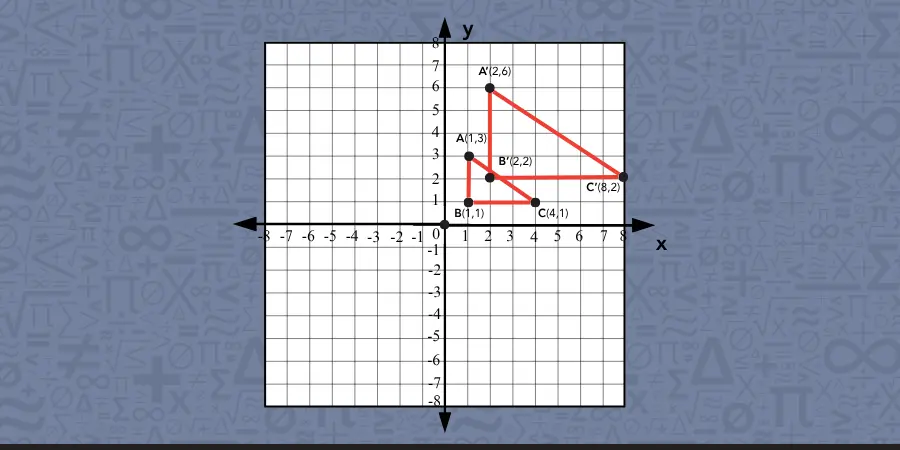
The image is twice as large as the original triangle, but its shape stays the same.
📕 You May Also Like: Is Your Student Ready for Their Geometry Class? [+Quiz]
Quick Overview of 4 Transformation Types in Geometry
Each transformation keeps some features of a figure and changes others. Our tutors put the key features of all four transformations in one place, so you can review them quickly before homework or a test:
|
Transformation
|
What happens to the directions?
|
What happens to the coordinates?
|
What stays the same
|
Rigid?
|
|
Translation
|
Slides every point the same distance in the same direction
|
Position
|
Size, shape, orientation
|
Yes.
|
|
Reflection
|
Flips a figure across a line
|
Orientation; usually position
|
Size, shape
|
Yes.
|
|
Rotation
|
Turns a figure around a fixed point
|
Position, direction
|
Size, shape, orientation
|
Yes.
|
|
Dilation
|
Enlarges or reduces a figure from a fixed center
|
Size; usually position
|
Shape, angle measures, orientation
|
No.
|
📕 You May Also Like: Geometry Vocabulary: 59 Terms for Students in Grades 1-8
Your Turn: Identify the Type of Transformation
For each problem, compare the coordinates of the pre-image and image to decide which transformation was used. If two transformations seem possible, check the order of the vertices for another clue.
Challenge 1
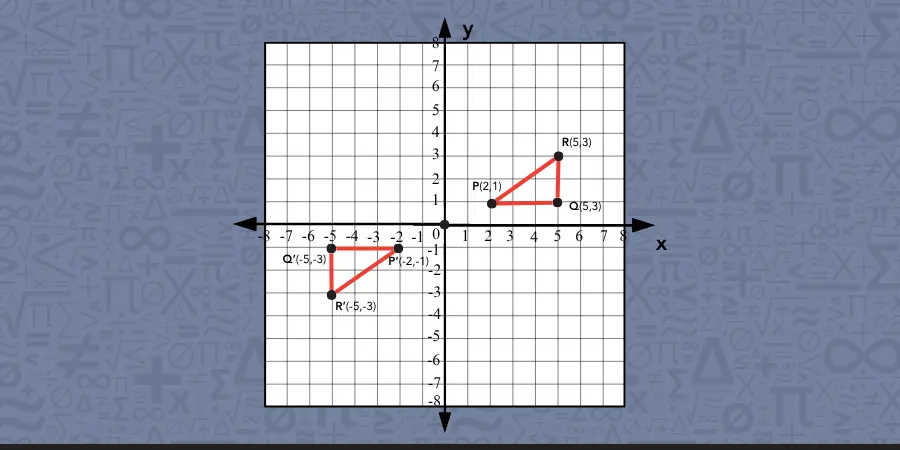
Triangle PQR with P(2, 1), Q(5, 1), and R(5, 3) maps to P′(−2, −1), Q′(−5, −1), and R′(−5, −3).
Challenge 2
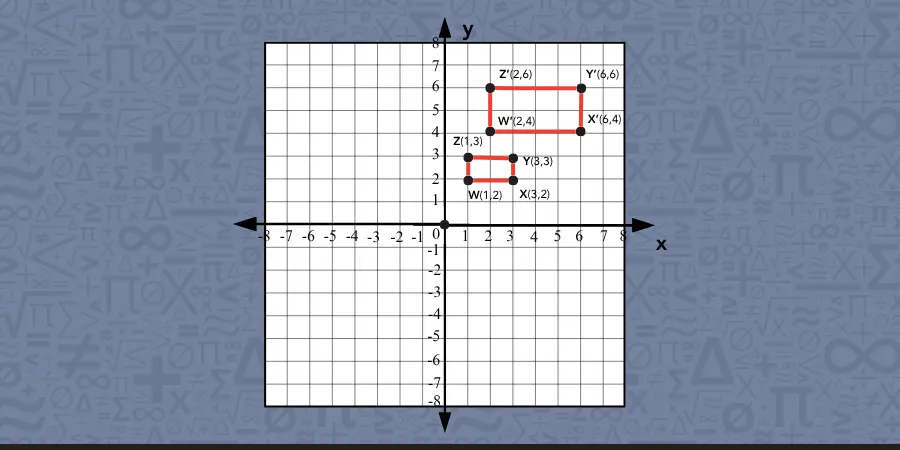
Rectangle WXYZ with corners W(1,2), X(3,2), Y(3,3), and Z(1,3) maps to W′(2,4), X′(6,4), Y′(6,6), and Z′(2,6).
Challenge 3
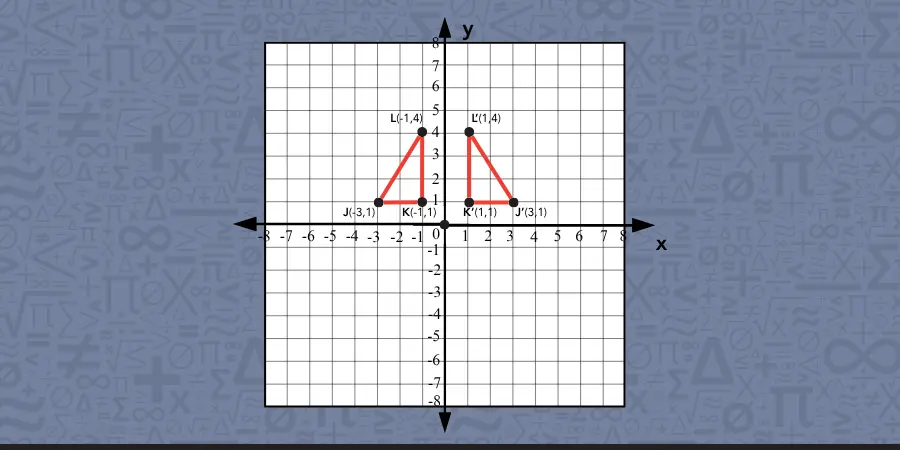
Triangle JKL with vertices J(-3,1), K(-1,1), and L(-1,4) maps to J′(3,1), K′(1,1), and L′(1,4).
Challenge 4
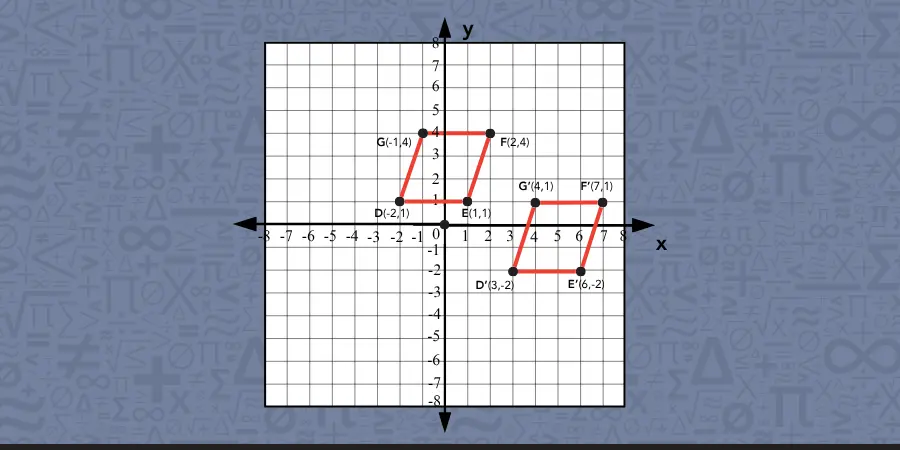
A quadrilateral (DEFG) with vertices D(-2, 1), E(1, 1), F(2, 4), and G(-1, 4) maps to D′(3, -2), E′(6, -2), F′(7, 1), and G′(4, 1).
You’ll find the answers at the bottom of the page.
📕 You May Also Like: Why Math Practice Matters & What Happens When Kids Skip It

Mathnasium tutors use different teaching techniques and hands-on models to help students better understand geometry concepts, such as transformations.
How Mathnasium Helps Students Make Sense of Transformations (and Other Geometry Topics)
Mathnasium is a math-only learning center dedicated to helping K–12 students of all skill levels excel in math.
Geometry becomes easier to understand when students can see how figures, coordinates, and measurements relate to one another. Transformations give students a clear way to explore those relationships by moving, flipping, turning, or resizing a figure and observing what changes and what stays the same. That reasoning also supports later work with congruence, similarity, and coordinate geometry.
At Mathnasium, we build that kind of connected understanding through the Mathnasium Method™, our proprietary teaching approach. We meet students where they are and guide them forward step by step.
Each student begins with a diagnostic assessment that helps us understand their current skill level, knowledge gaps, goals, and how they think and feel about math.
Using these insights, we create a personalized learning plan focused on the skills the student needs most, whether that means practicing coordinate-plane skills, working with negative numbers, comparing figures, or preparing for congruence and similarity.
Our specially trained tutors follow the plan closely and provide live, face-to-face instruction in a caring and fun group environment. They use mental, verbal, visual, tactile, and written techniques to help students see how transformations work. Students might draw figures on coordinate grids, compare corresponding points, rotate or reflect shapes, or use hands-on materials to track how a figure changes.
Students also get room to think through problems before tutors step in. Our tutors guide them to compare figures, identify what changed, explain what stayed the same, and check whether their reasoning fits the diagram. This helps students build critical thinking, spatial reasoning, and greater independence in math.
Fun is part of the approach, too. We use hands-on and game-based activities, rewards, and consistent encouragement to keep students engaged as they explore shapes, movement, coordinates, and geometric relationships.
Families see the difference:
-
94% of parents report an improvement in their child's math skills and understanding
-
93% of parents report their child's improved attitude toward math after attending Mathnasium
-
90% of students saw an improvement in their school grades
With over 1,100 learning centers across North America, there is likely a Mathnasium close to you.
For families in and near Winter Springs, FL, Mathnasium of Tuskawilla brings that same approach close to home, with specially trained tutors who help students make sense of transformations, the coordinate plane, and the geometry skills that build from them.
If your child needs support with transformations or any other math topic, a free diagnostic assessment is a great place to start. Using what we learn, we create a personalized learning plan that helps your child master the skills they need next.
📅 Schedule a Free Assessment at Mathnasium of Tuskawilla
Not near Winter Springs?
📍 Find a Mathnasium Learning Center Near You
Check Your Answers Here
Ready to see how you did? Here’s which transformation each problem shows and how we can tell.
Challenge 1
Rotation of 180° about the origin. Every point follows (x, y) → (-x, -y). It might look like a reflection, but the vertices still read in the same direction (counterclockwise), so the orientation didn’t reverse. A reflection would have reversed it.
Challenge 2
Dilation with a scale factor of 2. Every coordinate doubled, following (x, y) → (2x, 2y). The rectangle’s sides grew from 1 and 2 units to 2 and 4 units, and its shape stayed the same.
Challenge 3
Reflection over the y-axis. Every point follows (x, y) → (-x, y): the x-coordinates switched signs, and the y-coordinates stayed the same. The vertex order is reversed, which is the sign of a reflection.
Challenge 4
Translation 5 units right and 3 units down. Every point follows (x, y) → (x + 5, y - 3): the x-coordinates increased by 5, and the y-coordinates decreased by 3. The vertex order stays the same, which is what we expect from a translation.


 (407) 243-6284