0207 0787 000










Is Your Child Really Ready for Back to School? Here's What Parents Often Miss
Aug 21, 2026 |

The first few weeks of a new school year can be a whirlwind.
New teachers. New routines. New classmates. Harder work.
It's completely normal for children to take a little while to settle in.
But by the middle of September, many parents start to notice small changes.
Homework suddenly takes much longer. Your child says they "hate maths." They get frustrated over questions they used to answer confidently. Or their teacher mentions they've gone a bit quiet in class.
None of these are automatic causes for concern but they are worth paying attention to. The earlier you spot a child who's beginning to lose confidence, the easier it is to help them get back on track.
Yes. As lessons get harder and expectations rise, most children need a few weeks to find their rhythm. One tricky homework session, or one grumble about maths, doesn't mean your child is falling behind.
What matters is whether these moments become a pattern rather than a one-off. If they're still showing up several weeks in, they may be pointing to something more than settling-in nerves.
Children rarely say "I don't understand this." Instead, they tend to avoid the situation altogether, finding excuses to delay homework, getting distracted easily, asking for constant breaks, or insisting they'll "do it later."
This isn't laziness. A recent study of primary-aged children found that homework anxiety and avoidance tend to feed each other in a cycle: the more anxious a child feels about a task, the more they put it off and the more they put it off, the more overwhelming it feels by the time they sit down to do it (Frontiers in Psychology, 2024). Avoidance is very often one of the earliest signs that confidence is starting to dip, well before grades show it.
Few phrases are more worth noticing than a child starting to define themselves by their ability. Comments such as "I'm rubbish at maths," "everyone else gets it except me," or "I'm never going to understand this" suggest the problem has stopped being about the work and started being about identity.
This is the exact pattern Stanford psychologist Carol Dweck's research has spent decades examining. Her work distinguishes between children who believe ability is fixed and children who believe it can grow with effort and in a study following pupils into the harder coursework of secondary school, the children with a growth mindset persisted more and ended up with better grades, even though both groups started at a similar level (Blackwell et al., summarised by Child Mind Institute). Dweck's own suggested fix is simple: when a child says "I can't do this," the most useful reply is "you can't do this yet."
Confidence has a real influence on learning. Children who believe they can't succeed are far less likely to keep trying once the work gets harder.
It's normal for homework to be a struggle occasionally. But if every maths task ends in tears, arguments or a complete shutdown, it's worth asking why.
Often the issue isn't effort, it's that the work feels overwhelming because there's a gap in understanding somewhere earlier in the topic. Maths is a subject where each new idea is built directly on top of the last one, so a small, unaddressed gap tends to resurface and grow rather than disappear.
Many parents naturally help with homework. But if your child can't make any progress without step-by-step guidance, it may signal they're lacking the confidence to trust their own thinking, rather than lacking the ability itself.
One of the central goals of good maths teaching is building independent problem-solvers, children who are willing to try an approach, get it wrong and try another, rather than waiting to be told what to do next.
This is arguably the biggest sign of all, because it can show up before grades ever slip. Children may stop putting their hand up in class, rush through work assuming they'll get it wrong anyway, or quietly decide that maths "isn't for them."
The good news: confidence that's been lost can be rebuilt. It just tends to need a deliberate approach rather than time alone.
Because small gaps in maths understanding rarely stay small. Each new topic in maths builds on the one before it, so a shaky foundation in September tends to compound rather than resolve itself by the next parents' evening.
The stakes of leaving numeracy gaps unaddressed are well documented at a population level, too, UK research has linked persistently low numeracy in childhood to a materially higher risk of unemployment, lower lifetime earnings and poorer mental and physical health in adulthood (systematic review protocol, PMC). That's not a reason to panic over a single tricky homework session, but it is a reason to treat an early, consistent pattern seriously rather than hoping it resolves on its own.
Addressing concerns early doesn't mean assuming there's a serious problem. It means giving your child support before they lose more confidence than they need to.
Not by children becoming better at maths first and feeling confident second, it usually works the other way round. When a child experiences a genuine success, understands why an answer works rather than just memorising the steps and discovers they can solve something independently, confidence starts to grow. That confidence then makes them more willing to engage in lessons, take on new challenges and cope with getting things wrong.
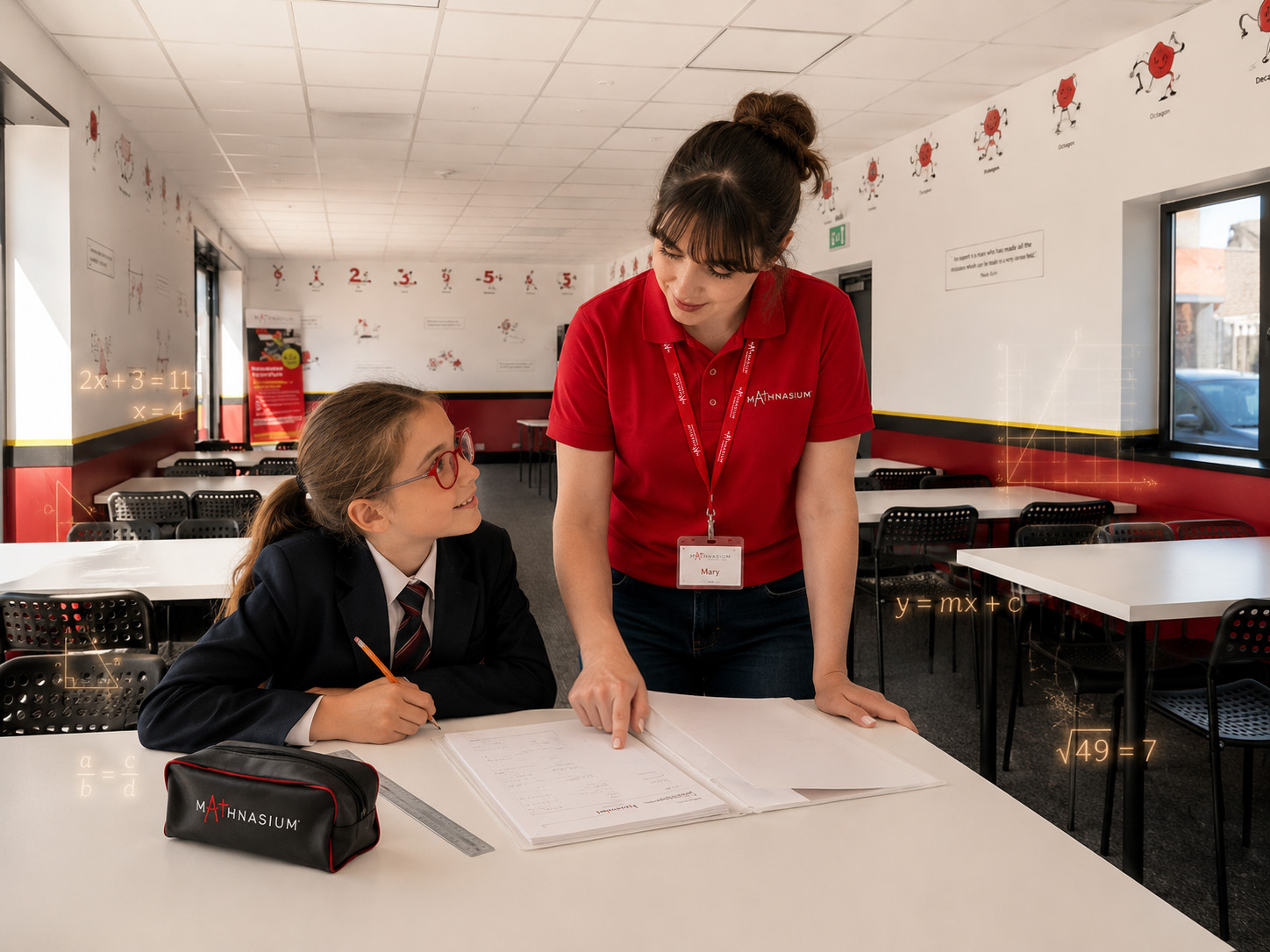
This is exactly what the Mathnasium Method™ is built around. Through personalised learning plans and instructors who focus on understanding rather than rote procedure, we help children close the specific gaps holding them back and rebuild the confidence that makes progress stick.
How do I know if my child's maths struggles are normal settling-in nerves or something more? A one-off difficult homework session is normal. Consistent avoidance, frustration, or negative self-talk about maths over several weeks is worth paying attention to and if it continues, worth getting support for.
What should I say if my child says "I'm bad at maths"? Try reframing it around effort rather than ability, for example, "you haven't learned how to do this yet" rather than agreeing or disagreeing with the statement. This keeps the door open for progress rather than confirming a fixed identity.
Can a child recover confidence in maths once they've lost it? Yes. Confidence generally returns through small, genuine successes and a clearer understanding of why methods work, rather than through reassurance alone.
Every child has moments when school feels difficult. That doesn't mean they're destined to struggle, it means it's worth noticing whether a temporary wobble is turning into a pattern.
If you've noticed your child avoiding homework, getting frustrated with maths, or starting to doubt their own ability, now is a good time to act.
Book a free assessment at your local Mathnasium Learning Centre and let us show you how personalised maths learning can help your child build confidence, close knowledge gaps, and enjoy a more successful school year.