How many times have you drawn a simple house with a triangle for the roof? Probably countless, but if you made the two sloping sides the same length, you were, in fact, drawing an isosceles triangle.
You’ll come across the same shape in geometry problems, where recognizing it can help you work out angles and other measurements.
We’re a team of math educators at Mathnasium, and today we’ll look at its main properties and types, learn how to find missing angles, see a few real-life examples, and put your knowledge into practice.
What Makes a Triangle Isosceles?
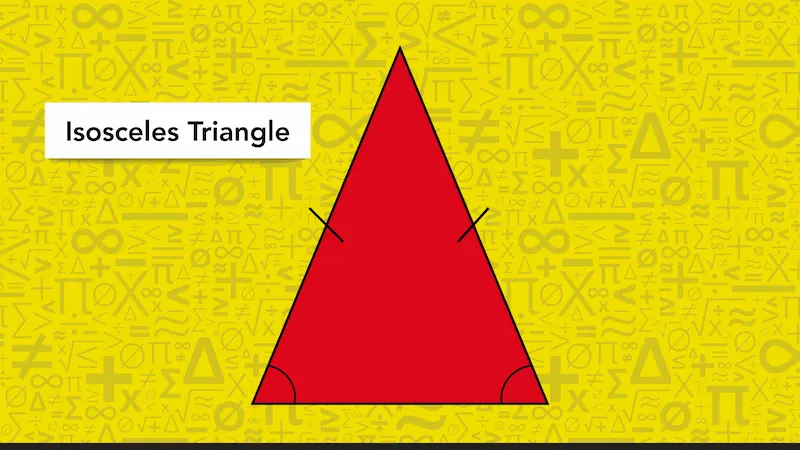
An isosceles triangle has two sides of the same length and two angles of the same measure opposite them.
To put the definition into practice, let’s imagine a triangle with sides measuring 5 cm, 5 cm, and 8 cm. Since two sides measure 5 cm, we can identify it as isosceles.
In any triangle, equal sides have equal angles opposite them, so the angles across from the two 5 cm sides must have the same measure.
You may also see a broader definition that describes an isosceles triangle as having at least two sides of the same length. Under that definition, equilateral triangles count as isosceles too because all three sides have the same length.
Some textbooks and classrooms use the term "isosceles" only when two sides match, and the third has a different length, so either definition may come up depending on the convention being used.
📕 You May Also Like: Equilateral Triangles Simplified: Properties, Formulas & Features
Parts and Properties of an Isosceles Triangle
Isosceles triangles have several parts that help us describe how their sides and angles relate to one another. We use specific terms to name each one:
-
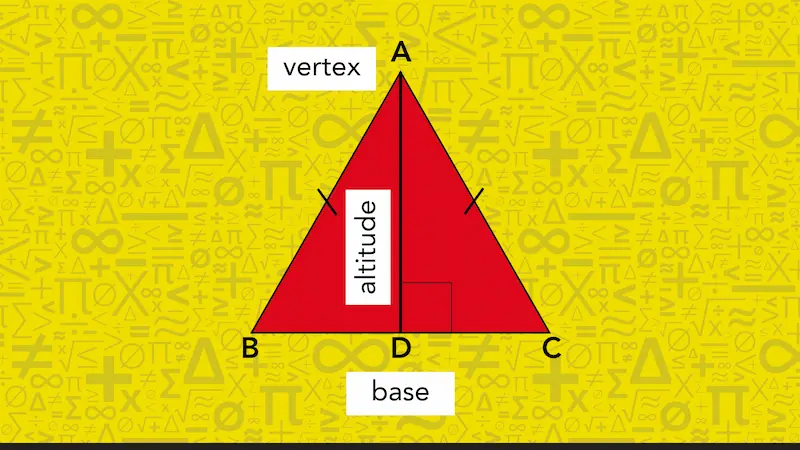
The vertex angle is the angle formed by the two equal sides.
-
The base is the side opposite the vertex angle.
-
Base angles are the two equal angles opposite the equal sides.
We can see more of the triangle’s properties by drawing an altitude from the vertex angle to the base. In an isosceles triangle, the altitude meets the base at 90°, divides it into two equal segments, and splits the vertex angle in half. It also creates two congruent right triangles of the same size and shape.
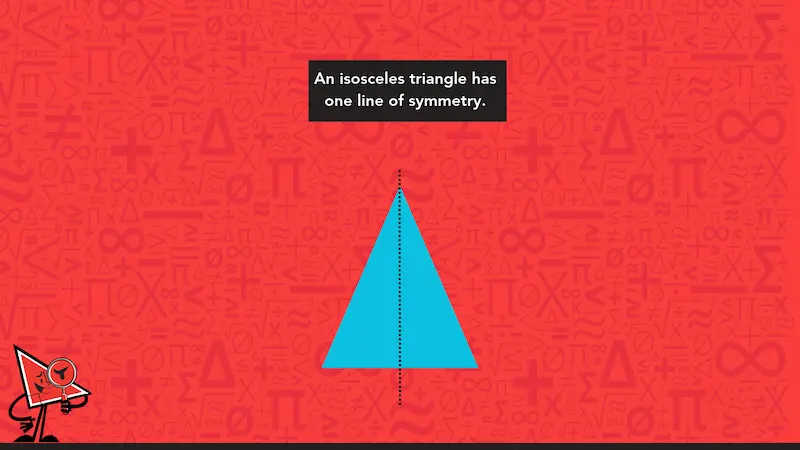
For a triangle with two equal sides, the altitude also lies along its line of symmetry. If we folded the triangle along that line, its two halves would fit over each other.
Besides being equal, the two base angles are always acute, which means each measures less than 90°. Why does that have to be true?
All three interior angles of a triangle add up to 180°. If both base angles measured 90°, they would already total 180°, leaving no room for the vertex angle. Any larger measurement would push the total past 180°, so each base angle must be less than 90°.
📕 You May Also Like: Types of Angles in Geometry: A Kid-Friendly Guide
Types of Isosceles Triangles
To classify an isosceles triangle further, we look at the size of its angles. Depending on their measurements, we can sort isosceles triangles into three categories.
Let’s look at each one.
A. Acute Isosceles Triangle
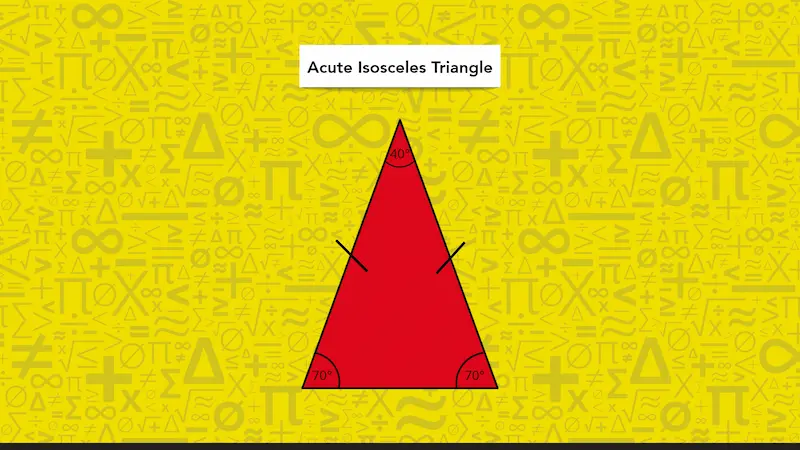
All three angles in an acute isosceles triangle measure less than 90°.
For example, the angles could measure 40°, 70°, and 70°, with the two equal 70° angles forming the base angles and 40° forming the vertex angle.
B. Right Isosceles Triangle
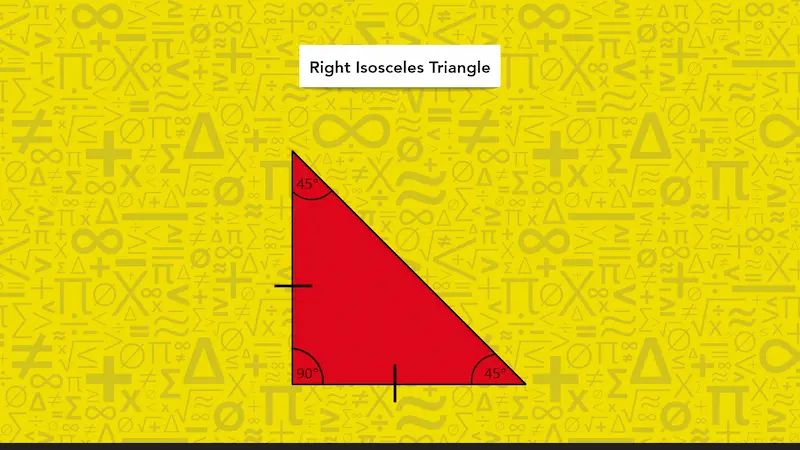
One angle in a right isosceles triangle measures 90°.
The other two angles are equal, so they each measure 45°, giving us the familiar 45°-45°-90° triangle.
C. Obtuse Isosceles Triangle
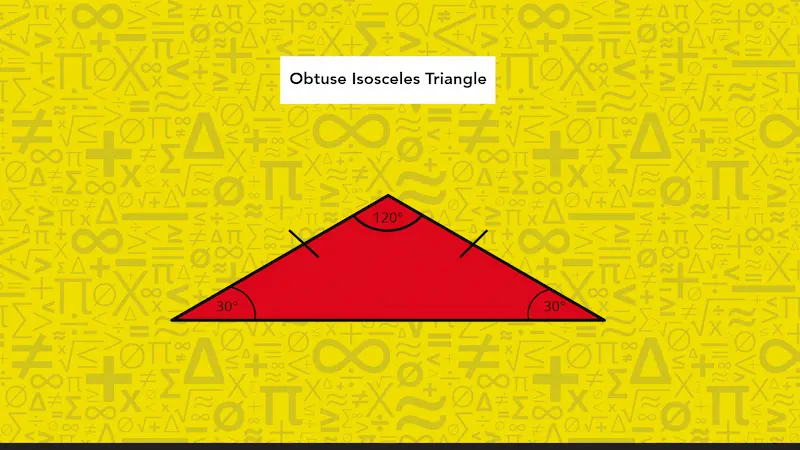
With an obtuse isosceles triangle, one angle measures more than 90°. Both base angles remain equal and acute, so the obtuse angle must be the vertex angle.
For instance, the angles could measure 120°, 30°, and 30°, with the two equal 30° angles forming the base angles.
📕 You May Also Like: Types of Triangles: How to Classify by Sides and Angles (Grades 4–8)
How to Find Missing Angles in an Isosceles Triangle
To find a missing angle in an isosceles triangle, we use the 180° total together with the fact that its two base angles are equal.
The angle we already have determines what we need to calculate next. We can break the method into two cases:
-
If we know the vertex angle, we subtract it from 180°. The two equal base angles make up what remains, so we divide the result by 2.
-
If we know one base angle, we use the same value for the other. We add the two angles and subtract their total from 180° to find the vertex angle.
Let’s see how each calculation works with a worked example.
1. We Know the Vertex Angle
Suppose the vertex angle measures 76°. We start by subtracting it from 180°, which leaves 104° for the two base angles: 180° − 76° = 104°.
Since they have the same measure, we divide 104° by 2 to get 52° for each one.
We can now check our answer by adding all three angles: 76° + 52° + 52° = 180°, so our measurements work.
2. We Know the Base Angle
Let’s consider one base angle that measures 63°. Its matching angle must also measure 63°, so together they total 63° + 63° = 126°.
We then subtract 126° from the 180° total to find what remains. The calculation 180° − 126° = 54° gives us the vertex angle, so it measures 54°.
To check our answer, we add all three angles: 63° + 63° + 54° = 180°, which is the total we should get.
📕 You May Also Like: Triangle Angle Sum and Exterior Angle Theorems Explained
3 Real-World Examples of Isosceles Triangles
Objects and designs may not always form mathematically perfect isosceles triangles, but they can still show the same arrangement of two equal sides and two equal opposite angles outside of geometry problems.
Here are three places where that relationship can appear.
A. Clothes Hanger
Many triangular clothes hangers have two matching sloping sides that meet near the hook. When those sides have the same length, they form the equal sides of an isosceles triangle, while the bottom bar forms its base.

Believe it or not, geometry might be hanging in your closet.
B. Pizza or Cake Slice
Slices cut from the center of a circular pizza or cake can show the same geometry. Both straight sides of the slice run from the center to the edge of the circle, which makes them radii. Since all radii in the same circle have the same length, those two sides can form the equal sides of an isosceles triangle.
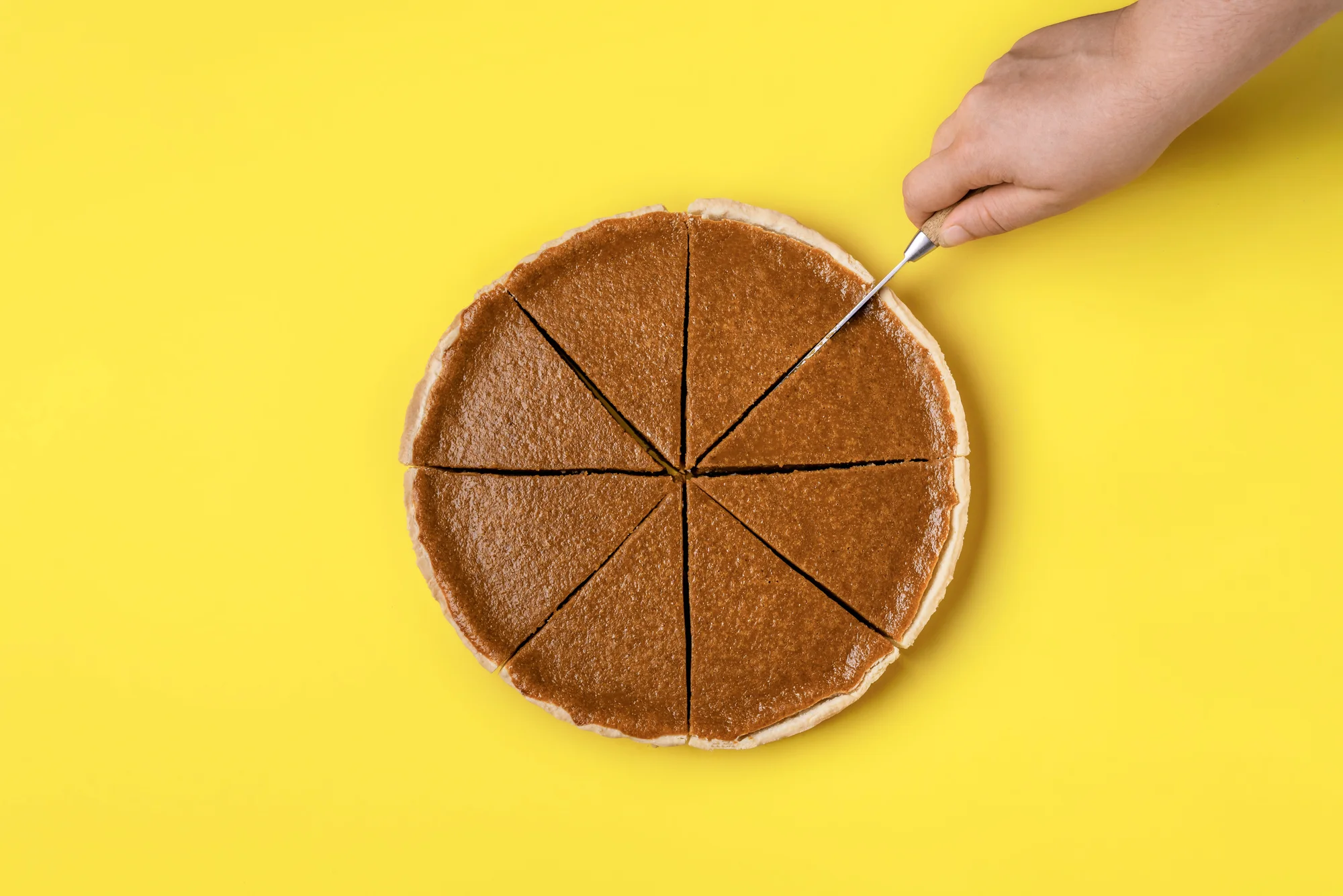
Math lesson or dessert? Sometimes it’s both.
C. Triangular Pennant
Symmetrical triangular pennants can have an isosceles outline. Their two sloping sides have the same length and meet at the bottom point, while the top edge forms the base.
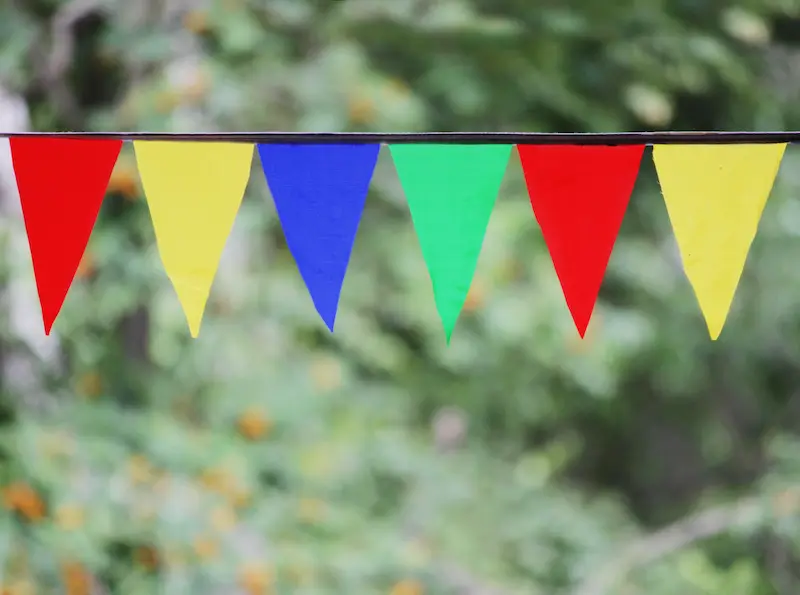
Who knew a string of colorful pennants could double as a row of isosceles triangles?
📕 You May Also Like: Geometry in Real Life: How We Use Shapes, Angles, and Measurements
Over to You! Practice With Isosceles Triangles
If you’re ready to practice on your own, try these isosceles triangle challenges using what we’ve covered so far.
-
The vertex angle of an isosceles triangle measures 84°. What is the measure of each base angle?
-
One base angle of an isosceles triangle measures 58°. What is the measure of the vertex angle?
-
An isosceles triangle has a vertex angle of 100°. Can this triangle exist? If so, what are the measures of its two base angles, and what type of isosceles triangle is it?
Work through each one before checking your answers at the end of the article.
📕 You May Also Like: 2D Shape Names: The Complete List from 3 to 12 Sides (Grades 3–7)
FAQ About Isosceles Triangles
We’ve still got a few interesting questions about isosceles triangles to answer, so let’s look at them together.
1. Can an isosceles triangle also be a scalene triangle?
No. An isosceles triangle has at least two sides of the same length, while a scalene triangle has three sides of different lengths. A triangle cannot satisfy both definitions at the same time.
2. Where does the name “isosceles” come from?
The name "isosceles" comes from two Greek words that describe the triangle itself. "Isos" means “equal,” and "skelos" means “leg.” In geometry, the two equal sides of an isosceles triangle are traditionally called its legs, so the name literally points to those two sides having the same length.
3. When do students learn about isosceles triangles?
Students typically start learning about isosceles triangles in Grades 3–5, when they learn to recognize and classify triangles by their sides and angles.
From Grade 6 onward, students use those properties in more advanced geometry problems involving angles, symmetry, and congruence.
📕 You May Also Like: 9 Examples of Symmetry in Nature, Art & Architecture

At Mathnasium, we take our students on a learning journey through assessment, customized learning paths, and targeted lessons to build understanding and comprehension.
How Mathnasium Helps Students Master Geometry and Any Other Math Concept
Mathnasium is a math-only learning center dedicated to helping K–12 students of all skill levels excel in math.
Isosceles triangles can bring several geometry skills together. Students learn to classify them by their sides and angles, recognize their symmetry, and use angle relationships to find missing measurements.
As students move into more advanced geometry, they build on the same skills while working with other shapes, theorems, and proofs.
Our specially trained geometry tutors support students across K–12 geometry, from the properties and measurements of geometric figures to transformations, coordinate geometry, and logical reasoning.
We make that possible through the Mathnasium Method™, our proprietary teaching approach designed around each student's needs and learning style. Our approach includes:
-
Assessment and Personalized Learning Plans: Each student begins their Mathnasium journey with a diagnostic assessment that identifies current skills, strengths, and knowledge gaps. From those findings, we build a personalized learning plan based on what they need to work on next, whether that means triangle properties and angles or more advanced geometry topics.
-
Teaching for Understanding: Our tutors teach students how and why the math works rather than relying on memorized steps alone. They use mental, verbal, visual, tactile, and written techniques to explain concepts in different ways and help students understand the relationships behind them.
-
Problem-Solving and Critical Thinking: Students have opportunities to think through problems, try different approaches, and explain their reasoning. Our tutors provide guidance when needed while encouraging students to take an active role in finding solutions and developing their problem-solving skills.
-
An Engaging and Fun Learning Environment: Mathnasium combines face-to-face instruction with activities, games, and rewards that recognize students’ effort and progress. Students can practice new skills in a supportive setting, experience success, and build confidence as they move forward.
The impact extends beyond the classroom:
-
94% of parents report an improvement in their child's math skills and understanding
-
93% of parents report their child's improved attitude toward math after attending Mathnasium
-
90% of students saw an improvement in their school grades
With over 1,100 learning centers across North America, there is likely a Mathnasium close to you.
Whether your student is looking to catch up, keep up, or get ahead in math, your local Mathnasium center can help.
Start by booking a diagnostic assessment, and together we'll create a personalized plan for math mastery.
Pssst! Check Your Answers Here
If you’ve given our challenges a try, see how you did below.
-
Subtract 84° from 180° to get 96° for the two base angles. Next, divide 96° by 2 to get 48°. Each base angle is 48°.
-
Both base angles measure 58°, so together they total 116°. We subtract 116° from 180° to get 64°. The vertex angle is 64°.
-
Subtract 100° from 180° to get 80° for the two base angles. Then, divide 80° by 2 to get 40° for each one. The angles 100° + 40° + 40° = 180°, so the triangle can exist. Since the vertex angle is greater than 90°, it is an obtuse isosceles triangle.