The Pythagorean theorem and right triangles go hand in hand because their 90° angle determines how the three side lengths fit together (a² + b² = c²).
If we change that angle to measure less or more than 90°, we are dealing with a different triangle type, and the same relationship no longer holds.
We are a team of math educators at Mathnasium, and today we’ll show how to tell what kind of triangle we have from its side lengths and choose the right method from there.
We’ll also explain when the Law of Cosines comes into play and answer common questions about triangles and the Pythagorean theorem.

Quick Review: What Is the Pythagorean Theorem?
The Pythagorean theorem is a rule in geometry that helps us find side lengths in a right triangle. It states that the sum of the squares of the two legs equals the square of the hypotenuse.
In other words, if we know the lengths of any two sides in a right triangle, we can use this relationship to find the missing third side.
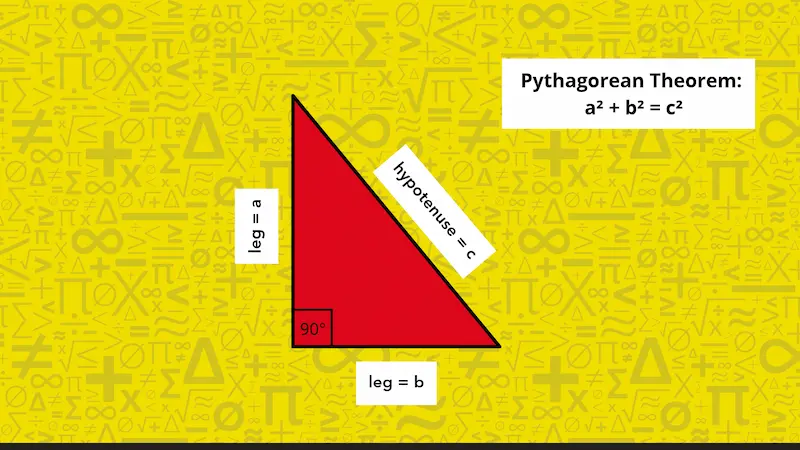
To put that relationship into a formula, we write:
a² + b² = c²
Here is what each letter represents:
-
a and b are the legs, or the two sides that meet at the 90° angle.
-
c is the hypotenuse, the longest side of a right triangle, which sits opposite the 90° angle.
You’ll also see a small raised 2 (²) beside each letter. We read it as “squared,” which means multiplying a number by itself. For example, 4 squared (4²) is 4 × 4 = 16.
📕 You May Also Like: How to Find the Hypotenuse Using the Pythagorean Theorem
How to Tell If the Pythagorean Theorem Holds for a Triangle
We can tell whether the Pythagorean theorem holds for a triangle by comparing the square of its longest side with the sum of the squares of the other two sides. If the two values are equal, the triangle is right (90°), and the theorem holds.
We can make that comparison in three steps:
-
Label the longest side c and the other two sides a and b.
-
Square all three values.
-
Add a² + b² and compare the result with c².
For example, let’s look at a triangle with side lengths 6, 8, and 10. To see whether these side lengths follow the Pythagorean relationship, we start with the formula a² + b² = c².
-
We substitute 6 for a, 8 for b, and 10 for c, which gives 6² + 8² = 10².
-
Next, we square each number to get 36 + 64 = 100.
-
Once we add 36 + 64, we get 100 = 100.
Here, both sides are equal, so we can conclude that the triangle is right, and the Pythagorean theorem applies.
If the two values do not match, the direction of the comparison tells us whether the triangle is acute or obtuse:
-
a² + b² > c² means the triangle is acute, so all three angles are smaller than 90°.
-
a² + b² < c² means the triangle is obtuse, so one angle is larger than 90°.
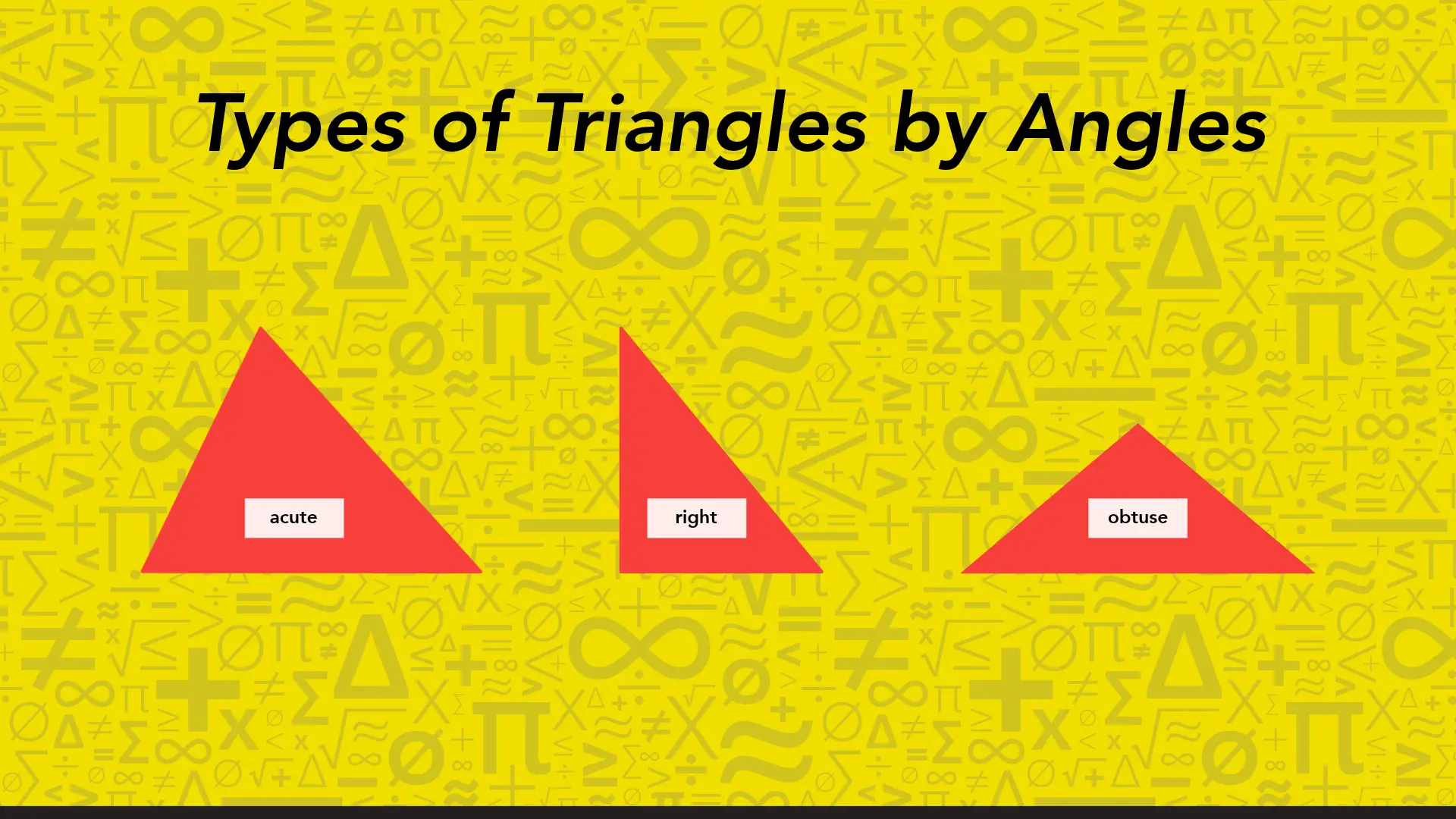
Here is how the comparison looks for all three types of triangles based on their angles:
|
Everyday Situation
|
Number
|
Fraction Form
|
Triangle type
|
|
4, 5, 6
|
4² = 16, 5² = 25, 6² = 36
|
16 + 25 = 41 > 36
|
Acute
|
|
3, 4, 5
|
3² = 9, 4² = 16, 5² = 25
|
9 + 16 = 25
|
Right
|
|
3, 5, 7
|
3² = 9, 5² = 25, 7² = 49
|
9 + 25 = 34 < 49
|
Obtuse
|
📕 You May Also Like: Types of Triangles: How to Classify by Sides and Angles (Grades 4–8)
How to Use the Pythagorean Theorem on Isosceles and Equilateral Triangles
Up to now, we’ve classified triangles by their angles to see whether the Pythagorean relationship holds, but triangles can also be classified by their side lengths.
Here, we’ll focus on isosceles (2 equal sides) and equilateral triangles (3 equal sides) because their equal sides let us divide them into two matching right triangles and use the theorem to find their altitude, or height.
Scalene triangles do not have the same equal-side structure, so this particular method does not apply in the same way.
To create the right triangles, we draw an altitude from a vertex to the opposite side, or base, at a 90° angle. For an isosceles triangle, the altitude starts at the vertex where the two equal sides meet.
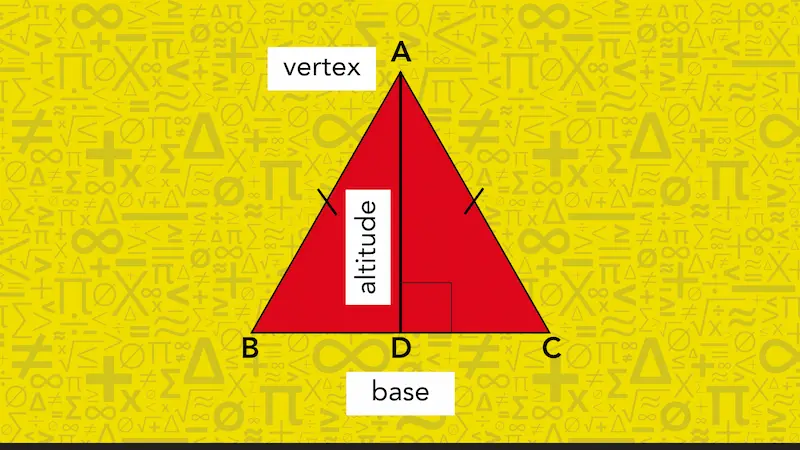
With an equilateral triangle, we can start at any vertex because all three sides are equal.
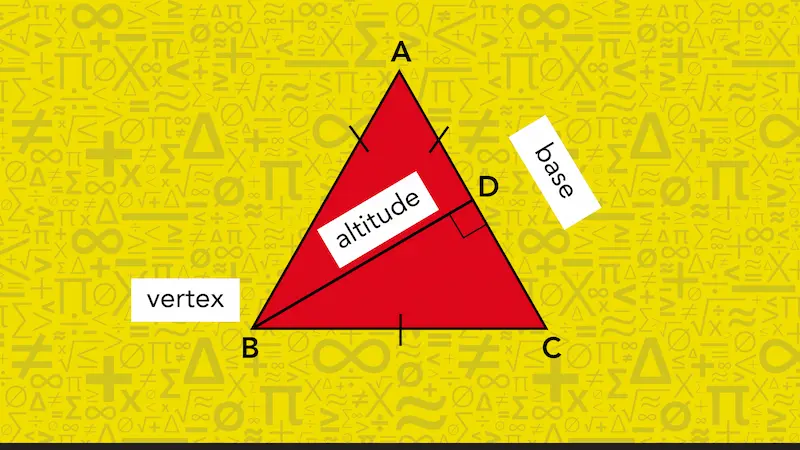
In both cases, the altitude divides the base into two equal parts. If we focus on one of these right triangles, half of the base and the altitude form the two legs, while the equal side is the hypotenuse.
To find the altitude, we follow three steps:
-
Divide the base by 2 to find the length of one leg.
-
Write the Pythagorean equation using half of the base for one leg, h for the altitude, and the equal side for the hypotenuse: (half the base)² + h² = (equal side)².
-
Substitute the side lengths and solve for h.
Now, let’s put the method into practice.
1. Isosceles Triangle
Suppose an isosceles triangle has two equal sides of 10 and a base of 12. We want to find its altitude, and the three steps show us how:
-
Divide the base by 2. The altitude splits the 12-unit base into two equal parts, so we divide 12 by 2 to find the length of one leg: 12 ÷ 2 = 6.
-
Write the Pythagorean equation. We use 6 for half of the base, h for the altitude, and 10 for the hypotenuse: 6² + h² = 10².
-
Substitute the side lengths and solve for h. We get 36 + h² = 100. After we subtract 36 from both sides, h² = 64, which gives us h = 8.
The altitude of the isosceles triangle is 8 units.
2. Equilateral Triangle
Consider an equilateral triangle with side lengths of 6. Since all three sides are equal, whichever side we choose as the base also measures 6. We want to find its altitude, so let’s follow the same three steps:
-
Divide the base by 2. Each half of the 6-unit base becomes one leg of the right triangle, so we find its length by dividing 6 by 2 to get 3.
-
Write the Pythagorean equation. This time, half of the base is 3, the altitude is h, and the hypotenuse is 6, so we write: 3² + h² = 6².
-
Substitute the side lengths and solve for h. We get 9 + h² = 36. Next, we subtract 9 from both sides to get h² = 27, so h = \(\sqrt{27} = 3\sqrt{3}\) ≈ 5.2.
The altitude of the equilateral triangle is approximately 5.2 units.
📕 You May Also Like: Equilateral Triangles Simplified: Properties, Formulas & Features
Bonus: What Is the Law of Cosines?
The Law of Cosines is a rule that connects the three side lengths of a triangle with one of its angles. We can use it with any triangle, whether it is acute, right, or obtuse.
For students who already know the Pythagorean theorem, the Law of Cosines takes that familiar relationship one step further by including the measure of an angle. We write one version of the formula as:
c² = a² + b² − 2ab cos(C)
Here is what each part means:
-
a, b, and c are the three side lengths.
-
C is the angle opposite side c. Sides a and b meet to form this angle.
-
cos(C) is read as “cosine of C.” Its value depends on the measure of angle C.
-
−2ab cos(C) uses that value to bring angle C into the calculation.
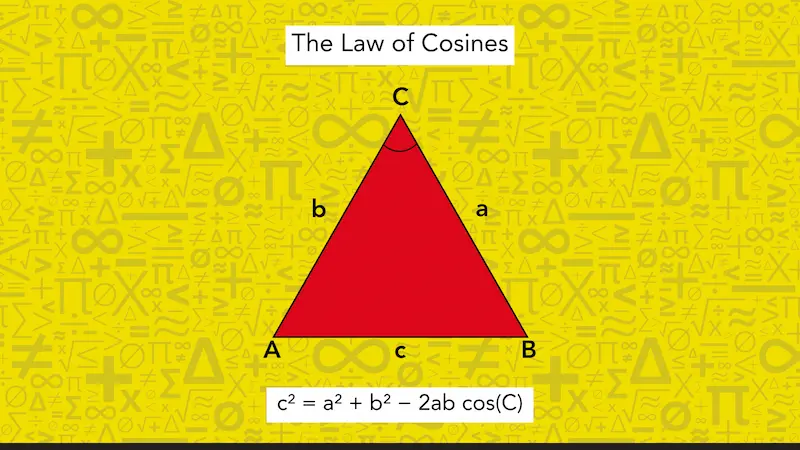
Students typically meet the Law of Cosines later, in high school geometry or trigonometry. We’ll keep it conceptual here and focus on how it connects to the Pythagorean theorem.
Angle C can be acute, obtuse, or right, and its cosine changes with it. Let’s see what each possibility means for the relationship between the side lengths.
-
If C < 90°, the angle is acute, and its cosine is positive. The Law of Cosines gives us c² < a² + b².
-
If C > 90°, the angle is obtuse and its cosine is negative. Here, we have c² > a² + b².
-
If C = 90°, the angle is right and its cosine is 0. With the cosine part reduced to 0, the equation becomes c² = a² + b², which is the Pythagorean theorem.
So, the Pythagorean theorem is the version we get from the Law of Cosines when C = 90°. For other angle measures, the cosine part remains in the equation.
📕 You May Also Like: Real-Life Applications of Trigonometry
Over to You: Triangle and Pythagorean Theorem Practice Problems
Now it’s your turn to put what we’ve worked through into practice. Grab a pencil and see if you can solve these four challenges.
-
The side lengths of a triangle are 5, 12, and 13. Is the triangle acute, right, or obtuse?
-
An isosceles triangle has two equal sides measuring 13 and a base of 10. What is its altitude?
-
Consider a triangle with side lengths 7, 8, and 10. Is it acute, right, or obtuse?
-
In a right triangle, the two legs measure 8 and 15. What is the length of the hypotenuse?
You’ll find the solutions at the end of the article, so finish all four before you take a peek.
📕 You May Also Like: ‘When Will I Ever Use the Pythagorean Theorem?’ Here Are 7 Real-Life Answers
FAQ About Triangles and the Pythagorean Theorem
Before we wrap up, let's look at a few other questions that often come up when students study triangles and the Pythagorean theorem.
1. Can any three side lengths form a triangle?
Three side lengths can form a triangle only if the sum of the two shorter sides is greater than the longest side. For example, 5, 7, and 9 can form a triangle because 5 + 7 > 9.
If the two shorter sides add up to the longest side or less, the lengths cannot form a triangle. We call this rule the triangle inequality theorem, and we can use it to check whether three given side lengths can form a triangle before we classify it.
2. What is a Pythagorean triple?
We call three positive integers that satisfy a² + b² = c² a Pythagorean triple. For instance, 3, 4, and 5 form one because 3² + 4² = 5².
We can create another Pythagorean triple if we multiply all three numbers by the same positive integer. If we double 3, 4, and 5, we get 6, 8, and 10, which also satisfy the Pythagorean theorem.
3. What grade do students learn about triangles and the Pythagorean theorem?
Students learn to identify and classify triangles throughout elementary school. By 4th grade, the Common Core State Standards include classifying them by properties such as their angles and recognizing right triangles.
The Pythagorean theorem becomes a specific focus in 8th grade. The Common Core Grade 8 Geometry standards cover finding unknown side lengths and using the theorem to solve related problems.
Students continue working with these concepts in high school geometry and trigonometry, where they connect the Pythagorean theorem with triangle similarity and trigonometric ratios.
📕 You May Also Like: Geometry in Real Life: How We Use Shapes, Angles, and Measurements

At Mathnasium, we’ve spent decades perfecting a unique approach that inspires confidence, builds skills, and empowers every child to thrive in math and beyond.
How Mathnasium Helps Students Master Geometry Concepts and Beyond
Mathnasium is a math-only learning center dedicated to helping K–12 students of all skill levels excel in math.
Whether students are learning to classify triangles, working with the Pythagorean theorem, or moving into coordinate geometry and trigonometry, each new concept becomes part of a much larger geometry toolkit.
Our specially trained geometry tutors focus on the concepts each student needs to work on, from closing knowledge gaps to developing the reasoning behind formulas and problem-solving strategies.
We make that possible through the Mathnasium Method™, our proprietary teaching approach designed around each student's individual needs to help them learn and master math. Our approach includes:
-
Assessment and Personalized Learning Plans: Each student begins their Mathnasium journey with a diagnostic assessment that identifies current skills, strengths, and knowledge gaps. From those findings, we build a personalized learning plan tailored to their goals, whether that means mastering the Pythagorean theorem, building fluency with triangle classification, or preparing for the coordinate geometry and trigonometry that build on it in high school.
-
Teaching for Understanding: Our tutors teach students to understand how and why the math works instead of relying on memorized steps alone. They use a mix of mental, verbal, visual, tactile, and written techniques to explain concepts in different ways and build deeper understanding.
-
Problem-Solving and Critical Thinking: Students have opportunities to think through problems, try different approaches, and explain their reasoning. Our tutors provide guidance when needed while encouraging students to take an active role in finding solutions and developing their problem-solving skills.
-
An Engaging and Fun Learning Environment: Mathnasium combines face-to-face instruction with fun activities, games, and rewards that recognize students’ effort and progress. Students can practice new skills in a supportive setting, experience success, and build confidence as they move forward.
The impact extends beyond the classroom:
-
94% of parents report an improvement in their child's math skills and understanding
-
93% of parents report their child's improved attitude toward math after attending Mathnasium
-
90% of students saw an improvement in their school grades
With over 1,100 learning centers across North America, there is likely a Mathnasium close to you.
Whether your student is looking to catch up, keep up, or get ahead in math, your local Mathnasium center can help.
Start by booking a diagnostic assessment, and together we'll create a personalized plan for math mastery.

Psst! Check Your Answers Here
If you've given our challenges a go, check your results here.
-
We start with the longest side, 13, and compare its square with the sum of the squares of the other two sides. We get 5² + 12² = 25 + 144 = 169 and 13² = 169. The values are equal, so the triangle is right.
-
We first divide the 10-unit base in half, which gives us a 5-unit leg in each right triangle. Now we can write 5² + h² = 13². We get 25 + h² = 169, so h² = 144 and h = 12. The altitude is 12 units.
-
Again, we start with the longest side, 10. We get 7² + 8² = 49 + 64 = 113, while 10² = 100. Since 113 > 100, the triangle is acute.
-
We know both legs of the right triangle, so we write 8² + 15² = c². We get 64 + 225 = 289, so c² = 289 and c = 17. The hypotenuse is 17 units.