When Plano ISD doors opened on August 11, new and returning middle schoolers took on their new math tracks and tighter schedules.
The first two months (the official first nine-week quarter of the school year) serve as a helpful adjustment period for your student. This opening time gives teachers and parents the ideal window to confirm course placement, establish solid study habits, and build math confidence early.
To help you manage this transition, our education specialists at Mathnasium of Plano Legacy break down how your student’s middle school pathways work, what math skills are in focus across grades 6–8, and how you can support your child and set them up for success for the entire year.

How Middle School Math Placement Works in Plano ISD
By the time your student enters middle school, their math track is already decided and on their schedules. Whichever math course your learner is in, the district builds it around the same statewide math standards, known as Texas Essential Knowledge and Skills (TEKS).
We created a quick overview below to help you understand what to expect from each placement.
-
Standard math track focuses immediately on 6th-grade standards with emphasis on positive rational numbers, initial ratio concepts, integer placement, and basic expressions.
-
Honors Math Pathway starts right away with a compressed curriculum that covers 6th- and 7th-grade math standards and builds a direct foundation for High School Algebra I in 8th grade.
-
Math Rocks delivers an advanced and highly accelerated curriculum that covers 6th through 8th-grade pre-algebra concepts and integrates contest-style problem-solving from the first day.
While these schedules are set on day one, placement remains flexible. Teachers monitor early student performance closely during the first nine weeks to confirm each student is on the right track.

How Math Teachers Build Momentum in the First Nine Weeks
Before they dive into new grade-level concepts or fast-paced accelerated topics, middle school math teachers dedicate the first six to nine weeks of the school year to establish baselines and build effective habits.
During this period, classrooms across all tracks may focus on:
-
Baseline diagnostics: Teachers use Beginning-of-Year (BOY) NWEA MAP baseline checks across every pathway in late August or early September to identify summer learning loss, pinpoint individual skill gaps, and establish a growth benchmark for the year.
-
Process standards and problem-solving habits: Teachers introduce the official 5-step problem-solving sequence (analyze, plan, solve, justify, and evaluate) and ask for line-by-line written steps instead of simple mental math.
-
Operational fluency checks: Teachers confirm whether students can recall facts quickly and show mastery with multi-digit operations, fractions, and decimals before complex equations appear in class.
-
Placement window monitoring: Teachers observe student performance during the first 6 to 9 weeks to confirm the assigned pathway offers the right level of challenge without overwhelming them.
To give parents a clear picture of what lies ahead, we put together this breakdown of the math concepts Plano ISD students cover during the first nine weeks across grades 6 through 8.
📕 You May Also Like: Why Kids Struggle With Multi-Digit Multiplication + Tips
What Math Concepts Are Covered Grade by Grade in the First Nine Weeks
While foundational routines apply to all middle school classrooms, specific math concepts vary widely across each middle school grade and pathway.
A. 6th Grade
As your student transitions to middle school math, they focus on expanded number sense and a move from basic arithmetic to abstract reasoning. Standard tracks reinforce fundamental operations with rational numbers, while accelerated pathways compress multi-grade standards to fast-track pre-algebra.
|
Pathway
|
Course Title
|
Focus areas
|
|
Standard math track
|
Math 6
|
• Classify integers and rational numbers with Venn diagrams
• Evaluate absolute value and order rational numbers
• Multiply and divide positive rational numbers (decimals and fractions)
• Establish baseline 6th-grade MAP performance metrics
|
|
Honors Math Pathway
|
Math 6 Honors
|
• Complete a fast-track review of rational number operations
• Represent and solve multi-step equations and inequalities
• Analyze ratios, rates, and unit rates with 7th-grade standards
• Adapt to an accelerated test schedule and more assignments
|
|
Math Rocks
|
Math Rocks 6
|
• Master advanced 7th/8th-grade pre-algebra topics (multi-step linear equations)
• Evaluate exponents, scientific notation, and the real number system
• Apply contest-style problem-solving strategies (AMC 8 alignment)
• Work through complex multi-step reasoning without standard templates
|
📕 You May Also Like: How to Make Sure Your Child Is Ready for Algebra?
B. 7th Grade
In 7th grade, your student transitions from foundational proportional reasoning to multi-step linear equations. Standard tracks reinforce core rational number operations. In contrast, accelerated pathways jump directly into high-school credit math.
|
Pathway
|
Course Title
|
Focus areas
|
|
Standard math track
|
Math 7
|
• Perform operations across all rational numbers (with negative integers)
• Calculate unit rates, constant rate of change, and proportional relationships
• Graph proportional relationships (y = kx)
• Solve two-step equations and inequalities
|
|
Honors Math Pathway
|
Math 7 Honors
|
• Solve accelerated linear equations and inequalities
• Determine slope (m) and y-intercept (b) representations (y = mx + b)
• Graph and interpret scatter plots, trendlines, and two-variable data
• Explore transformations and geometric relationships
|
|
Math Rocks
|
Math Rocks 7 / Honors Algebra 1
|
• Build foundations of High School Algebra I (solve complex linear equations)
• Identify domain, range, and functional notation (f(x))
• Graph linear functions and write linear inequalities
• Write advanced algebraic proofs and complete logic modules
|
C. 8th Grade
The final year of middle school prepares your student for high school mathematics. Students on the standard track build core pre-algebra skills for 9th-grade Algebra I, while those in Honors and Math Rocks dive directly into high school transcript courses.
|
Pathway
|
Course Title
|
Focus areas
|
|
Standard math track
|
Math 8
|
• Analyze the real number system, square roots, and scientific notation
• Compare proportional vs. non-proportional linear relationships
• Calculate the slope of a line from tables, graphs, and coordinate pairs
• Solve multi-step equations with variables on both sides
|
|
Honors Math Pathway
|
Honors Algebra 1
|
• Master High School Algebra I linear functions and inequalities
• Solve systems of linear equations (graph, substitute, eliminate)
• Write linear equations for complex real-world scenarios
• Manage high school transcript credit and weighted GPA requirements
|
|
Math Rocks
|
Math Rocks 8 / Honors Geometry
|
• Learn High School Geometry fundamentals (points, lines, planes, angles)
• Distinguish between deductive and inductive reasoning and conditional statements
• Write formal two-column geometric proofs
• Calculate coordinate geometry and parallel/perpendicular line equations
|
📕 You May Also Like: How to Prepare for High School Math (Algebra, Geometry, etc.)
How Parents Can Support Middle School Math Success in the First Nine Weeks and Beyond
The first two months shape far more than grades. Your learner builds core study habits, demonstrates baseline skills, and adapts to new course expectations.
Your active support during this window ensures a confident transition into middle school math. We recommend three practical ways to support your child through the first quarter and beyond.
1. Review the Beginning-of-Year (BOY) MAP Score Report
During late August and early September, math teachers in Plano ISD use baseline NWEA MAP Growth diagnostic screeners across every grade level and course pathway.
These adaptive tests measure your child's math skills to set a starting benchmark. Instead of grading these results on a report card, teachers use the data to:
-
Pinpoint specific skill gaps left over from summer break before fast-paced instruction begins.
-
Measure academic growth accurately across the Middle-of-Year (MOY) and End-of-Year (EOY) test cycles.
-
Tailor classroom practice to match each student's current proficiency level.
You can request a copy of the student profile report from your child's teacher or counselor. This RIT breakdown by focus area, such as operations or algebraic relationships, helps you spot weak areas early and address them before major unit exams arrive.
2. Establish the 5-Step Problem-Solving Sequence at Home
Plano ISD places a heavy emphasis on statewide math standards, which evaluate how your student thinks through a math problem over simply finding the right final answer.
In middle school, math teachers expect students to move away from quick mental math and use an explicit 5-step model:
Analyze → Plan → Solve → Justify → Evaluate
These steps work across any middle school grade and turn any multi-step word problem into smaller, manageable tasks. Let’s see how your child can apply the steps to a real-world scenario, such as finding the total cost of a gym membership with a sign-up fee:
-
Analyze what information is given (monthly fee, one-time setup fee) and what exact question asks (total cost after 6 months).
-
Plan the mathematical strategy or setup (write out an equation or set up a work table).
-
Solve the problem by writing every step on paper instead of skipping steps in their head.
-
Justify out loud or in writing why that operation makes sense (e.g., "I multiplied the monthly rate first because it repeats every month").
-
Evaluate the final answer by putting the result back into the problem to make sure the total cost makes practical sense.
This means that, during homework checks in September and beyond, you should prioritize steps your learner wrote over the correct final answer. This protects your student from making mistakes when math becomes more complex later in the term.
📕 You May Also Like: How to Break Down Any Math Problem Into Steps
3. Address Math Placement Concerns in the First Two Months
In Plano ISD, middle schoolers are assigned to their math pathways based on STAAR scores, NWEA MAP performance, and teacher recommendations. Because course pacing and workload vary by track, keep these steps in mind if a placement adjustment becomes necessary:
-
To move down to on-level, submit a level change request to your child's counselor before the six-week mark in mid-to-late September so they can complete the required trial period and consultation before switching tracks.
-
If your child needs a higher challenge, contact the counselor immediately in August or early September, secure high fall MAP scores, and get a teacher recommendation confirming your student can bridge the missed curriculum.
-
To stay in the current class with extra help, request an MTSS support plan and classroom accommodations directly from the teacher before the nine-week report card closes.

At Mathnasium, specially trained tutors meet each middle schooler exactly where they are and help them navigate middle school math with confidence.
How Mathnasium Helps Students Navigate Middle School with Success
Mathnasium is a math-only learning center helping K-12 students of all skill levels learn and master math.
Each new school year introduces higher academic expectations, but the leap into middle school math is often the steepest. Students must adapt to multiple teachers and different class routines while learning fast-paced, abstract math.
That is why our team at Mathnasium works with middle schoolers every day to make math clear and manageable.
We use the Mathnasium Method™, our proprietary teaching approach. Rather than a one-size-fits-all program or curriculum, it adjusts to each student's current skill level, learning goals, and learning style.
Each student begins with a diagnostic assessment that identifies current skills and knowledge gaps. From those findings, we build a personalized learning plan tailored to their goals.
Our specially trained tutors deliver face-to-face instruction in a caring and fun group environment, both in-center and online.
We use natural language and a mix of verbal, visual, mental, tactile, and written techniques so each math concept lands before we move forward.
Our students have time to work through problems independently. That productive struggle helps them learn to trust their own reasoning.
When we do step in, we explain both the how and the why behind each answer, so students build problem-solving and critical thinking skills they can use in math class and beyond it.
The results speak for themselves:
-
94% of parents report an improvement in their child's math skills and understanding
-
93% of parents report their child's improved attitude toward math after attending Mathnasium
-
90% of students saw an improvement in their school grades
With over 1,100 active learning centers, Mathnasium brings top-rated math instruction close to your community.
For families in or near Plano and the Colony, TX, Mathnasium of Legacy West is a local center with years of experience helping students navigate middle school with success and confidence.
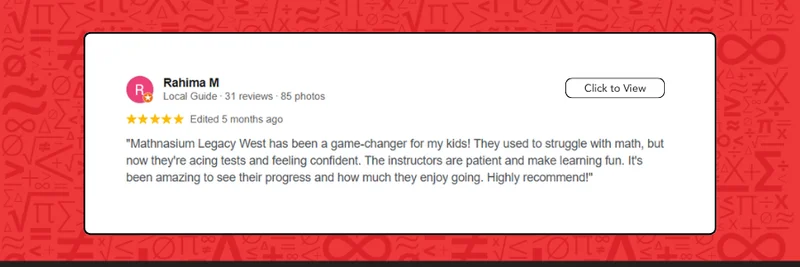
With over 100 five-star Google reviews, our community recognizes our dedication to building confident math thinkers.
Here's what one parent had to share about our center:
Whether your child needs to build foundational skills, master the 5-step problem-solving sequence, or stay ahead in an accelerated track, our team is ready to help.
📅 Schedule a Free Diagnostic Assessment at Mathnasium of Legacy West
Not near Plano?
📍 Find Mathnasium Learning Centers Near You


 (214) 618-0558
 (214) 618-0558