Unlike traditional algebra problems where our goal is to land on a clean, single answer like x=5, literal equations ask us to solve for a variable using other variables. We aren't finding a final hidden number.
Instead, we are simply changing the perspective of the formula. Once we realize that letters follow the exact same balance rules as numbers, these seemingly complex equations become much simpler to handle.
Today, our Mathnasium tutors will explain what literal equations are, show their different types, and demonstrate how to solve them by isolating the targeted variable.

What Are Literal Equations?
Literal equations are equations that contain two or more variables.
The word "literal" comes from the Latin word littera, which means "letter." Therefore, a literal equation is quite literally an equation made up of letters.
While a traditional algebraic equation like 2x + 5 = 11 asks us to find a specific numerical value for a single unknown, a literal equation establishes a structural relationship between multiple moving parts.
For example, the formula for the area of a rectangle (A = lw) is a literal equation. It shows us how these dependent quantities work together:
When we “solve” a literal equation, we rearrange it to express one specific variable in terms of the others.
We call this process isolating the variable.
If we solve A = lw for w, we want to rearrange the puzzle pieces so that w sits entirely by itself on one side of the equal sign.

Types of Literal Equations
Literal equations appear across various disciplines, ranging from basic geometry to advanced science. We can broadly categorize them into three main types based on their complexity and algebraic structure.
Let’s see some of them and where they show up.
|
Type
|
Explanation
|
Examples
|
|
1. Geometric formulas
|
These are the most common literal equations we encounter in early algebra. They define the structural properties of shapes, such as perimeter, area, volume, or circumference.
|
Area of a circle: A = πr2
Volume of a cube: V = s3
Pythagorean theorem: a2 + b2 = c2
|
|
2. Scientific and real-world formulas
|
Science and finance rely entirely on literal equations to model how the world works, and algebra classrooms use them to build the foundational skills needed for solving linear equations with multiple variables.
|
Distance formula: d = rt
Simple interest: I = Prt
Temperature conversion: F = \(\frac{9}{5}\)C + 32
|
|
3. Abstract linear and rational equations
|
In pure mathematics, we’ll constantly face abstract equations made up almost entirely of letters. We use them to build fluency in rearranging equations with several variables, and they often involve lines or fractions.
|
2x + 3y = 6
\(\frac{2}{x} + \frac{3}{y}\) = 6
4x + ax = 18
|
Each equation here connects at least two variables, and we can rearrange any of them to solve for the letter we need.
That’s exactly what we’ll tackle next. Let’s dig right in!
📕 You May Also Like: What Is the Difference Between a Rule and a Formula in Math?
How Do We Solve Literal Equations?
To solve a literal equation, we need to isolate the target variable by undoing the operations around it with inverse operations.
The other letters act like numbers, so they stay in the equation and travel with each operation we undo. Depending on the problem in front of us, we may also need to distribute or combine like terms along the way.
Literal equations remain equations at their core. So we need to keep in mind that whatever we do to one side, we must do to the other to keep the equation balanced.
To solve any literal equation, we can follow these steps:
-
Clear fractions or decimals first.
-
Group and factor if the variable appears more than once.
-
Use PEMDAS in reverse to decide which operation to undo first.
-
Apply the inverse operation to both sides, one operation at a time.
-
Move the target variable to the left of the equation.
Now that we have the steps, let’s apply them to a couple of examples.
Worked Example 1: Isolating a Variable in a Two-Step Formula
In P = 2w + 2l , solve for w.
Before we start, our tutors recommend that we circle the target variable, the letter we want alone. In this equation, we circle w.
We recommend this step because it makes it easier to follow what we are solving for.
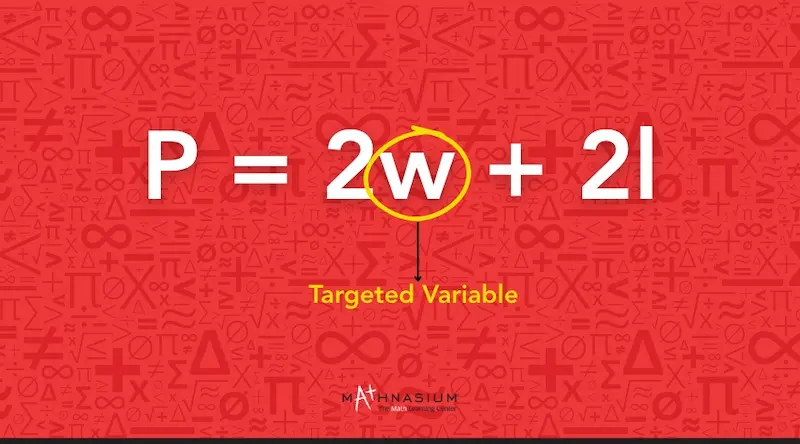
Now let’s get back to our example.
Step 1: Use PEMDAS in reverse
Right now, w sits on the right side as a term 2w and is added to 2l.
Which means we have addition and multiplication.
By following reverse PEMDAS, we need to undo addition first.
Step 2: Undo the addition
To cancel out the 2l on the right side, we need to apply the inverse operation and subtract 2l from both sides of the equation:
P - 2l = 2l - 2l + 2w
On the right side, 2l - 2l cancels out, which leaves:
P - 2l = 2w
Step 3: Undo the multiplication
Now our target variable is trapped with a coefficient of 2. To undo that multiplication, we need to apply division on both sides of the equation by 2:
\(\Large\frac{P-2l}{2} = \Large\frac{2w}{2}\)
\(\Large\frac{P-2l}{2} = w\)
Step 4: Verify the target variable's position
For our final step, we need to rewrite the final rearranged formula with w on the left:
\(w = \Large\frac{P-2l}{2}\)
📕 You May Also Like: Solving Multi-Step Equations with Variables on Both Sides
Worked Example 2: Clearing Fractions in a Multi-Step Formula
In F = \(\Large\frac{9}{5}\)C+32, solve for C.
This equation has a fraction, so we start with the first step in our list and clear it.
Step 1: Clear the fraction
The fraction \(\Large\frac{9}{5}\) has a denominator of 5. To undo it, we need to multiply every term on both sides of the equation by 5, so the equation stays balanced:
5 · F = 5 · \(\Large\frac{9}{5}\)C + 5 · 32
Notice that the 5 multiplies the 32 as well, which gives 160.
5F = 9C + 160
Step 2: Use PEMDAS in reverse
Now we are left with addition and multiplication in our equation. This means that we need to undo the addition first.
Step 3: Undo the addition
We need to apply the inverse operation and subtract 160 from both sides of the equation.
5F - 160 = 9C + 160 - 160
5F - 160 = 9C
Step 4: Undo the multiplication
To undo the multiplication and clear the coefficient of 9, we divide both sides of the equation by 9:
\(\Large\frac{5F-160}{9} = \Large\frac{9C}{9}\)
\(\Large\frac{5F-160}{9} = C\)
Step 5: Verify the target variable's position
For our final step, we rewrite the rearranged formula with C on the left:
\(C = \Large\frac{5F-160}{9}\)
📕 You May Also Like: Fractions and Algebra: How Are They Connected?
Worked Example 3: Factoring a Variable That Appears Twice
In 4x + ax = 18, solve for x.
This equation doesn't have any fractions to clear, but our target variable x appears in two separate terms (4x and ax). Because they are unlike terms, we cannot add them together into a single number.
Step 1: Group and factor the target variable
We need to apply the distributive property in reverse to factor out the x into a single spot outside a set of parentheses.
Each term holds an x multiplied by something. We can write 4x as x · 4 and ax as x · a:
4x + ax = x · 4 + x · a
Both terms now share the factor x. We can write x once outside a set of parentheses and place what is left, 4 and a, inside:
x · 4 + x · a = x(4 + a)
Now we can write our equation like this:
x(4 + a) = 18
Step 2: Use PEMDAS in reverse
Our target variable x is now multiplied by the entire group (4 + a). By using reverse PEMDAS, we treat this parenthetical block as a single unit and undo the multiplication next.
Step 3: Undo the multiplication
To completely isolate x and clear away the expression inside the parentheses, we apply the inverse operation and divide both sides of the equation by the entire quantity (4 + a):
\(\Large\frac{x(4+a)}{4+a} = \Large\frac{18}{4+a}\)
On the left side, the (4 + a) in the numerator and denominator cancel out completely, which leaves:
x = \(\Large\frac{18}{4+a}\)
Step 4: Verify the target variable's position
Our target variable x is already sitting perfectly alone on the left side of the equals sign; we do not need to rewrite or flip the equation.
x = \(\Large\frac{18}{4+a}\)
Our rearranged formula is complete!
📕 You May Also Like: What Is the Distributive Property and Its Role in Algebra
Put Your Skills to Work: Literal Equations Practice
Our tutors put together 4 problems that cover everything we did today. For each one, circle the letter we are solving for, undo the operations around it, and write the answer with that letter alone on the left side of the equal sign.
-
In d = rt, solve for t.
-
In 3x + 2y = 12, solve for y.
-
In A = \(\Large\frac{1}{2}\)bh, solve for h.
-
In 6y + by = 24, solve for y.
Check the answers at the bottom of the guide.

At Mathnasium, we build understanding from the ground up, so concepts like literal equations make sense to every student.
How Mathnasium Helps Students Master Algebra (and Any Math Concept)
Mathnasium is a math-only learning center serving students of all skill levels. We build confident, independent math thinkers through personalized instruction and targeted support.
Students come to us at different points in their algebra journey, from foundational skills like solving one-step and two-step equations to rearranging formulas and graphing lines. Wherever a student starts, we build the path forward from that exact point. We teach for deep understanding at every level, so students learn why each step works and how to do it.
We do that through the Mathnasium Method™, our proprietary teaching approach built around personalized learning and proven instructional techniques.
Here is what that looks like in practice:
-
Diagnostic Assessment and Personalized Learning Plans. Each student begins with a diagnostic assessment, a relaxed interaction that identifies strengths and knowledge gaps. From there, we build a personalized learning plan around their needs and goals. Students reach lasting math mastery at a pace that works for them.
-
Teaching for Understanding. Our specially trained tutors teach face-to-face in a supportive and fun setting. We use everyday language and a mix of verbal, visual, mental, tactile, and written techniques so concepts like literal equations make sense to each student.
-
Problem-Solving and Critical Thinking. When a concept feels unclear, we break it down into smaller steps and explain both the how and the why. In time, students build the problem-solving skills and critical thinking tools they can use in math and beyond.
-
An Engaging and Fun Learning Environment. Our activities are game-based and hands-on, and students earn rewards along the way. We track progress and celebrate every win, so confidence grows with every session.
The results reflect that approach:
-
94% of parents report an improvement in their child’s math skills and understanding
-
93% of parents report an improved attitude toward math after attending Mathnasium
-
90% of students saw an improvement in their school grades
We operate over 1,200 centers across North America, so there is likely a Mathnasium close by.
Families in New City and the surrounding area can visit Mathnasium of New City, a trusted local center that helps students become confident math thinkers.
Whether a student is looking to catch up, keep up, or get ahead in math, our local team is happy to help!
📅 Schedule a Free Diagnostic Assessment at Mathnasium of New City
Not near New City?
📍 Find a Mathnasium Learning Center Near You
Pssst! Check the Answers Here
Here are the answers. How did you do?
-
t = \(\Large\frac{d}{r}\)
-
y = \(\Large\frac{12-3x}{2}\)
-
h = \(\Large\frac{2A}{b}\)
-
y = \(\Large\frac{24}{6+b}\)


 (845) 990-9019