If you already know how to solve a linear equation, you are more than halfway to mastering linear inequalities!
We still isolate the variable using inverse operations, and our answer will cover a whole range of values instead of just one number. There is just one new rule to watch out for, which is that whenever we multiply or divide by a negative number, the inequality symbol flips.
Today, our Mathnasium tutors will explain how to solve linear inequalities with one variable, graph each answer on a number line, and work through one-step, two-step, and multi-step examples. We will also cover the mistakes to watch for.
Let’s dig right in!

What Are Linear Inequalities?
Linear inequalities are mathematical statements that compare two expressions with an inequality symbol (<, >, ≤, ≥), where the variable has an exponent of 1.
To better understand linear inequalities with one variable, we can compare them to linear equations.
In an equation like 2x = 6, we are looking to isolate the variable, and we’ll get one solution. We do the same in linear inequalities, but when we isolate our variable here, it can represent infinitely many solutions.
For example, x > 2 represents all the numbers greater than 2. That means we can plug in any number bigger than 2, like 3, 5, or even 105, and our inequality statement will always be true.
When we are working with inequalities, we can represent the answer in two different ways:
-
Inequality notation: Where we write the solution as an inequality, such as x > 2.
-
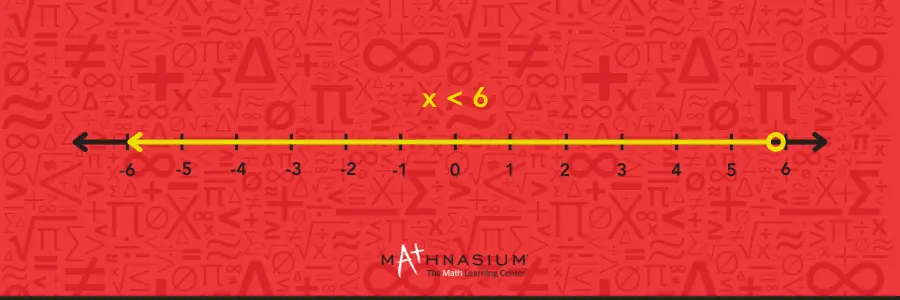
Number line graph: Where we show an open circle at 2 for < or >, or a closed circle for ≤ or ≥, and use an arrow that follows all the matching values.
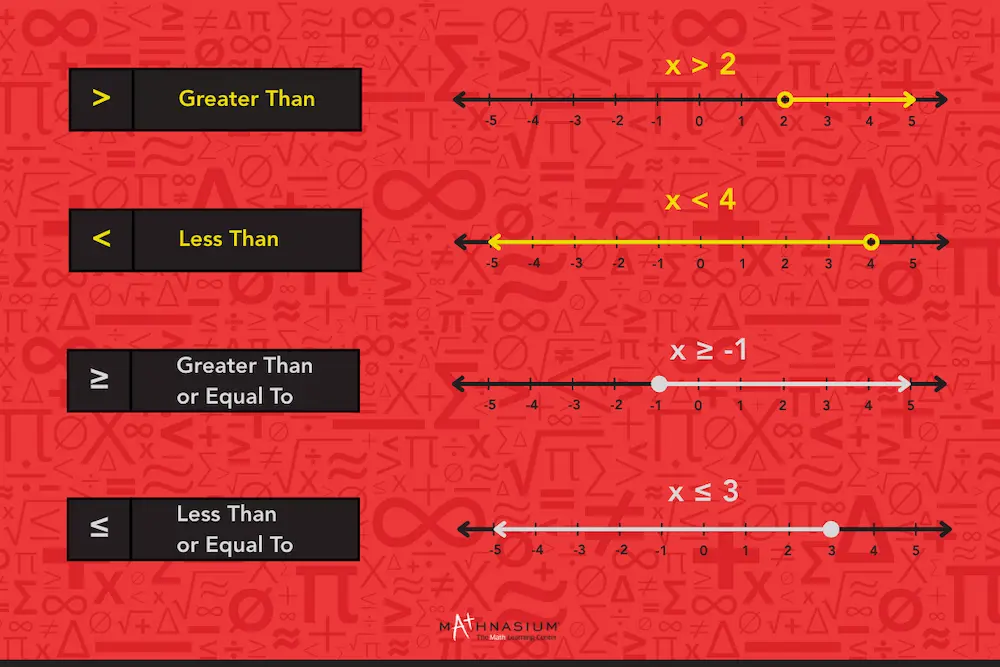
As we can see from our visual examples here, the solutions are represented along a straight line, which is why we call them linear.
This happens because our variable has an exponent of 1. If we used squares (x²), cubes (x³), or square roots instead, our inequality would curve or bend, and it would no longer be linear!
📕 You May Also Like: What Is Inequality in Math? Everything You Need to Know
How Do We Solve Linear Inequalities with One Variable?
To solve a linear inequality with one variable, we need to isolate the variable by using inverse operations on both sides, just like we do with equations. We can also distribute and combine like terms, depending on the inequality problem in front of us.
There is one serious situation where inequalities work differently from equations. If we run into a step where we need to multiply or divide both sides by a negative number, the inequality symbol needs to flip.
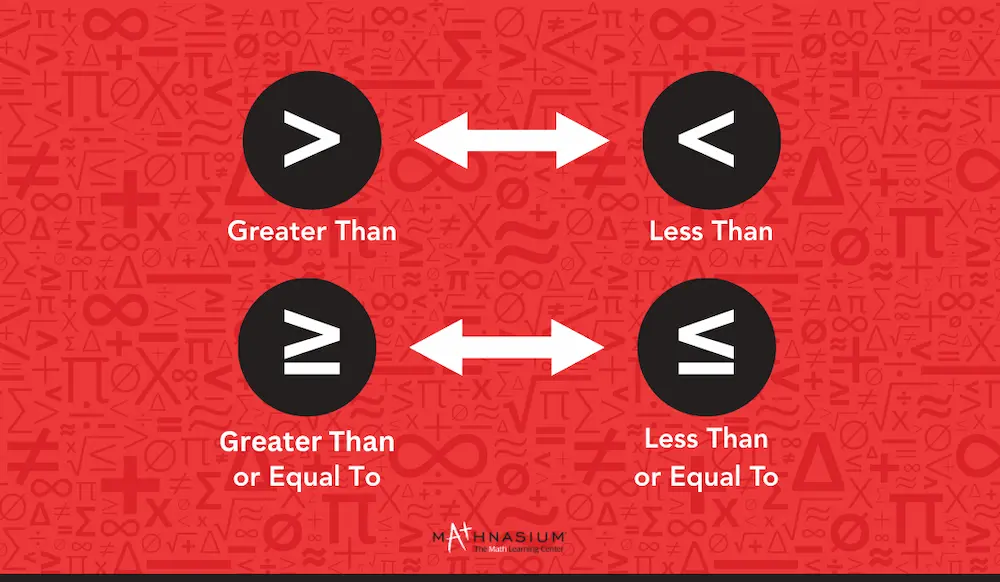
So why does the inequality symbol flip at all?
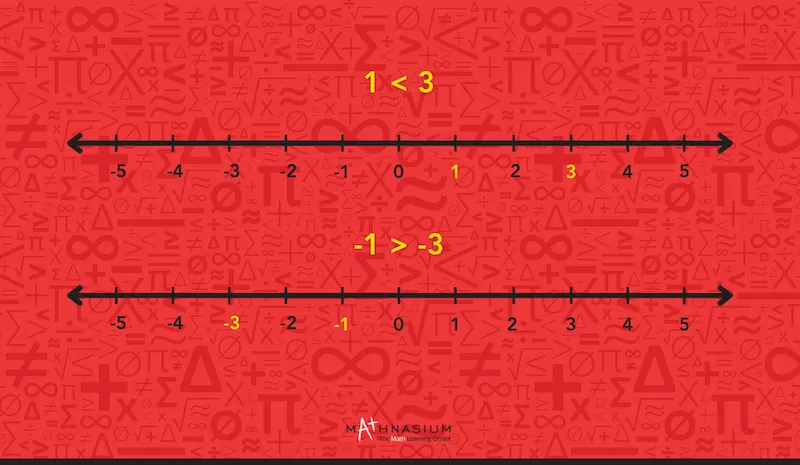
Let’s see it through an example of 1 < 3.
On the number line, 1 sits to the left of 3. When we multiply both sides by −1, we get -1 < -3.
Now, if we look at -1 and -3 on the number line, -3 actually sits to the left of -1, which means -3 is smaller. That means the statement -1 < -3 is false because -1 is actually greater than -3.
That’s why we need to flip the symbol, so our statement becomes true inequality like this: -1 > -3.
Now, let’s tackle some common inequalities with one variable with step-by-step guidance from our tutors.

1. Worked Example: One-Step Linear Inequalities with One Variable
To solve a one-step linear inequality with one variable, we undo its single operation with the inverse operation.
Let’s solve x + 3 > 7.
Step 1: Identify the operation
In x + 3 > 7, we have one operation, and that is addition (+ 3).
Step 2: Undo the addition
To undo the addition, we need to subtract 3 from both sides:
x + 3 − 3 > 7 − 3
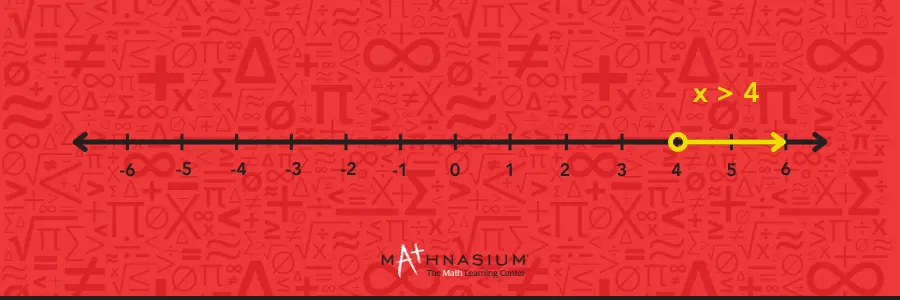
x > 4
Step 3: Graph the solution
The solution x > 4 means we want every number bigger than 4. To graph this, we put an open circle at 4 because of the "greater than" sign, and then draw an arrow pointing right toward the bigger numbers.
Now, if we want, we can check our work by picking any number that is bigger than 4.
Let's pick 6 and substitute it for x:
x + 3 > 7
6 + 3 > 7
9 > 7
Since 9 is indeed greater than 7, our statement is true, which confirms our solution is correct!
📕 You May Also Like: How to Solve One-Step Equations: A Step-by-Step Guide
2. Worked Example: Two-Step Linear Inequalities with One Variable
To solve a two-step linear inequality with one variable, we undo its two operations one at a time, just like in a two-step equation.
To know which operation to tackle first, we can use PEMDAS to help us. We can first identify which operation has priority according to the order of operations, and then we reverse that order to figure out what to undo first.
Let’s test this out with −2x + 5 ≤ 11.
Step 1: Identify the operations
In −2x + 5 ≤ 11, we have multiplication (−2x) and addition (+ 5).
Step 2: Use PEMDAS in reverse
PEMDAS tells us to multiply before we add. When we reverse that order to solve our inequality, we need to undo the addition first.
Step 3: Undo the addition
To undo the addition, we have to subtract 5 from both sides of the inequality.
−2x + 5 − 5 ≤ 11 − 5
−2x ≤ 6
Step 4: Undo the multiplication
Now we are left with multiplication only. We undo it by using its inverse operation and dividing both sides of the inequality by -2 to isolate the variable.
−2x ÷ (−2) ≤ 6 ÷ (−2)
Since we are dividing by a negative number, the ≤ symbol flips to become ≥.
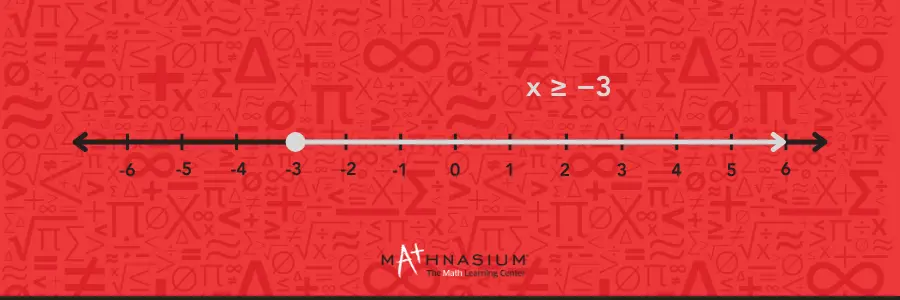
x ≥ −3
Step 5: Graph the solution
When we have a greater than or equal to symbol, we need to draw a closed circle at -3 to show that -3 is included in the solution.
Then, we draw an arrow pointing right toward the bigger numbers on the number line.
📕 You May Also Like: How to Solve Two-Step Equations Using the Undo Method
3. Worked Example: Multi-Step Linear Inequalities with One Variable
To solve a multi-step linear inequality with one variable, we distribute, combine like terms, and isolate the variable with inverse operations.
Consider the inequality 2(x + 3) + 4 ≤ 18.
Step 1: Distribute
The 2 outside the parentheses multiplies every term inside, so we multiply both x and 3 by 2:
2(x + 3) + 4 ≤ 18
2x + 6 + 4 ≤ 18
Step 2: Combine like terms
The constants 6 and 4 are like terms, so we add them together: 6 + 4 = 10.
2x + 10 ≤ 18
Step 3: Undo the addition
We now have a two-step inequality, so we follow the same steps as before. To undo the addition, we subtract 10 from both sides:
2x + 10 − 10 ≤ 18 − 10
2x ≤ 8
Step 4: Undo the multiplication
At this point, only multiplication remains. We use its inverse operation and divide both sides by 2 to completely isolate the variable.
2x ÷ 2 ≤ 8 ÷ 2
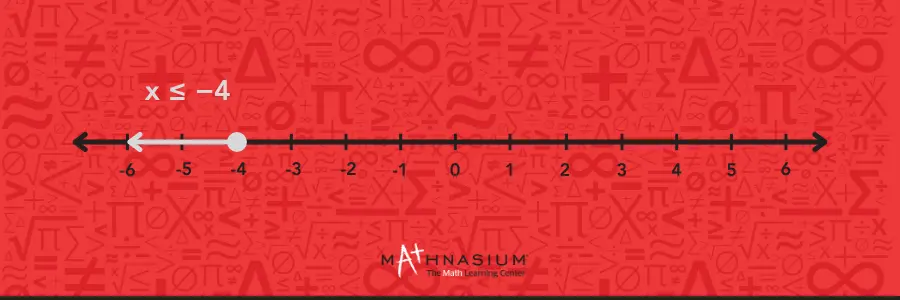
x ≤ 4
We did not multiply or divide by a negative number, so the inequality symbol stays the same.
Step 5: Graph the solution
Since the inequality includes 4 itself along with everything smaller, we place a closed circle at 4 and draw an arrow pointing left toward the lower numbers.
📕 You May Also Like: Solving Multi-Step Equations with Variables on Both Sides
Common Mistakes to Avoid When Solving Linear Inequalities
In our work with students, we’ve noticed that forgetting to flip the symbol is the most common mistake that comes up when we solve linear inequalities. Equations never require a symbol flip, so this tricky rule tends to trip students up even when they solve equations with total confidence.
Let’s take a look at the table to see what to watch for.
|
Common mistake
|
Example
|
How we avoid it
|
|
Forgetting to flip the symbol when multiplying or dividing by a negative number
|
−2x < 10
→
x < −5
|
A negative number moves every value to the opposite side of zero, so the order of the numbers reverses and the symbol flips with it. We divide both sides by −2 and write:
x > −5
|
|
Mistaking any negative number for a trigger to flip the symbol
|
3x < −18
→
x > −6
|
We only flip the symbol if the number we are multiplying or dividing both sides by is negative. Here we divide by 3, which is positive, so the symbol stays the same and we write:
x < −6
|
📕 You May Also Like: Expressions vs. Equations vs. Inequalities Explained
Practice: Solving and Graphing Linear Inequalities
Our tutors put together 3 problems that cover everything we did today. For each one, solve the inequality and graph the solution on a number line.
-
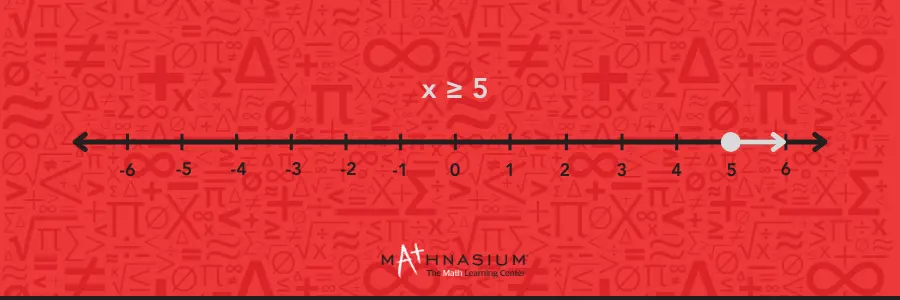
4x ≥ 20
-
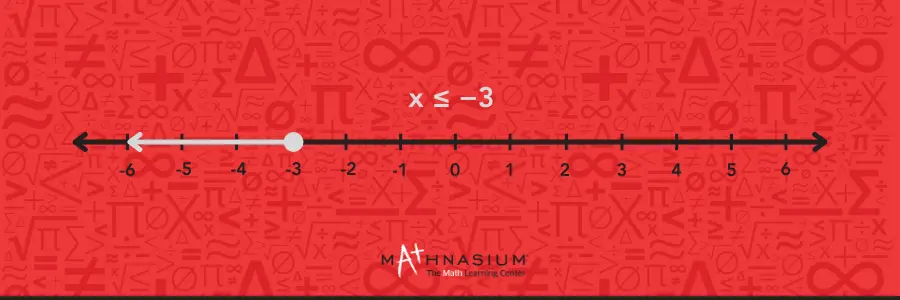
−2x + 5 ≥ 11
-
3(x − 1) + 5 < 20
You can check the answers at the bottom of the guide.

At Mathnasium, we build understanding from the ground up, so concepts like linear inequalities make sense to every student.
How Mathnasium Helps Students Master Algebra (and Any Math Concept)
Mathnasium is a math-only learning center serving students of all skill levels. We build confident, independent math thinkers through personalized instruction and targeted support.
Students come to us at different points in their algebra journey, from foundational skills like solving equations and working with negative numbers to multi-step inequalities and beyond. Wherever a student starts, we build the path forward from that exact point. We teach for deep understanding at every level, so students learn why each step works and how to do it.
We do that through the Mathnasium Method™, our proprietary teaching approach built around personalized learning and proven instructional techniques.
Here is what that looks like in practice:
-
Diagnostic Assessment and Personalized Learning Plans: Each student begins with a diagnostic assessment, a relaxed interaction that identifies strengths and knowledge gaps. From there, we build a personalized learning plan around their needs and goals. Students reach lasting math mastery at a pace that works for them.
-
Teaching for Understanding: Our specially trained tutors teach face-to-face in a supportive and fun setting. We use everyday language and a mix of verbal, visual, mental, tactile, and written techniques so concepts like linear inequalities make sense to each student.
-
Problem-Solving and Critical Thinking: If a concept feels challenging, we break it down into manageable parts and teach both the how and the why. In time, students build problem-solving skills and critical thinking tools they can use in math and in life.
-
An Engaging and Fun Learning Environment: Our activities are game-based and hands-on, and students earn rewards along the way. We track progress and celebrate every win, so confidence grows with every session.
The results reflect that approach:
-
94% of parents report an improvement in their child’s math skills and understanding
-
93% of parents report an improved attitude toward math after attending Mathnasium
-
90% of students saw an improvement in their school grades
We operate over 1,200 centers across North America, so there is likely a Mathnasium close to you.
Families in Windermere and the surrounding area can visit Mathnasium of Windermere FL, a trusted local center that helps students become confident math thinkers.
Whether a student is looking to catch up, keep up, or get ahead in math, our local team is happy to help!
📅 Schedule a Free Diagnostic Assessment at Mathnasium of Windermere FL
Not near Windermere?
📍 Find a Mathnasium Learning Center Near You
Pssst! Check the Answers Here
Here are the answers. How did you do?


 (407) 243-6284