The Multiplication Tables Check (MTC) gives pupils 6 seconds per question. That rules out counting up, working backwards from a nearby fact, or any other strategy that takes thinking time. What the MTC tests is instant recall and that's a skill that has to be built separately from knowing your tables.
Here’s what the test looks like, how to build that kind of fluency at home and what to do if practice alone isn't enough.

What Is the Multiplication Tables Check?
The Multiplication Tables Check is a short, timed, on-screen assessment that every Year 4 student in England takes each June. All state primary schools must administer it.
Here is what the test looks like:
-
25 multiplication questions from the 2–12 times tables
-
6 seconds per question; 3-second gap between questions
-
Scored out of 25, no pass/fail threshold
-
The 6, 7, 8, 9, and 12 times tables appear more frequently
The 6-second limit is the part most parents don't fully account for. The MTC tests instant recall. If your child works out 7 × 8 by counting up in 7s, they will run out of time before they reach 56.
The 2026 administration window runs from 1st June to 12th June.
How to Build Times Tables Fluency at Home
Practicing at home can reinforce what your child is already working on.
1. Start with What They Know, Then Push Outward
Most Year 4 young learners are solid on the 2s, 5s and 10s. That is your starting point. From there, move to the 3s and 4s before tackling the 6s, 7s, 8s and 9s.
Knowledge gaps in easier tables undermine the harder ones. If your child is shaky on 4 × 6, they will likely stall on 8 × 6 too, because 8 × 6 is just 4 × 6 doubled. Fixing the foundation fixes more than one problem at once.
A quick table to show the progression:
|
Stage
|
Tables to focus on
|
|
Start here
|
2s, 5s, 10s
|
|
Build on these
|
3s, 4s, 11s
|
|
Then tackle
|
6s, 7s, 8s, 9s, 12s
|
2. Prioritise Recall Over Recitation
If your child can recite "six, twelve, eighteen, twenty-four..." it means they have learned a sequence. The MTC, however, asks: What is 3 × 4? Out of order, no warm-up, 6 seconds.

So mix it up. In a single session, try something like this:
-
You ask: 7 × 4
Student answers: 28
-
You ask: 4 × 7
Student answers: 28
-
You ask: 9 × 6
Student answers: 54
-
You ask: 6 × 3
Student answers: 18
Switching tables mid-session is exactly the kind of practice that builds instant recall.
Note: the MTC only tests multiplication, never division. Practising commutativity (7 × 4 and 4 × 7) is a useful way to double the variety without going outside the test's scope.
3. Keep Sessions Short, Every Day
Five focused minutes beats thirty distracted ones.
Repeating the same facts across multiple short sessions is how the brain moves them into long-term memory. This is called “spaced repetition” and it is the reason that practising for five minutes daily at home can help.
A simple daily routine might look like this:
-
Day 1: 10 questions mixing 6s and 7s
-
Day 2: 10 questions mixing 8s and 9s
-
Day 3: 15 random questions from all tables covered so far
-
Day 4: 10 questions on whichever facts slipped the day before
-
Day 5: Full mix, 15 questions, no table-by-table order
-
Day 6: Same as Day 5, timed
At Mathnasium, the five-minutes-a-day rule works differently. Our specially trained instructors are trained to keep students engaged throughout a full session, so the short-burst principle still applies; we just get more bursts in. The small-group setting helps too.
4. Simulate the Test Conditions
As June approaches, practise with the 6-second time limit.
This is the step most families skip and it is the one that matters most in the final weeks. Your young learner can know every fact perfectly and still find the test uncomfortable if they have never practised at pace.
The official MTC practice site at gov.uk replicates the real format exactly: 25 questions, 6 seconds each, 3-second gap between questions. Use it. Run a full practice test together once a day in the week before the administration window opens.
Here is what that looks like in real terms:
→ Question appears: 8 × 7
→ Clock: 6 seconds
→ Your child types: 56 ✓
3-second gap
→ Question appears: 9 × 6
→ Clock: 6 seconds
→ Your child types: 54 ✓
Familiarity with the pace reduces anxiety. The format should feel routine by the time your child sits down in school.
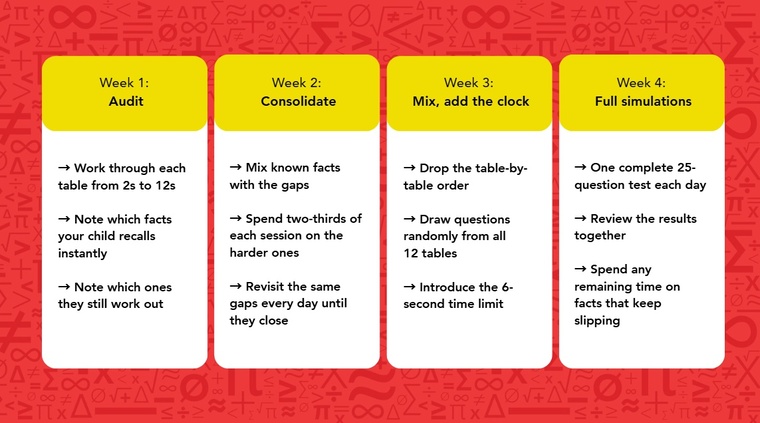
Four weeks is enough time to make a real difference, as long as the practice is focused. The format is simple: 5 minutes, 10–15 questions, every day. Here’s a week-by-week MTC practice plan for Year 4:
📕 You May Also Like: Making Maths Support Work for Busy Families
What to Do If Your Child Is Still Struggling
Times table struggles that persist through home practice typically point to something deeper than the tables themselves.
First, ask: Is the difficulty specific or broad?
If your child stalls on one or two tables, targeted daily practice on those facts is the fix. If they lose place across most tables, the following foundations may not be solid: skip counting, number bonds and the basic concept of multiplication.
Drilling tables on top of shaky foundations produces temporary improvement at best.
Research on how children actually memorise multiplication facts shows that similar facts can interfere with one another in memory, so some students will continue to struggle with tables unless teaching also addresses underlying understanding and practice design, not just more drilling.
Next, talk to the teacher. Find out whether the difficulty appears across formats or only under timed conditions. Anxiety under time pressure is a different problem from a knowledge gap.
If you are still not seeing progress, a structured diagnostic assessment can trace the struggle back to its source.
📕 You May Also Like: Everyday Maths: Fun Activities to Reinforce Math Skills at Home
Common MTC Preparation Mistakes
Most Year 4 families make the same four preparation mistakes and they all come down to practising inefficiently rather than insufficiently.
1. Chanting in Order Only
Reciting 6, 12, 18, 24 teaches your child a sequence. The MTC asks for facts and asks questions in random order. If your child has only ever practised in sequence, they will likely stall the moment 6 × 8 appears out of context.
Test it now: ask your child 7 × 6, not "what comes after 42 in the 7s?"
2. Starting Preparation Too Late
Times tables fluency is built through repetition across weeks, not days. A concentrated push in the final week before the test is too late to move facts into long-term memory. The consolidation has to happen well before June.
3. Staying in the comfort zone
The 6, 7, 8 and 9 times tables are the ones most young learners find hardest and they are the ones weighted most heavily in the MTC question pool. If your child's daily practice is mostly 2s, 5s and 10s, the biggest knowledge gaps are going unaddressed.
 Practicing regularly is what makes the difference with MTC.
4. Practising without a clock
Answering correctly with no time pressure is a different skill from answering correctly in 6 seconds. Here is the difference in practice:
-
Without a clock: "What is 8 × 7?" ... "Um ... 56." (4 seconds, correct but slow)
-
With a clock: same question, same answer, but the 4-second pause costs the mark.
Introduce timed practice well before the test window so the pace feels familiar.
📕 You May Also Like: Maths Confidence Doesn’t Take a Holiday: Why It Matters Year-Round
FAQs About Year 4 Multiplication Tables
Still having uncertainties about Year 4 multiplication tables check? Perhaps these FAQs will help:
Is there a pass mark for the Multiplication Tables Check?
No. The MTC is scored out of 25, but there is no pass or fail threshold. Results are shared with the school and reported to the DofE as part of national data collection. Your child won't receive a grade or a report; the score is used by teachers to identify where extra support may help.
Does the MTC result affect secondary school admissions?
No. Secondary school admissions in England are based on factors such as catchment area, sibling links, and, for selective schools, 11+ results. The MTC plays no part in that process. It is a diagnostic tool, not a high-stakes exam.
What if my child has SEND or requires access arrangements?
Digital adjustments are fully supported. Your child can access features like screen font adjustments, audio versions, an input assistant, or a "Next" button to pause between questions. Please notify your child's teacher or SENCo early. These settings must be active by April, so your child can practice using them before the official June assessment window opens.
My child's school hasn't told us much about the MTC. Is that normal?
Yes, fairly common. Schools are required to administer the MTC but aren't required to send detailed briefing packs to parents. If you'd like to know more about how your child's school approaches preparation, the class teacher or Year 4 lead is the right person to ask. Most are happy to share how they're covering it in class.
 Our specially trained instructors make sure that building times tables fluency is both structured and effective, going beyond drilling to address the number sense behind the facts.
How Mathnasium Helps Year 4 Students Prepare for the MTC
Times tables knowledge gaps that reach Year 5 unfixed make written multiplication, long division and fraction work harder than it needs to be.
We see this pattern regularly. Your young learner arrives struggling with the 7 and 8 times tables and closer work reveals the underlying difficulty is with skip counting and the concept of multiplication as repeated grouping. The tables problem turns out to be a number sense problem in disguise.
Mathnasium is a maths-only learning centre. Every student begins their Mathnasium journey with a diagnostic assessment that identifies which facts they cannot recall and why. From there, our specially trained instructors use the Mathnasium Method™ to deliver face-to-face instruction built around a personalised learning plan, one that fills those gaps systematically, in a small-group setting that's both caring and fun.
And parents consistently tell us this method makes the difference:
-
94% of parents report an improvement in their child's maths skills and understanding
-
93% of parents report their child's improved attitude toward maths after attending Mathnasium
-
90% of students saw an improvement in their school grades
With over 1,250 centres worldwide, including 40 across the UK, there's likely a Mathnasium near you.
If you're based in Blackheath or the surrounding South East London area, Mathnasium of Blackheath works with Year 4 students to build times tables fluency, the MTC tests, and the deeper number confidence that holds up long after June. A free assessment is the right place to start.
📅 Book a Free Assessment at Mathnasium of Blackheath
Not in Blackheath?
📍 Find a Mathnasium Centre Near Yo


 020 8396 7377
 07751868687