Most parents track grades, which is reasonable as grades are visible, comparable and arrive on schedule. The problem is that by the time your child's marks slip, their relationship with maths has often already been deteriorating for a while. So, we can view grades as a lagging indicator.
Maths confidence is the upstream condition and it is the one that predicts whether your child will persist when the material gets harder, not just whether they passed last week's test.

Maths Confidence Predicts Long-Term Performance Better Than Any Single Test Score
Your child's belief in their own maths ability predicts whether they will persist through harder material more reliably than any single test score. Grades measure what your child knew on one particular day, while maths confidence shapes how they approach every other day.
The Education Endowment Foundation's guidance report on metacognition and self-regulation shows that readiness to tackle unfamiliar problems has a measurable impact on outcomes. Your child can perform well on familiar material, but the moment it looks different, that confidence disappears. And the material does change at the Year 7 KS3 transition and again at GCSE.
Here is what that tends to look like:
-
Marks stay flat or improve on unit tests, but your child becomes more reluctant to attempt anything unfamiliar
-
Homework gets done, but only the questions that look like ones they have seen before
-
Confidence in the classroom holds up until the topic changes, then drops noticeably
If any of those sound familiar, the issue is unlikely to be ability and far more likely to be a knowledge gap.
Maths Anxiety Is More Common Than You Might Think
Maths anxiety is a specific, well-documented psychological response to mathematics that has nothing to do with personality or ability. Research from the University of Cambridge and the Nuffield Foundation shows that it affects students across both primary and secondary school and that many children with high maths anxiety still achieve at normal or above-average levels.
Maths anxiety usually develops when a child encounters material they cannot make sense of and doesn't get the chance to consolidate it before the curriculum moves on.
The process typically looks like this:
-
Your child encounters material they cannot make sense of
-
They do not get the chance to consolidate it
-
They then have to keep moving forward on an unstable foundation
Grades and anxiety are not necessarily in a causal relationship, which is exactly why results alone will not tell you that your child’s confidence is affected.
Year 5 and Year 6 are common points of emergence, particularly around the KS2 SATs period. The deeper form of maths anxiety tends to sit behind otherwise acceptable results for quite some time. In practice, it shows up as:
-
Persistent avoidance of maths tasks, including homework that gets left until last
-
Physical tension or distress before assessments, not just on the day but in the days before
-
A settled conviction that "I'm just not a maths person," stated as fact rather than frustration
-
Willingness to attempt familiar problem types, but shutting down in front of anything unfamiliar
If your child shows more than one of these, the results on their last report are not telling the whole story.
📕 You May Also Like: “From ‘I Can’t’ to ‘I Can’
The Gap Between Grades and Real Understanding
There is a pattern many parents recognise without having named it: your child improves their mark on a unit test, but two weeks later cannot apply the same concept in a different format or context.
When the incentive structure rewards correct answers over reasoning, young learners quite rationally orient their effort towards reproducing familiar steps. As a result, the mark improves, but the knowledge gap remains.
Your child can pass test after test without truly understanding the material; however, when unfamiliar problems appear, maths anxiety hits harder, because there is no framework to fall back on. Maths anxiety and surface-level learning reinforce each other in a cycle that grades alone cannot break.
What Maths Confidence Looks Like in Practice
Maths confidence has a precise definition: it is the willingness to engage with a problem you do not already know how to solve. So, a confident student does not necessarily get everything right. They have a go, talk through their thinking even when uncertain and recover from mistakes without shutting down.
If this reminds you of growth mindset, you are on the right track. Psychologist Carol Dweck's work established that children who believe their abilities can develop through effort approach challenges differently from those who believe ability is fixed. In maths, that belief shows up as confidence.
The markers of eroded maths confidence are just as recognisable:
-
Refusing to attempt work that feels uncertain, or waiting to be shown the method before trying
-
Relying on steps they have memorised without understanding why they work
-
Tying their sense of self-worth closely to whether the answer is correct
Maths confidence is teachable and recoverable. Your child is not deficient and the trajectory is not fixed. Your child needs an approach that builds understanding and treats mistakes as part of the process.
📕 You May Also Like: Maths Confidence Doesn’t Take a Holiday: Why It Matters Year-Round
What Grade Represents the Biggest Challenge for Maths Confidence?
Year 7 is the point where maths confidence problems that have been building tend to surface. The move to secondary school brings a simultaneous increase in content abstraction, a new teaching environment and a significant widening of the attainment spread within any class.
Your child may have felt perfectly capable in Year 6 and still find the pace and depth of KS3 disorienting. The National Curriculum for Mathematics sequences content in a way that assumes solid foundations from primary school, particularly in fractions, decimals and place value. Your child arrives at Year 7 carrying whatever foundation primary school built and gaps in fractions, decimals, or place value tend to surface fast.
The curriculum is structured this way by design and the gap it exposes is addressable.
 Building the kind of confidence that carries beyond the worksheet.
How to Support Maths Confidence at Home (Without Becoming a Maths Tutor)
Your own relationship with maths matters far less than how you talk about difficulty in front of your child.
Back when we were in school, maths was largely about getting the right answer. Showing your working was something teachers asked for; understanding why a method worked was rarely the point. That framing sticks and it can colour how we talk about maths at home without us realising it.
How you talk about maths matters more than how good you are at maths. Praise effort and reasoning over correct answers and your child learns that the process is where learning happens. Saying "I'm not sure, let's work it out" shows your child that pausing to think is what maths looks like.
A few practical adjustments make a real difference:
-
Avoid telling your child you were never good at maths. It teaches them that ability is fixed before they have had the chance to find out otherwise
-
Ask "how did you approach that?" rather than "did you get it right?"
-
When homework is causing distress, step back from the content and focus on the feeling: "This feels hard right now, that's fine"
-
When maths homework is met with dread most evenings, that pattern tells you more than the grade does.
Maths anxiety that is left to compound tends to worsen at every curriculum transition. Early support, targeted at rebuilding understanding and confidence together, is considerably more effective than waiting for results to drop.
📕 You May Also Like: Everyday Maths: Fun Activities to Reinforce Maths Skills at Home
Filling Knowledge Gaps Rebuilds Maths Confidence
Knowledge gaps come first. And as we mentioned earlier, maths anxiety usually develops when your child hits material they cannot follow, and the curriculum moves on before they have consolidated it.
The anxiety is a rational response to that experience.
Support that goes back and fills those gaps changes how your child experiences maths because it changes what maths feels like to them. Lessons start to make sense and they start to feel capable even when faced with problems they would once give up on before even trying to solve.
That is what rebuilding maths confidence looks like from the inside and is what happens when your child finally has the foundations to stand on.
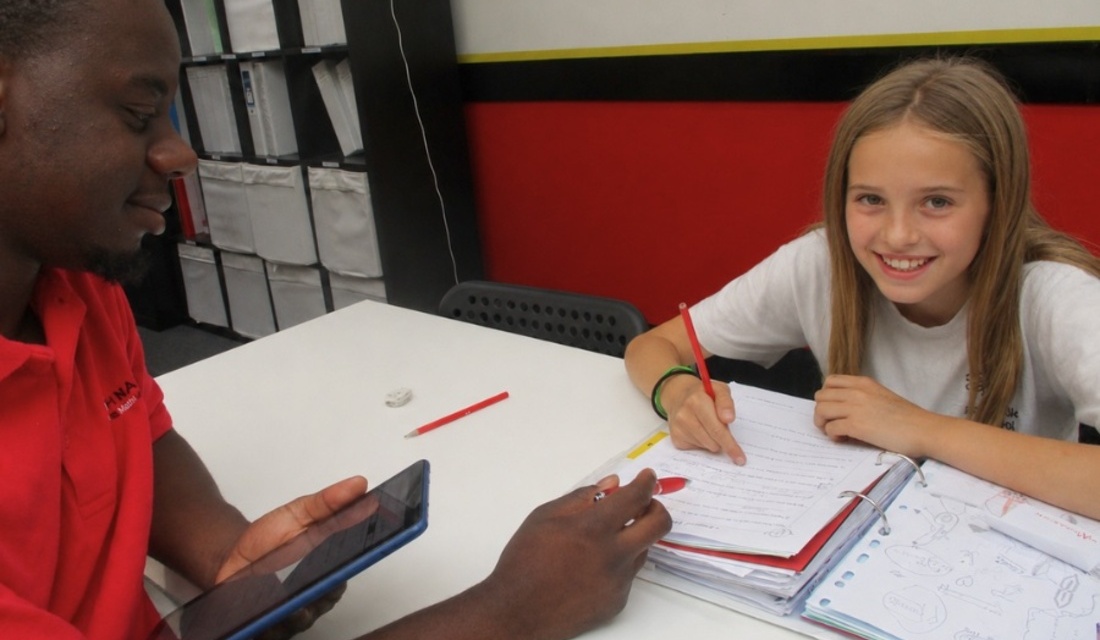
 A specially trained instructor works through a problem with a student. Themoment understanding clicks is where maths confidence starts to build.
How Mathnasium Helps Students Build Maths Confidence and Beat Maths Anxiety
Mathnasium is a maths-only learning centre dedicated to helping students in Years 1-11 catch up, keep up and get ahead in maths.
Maths confidence rarely fixes itself. When a student has knowledge gaps underneath otherwise acceptable results, the most effective thing is to find them and address them directly, before the next curriculum transition makes them harder to unpick.
Every student starts their Mathnasium journey with a diagnostic assessment that pinpoints the specific knowledge gaps behind any confidence or performance issues. From there, our specially trained instructors build a personalised learning plan and work through face-to-face instruction in a supportive and fun small-group setting, using the Mathnasium Method™, a teaching approach designed to help children truly understand maths, not memorise it.
The results reflect that:
-
94% of parents report an improvement in their child's maths skills and understanding
-
93% of parents report their child's improved attitude towards maths after attending Mathnasium
-
90% of students saw an improvement in their school grades
With over 1,200 centres worldwide, including 40 across the UK, there's likely a Mathnasium near you.
Families across Wimbledon, Southfields, Wimbledon Park, Wimbledon Chase, Merton Park, Raynes Park and the surrounding areas trust Mathnasium of Wimbledon to give their child the foundations to approach maths with confidence, from KS2 through to GCSE.
If your child is coping with maths but you sense something is off, a diagnostic assessment is the clearest place to start.
📅 Book a Free Assessment at Mathnasium of Wimbledon
Not in Wimbledon?
📍 Find a Mathnasium Learning Centre Near You


 0207 550 6100
 07845671964