Your child breezed through elementary math but now finds algebra much harder? This is quite common during this transition. At the Mathnasium of Manhattan Beach, we see this pattern regularly among students in Manhattan Beach Unified School District (MBUSD).
Solid grades in earlier math may show that your student learned the procedures and problem types expected at that stage. Algebra asks them to reason about unknown quantities and relationships in a more abstract way, which can expose gaps that were easier to miss before.
So if your child’s performance suggested they were ready for algebra, but their day-to-day work now tells a different story, you might need to look more closely at the foundations behind algebra readiness.
Today, our education specialists will help you identify those foundations, recognize which areas may be holding your child back, and follow a step-by-step plan to address them.

What Changes for Your Student When They Move From Arithmetic to Algebra
Let’s see how California’s Common Core State math standards map out the move from arithmetic to algebra as your child progresses through school:
-
Elementary school: Your learner spends much of their time building fluency with whole numbers, fractions, decimals, and, in later grades, percentages.
-
Middle school: The work becomes more focused on expressions, equations, proportional relationships, functions, geometry, and statistics.
-
By 8th grade: They take on more advanced topics, including integer exponents, proportional relationships, lines, and systems of equations.
But the bigger change happens in how your child is expected to think about math. Here are three ways algebraic thinking differs from the arithmetic thinking your student used earlier:
-
From finding an answer to representing a relationship. In elementary math, your learner often works toward one numerical answer. In middle school, they begin using variables to represent unknown or changing quantities, writing expressions such as 5 − y or 3(x + 2), and treating equations as relationships between values.
-
From following a procedure to reasoning about equivalence. Your child may already know how to distribute or use inverse operations. In algebra, they also need to keep track of what stays equal as they work. For example, 3(x + 2) and 3x + 6 have the same value, and subtracting 5 from both sides of 2x + 5 = 17 keeps the equation balanced.
-
From one representation to several connected representations. By 8th grade, your student should be able to connect a table, a graph, an equation, and a verbal description of the same relationship. They also begin to recognize slope as the same rate showing up across those different forms.
After you figure out what algebra now asks your learner to do differently, we recommend checking the specific foundations behind those new demands. From there, you can focus practice on the areas that need the most attention.
📕 You May Also Like: Algebraic Reasoning: What It Is and How to Develop It
Which Math Gaps Can Make Algebra Harder & How to Spot Them
From our work with students, we see several foundational gaps come up repeatedly when algebra starts getting harder.
To pinpoint those gaps and see which skills need support and which are already secure, each learner begins their Mathnasium journey with a diagnostic assessment that looks beyond grades.
You can take a similar approach at home with the table below, which our education specialists put together using both our experience and research evidence.
|
Skill
|
Where it appears in algebra
|
At-home check
|
What to look for
|
|
Fractions and rational numbers
|
- Equations
- Proportions
- Slope
- Rational expressions
- Signed-number work
|
Have your child compare \(\frac{7}{8}\) or \(\frac{9}{10}\), and how they know. Then see whether they can predict if \(\frac{5}{6}\) + \(\frac{1}{8}\) will be greater or less than 1 before calculating.
|
Your child may need more support with fraction sense if they compare only numerators or denominators and rarely use benchmarks or a number line to reason about fraction size.
|
|
Proportional reasoning
|
- Unit rates
- Scale
- Slope
- Linear relationships
|
Try this: 5 movie tickets cost $60. How much would 8 tickets cost at the same rate? Then ask what the 12 represents in y = 12x.
|
Your learner is expected to connect the quantities through a constant rate. Guessing or using unrelated addition may point to a gap in proportional reasoning.
|
|
Equality and equations
|
Keeping equations equivalent while isolating an unknown
|
Give your learner 15 − 4 = □ + 3 and have them find the missing value. Then discuss what stays equal after dividing both sides of 8x = 16 by 8.
|
They should work more with equivalence if they understand the “=” sign as a signal that an answer comes next.
|
|
Variables and expressions
|
- Expressions
- Equations
- Functions
|
Explore the meaning of variables with 4a + 3b. Then ask whether x can take different values in y = 2x + 1
|
See whether they expect each letter to have one fixed value or treat it mainly as a label. Either response may call for more practice with variables.
|
|
Multi-step reasoning
|
- Planning solution steps
- Tracking signs
- Preserving equality
- Checking each step
|
Suggest that your learner work through 3(x − 2) + 4 = 19 and explain each step. Then show 3(x − 2) = 3x − 2 and ask what went wrong.
|
The skill may require more support if they can follow a familiar routine but cannot explain a step or spot an incorrect one.
|
📕 You May Also Like: Fractions and Algebra: How Are They Connected?
5 Steps to Close Math Gaps That Hinder Algebra Progress
As soon as you get a sense of which foundation needs support, focus practice on that area. We follow a similar targeted approach at Mathnasium.
Through a diagnostic assessment, we identify each student’s current skill level and specific learning needs. From there, we create a personalized learning plan around the areas that require the most attention. As your child progresses, our tutors adjust the pace and content of instruction so the work continues to match what they are ready for next.
To help you work on your child’s math gaps at home, we’ve adapted that same idea into a simple five-step practice plan.
1. Sort errors by cause
You can learn much more from your child’s mistake once you understand what caused it. A one-time slip calls for a different response than a repeated misunderstanding or a missing earlier skill.
Russell et al.’s 2009 pilot study illustrates the importance of identifying specific algebra misconceptions before deciding what kind of support a student needs.
For example, your child may need more work with signed numbers if they confuse (7−(−4)) with (−7−4). But if they simply copied a number incorrectly, they may need to slow down and develop a habit of double-checking their work rather than spend more time practicing the skill.
2. Use worked examples strategically
At first glance, unfamiliar problems may seem more useful for building conceptual understanding. But worked examples can be just as effective for your student when used well, especially when a topic is still new to them.
Research (2019) by Barbieri et al. with middle-school algebra students found that worked examples led to better learning when students were asked to explain the reasoning behind main steps.
Here is how practice with worked examples can look like:
After your learner walks through a completed solution to an equation such as 4(x + 2) = 28, ask them why we divide both sides by 4, and then subtract 2 from both sides of the equation. You can also show an incorrect version that changes only one side and ask your learner to explain what went wrong.
📕 You May Also Like: Is Your Student Ready for Their Algebra Class? [+Quiz]
3. Gradually reduce support
Once your child is more comfortable with the math concept, move gradually from worked examples to partially completed problems and then to independent problem-solving.
Tiedra and Toraja discuss this kind of fading support in their 2025 study on the Gradual Release of Responsibility. They revealed that this approach produced meaningful gains in both math performance and collaboration.
Our tutors often follow a similar pattern to help students become more independent in math. They guide learners through a problem first, then gradually step back as the student becomes ready to take on more of the work.
You can do the same, too:
-
Start with full support. Take this problem as an example \(\Large\frac{2}{3} + \Large\frac{1}{4}\). Walk through it together and explain why you need a common denominator.
-
Reduce the support. Give them \(\Large\frac{3}{5} + \Large\frac{1}{6}\) with the first step already completed, then ask them to explain what happened and finish the problem.
-
Let them work independently. Ask your child to solve a similar problem, such as \(\Large\frac{4}{7} + \Large\frac{1}{3}\) on their own and explain their reasoning afterward.
📕 You May Also Like: Math Homework Independence: Grade-by-Grade Guide
4. Check their understanding with an unfamiliar problem
Give your student a concept they already know in a new format or context. This way, they will learn to recognize math ideas across different representations and apply what they know in a less familiar problem.
This aligns with guidance from the National Council of Teachers of Mathematics, which recommends that students move between representations as they solve problems and interpret real-world situations.
You can put that recommendation into practice this way. Say your learner has already built a secure understanding of constant rates through earlier practice.
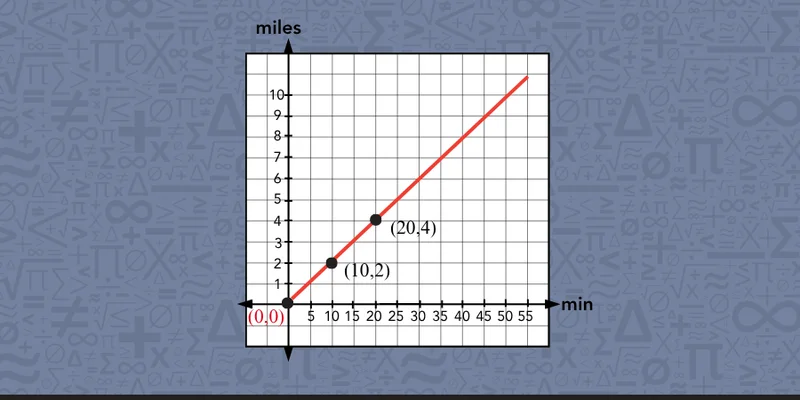
Now see how well they can carry that skill into a real-world context. Suppose a cyclist covers 2 miles along The Strand in Manhattan Beach in 10 minutes at a steady pace. Ask your child how far the cyclist would travel in 45 minutes.
Then turn the situation into a graph:
-
Put time in minutes on the horizontal axis and distance in miles on the vertical axis.
-
Start at (0,0), because the cyclist has traveled 0 miles at 0 minutes. After 10 minutes, the cyclist has traveled 2 miles, so your learner can plot (10,2). Since the pace stays constant, another 20 minutes corresponds to 4 miles, giving the point (20,4).
-
Have your child connect the points and look at the line.
-
Ask what the steady upward pattern tells them about the cyclist’s speed, where 45 minutes would fall on the graph, and how they could use the line to estimate the distance traveled by that point.
5. Revisit the skill over time
Short review sessions spread across several days can help your child remember a skill longer than one concentrated practice session.
Murray et al. supported this idea in their 2025 meta-analysis of 27 studies, which showed that spaced practice was linked to better long-term learning than doing all the work in one sitting.
Build this into your student’s routine with a simple schedule:
-
Say they learn to solve 3x + 5 = 20 today.
-
Bring back a related equation two days later, another one the following week.
-
Later, include a similar problem in a mixed set with fractions and graphing.
This gives your learner several chances to retrieve and use the skill in different contexts, which can help it stick.
You may find that some of these steps are easier to manage with extra support. Our algebra tutors at Mathnasium of Manhattan Beach can help your child work through the specific skills they need.
📕 You May Also Like: How to Use Spaced Practice to Help Math Stick

At Mathnasium, we use different teaching techniques and hands-on tools to help students see the same concept from more than one angle.
How Mathnasium of Manhattan Beach Helps Students With Algebra (and Beyond)
Mathnasium of Manhattan Beach is a math-only learning center dedicated to helping K–12 students of all skill levels excel in math.
We aim to help learners build a true understanding of math, which includes addressing the specific gaps that can make algebra difficult.
That’s where the Mathnasium Method™, our proprietary teaching approach, comes in. We use it to meet students where they are and guide them forward step by step.
Each student begins with a diagnostic assessment that helps us understand their current skill level, knowledge gaps, goals, and how they think and feel about math.
Using these insights, we build a personalized learning plan focused on the skills the student needs most, whether that means revisiting fraction relationships, making sense of variables and equations, working confidently with signed numbers, or connecting equations, tables, and graphs.
Our specially trained tutors follow that plan closely and provide live, face-to-face instruction in a caring and fun group environment. They use mental, verbal, visual, tactile, and written techniques to help students notice patterns and connect algebraic symbols to the relationships they represent.
Students also get room to think through problems before tutors step in. Our tutors guide them to explain their reasoning and try another approach when a strategy is not working. As students become ready to handle more of the process themselves, tutors step back, helping them develop the problem-solving skills and independence they need in Algebra 1 class and beyond.
Fun is part of the approach, too. We use game-based activities, rewards, and consistent encouragement to keep students engaged as they revisit earlier skills and take on more complex algebraic thinking.
The results speak for themselves:
-
94% of parents report an improvement in their child's math skills and understanding
-
93% of parents report their child's improved attitude toward math after attending Mathnasium
-
90% of students saw an improvement in their school grades
If your child gets stuck with algebra, a free diagnostic assessment is a great place to start. Using what we learn, we create a personalized learning plan focused on the specific skills they need to make sense of algebra and move forward with greater independence.
📅 Schedule a Free Assessment at Mathnasium of Manhattan Beach
Not near Manhattan Beach?
📍 Find a Mathnasium Learning Center Near You


 (310) 905-6284