In primary school, children build fluency with numbers and familiar methods. As they move into secondary school, maths asks them to connect ideas, work with greater abstraction and use what they know in unfamiliar problems.
As expectations grow, areas children previously handled with confidence can become more demanding, which can explain why some find the move to secondary maths challenging even after years of good progress.
So, what changes between the two stages?
Our maths instructors have the answers! We’ll explain how mathematical thinking develops from primary to secondary school, why some children find the transition challenging and how you can recognise when your child’s foundations may need support.

What Maths Skills Look Like in Primary and Secondary School
In England, the national curriculum for mathematics sets out how students develop fluency, mathematical reasoning and problem-solving throughout primary and secondary school.
In primary school, students build much of the mathematical knowledge they will rely on later. By the end of Key Stage 2 (KS2), they work confidently with the four operations, fractions, decimals and percentages, tackle multi-step problems and explain their mathematical reasoning.
In secondary school, students use that knowledge across more abstract and interconnected maths. At Key Stage 3 (KS3), they extend their work with number into algebra, ratio and proportion, graphs and other mathematical relationships. They also select appropriate methods, move between different representations and apply what they know to unfamiliar problems.
The main difference, then, is how students are expected to use what they know. Primary maths establishes important foundations, while secondary maths asks them to connect, generalise and use their knowledge across different problems.
📕 You May Also Like: Why Maths Confidence Matters More Than Maths Grades
How Maths Thinking Develops From KS2 to KS3
Secondary maths builds on mathematical thinking children develop in primary school, so we can trace many KS3 skills back to those earlier ideas.
Instead of treating the transition as a completely new type of maths, we’ll look at how familiar thinking develops into more advanced mathematical ideas.
1. Separate Concepts Start Working Together
In primary school, children receive a growing “toolkit” of mathematical knowledge, while secondary maths asks them to recognise which parts of that toolkit belong in the same problem.
Fractions are a good example. At KS2, children learn relationships between fractions, decimals and percentages, while at KS3, they draw on those relationships when working with ratio and proportion.
They are supposed to observe clearly how the maths they learned earlier builds towards the new concepts and helps them make sense of a wider set of problems.
📕 You May Also Like: Why Fractions, Decimals & Percentages Confuse Your Child
2. Arithmetic Develops Into Algebraic Thinking
With algebra, children learn to express number relationships more generally, while building on patterns they can already recognise through arithmetic.
We can see this progression in a simple number pattern, like in 3 + 5 = 8, 3 + 6 = 9 and 3 + 7 = 10, where increasing the second number by 1 also increases the total by 1. If n represents the changing number, 3 + n expresses the relationship for any value of n.
This works because one number always stays at 3 while n can represent any other number, so the same relationship holds no matter which value replaces n.
Arithmetic lets children observe the pattern with particular numbers, while algebra shows how the numbers are related and why the pattern continues beyond the examples they can see. The DfE Key Stage 3 mathematics programme of study includes using algebraic notation to represent mathematical situations and generalise relationships.
3. Problem-Solving Involves More Explanation and Choice
As problems become more advanced, students need to identify the mathematical relationship first and then decide which operation or method will help them solve it.
For example, imagine a rectangle with an area of 24 cm² and one side measuring 6 cm. To work out the missing side, students need to divide the area, 24 cm², by the known side, 6 cm, but the problem does not tell them to do so.
They need to recognise the relationship area = length × width and reason that if 6 × ? = 24, they can divide 24 by 6 to find the missing value. So, 24 ÷ 6 = 4, which means the missing side is 4 cm.
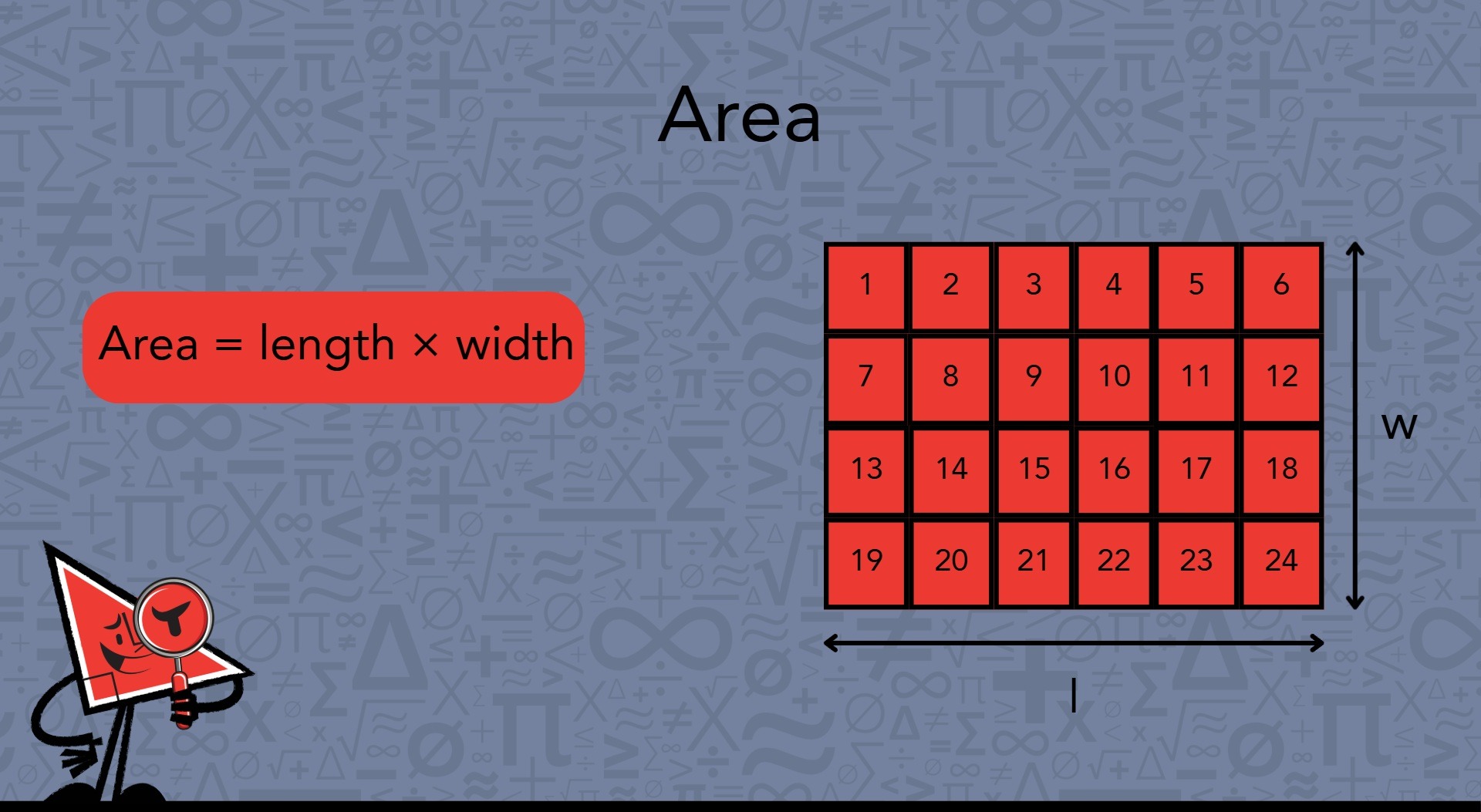 The 24 square units form 6 columns and 4 rows, so dividing 24 by the known side of 6 gives the missing side of 4.
The calculation itself is straightforward, but choosing it from the given information requires a deeper understanding of the relationship between the quantities.
📕 You May Also Like: How to Prepare Your Child for 11+ Maths This Summer: A Guide for Year 4 and Year 5 Families
Why Some Children Begin to Struggle With Maths in Secondary School
Some children begin to struggle with maths in secondary school because new work depends more heavily on knowledge and skills they developed in primary school.
We might expect years of good progress in maths to keep rolling, so why can secondary school sometimes interrupt that rhythm?
One important reason lies in its cumulative nature, where new learning builds on concepts and procedures children learned earlier.
As the work becomes more advanced, we can spot gaps in earlier knowledge more easily because:
-
One problem can draw on several earlier skills. In the equation 3x + 6 = 21, for example, students first need to understand that they can undo the + 6 by subtracting 6 from both sides, giving 3x = 15. They then divide both sides by 3 to find x = 5. If subtraction, division, or inverse operations are still shaky, the student may struggle with the equation even when they understand the basic idea of algebra.
-
The curriculum keeps building on earlier knowledge. Students meet more advanced content at KS3 while continuing to use what they learned in primary school. The DfE's KS3 guidance reflects this cumulative structure by linking new learning with the mathematical knowledge students have developed previously.
For parents, this changes what a sudden difficulty can tell you. The topic your child is struggling with may offer a clue that an earlier area of maths needs more attention. Once you know where the difficulty begins, you have a much clearer idea of the support your child needs.
📕 You May Also Like: How to Help Your Child Through Their Maths Homework Without the Stress
How to Tell if Your Child's Maths Foundations Have Gaps
We can pick up clues about gaps in maths foundations from the way children approach maths at home.
The Education Endowment Foundation’s guidance for maths at Key Stages 2 and 3 explains that students can have strengths in one part of their mathematical knowledge and weaknesses in another, so confidence in one area does not necessarily tell us how secure their knowledge is elsewhere.
It also describes a misconception as an understanding that leads to a systematic pattern of errors. In other words, an occasional mistake tells us much less than an error that keeps appearing in similar situations.
Some patterns may become apparent when a student:
-
Repeatedly makes the same type of error, even after practising similar questions
-
Knows a procedure but has difficulty explaining or reconstructing it when they forget a step
-
Struggles to choose an appropriate method when a familiar mathematical idea appears in a different type of problem
-
Has not developed fluent recall of important number facts, so basic calculations still require considerable effort
No single sign can tell you exactly where a gap lies, but the same difficulty across similar problems can show when your child’s mathematical understanding needs a closer look.
This is where tools, such as a diagnostic assessment, can provide more clarity by identifying which concepts your child understands securely and where their knowledge needs strengthening.
At Mathnasium, a diagnostic assessment is the first step students take during enrolment. It helps us build that fuller picture of your child’s mathematical knowledge. We use the findings to create a personalised learning plan around their specific goals and knowledge gaps.
📕 You May Also Like: 6 Benefits of Maths Tuition Beyond Grades
 At Mathnasium, our instructors help children understand how and why maths works, building confidence along the way.
How Mathnasium Supports Every Child's Maths Journey
Mathnasium is a maths-only learning centre dedicated to helping students of all skill levels excel in maths. Whether your child is catching up, keeping up or getting ahead, we can support them.
We do this through the Mathnasium Method™, our proprietary teaching approach designed to build maths mastery through deep understanding. Our approach includes:
-
Assessment and personalised learning plans. Every student begins their Mathnasium journey with a diagnostic assessment that identifies their current skills, strengths and knowledge gaps. We use those insights to create a personalised learning plan around their individual needs and goals.
-
Teaching for understanding. Our specially trained instructors use mental, verbal, visual, tactile and written techniques. Different ways of presenting a concept give students more than one path to understanding, whether they benefit from visual tools, hands-on activities or verbal explanations.
-
Face-to-face instruction. Students learn in a fun and supportive environment while following their own personalised learning plans, working with instructors face-to-face at the pace that's right for them, both in-centre and online.
-
Confidence and engagement. Sessions include games, earned rewards, and consistent celebration of progress, so students actively participate, solve problems, and engage with maths instead of simply listening to a lesson. They build confidence alongside fluency and many develop a more positive relationship with maths over time.
The results show what this approach can achieve:
-
94% of parents report an improvement in their child's maths skills and understanding
-
93% of parents report their child's improved attitude towards maths after attending Mathnasium
-
90% of students saw an improvement in their school grades
With over 1,250 centres worldwide, including over 40 across the UK, there is likely a Mathnasium near you.
Families across Harrow on the Hill, Harrow & Wealdstone, Kenton, South Kenton, Northwick Park, South Harrow, Sudbury Hill and North Wembley trust Mathnasium of Harrow to help their children build lasting maths confidence at every stage.
If your child is finding the move to secondary maths challenging, or you want to make sure their foundations are ready for what comes next, our team is ready to help.
✉️ Click Contact Us to get in touch with Mathnasium of Harrow
Not near Harrow?
📍 Find a Mathnasium Centre Near You


 020 8004 8220