01727 322830










The Limitations of Home Tutors — And How Mathnasium’s Team Model Overcomes Them
May 12, 2026 | St. Albans

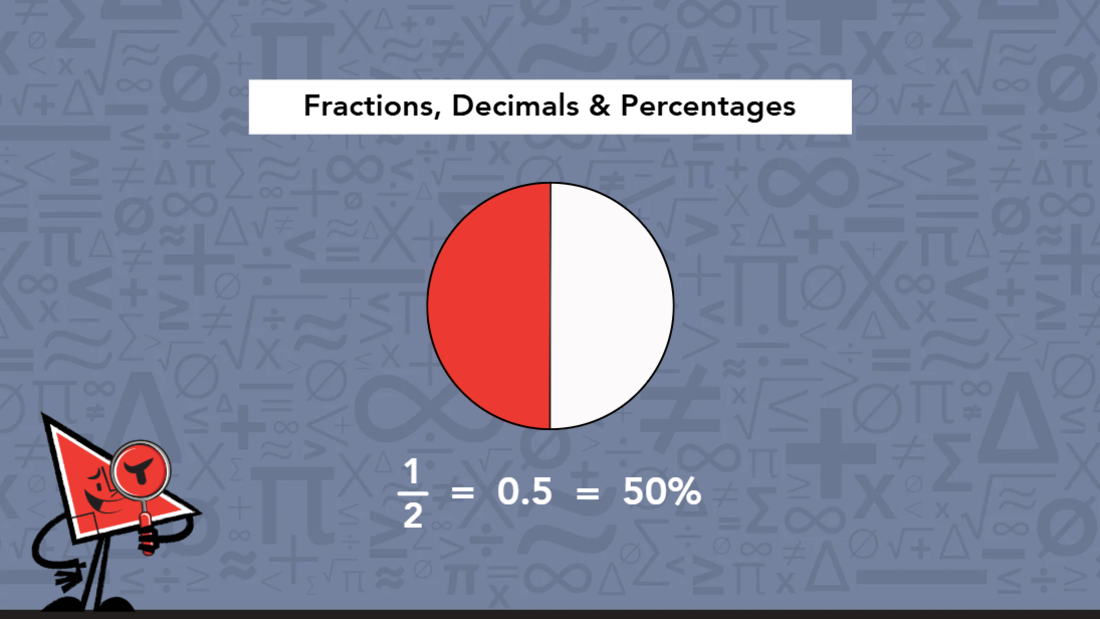
By Years 5 and 6, students have already met fractions, decimals and percentages, and are expected to recognise that \(\Large\frac{1}{2}\), 0.5 and 50% can represent the same quantity as they move between these forms confidently.
If your child is still struggling to connect these three concepts, our maths instructors are here to help, just like we would at our centre.
We’ll explain what changes in Years 5 and 6, how fractions, decimals and percentages fit together and what you may notice when those connections are not yet secure.
Fractions, decimals and percentages give us different ways to describe parts of a whole or compare a part to the whole. For your child, the important step is learning to recognise when these different forms represent the same value.
To see where that connection comes from, it’s useful to first look at what each form tells us:
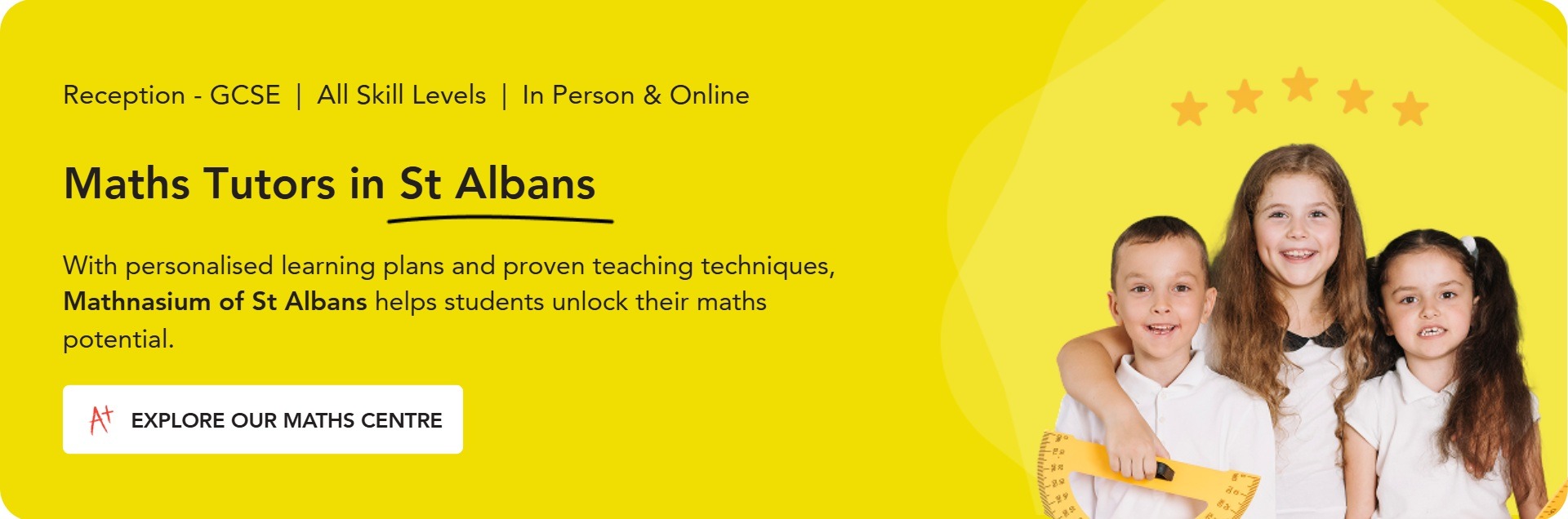
Fractions show how many equal parts we have compared with the number of equal parts in the whole. For example, \(\Large\frac{3}{5}\) means 3 out of 5 equal parts.
Decimals express parts of a whole using place value. 0.6, for instance, means 6 tenths.
Percentages express a quantity in relation to 100, so 60% means 60 out of 100.
Now, your child can make the connection between the three forms by moving from one representation to the next. With \(\Large\frac{3}{5}\), they can first write the fraction as a decimal by dividing the numerator by the denominator: 3 ÷ 5 = 0.6.
They can then express 0.6 as a percentage. Since per cent means per hundred, 0.6 = \(\Large\frac{60}{100}\) = 60%.
As you can see, \(\Large\frac{3}{5}\), 0.6 and 60% can all be used to represent the same value, but one form may be more useful than another depending on the problem. For instance, \(\Large\frac{3}{5}\) shows the relationship as equal parts, 0.6 makes the place value clear, and 60% expresses the proportion out of 100.
📕 You May Also Like: Everyday Maths: Fun Activities to Reinforce Skills at Home Help Them See Maths Differently with Hands-On Learning
Year 5 brings fractions, decimals and percentages into much closer alignment within the curriculum. The DfE’s maths programme of study for Key Stages 1 and 2 describes them as different ways of expressing proportions and sets out how students develop those relationships through Years 5 and 6.
In Year 5, students begin to:
recognise the percent sign (%) and understand that per cent means parts per hundred
write percentages as fractions with a denominator of 100 and as decimals
connect familiar fractions with their decimal and percentage equivalents, such as \(\Large\frac{1}{5}\) = 0.2 = 20%
work with decimals up to three decimal places
In Year 6, students are calculating decimal equivalents by associating fractions with division, so \(\Large\frac{3}{8}\) can be worked out as 3 ÷ 8 = 0.375. They also recall and use simple fraction, decimal and percentage equivalences in different contexts.
So, the challenge in Years 5 and 6 comes from recognising when different notation represents the same quantity and using those connections as the problem changes.
📕 You May Also Like: How to Prepare Your Child for 11+ Maths This Summer: A Guide for Year 4 and Year 5 Families
Difficulties with fractions, decimals and percentages can stem from converting between the forms or from the underlying mathematical ideas that support them.
Here are three areas where problems can arise:
Equivalent forms. Students may know that \(\Large\frac{3}{4}\) = 0.75 but struggle to express the same quantity as a percentage. If 75% does not immediately connect with \(\Large\frac{3}{4}\) and 0.75, the equivalence across all three forms may need more attention.
Decimal place value. The position of each digit determines its value in a decimal, which means they cannot compare decimal numbers in the same way as whole numbers. They may think 0.4 is smaller than 0.35 because 4 is smaller than 35, which is why writing 0.4 as 0.40 makes the comparison clearer. 40 hundredths is greater than 35 hundredths, so 0.4 > 0.35.
Percentages and the whole. To work out a percentage when the whole is not already expressed as 100, students need to understand how the given part relates to the whole. For example, take 15 out of 20. To express this as a percentage, students need to find the equivalent amount out of 100 because per cent means per hundred. Next, they can multiply both 15 and 20 by 5, which gives \(\Large\frac{75}{100}\), so \(\Large\frac{15}{20}\) = 75%.
Each difficulty points to a particular mathematical relationship that may need more attention.
The NCETM materials on linking fractions, decimals and percentages reflect the importance of building these foundations through their Year 6 teaching points on fraction-decimal equivalence, percentages as proportions and equivalent fraction, decimal and percentage forms.
📕 You May Also Like: 6 Benefits of Maths Tuition Beyond Grades
Answers and results aside, focus on how your child approaches the three concepts. This is how our seasoned instructors identify the type of support their student needs. If the same difficulties appear across different questions, they may point to a connection or underlying idea that needs more attention.
You might notice that your child:
Takes much longer with questions that combine fractions, decimals and percentages than with questions that use only one form
Can work with familiar equivalents but hesitates with less familiar ones, such as recognising \(\Large\frac{1}{2}\) = 0.5 = 50% more easily than other equivalences
Struggles to explain why two forms are equivalent, even after finding the correct answer
Converts numbers into the form they feel most comfortable with before solving a problem, even when the original form would make the calculation simpler
Patterns across several problems may suggest that something needs attention, yet they do not always show where the difficulty begins. Tools such as diagnostic assessments can help us look more closely at the underlying concepts.
For this reason, every student at Mathnasium begins with a diagnostic assessment to help us understand the strengths and knowledge gaps behind the patterns we see.
📕 You May Also Like: Why Maths Confidence Matters More Than Maths Grades
 At Mathnasium, we go far beyond traditional tutoring to help children understand and develop a love for maths.
Mathnasium is a maths-only learning centre helping students of all skill levels excel in maths.
We help students deepen their understanding of fractions, decimals and percentages alongside the broader maths skills they need as they progress through school.
For students preparing for the 11+, secure foundations in Years 5 and 6 maths can also support the broader mathematical reasoning they will need for entrance exams.
Our 11+ Test Prep Programme builds solid subject knowledge alongside critical thinking and problem-solving skills, so students can apply their maths understanding to unfamiliar questions.
Our caring instructors use the Mathnasium Method™, our proprietary teaching approach designed to build maths mastery through deep understanding. This approach consists of:
Assessment and personalised learning plans. Every student begins their Mathnasium journey with a diagnostic assessment that identifies their current skills, strengths and knowledge gaps. We use those insights to create a personalised learning plan around their individual needs and goals.
Teaching for understanding. Our specially trained instructors use mental, verbal, visual, tactile and written techniques. Different ways of presenting a concept give students more than one path to understanding, whether they benefit from visual tools, hands-on activities or verbal explanations.
Face-to-face instruction. Students learn in an engaging and fun setting while following their own personalised learning plans, working with instructors face-to-face at the pace that's right for them, both in-centre and online.
Confidence and engagement. Sessions include games, earned rewards, and consistent celebration of progress, so students actively participate, solve problems, and engage with maths instead of simply listening to a lesson. They build confidence alongside fluency and many develop a more positive relationship with maths over time.
The impact extends beyond the classroom:
94% of parents report an improvement in their child's maths skills and understanding
93% of parents report their child's improved attitude towards maths after attending Mathnasium
90% of students saw an improvement in their school grades
With over 1,250 centres worldwide, including over 40 across the UK, there is likely a Mathnasium centre near you.
Families across Marshalswick, Bernards Heath, Clarence Park and Fleetville, Verulam and Verulamium Park, City Centre and Abbey District and Sopwell trust Mathnasium of St Albans to help their children build lasting maths confidence.
If fractions, decimals, percentages or any other maths topic is giving your child trouble, our team is ready to help.
✉️ Click Contact Us to get in touch with Mathnasium of St Albans
Not near St Albans?
Mathnasium of St. Albans is a math-only learning centre for K-12 students in St Albans, LON. Trusted by over a million parents, Mathnasium uses personalized learning plans and the proprietary Mathnasium Method™ to help students catch up, keep up, and get ahead on their math journey.
Our specially trained tutors deliver face-to-face instruction in a supportive and fun small-group environment, working with students to develop a deep understanding of math, build confidence, and improve academic performance.
Contact Us