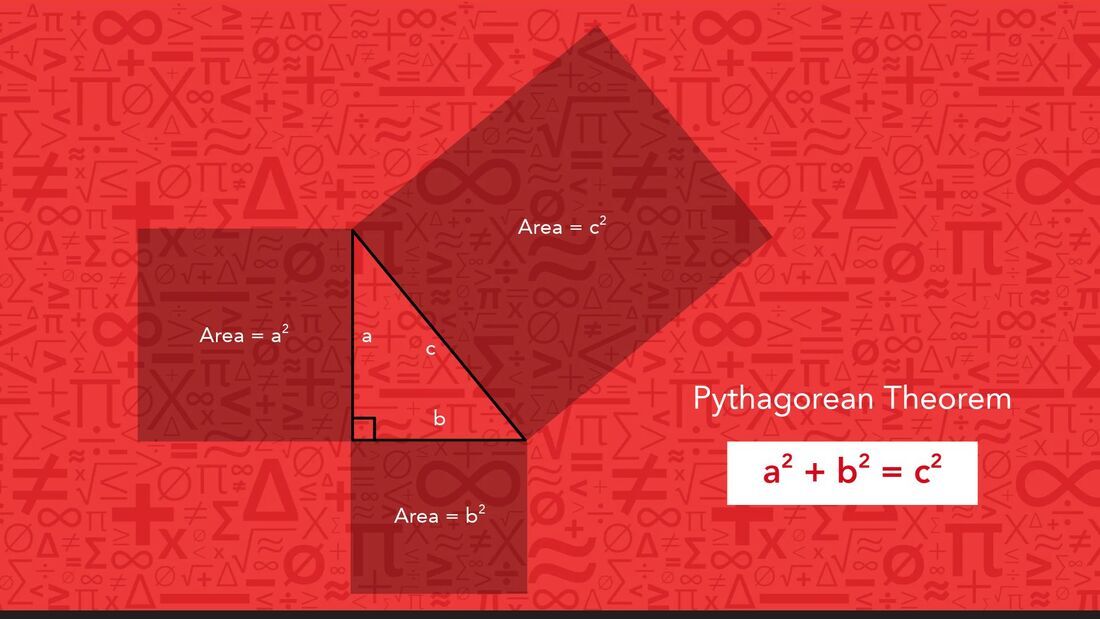
Pythagoras' theorem describes a relationship between the three sides of a right-angled triangle (a² + b² = c²). If we know the lengths of two sides, we can use this relationship to calculate the third.
Students encounter Pythagoras' theorem during Key Stage 3 (KS3) and continue using it at GCSE, where questions may involve more complex shapes and diagrams.
Today, we'll explain how the theorem works in a beginner-friendly way, show how to calculate missing side lengths and demonstrate how to check whether a triangle is right-angled.
What Is Pythagoras' Theorem?
Pythagoras' theorem is a mathematical rule that describes how the three sides of a right-angled triangle are related.
To understand why it works, imagine drawing a square on each side of the triangle. The combined areas of the two smaller squares will always equal the area of the largest square, which is built on the longest side.
We express this relationship using the formula a² + b² = c².
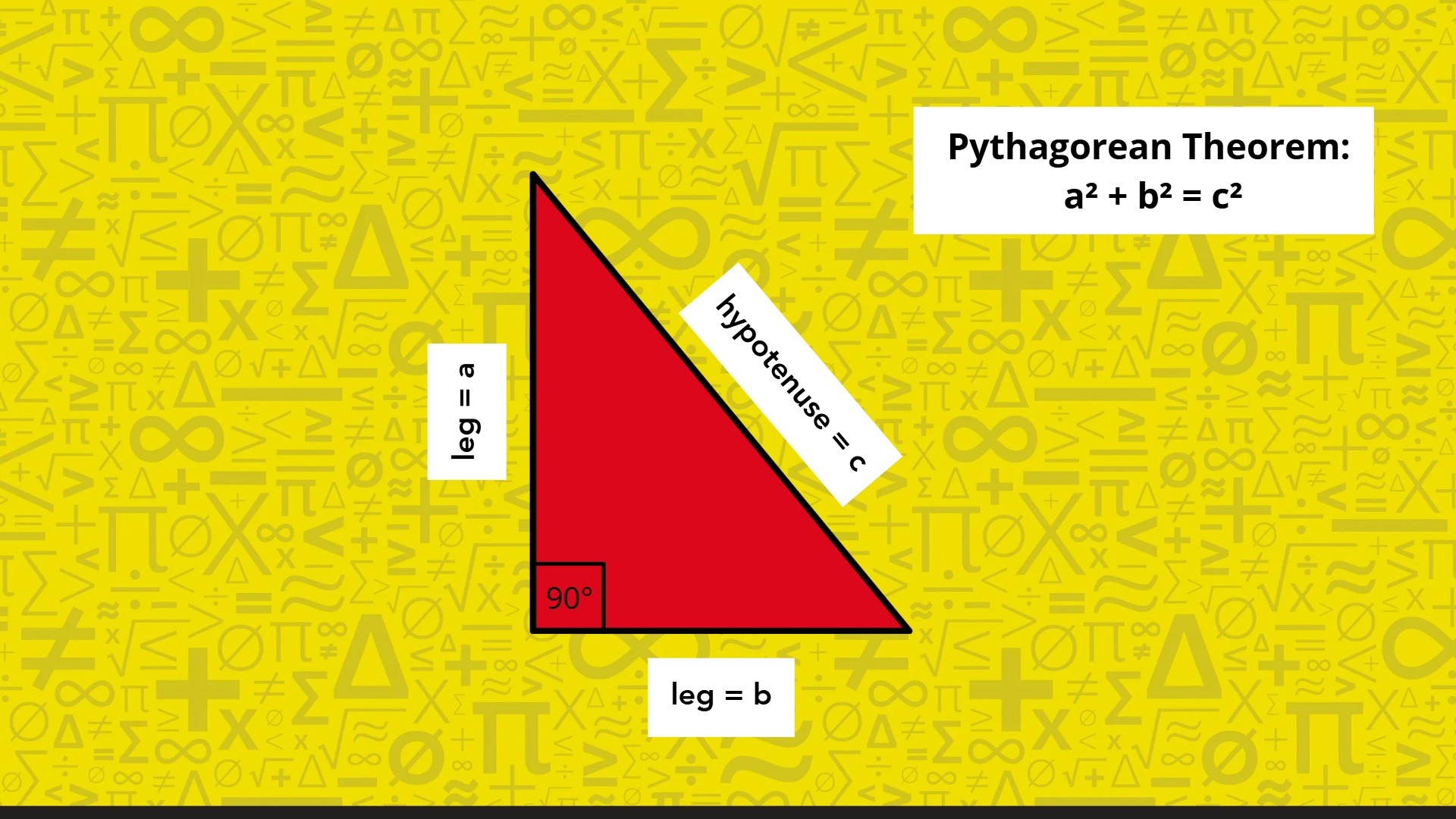
Each letter represents one side of the triangle:
-
a and b are the two shorter sides that meet to form the right angle (90°).
-
c is the hypotenuse, the longest side, which sits directly opposite the right angle.
The small raised 2 (²) means squared, or multiplied by itself. For example, 5² = 5 × 5 = 25.
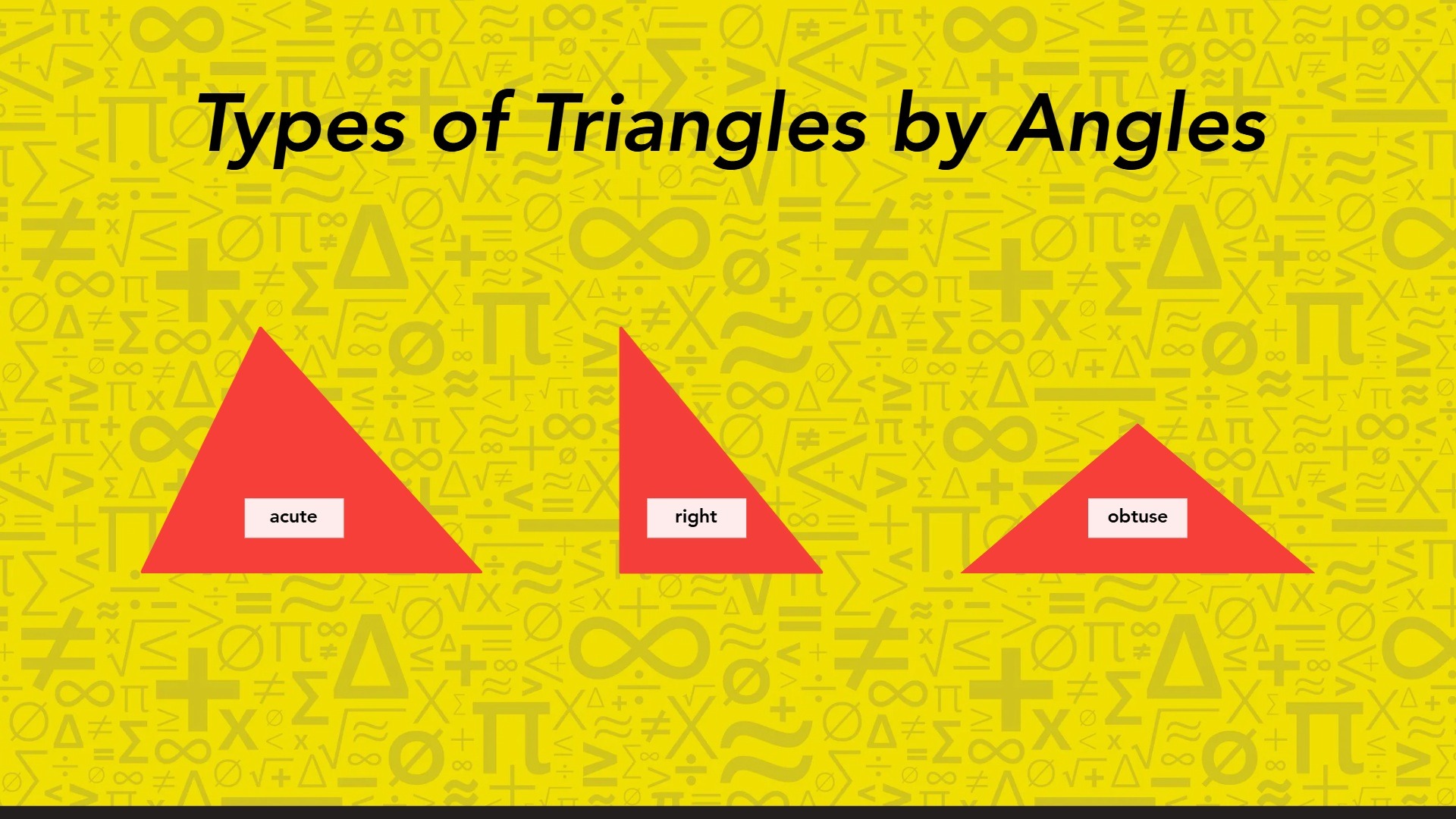
Triangles can also be classified by their angles. Acute-angled triangles have three angles smaller than 90°, while obtuse-angled triangles have one angle greater than 90°. Neither has a right angle, so the Pythagorean relationship does not hold for their side lengths.
📕 You May Also Like: Number Sense: Squaring Numbers Ending in 0, 5
How to Use Pythagoras' Theorem to Find a Missing Side
To use Pythagoras' theorem, we first need to identify the hypotenuse, which sits opposite the right angle (90°) and always wins the longest-side contest because the largest angle in any triangle gets the longest side!
From there, the calculation depends on whether we are looking for the hypotenuse or one of the shorter sides.
Let's work through both methods.
1. Use the Theorem to Find the Hypotenuse
We can calculate the hypotenuse directly from the lengths of the two shorter sides. To see how this works in practice, suppose a right-angled triangle has two shorter sides measuring 7 cm and 9 cm. Here, c represents the hypotenuse in our formula a² + b² = c².
Here are the steps:
-
Square the two shorter sides. We calculate 7² = 49 and 9² = 81.
-
Add the squared values. This gives us 49 + 81 = 130, so c² = 130.
-
Take the square root. We get c = \(\sqrt{130}\) ≈ 11.4 cm, rounded to one decimal place.
The hypotenuse is approximately 11.4 cm, which is longer than either of the other two sides, as we would expect.
2. Use the Theorem to Find a Shorter Side
If we know the hypotenuse and one shorter side, we can calculate the length of the remaining side.
Let's try a different example with a right-angled triangle whose hypotenuse measures 15 cm and another side measures 9 cm. We can find the missing side, b, by rearranging the formula and adapting the steps from our previous example:
-
Square the known sides. We calculate 15² = 225 and 9² = 81.
-
Subtract the squared values. Since 9² + b² = 15², we get b² = 225 − 81 = 144.
-
Take the square root. We get b = \(\sqrt{144}\) = 12 cm.
The missing shorter side measures 12 cm.
📕 You May Also Like: Parent Maths Tip #9: Shapes
How Can You Check if a Triangle Is Right-Angled?
Once we know that a² + b² = c² always holds true in a right-angled triangle, we can use Pythagoras' theorem to check whether a triangle has a right angle just by knowing the lengths of its three sides. If the values are equal, the triangle is right-angled.
This is also known as the converse of Pythagoras' theorem. To see how it works, consider a triangle with sides measuring 6 cm, 7 cm and 10 cm. Let's check whether it is right-angled in three simple steps:
-
Identify the longest side. Here, the longest side is c = 10 cm, while a = 6 cm and b = 7 cm.
-
Square the side lengths. We get 6² = 36, 7² = 49 and 10² = 100.
-
Compare the results. We substitute the squared values into a² + b² = c² to check whether 36 + 49 = 100. Since 36 + 49 = 85, the two values are not equal.
We have 6² + 7² ≠ 10², so the triangle is not right-angled.
But what happens if we change the 7 cm side to 8 cm? Now we have 6² + 8² = 10², or 36 + 64 = 100. Both sides of the equation are equal, so this triangle is right-angled.
📕 You May Also Like: Mathnasium #MathsTricks: Squaring Numbers (Part 2)
Where Is Pythagoras' Theorem Used in KS3 and GCSE Maths?
Students learn to use Pythagoras' theorem during Key Stage 3 (Years 7–9). The KS3 curriculum includes finding missing lengths in right-angled triangles and applying the theorem to problems involving two-dimensional shapes. Schools may introduce the topic at different points during these years.
At GCSE, students use the theorem in more complex geometry problems. AQA, one of England's GCSE exam boards, sets different requirements for Foundation tier (grades 1–5) and Higher tier (grades 4–9) in its maths specification:
-
Foundation tier: Students apply Pythagoras' theorem to find missing lengths in two-dimensional figures, including diagrams where the right-angled triangle forms part of a larger shape.
-
Higher tier: Students also solve problems involving three-dimensional figures, such as finding diagonals within cuboids.
In more complex questions, students may need to identify or construct the relevant right-angled triangle within a larger diagram before applying the theorem.
For a closer look at GCSE questions, students can use AQA's official past papers, which include question papers and mark schemes for practising and checking answers.
📕 You May Also Like: Year 10 Maths and the Start of GCSE: A Parent's Guide
 At Mathnasium, we provide bespoke maths tuition that builds understanding, develops confidence and helps each child progress at the right pace.
How Mathnasium Helps Children Understand Pythagoras' Theorem and Beyond
Mathnasium is a maths-only learning centre dedicated to helping students of all skill levels excel in maths.
Pythagoras' theorem is one of the geometry topics children encounter as they progress through secondary maths. Our instructors help them understand the relationships between shapes, angles and side lengths so they can apply what they know to unfamiliar problems.
Our geometry tuition supports children with topics such as triangles, angles and measurement, while our GCSE preparation programme develops subject knowledge, reasoning and problem-solving skills, with exam-style practice for Foundation and Higher tier students.
We deliver this support through the Mathnasium Method™, our proprietary teaching approach designed to build maths mastery through deep understanding. Our approach includes:
-
Assessment and customised learning plans. Every child begins their Mathnasium journey with a diagnostic assessment that identifies what they already know and where gaps remain. We use the insights to create a bespoke learning plan that addresses those gaps, builds on existing knowledge and provides greater challenge where appropriate.
-
Teaching for understanding. Our specially trained instructors teach children how and why maths works through mental, verbal, visual, tactile and written techniques. They also use Socratic questioning to help children explain their reasoning, understand geometric relationships and work towards solutions.
-
Face-to-face instruction. Children work face-to-face with specially trained instructors while following their own learning plan at a pace that suits their needs. Families can access the same tailored approach in-centre or through live online tuition at participating centres.
-
Confidence as maths develops. Children strengthen their mathematical understanding and problem-solving skills as they progress through their learning plan. They can build on their knowledge of geometry and develop the skills needed for more demanding secondary-school and GCSE questions.
The results show what this approach can achieve:
-
94% of parents report an improvement in their child's maths skills and understanding
-
93% of parents report their child's improved attitude towards maths after attending Mathnasium
-
90% of students saw an improvement in their school grades
With over 1,250 centres worldwide, including over 40 across the UK, there is likely a Mathnasium centre near you.
Families across Marshalswick, Bernards Heath, Clarence Park and Fleetville, Verulam and Verulamium Park, City Centre and Abbey District and Sopwell can turn to Mathnasium of St Albans for maths support from Reception through to GCSE. The centre also offers preparation for the 7+, 11+, 12+, 13+, Common Entrance and GCSE exams.
Whether your child needs help understanding Pythagoras' theorem, strengthening their geometry skills or preparing for GCSE maths, our team is ready to help.
✉️ Click Contact Us to get in touch with Mathnasium of St Albans
Not near St Albans?
📍 Find a Mathnasium Centre Near You


 01727 322830