The General Certificate of Secondary Education (GCSE) maths curriculum may be organised into separate topics, but many draw on shared mathematical skills.
Proportional reasoning is one of the skills that connects fractions, ratio, percentages, scale, rates and even parts of algebra. As students move towards GCSE, it helps them understand how quantities relate and change across these different areas of maths.
To help you understand what this means for your child, we’ll look at how proportional reasoning develops through Years 8 and 9, where students use it at GCSE and how you can recognise when your child may need support.
What Proportional Reasoning Means in Practice
Proportional reasoning is the ability to understand how two quantities relate and change together.
For your child, the important part is recognising that relationship and knowing how to use it, rather than simply carrying out a calculation.
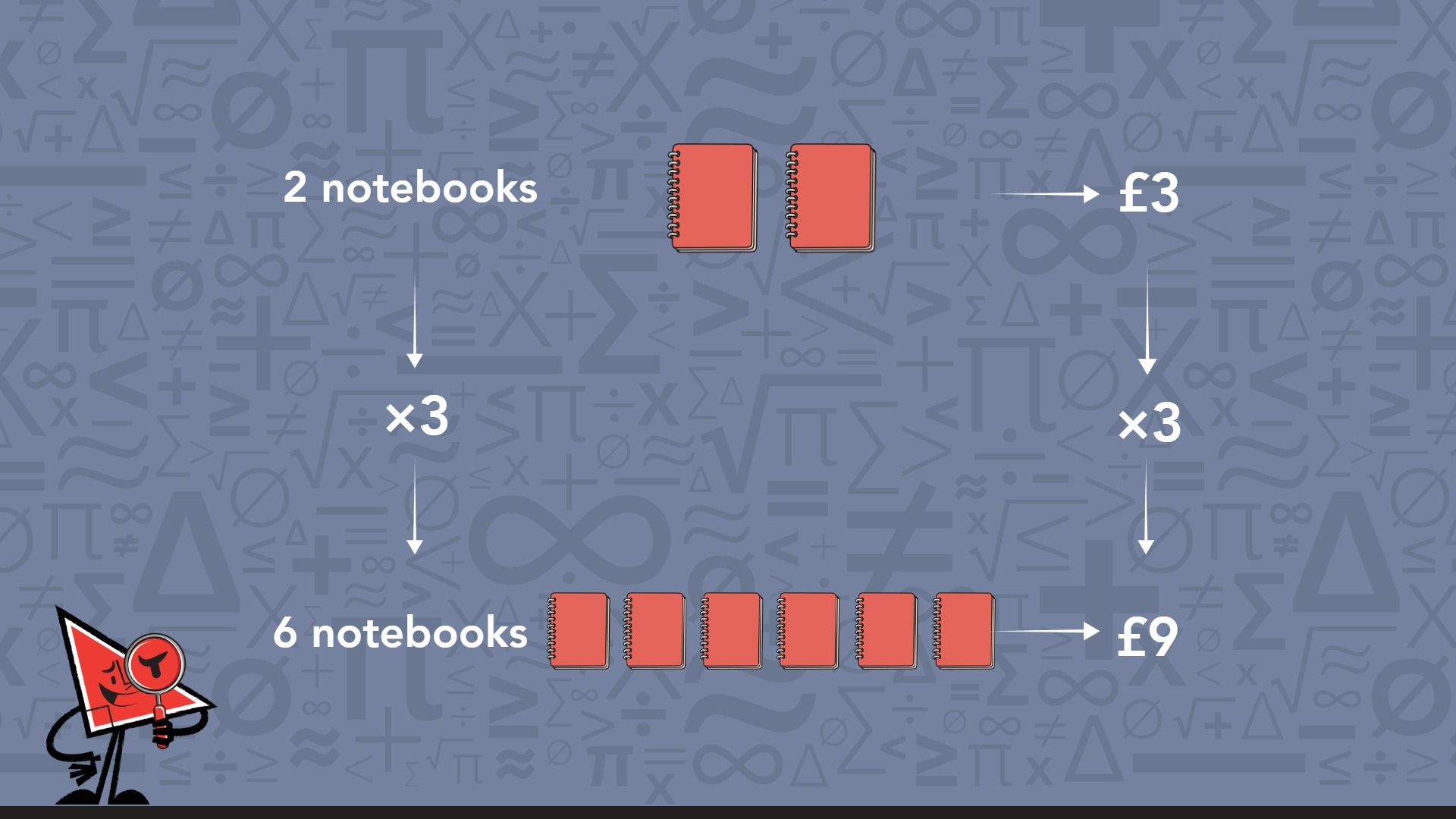
Let’s see how it works with a simple example you can work through together. If 2 notebooks cost £3 and each notebook costs the same amount, how much would 6 notebooks cost?
The number of notebooks has increased from 2 to 6, which is three times as many. To keep the price proportional, we also multiply the original cost by 3. So, £3 × 3 = £9. In other words, if we buy three times as many notebooks, we pay three times as much.
Your child will use this type of reasoning across several areas of maths as they move towards GCSE:
-
Fractions can describe one quantity in relation to another, such as 3 out of 4 equal parts (\(\Large\frac{3}{4}\)).
-
Ratios compare quantities, such as 2 red counters for every 3 blue counters (2:3).
-
Percentages express quantities in relation to 100, so 25% means 25 out of every 100.
-
Scale factors tell us how much a figure has been enlarged or reduced, so a scale factor of 2 doubles every length.
-
Rates compare quantities measured in different units, such as 60 miles per hour.
The NCETM's KS3 guidance brings these connections together through multiplicative reasoning, which it uses to link fractions, percentages, ratio, proportion and scale.
For students, the important idea is that these topics draw on related mathematical thinking. When students can recognise how quantities are connected, they are better prepared to use that relationship across different types of problems.
📕 You May Also Like: Back to School Maths: What Should My Child Know This Year?
How Proportional Reasoning Develops in Years 8 and 9
According to the national curriculum for England, students at Key Stage 3 build on their earlier maths knowledge as they extend and formalise their understanding of ratio and proportion. By Years 8 and 9, we can see these foundations develop as students explore relationships between quantities in greater depth.
We can see this progression particularly clearly by looking at fractions and ratios.
1. Fractions Become Operators
As your child progresses, fractions begin to describe what happens to a quantity, rather than only representing parts of a whole.
For example, \(\Large\frac{3}{4}\) of 20 is 15 (20 divided by 4, then multiplied by 3) because \(\Large\frac{3}{4}\) acts on the quantity 20 to find three-quarters of it. In this role, \(\Large\frac{3}{4}\) is called an operator because it tells us what to do with the quantity.
Students can apply the same operator to different quantities, such as \(\Large\frac{3}{4}\) of 20, \(\Large\frac{3}{4}\) of 200 or even \(\Large\frac{3}{4}\) of an unknown value. They need to use fractions in this broader way as they move into more advanced mathematical relationships.
Students’ earlier understanding of fractions can also be linked to their later maths achievement. One longitudinal study of students in the UK and US found that fraction knowledge at age 10 predicted algebra and overall maths achievement at age 16, even after the researchers accounted for other factors.
2. Ratios Describe Relationships That Can Scale
Students in Years 8 and 9 move beyond simply reading or writing ratios and start working with how the same relationship can scale across different quantities as they prepare for GCSE maths.
The ratio 2:3, for instance, tells us that for every 2 parts of one quantity, there are 3 parts of another.
Your child also needs to recognise that this relationship can scale while keeping the same proportion. 2:3, 4:6, 6:9 and 10:15 are equivalent ratios because we can multiply 2 and 3 by the same factor to produce each pair.
For students, the takeaway is that the quantities can change while the proportional relationship stays the same.
📕 You May Also Like: Why Fractions, Decimals & Percentages Confuse Your Child
Where Proportional Reasoning Shows Up in GCSE Maths
By GCSE, we can find proportional reasoning across several areas of the maths curriculum. Students may need to recognise the relationship themselves because a question will not always explicitly tell them to use proportion.
Here are some of the places they can encounter it:
|
GCSE area
|
Where proportional reasoning comes in
|
| Ratio |
Ratio-based sharing, scaling quantities and mixtures |
| Percentages |
Percentage increases and decreases, original values and compound growth |
| Scale and similarity |
Scale factors in maps, scale drawings and similar shapes |
| Rates |
Speed, rates of pay, unit prices and density |
| Graphs |
Direct proportion and gradients as rates of change |
| Algebra |
Equations that represent direct and inverse proportion |
The official GCSE mathematics subject content reflects this breadth. It includes ratio, proportion and rates of change as a core content area and connects proportional relationships with numerical, graphical and algebraic problems.
We can see one of these applications in a GCSE-style scale problem. On a map where 1 cm represents 5 km, two locations are 4 cm apart. Students can find the distance between them by calculating 4 × 5 = 20 km.
The question could also work in reverse. If two locations are 30 km apart, students calculate 30 ÷ 5 = 6 cm to find how far apart they should appear on the map.
Because proportional reasoning runs through so many areas of GCSE maths, gaps in it can affect how students approach a wide range of questions.
📕 You May Also Like: What Should My Child Know Before Starting GCSE Maths Revision?
How to Tell if Your Child Has a Proportional Reasoning Gap
It can sometimes be difficult to spot gaps in proportional reasoning because they may appear within different maths topics.
The national Key Stage 3 guidance gives us several useful clues to look for:
-
Your child relies on repeated addition rather than seeing multiplication as scaling. The guidance specifically says students need to understand multiplication as scaling as well as repeated addition.
-
Familiar methods become harder to use when the question looks different. Students are expected to apply previously learned maths to problems where the method is not immediately obvious.
-
Connections between fractions, percentages, ratio and proportion are difficult to see. The guidance identifies multiplicative reasoning as the idea that connects these topics, along with enlargement and scale.
-
Different representations of the same mathematical idea cause difficulty. The national curriculum expects students to move fluently between representations as they develop their mathematical reasoning.
If the same type of difficulty keeps returning, it may point to an underlying gap rather than difficulty with one individual topic. The pattern can alert us to a possible problem, but we still need to identify where in your child’s mathematical knowledge that problem begins.
One way to identify the source is through a diagnostic assessment, which checks your child’s knowledge across mathematical concepts and pinpoints areas that need strengthening.
Every child begins their Mathnasium journey with this assessment, and we use the findings to create a personalised learning plan around their needs and goals.
📕 You May Also Like: 6 Benefits of Maths Tuition Beyond Grades
 At Mathnasium, we take our students on a journey of learning, through assessment, customised learning paths and targeted lessons for understanding and comprehension.
How Mathnasium Helps Students Master Proportional Reasoning and Beyond
Mathnasium is a maths-only learning centre helping students of all skill levels excel in maths.
Whether your child needs support with proportional reasoning or wants to strengthen their maths skills more broadly, we can support them.
For students working towards GCSE maths, we also build the subject knowledge, reasoning and problem-solving skills they need to approach exam questions with confidence. Our GCSE maths support covers both Foundation and Higher tiers across Edexcel, AQA, and OCR.
No matter what your child is working towards, we support them through the Mathnasium Method™, our proprietary teaching approach designed to build maths mastery through deep understanding.
Our approach includes:
-
Assessment and personalised learning plans. Every student begins their Mathnasium journey with a diagnostic assessment that identifies their current skills, strengths and knowledge gaps. We use those insights to create a personalised learning plan around their individual needs and goals.
-
Teaching for understanding. Our specially trained instructors use mental, verbal, visual, tactile and written techniques. Different ways of presenting a concept give students more than one path to understanding, whether they benefit from visual tools, hands-on activities or verbal explanations.
-
Face-to-face instruction. Students learn in a caring and fun environment while following their own personalised learning plans, working with instructors face-to-face at the pace that's right for them, both in-centre and online.
-
Confidence and engagement. Sessions include games, earned rewards, and consistent celebration of progress, so students actively participate, solve problems, and engage with maths instead of simply listening to a lesson. They build confidence alongside fluency and many develop a more positive relationship with maths over time.
The results show what this approach can achieve:
-
94% of parents report an improvement in their child's maths skills and understanding
-
93% of parents report their child's improved attitude towards maths after attending Mathnasium
-
90% of students saw an improvement in their school grades
With over 1,250 centres worldwide, including over 40 across the UK, there is likely a Mathnasium centre near you.
Families across Watford, Cassiobury Park, Bushey, North Watford, Croxley, Croxley Green and Aldenham trust Mathnasium of Watford to help their children build lasting maths confidence.
If proportional reasoning, or any other maths concept, is giving your child trouble, our team is ready to help.
✉️ Click Contact Us to get in touch with Mathnasium of Watford
Not near Watford?
📍 Find a Mathnasium Centre Near You


 02081299788