Children may know their times tables by heart and answer multiplication questions in seconds. But this doesn’t always mean they understand the reasoning behind those answers. If you put the same numbers into a word problem or ask the question differently, their answers may not come quite so easily.
So, what does it mean to be fluent in maths?
Today, we’ll look more closely at that question, what maths fluency can look like for your child in KS2 and what you can do at home to help them become more confident and flexible with maths.
What Does Maths Fluency Mean in KS2?
Maths fluency in KS2 combines a secure understanding of mathematical ideas with the ability to recall and use what children know accurately. As that fluency develops, children can make connections between ideas and use their knowledge in different situations.
The National Curriculum for mathematics describes fluency in much the same way. It says children should become fluent through varied and frequent practice while developing conceptual understanding and the ability to recall and apply knowledge rapidly and accurately.
Times-table recall is one part of that fluency. Across KS2, children also develop fluency as they work with:
-
whole numbers and place value
-
addition, subtraction, multiplication and division
-
fractions, decimals and percentages
-
increasingly complex written and mental calculations
The curriculum reflects this progression. In Years 3 and 4, children become increasingly fluent with whole numbers, the four operations, number facts and place value. By Years 5 and 6, they extend those connections to larger numbers, fractions, decimals, percentages and ratio.
So, knowing a fact quickly is useful, but fluency also shows in what your child can do with that knowledge. They may use a familiar fact to work out a related one, recognise the same mathematical relationship in a different form or choose a suitable method for the problem in front of them.
📕 You May Also Like: Multiplication Tables Check 2026: A Guide to Year 4 Times Tables
How Can You Tell If Your Child Understands a Maths Fact?
You can get a clearer picture of your child’s maths fluency by paying attention to how they reach an answer, particularly how they use facts and methods they already know.
For example, your child may know 6 × 9 = 54 straight away. You can see whether they understand the relationship behind that fact by giving them a related word problem, such as “54 sweets are shared equally between 6 children. How many sweets does each child get?”
Here, 54 sweets are divided into 6 equal groups. If your child connects the problem to 6 × 9 = 54, they can use the inverse operation to find 54 ÷ 6 = 9.
Beyond this single example, you can also look for three signs of fluency in your child’s maths. The National Centre for Excellence in the Teaching of Mathematics (NCETM) describes these as:
As you watch your child work through KS2 maths, consider these three questions:
-
Can your child recall important facts accurately and use the relationships between them? In Year 4, children use inverse operations to check calculations. If your child works out 425 + 278 = 703, they can check the result with 703 − 278 = 425. Addition and subtraction are inverse operations, so using one operation to check the other can show that they understand the relationship between them.
-
Which method does your child choose, and can they explain why? If they solve 36 + 27 by adding 20 to 36 and then adding 7, they can explain that they broke 27 into 20 and 7 because those parts were easier to add mentally. Procedural fluency includes using procedures accurately and choosing a method that suits the task.
-
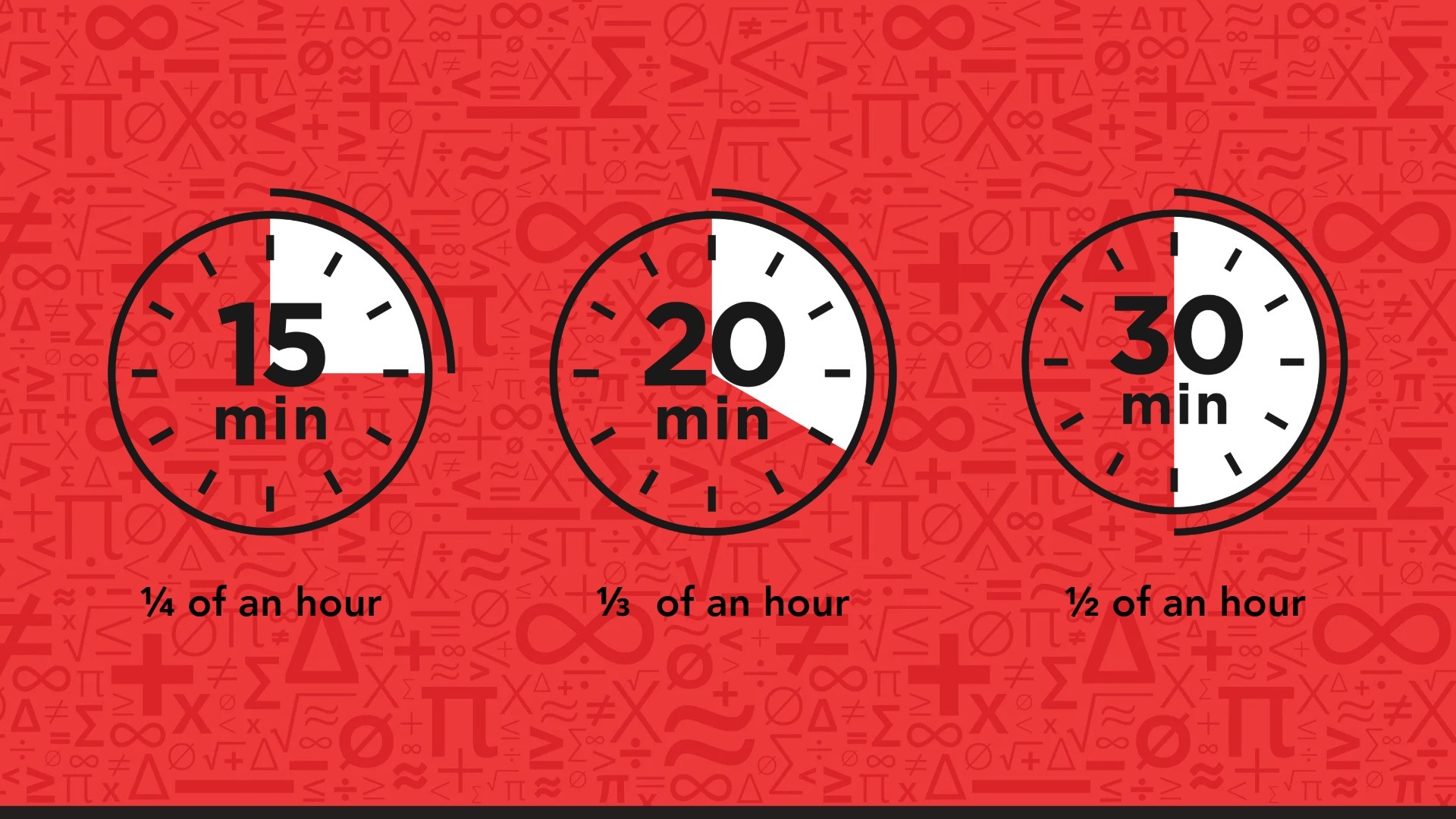
Do they recognise the same mathematical idea in different forms or contexts? Your child may understand \(\Large\frac{1}{4}\) as one of four equal parts of a shape and also recognise that 15 minutes is one quarter of an hour. KS2 maths explicitly connects fractions with shapes, quantities and measures, while Year 4 children also learn decimal equivalents such as \(\Large\frac{1}{4}\) = 0.25.
Fluent recall also leaves more mental space for the rest of the problem. NCETM explains that having key facts available automatically reduces the amount of working memory children need for basic calculations, so they can focus more readily on mathematical concepts and problem-solving.
📕 You May Also Like: Why Fractions, Decimals & Percentages Confuse Your Child
How Can Your Child Build Maths Fluency at Home?
You can help your child build maths fluency at home without turning everyday practice into another maths lesson. One useful approach is to guide their thinking with questions and give them opportunities to work things out using knowledge they already have.
The Socratic method, which we also use at Mathnasium, follows this principle. It uses purposeful questions to encourage children to draw on what they know and reason their way towards new understanding.
Here are a few ways you can bring this approach into maths practice at home:
-
Encourage your child to explain how they worked something out. Questions such as “How did you work out that answer?” or “Why does that method work?” invite your child to put their reasoning into words. If they solve 3.6 + 0.4, for instance, ask them to explain how they approached it. They may recognise that 0.6 needs another 0.4 to make 1, so adding 0.4 to 3.6 takes them to 4. Their explanation lets you hear the reasoning behind the calculation.
-
Give familiar knowledge a little more room to stretch. If your child knows that \(\Large\frac{1}{4}\) = 0.25, see whether they can use that knowledge to find \(\Large\frac{3}{4}\) as a decimal. They can reason that three quarters are three lots of 0.25, giving 0.75. Year 5 guidance specifically expects children to recall common fraction and decimal equivalents and extend that understanding to multiples of those fractions.
-
Use everyday quantities for short problems. Real-world situations can give your child a chance to reason with quantities and proportions. If a recipe uses 200 g of flour for 4 people, ask how much would be needed for 6 people. If they are unsure where to start, you can ask, “How much flour would you need for one person?” From there, they can work out the amount by dividing 200 ÷ 4 = 50 to find 50 g for one person, then multiply 50 × 6 = 300 to find the amount needed for 6 people. Recipes are one of the contexts the National Curriculum gives for recognising proportional relationships in Year 6.
Small variations like these give your child opportunities to use familiar maths in ways that require a little more reasoning. You can adjust the numbers, change the context or ask them to explain how they reached an answer, depending on what they are practising at the time.
If you are unsure which areas your child should work on next, Mathnasium starts with a diagnostic assessment to identify the skills they have already mastered and any knowledge gaps that need attention. We use what we learn to create a customised learning plan built around your child’s individual needs.
📕 You May Also Like: How Proportional Reasoning Impacts GCSE Maths Success
 At Mathnasium, our instructors guide children through challenging concepts by asking questions and using clear explanations that help them work towards the solution themselves.
How Mathnasium Teaches Children to Understand Maths
Mathnasium is a maths-only learning centre dedicated to helping students of all skill levels excel in maths.
If your child needs to build deeper fluency or wants support with maths more broadly, we can help.
Our specially trained instructors teach children how and why maths works, helping them develop deeper understanding, mathematical thinking and greater independence.
We bring these teaching principles together through the Mathnasium Method™, our proprietary teaching approach designed to help children develop lasting maths mastery through deep understanding.
To understand where your child is starting from, we first use a diagnostic assessment to identify what they already know and any knowledge gaps. Those insights allow us to create a bespoke learning plan focused on what your child needs to learn next.
During sessions, our instructors use that plan to guide face-to-face instruction and draw on mental, verbal, visual, tactile and written techniques. Children work at a pace that suits them in a caring and fun group environment, either in-centre or online through Mathnasium@home.
Our instructors also celebrate progress along the way, which helps children stay engaged and build confidence as their understanding develops.
The results show what this approach can achieve:
-
94% of parents report an improvement in their child's maths skills and understanding
-
93% of parents report their child's improved attitude towards maths after attending Mathnasium
-
90% of students saw an improvement in their school grades
With over 1,250 centres worldwide, including over 40 across the UK, there is likely a Mathnasium centre near you.
Families across Watford, Cassiobury Park, Bushey, North Watford, Croxley, Croxley Green and Aldenham trust Mathnasium of Watford to help their children build lasting maths confidence.
If your child seems to know their facts but struggles to use them, or any other maths topic is a challenge, our team is ready to help.
✉️ Click Contact Us to get in touch with Mathnasium of Watford
Not near Watford?
📍 Find a Mathnasium Centre Near You


 02081299788