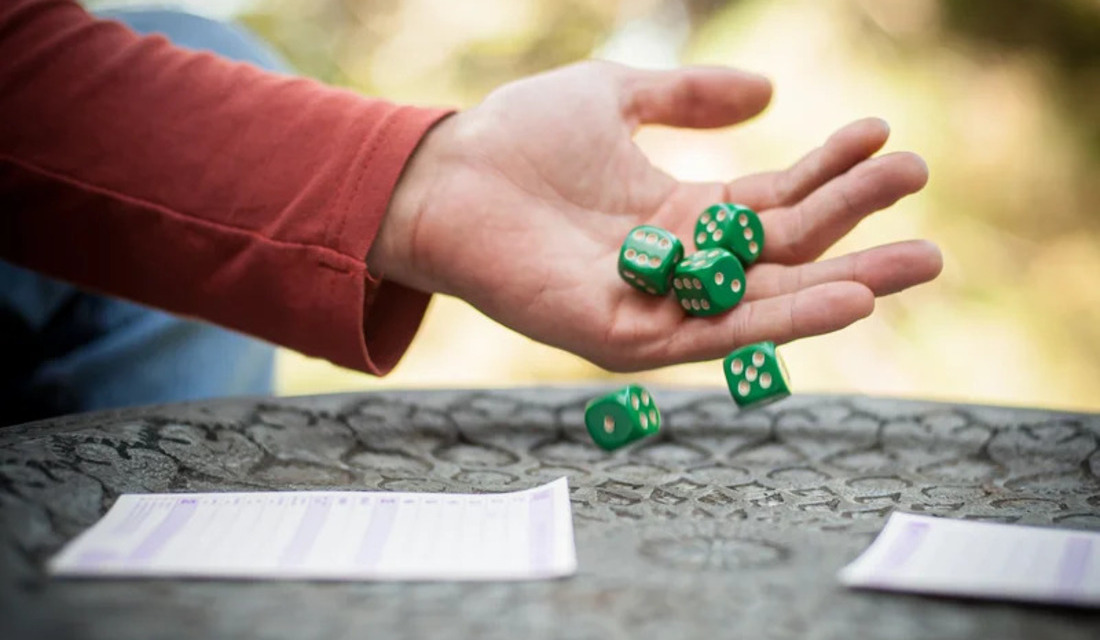
Every roll of a die has an uncertain outcome. Will it land on a six, an even number or something else? We can't know the result in advance, but probability helps us work out how likely each possibility is.
In maths, we can express that likelihood using numbers and calculate the probability of different outcomes. We'll look at what those numbers mean, how the probability scale works and how to calculate the probability of an event happening or not happening, step by step.
What Is Probability in Maths?
Probability is a way of measuring how likely an event is to happen. We often describe chances using words such as certain, likely, unlikely and impossible, but in maths, we can use numbers to express that likelihood more precisely.
To understand probability, we first need to distinguish between an outcome and an event. Each possible result is called an outcome, such as rolling a 4 on a fair six-sided die. An event is something we want to find the probability of, like rolling an even number.
With a fair six-sided die, there are six possible outcomes: 1, 2, 3, 4, 5 and 6. Each number has an equal chance of appearing, which means the outcomes are equally likely. We can use these possibilities to work out how likely different events are.
Probability is part of the Key Stage 3 maths curriculum in England, where students learn to describe likelihood, compare equally and unequally likely outcomes and calculate probabilities. They build on these foundations as they progress towards GCSE maths.
📕 You May Also Like: How Proportional Reasoning Impacts GCSE Maths Success
How Does the Probability Scale Work?
Probability is measured on a scale from 0 to 1, where each number represents how likely an event is to happen. Probabilities closer to 0 indicate that an event is less likely to happen, while values closer to 1 indicate that it is more likely.
Let's use our fair six-sided die to see what different points on the scale mean:
-
0 (Impossible): You cannot roll a 7 because the die only has numbers from 1 to 6.
-
0.5 (Even chance): Three numbers on the die are odd and three are even, so the probability of rolling an even number is 0.5.
-
1 (Certain): Every face shows a number below 7, so rolling a number less than 7 is certain.
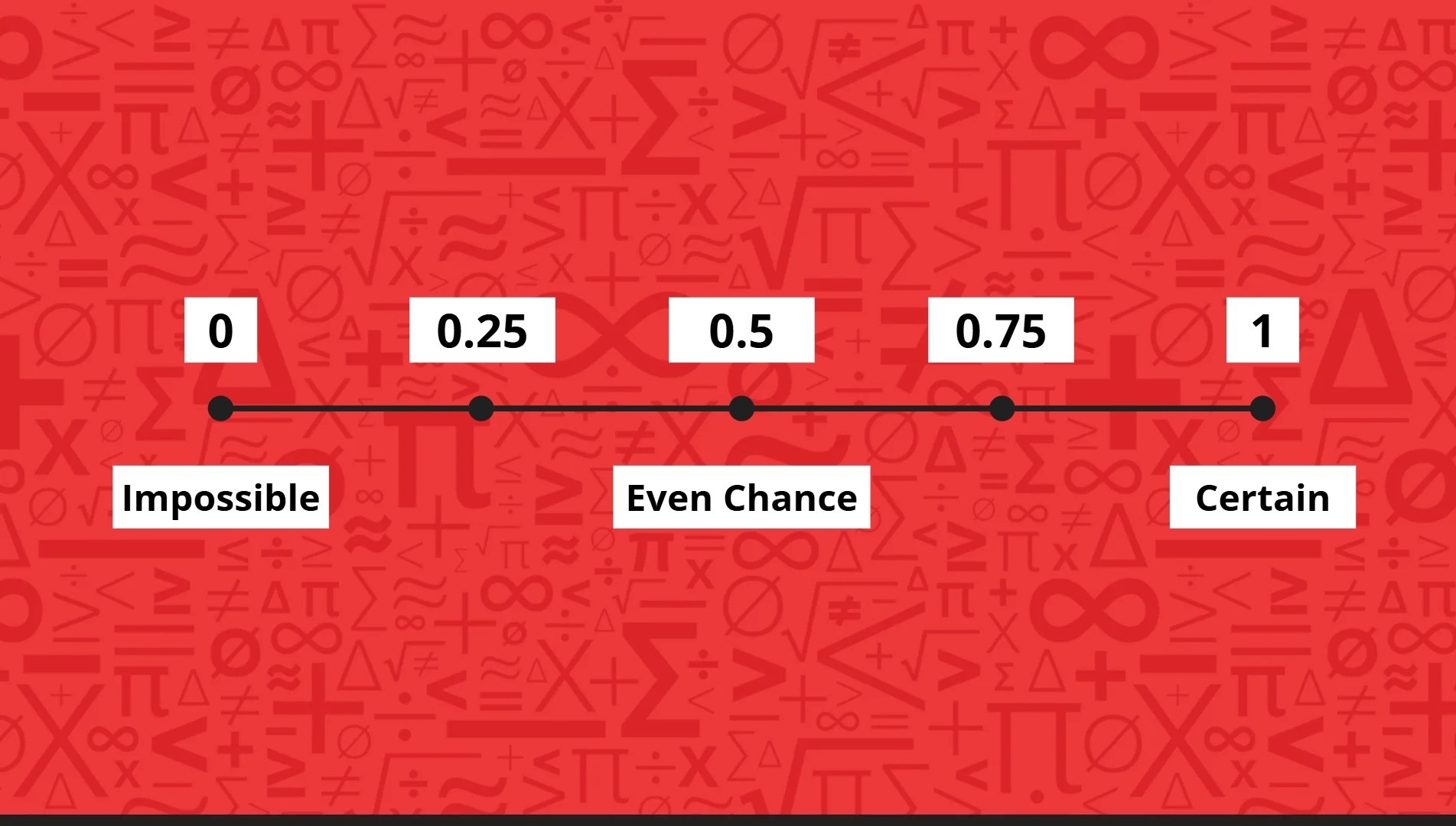
Values between these points show different degrees of likelihood. For example, 0.25 represents a 25% chance, while 0.75 represents a 75% chance. The higher value tells us that an event is more likely to happen than one with a lower probability.
We can also express the same probability as a fraction, decimal or percentage. For example, \(\Large\frac{1}{2}\) = 0.5 = 50%. All three represent an even chance, regardless of how we write the probability.
📕 You May Also Like: Why Fractions, Decimals & Percentages Confuse Your Child
How Do You Calculate Probability?
To calculate probability, we compare the number of favourable outcomes with the total number of possible outcomes. When all outcomes are equally likely, we can use this formula:
Probability = \(\Large\frac{\text{Number of favourable outcomes}}{\text{Total number of possible outcomes}}\)
Favourable outcomes are the results that match the event we're interested in. Let's return to our fair six-sided die and work out the probability of rolling an even number. We'll break the calculation into four steps so we can see how each part of the formula works.
Step 1: Identify All Possible Outcomes
The die has six possible outcomes: 1, 2, 3, 4, 5 and 6. So, the total number of possible outcomes is 6.
Step 2: Count the Favourable Outcomes
For our event, the favourable outcomes are 2, 4 and 6 because these are the even numbers on the die. That gives us 3 favourable outcomes.
Step 3: Apply the Probability Formula
We divide the number of favourable outcomes by the total number of possible outcomes:
P(even) = \(\Large\frac{3}{6}\)
Here, P(even) means the probability of rolling an even number.
Step 4: Simplify and Interpret the Result
Both 3 and 6 are divisible by 3, so we can simplify the fraction:
\(\Large\frac{3}{6}\) = \(\Large\frac{1}{2}\) = 0.5 = 50%
This means we have an even chance of rolling an even number because exactly half of the die's faces show even numbers.
Why Outcomes Must Be Equally Likely
The formula only works when all individual outcomes are equally likely. Take a fair spinner divided into two coloured sections, with one covering three-quarters of the circle (75%) and the other covering one-quarter (25%).
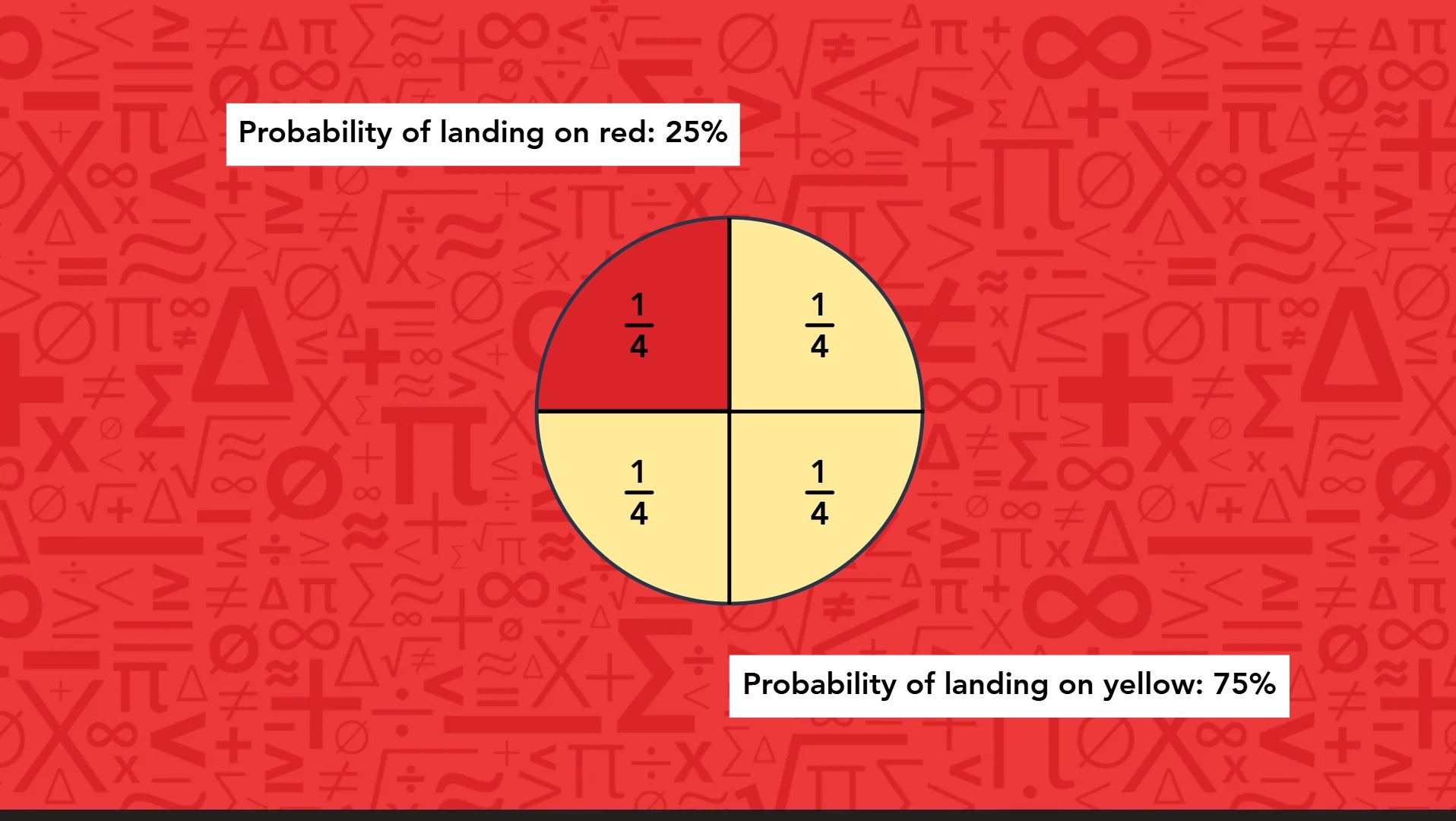
Although there are only two possible colours, they don't have an equal chance of being selected because one section covers more of the spinner than the other. We therefore cannot assume that each colour has a probability of \(\Large\frac{1}{2}\).
📕 You May Also Like: Mathnasium #MathsTricks: Probability (Part 1)
How Do You Find the Probability of an Event Not Happening?
We find the probability of an event not happening by subtracting the probability that it happens from 1. That works because the event either happens or it doesn’t, so the two probabilities cover every possible outcome and always add up to 1.
In maths, we call an event not happening the complement of that event. To calculate its probability, we use the following formula:
P(not A) = 1 − P(A)
Here, the letters and symbols mean:
-
A is the event we're interested in.
-
P(A) represents the probability of that event happening.
-
P(not A) tells us the probability of that event not happening.
We can use our familiar six-sided die to see how this works. Suppose we want to find the probability of not rolling a 6. Let's work through the calculation in two steps.
Step 1: Find the Probability of Rolling a 6
Only one of the six equally likely outcomes is a 6, so we write P(6) = \(\Large\frac{1}{6}\).
Step 2: Subtract That Probability From 1
P(not 6) = 1 − \(\Large\frac{1}{6}\) = \(\Large\frac{6}{6}\) − \(\Large\frac{1}{6}\) = \(\Large\frac{5}{6}\)
So, the probability of not rolling a 6 is \(\Large\frac{5}{6}\), or approximately 83.3%.
We can check our answer by counting the outcomes that are not 6. There are five of them: 1, 2, 3, 4 and 5. If we add the probabilities of rolling a 6 and not rolling a 6, we get \(\Large\frac{1}{6}\) + \(\Large\frac{5}{6}\) = 1, confirming that we've accounted for every possible outcome.
📕 You May Also Like: Mathnasium #MathsTricks: Probability (Part 2)
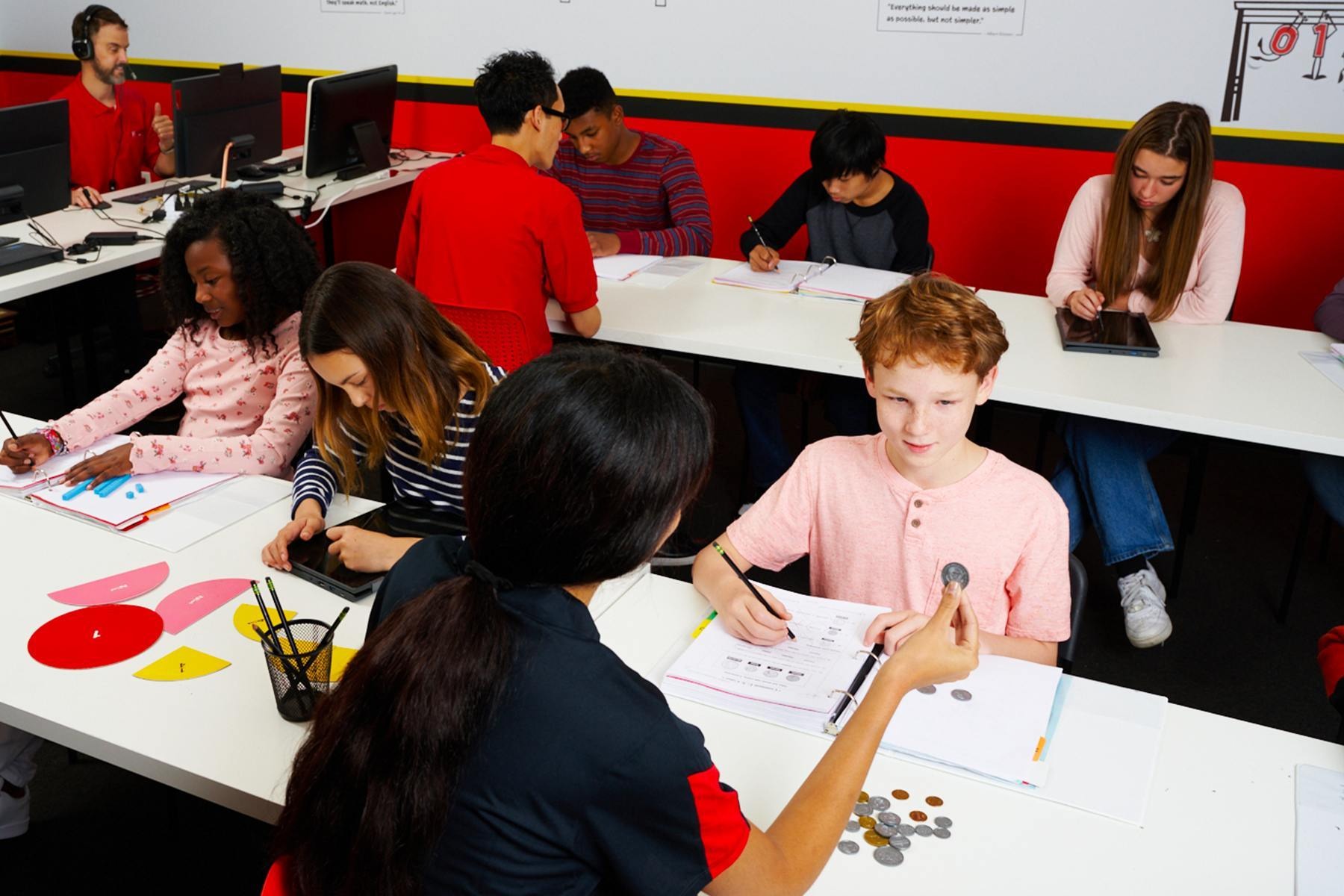 Our specially trained instructors are equipped to explain any concept in the way that works best for each child, from primary school through to GCSE.
How Mathnasium Helps Children Understand Probability and Other Maths Topics
Mathnasium is a maths-only learning centre dedicated to helping students of all skill levels excel in maths.
Probability brings together several maths skills, including fractions, decimals and percentages. If your child finds these connections difficult or needs support with other maths topics, we can help them build their understanding from what they already know.
We support primary and secondary school students with the maths they're learning in class, including topics such as probability, as well as preparation for GCSE maths.
Our specially trained instructors teach children how and why maths works, helping them develop deeper understanding, mathematical thinking and greater independence.
We bring these teaching principles together through the Mathnasium Method™, our proprietary teaching approach designed to help children develop lasting maths mastery through deep understanding.
To understand where your child is starting from, we first use a diagnostic assessment to identify what they already know and any knowledge gaps. Those insights allow us to create a bespoke learning plan focused on what your child needs to learn next.
During sessions, our instructors use that plan to guide face-to-face instruction and draw on mental, verbal, visual, tactile and written techniques. Children work at a pace that suits them in a caring and fun group environment, either in-centre or online through Mathnasium@home.
As children progress, we revisit their learning plans to reflect their developing skills and understanding. Our instructors also celebrate their achievements along the way, while helping them stay engaged and build confidence.
The results show what this approach can achieve:
-
94% of parents report an improvement in their child's maths skills and understanding
-
93% of parents report their child's improved attitude towards maths after attending Mathnasium
-
90% of students saw an improvement in their school grades
With over 1,250 centres worldwide, including over 40 across the UK, there is likely a Mathnasium centre near you.
Families across Watford, Cassiobury Park, Bushey, North Watford, Croxley, Croxley Green and Aldenham can turn to Mathnasium of Watford for support with everyday maths learning, GCSE preparation, entrance exams such as the 11+ and maths competitions, including the UKMT Junior Maths Challenge and Maths Olympiad.
Whether your child needs help calculating probability or tackling another maths topic, our team is ready to help.
✉️ Click Contact Us to get in touch with Mathnasium of Watford
Not near Watford?
📍 Find a Mathnasium Centre Near You


 02081299788