01962 671787











Mathnasium of Winchester featured in Hampshire Chronicle
Jul 29, 2026 | Winchester


If you think back to how you learned maths at school, you may notice your child is learning some concepts differently.
Schools today may use methods, visual representations and terminology that you did not come across in your own classroom, which can sometimes make it harder to know how to support what your child is learning.
We are a team of maths educators in Winchester, and today we'll take a closer look at how maths is taught in primary school and how these foundations develop as children move into secondary school.
We'll explain some common methods and share practical ways to support the maths your child is learning at school.
Primary schools in England generally follow the national curriculum for maths, which sets three main aims for children:
become fluent in the fundamentals of maths
reason mathematically
solve problems with increasing sophistication
The curriculum also gives schools flexibility in how they organise their teaching. Children are expected to develop secure understanding before progressing to more advanced ideas, while teachers can use different models and approaches to help them make connections across maths.
One way schools put these principles into practice is through teaching for mastery. The National Centre for Excellence in the Teaching of Mathematics (NCETM) describes five ideas that underpin this approach:
coherence
representation and structure
mathematical thinking
fluency
variation
In practice, teachers build concepts through connected steps and choose representations that show children the relationships within the maths. The DfE's primary mathematics guidance also provides core representations and language structures that teachers can use as children build their understanding from Year 1 to Year 6.
This is also why some of the methods children use today may look different from the ones their parents remember from school.
📕 You May Also Like: Why Being Good at Maths Looks Different in Primary and Secondary School
Primary maths methods can use diagrams and models to make the relationships between numbers easier to see. Teachers choose them according to the concept they are teaching, so children may meet the same model in more than one area of maths.
Children meet some of these representations early in primary school and continue to use them as the maths becomes more complex.
Here are three examples you may come across during primary school.
Part-whole models show how a whole quantity can be split into smaller parts or how separate parts combine to make a whole. The NCETM introduces this relationship from Year 1, where children use it as they develop their understanding of addition and subtraction.
For example, imagine 8 is the whole and 5 is one of its parts. We can find the missing part by asking what needs to be added to 5 to make 8. The answer is 3, so 5 and 3 are the two parts that make the whole 8.
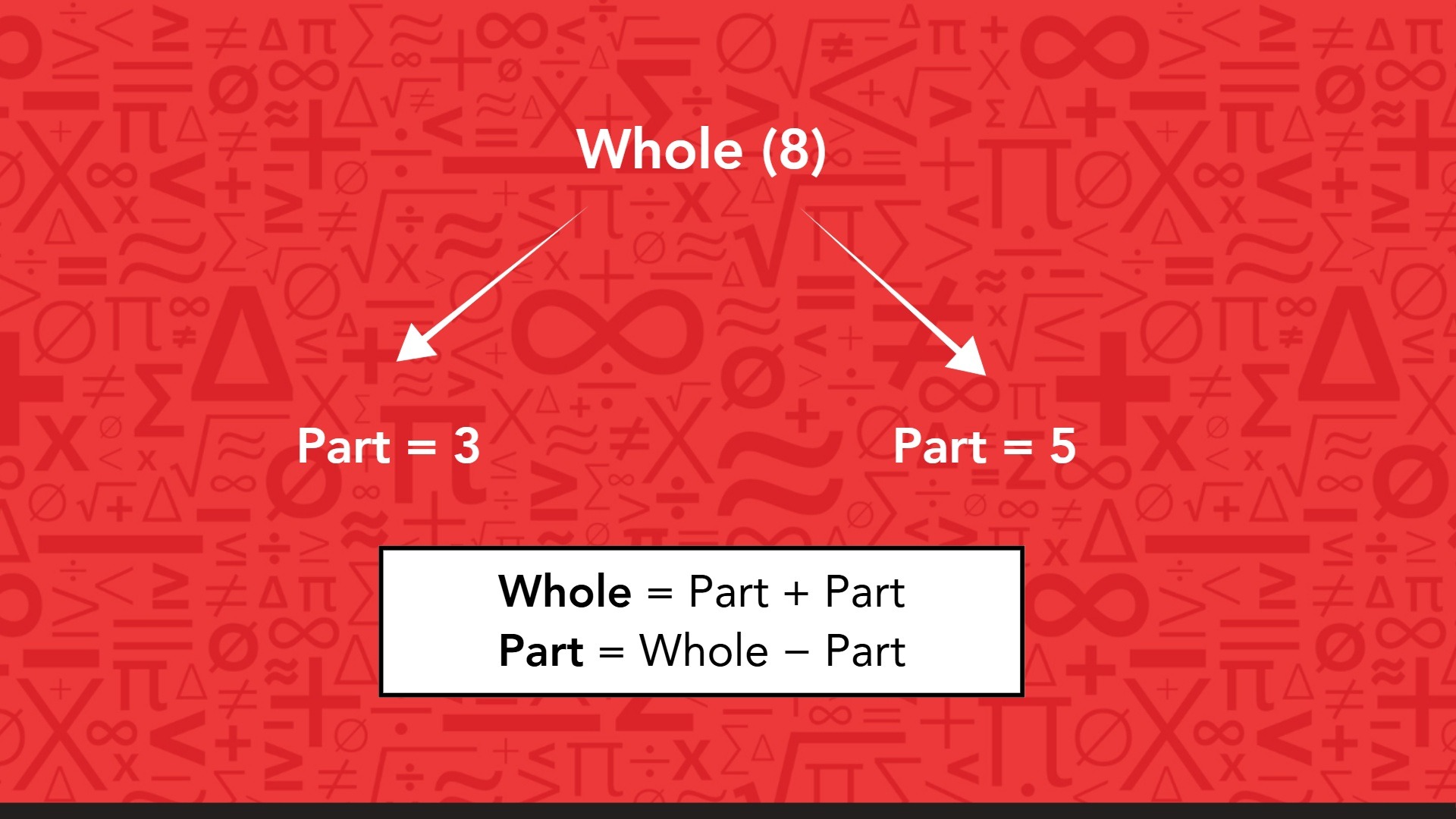
From that one relationship, children can see four connected calculations:
5 + 3 = 8
3 + 5 = 8
8 − 5 = 3
8 − 3 = 5
In this way, the model shows how addition and subtraction are connected through the same three numbers.
Bar models use rectangular bars to represent quantities and show how they relate to one another. According to NCETM guidance on bar models, children can use them to represent problems involving the four operations, ratio and proportion.
Suppose two quantities total 60, and the larger quantity is three times the smaller one. We can represent the smaller quantity with 1 part. Since the larger quantity is three times as large, it must contain 3 of those same parts. Together, the two quantities make 4 equal parts: 60 ÷ 4 = 15.
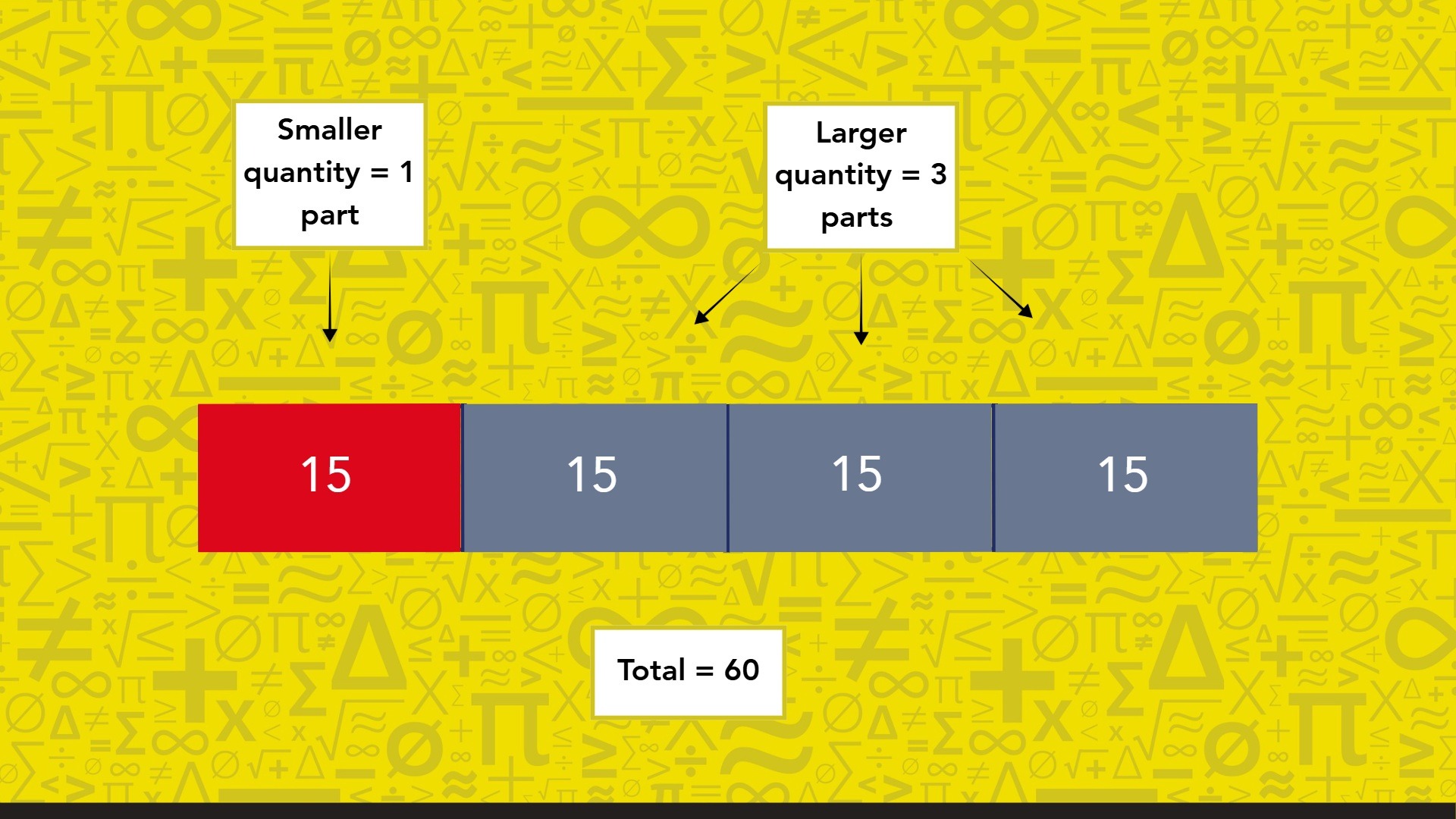
So, the smaller quantity has one part, which equals 15. The larger quantity has three parts, so 3 × 15 = 45.
Bar models show how the two quantities make up the total and why we divide 60 into four equal parts.
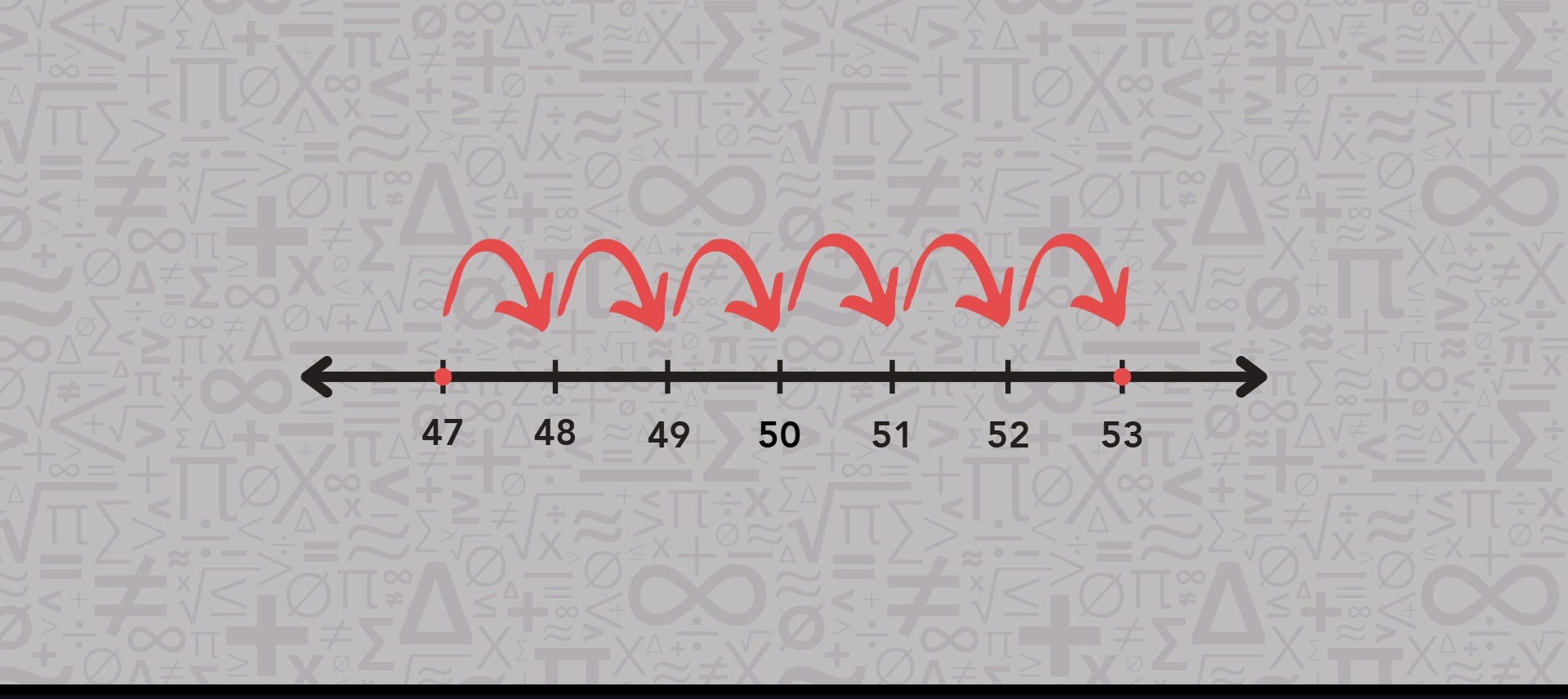
Number lines place numbers in order along a line, which can help children see their relative positions and the distance between them. The DfE's guidance uses number lines across primary maths for concepts including number and calculation.
For example, children can use a number line to find the difference between 47 and 53. When we start at 47, we count forward until we reach 53. The distance between the two numbers is 6, so the difference is 6.
📕 You May Also Like: Number Sense: The Foundation of Primary School Maths
Secondary maths builds on the foundations children develop in primary school and extends their knowledge across:
number
algebra
ratio, proportion and rates of change
geometry and measures
probability
statistics
Children also begin working with more formal mathematical notation and increasingly complex problems. The Key Stage 3 maths curriculum expects them to select appropriate calculation strategies and move between numerical, algebraic, graphical and diagrammatic representations.
For example, the relationships children explored with numbers in primary school can later be expressed algebraically:
5 + 3 = 8 shows a numerical relationship.
x + 3 = 8 expresses the same structure with an unknown value.
Children can then use the inverse operation, 8 − 3 = 5, to find that x = 5. Here, a familiar number relationship becomes an introduction to solving equations with unknown values.
📕 You May Also Like: Year 7 Maths: What Changes in Secondary School?
You may come across a method or term in your child's maths work that you do not recognise from your own school days. In that situation, start with what your child has been taught rather than introducing another method straight away.
We suggest trying a few questions to understand where your child may need support:
“Can you show me how you learned this at school?” gives your child a chance to explain the method in their own words.
“What does this model or step represent?” checks whether your child understands the maths behind the procedure.
“Which part is confusing you?” can show whether the difficulty comes from the method itself or from an earlier concept your child needs to revisit.
If the method is still unfamiliar, your child's school website can provide more context. Some schools publish a calculation policy, which explains the methods, models and mathematical language they use to teach calculations across different year groups.
For example, Stanmore Primary School in Winchester publishes separate calculation policies for addition and subtraction and for multiplication and division. Parents can use documents like these to see how a calculation is taught at school before working through it at home.
You can also look at the Hampshire Maths Team's progression resources, which show how areas such as calculation, number facts, counting, times tables and fractions develop through primary maths. Since Winchester is part of Hampshire, these resources provide useful local context alongside the approach published by your child's own school.
As you check the method your child's school uses, pay attention to the terminology too. Your child's school may use exchanging when teaching column subtraction, while you may remember the term borrowing.
The term exchanging describes the place-value process more precisely because one ten or hundred is exchanged for smaller units. You can make homework easier to discuss by using the language and method your child already knows, without introducing another approach for them to interpret.
📕 You May Also Like: How to Help Your Child Through Their Maths Homework Without the Stress
 At Mathnasium, maths instructors go far beyond traditional teaching approaches to help children understand and develop a love for maths.
Mathnasium is a maths-only learning centre dedicated to helping students of all skill levels excel in maths.
Whether your child needs support with a method they are learning at school, has gaps in their understanding or is ready for greater challenge, we can help from primary school through to secondary school and GCSE.
Mathnasium supports and complements what children learn at school while building the mathematical foundations they need to keep progressing.
We do this through the Mathnasium Method™, our proprietary teaching approach designed to help children build maths mastery, complementing what your child is already learning in class. Our approach includes:
Assessment and customised learning plans. Every child begins their Mathnasium journey with a diagnostic assessment that identifies their strengths and any gaps in their understanding. We use the results to create a bespoke learning plan based on what they already know and what they need to learn next.
Teaching for understanding. Our specially trained instructors teach children how and why maths works using mental, verbal, visual, tactile and written techniques. Children develop a deeper understanding of mathematical concepts rather than simply memorising methods.
Face-to-face instruction. Children work face-to-face with specially trained instructors and follow their bespoke learning plan at a pace that is right for them. Tuition is available in-centre and online, with online availability depending on the centre.
Confidence and engagement. Sessions include games and earned rewards, so children actively participate, solve problems and engage with maths instead of simply listening to a lesson. They build confidence alongside fluency and many develop a more positive relationship with maths.
The results show what this approach can achieve:
94% of parents report an improvement in their child's maths skills and understanding
93% of parents report their child's improved attitude towards maths after attending Mathnasium
90% of students saw an improvement in their school grades
With over 1,250 centres worldwide, including over 40 across the UK, there is likely a Mathnasium centre near you.
Families across Kings Worthy, Alresford, South Wonston, Colden Common, Stockbridge, Twyford, Chandlers Ford and Eastleigh trust Mathnasium of Winchester to help their children build lasting maths confidence.
If a specific method, or any other maths topic, is challenging for your child, our team is ready to help.
✉️ Click Contact Us to get in touch with Mathnasium of Winchester
Not near Winchester?
Mathnasium of Winchester is a math-only learning centre for K-12 students in Winchester, . Trusted by over a million parents, Mathnasium uses personalized learning plans and the proprietary Mathnasium Method™ to help students catch up, keep up, and get ahead on their math journey.
Our specially trained tutors deliver face-to-face instruction in a supportive and fun small-group environment, working with students both in centre and online to develop a deep understanding of math, build confidence, and improve academic performance.
Contact Us