When you think of maths, perhaps the first things that come to mind are long formulas or “complicated” equations.
What children learn in maths class, however, has a purpose beyond the textbook, as the same mathematical ideas help us understand patterns and relationships around us.
Maths can become more interesting to children when they recognise how familiar situations involve the ideas they learn in class. Today, we’re looking at six examples from your child’s day, unpacking the maths behind each one and showing how everyday moments can open up maths conversations at home.
What Maths Skills Do Children Use in Everyday Life?
Children draw on the maths they learn at school in many parts of their day that don't look like traditional exercises. Sometimes that involves a calculation, but mathematical thinking can also help your child:
-
Estimate and compare quantities, distances, prices or amounts of time.
-
Recognise patterns and relationships and use them to predict what comes next.
-
Interpret numerical information such as percentages, scores and timetables.
-
Reason through a problem and decide which information or method will help them solve it.
The National Curriculum in England reflects the same broader view of maths. Alongside fluency, it expects children to reason mathematically and apply their knowledge to both routine and non-routine problems.
Once we start looking at maths this way, we can spot the same thinking in parts of the day that may have little resemblance to a classroom exercise.
📕 You May Also Like: Fun Summer Maths Activities for Worcestershire Families
6 Everyday Situations Where Children Use Maths
Outside the classroom, mathematical ideas usually come up as part of something else your child is already doing. Numbers can carry useful information or help answer a practical question, so the maths may look quite different from the exercises children see at school.
Let’s look at six everyday situations where this happens.
1. Weather Forecasts
Weather forecasts bring together percentages, probability, temperature and time to tell us what conditions to expect.
Suppose the forecast shows a 70% chance of rain from 3 pm to 4 pm. The Met Office explains that a 70% chance means there is a 7 in 10 chance of precipitation falling at some point during that forecast period. Here, the percentage represents how likely something is to happen.
So, your child can use the forecast to decide whether they may need an umbrella during that hour. British weather may give them plenty of chances to practise. Older children can go further by comparing the rain and temperature figures from one hour to the next.
2. Games and Strategy
Games and strategy use numbers to show progress, set targets and influence what a player does next. Children may add scores, find the difference between two totals or calculate how many points they still need.
For example, let’s say your child has 38 points and needs 50 to reach the next target. The difference between the current score and the target tells them how many more points they need. Your child can subtract the current score from the target: 50 − 38 = 12, which means they need 12 more points to reach 50.
Scores are only one way children use maths while playing, since board games and cards can also involve calculations, reasoning and problem-solving.
3. Sport and Statistics
Sport and statistics come together whenever children use numbers to describe what happened in a game or compare performance over time.
Imagine your child is looking at a netball player who scored 6, 8 and 10 goals across three games. If we want to find out how many goals the player scored per game on average, we first need the total: 6 + 8 + 10 = 24. We then divide those 24 goals by the 3 games: 24 ÷ 3 = 8. So, the player scored an average of 8 goals per game.
Children can use statistics to bring several results together and see how a player performed across multiple games. Different sports involve other areas of maths too, including time and angles in football, timing in swimming and distance in athletics.
4. Music and Rhythm
Music and rhythm are full of repeated patterns in sound and time that children can count, recognise and predict.
One clear example comes from an NRICH Mathematics Project activity for children aged 7 to 11. It starts with the repeating rhythm clap, clap, click; clap, clap, click; clap, clap, click... and asks children to anticipate what they will do on different beats.
To find what happens on the 15th beat, children can first look at where each click falls: 3, 6, 9, 12... Each number is a multiple of 3, and 15 follows the same pattern, so the 15th beat will also be a click.
Children can use the pattern to identify later beats without counting through the entire rhythm one beat at a time. NRICH then extends this activity to cover factors, multiples and common multiples.
📕 You May Also Like: Factors and Multiples: What They Are and Why Children Mix Them Up
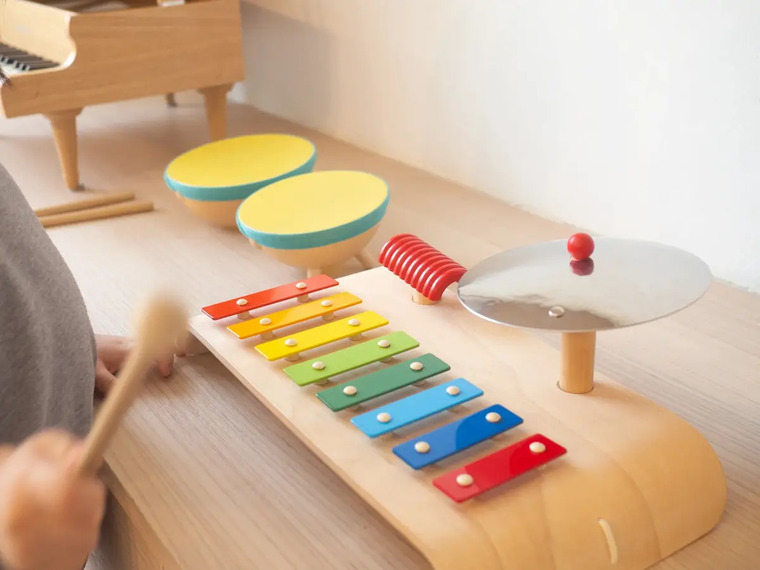 Even a simple rhythm asks children to keep track of what comes next and when.
5. Time and Timetables
Time and timetables give children practical reasons to read clock times, calculate intervals and plan a journey or activity.
Let’s say a bus leaves at 8:20 and the journey takes 18 minutes. To find the arrival time, your child needs to add the 18-minute journey to the departure time. They can add 10 minutes first to reach 8:30, then add the remaining 8 minutes to reach 8:38. So, the bus should arrive at 8:38.
The same time skills can, for example, help children decide when they need to leave home to arrive somewhere on time.
6. Pocket Money and Prices
Pocket money and prices bring calculations into decisions about what children can afford and how long they may need to save.
Your child might be saving for something that costs £18 and putting aside £3 each week. To find how many weeks they need to save, they can see how many weekly amounts of £3 make £18. Since £18 ÷ £3 = 6, they will have enough after 6 weeks.
We can see similar questions in National Numeracy’s activities for children, which suggest asking them what they can afford or how long they will need to save for something bigger.
📕 You May Also Like: Why Being Good at Maths Looks Different in Primary and Secondary School
How to Turn Everyday Moments Into Maths Conversations
Everyday maths conversations can grow naturally from something your child is already doing. What they notice or choose can give you an easy way to talk about the maths involved.
Researchers behind the University of Bristol’s Everyday Maths Project studied this approach with parents of primary school children.
They started with activities families were already doing and helped parents recognise the maths within them and discuss it with their children. Parents became more confident in prompting, recognising and referring to mathematical ideas through the workshops.
One example from the project begins with children choosing a biscuit from a plate during a family meal. From that everyday choice, a question such as “Why did you choose that biscuit?” can lead to conversations about size, order of preference, proportion or even the likelihood that a particular biscuit will still be there later.
For parents, the idea is to notice the maths within choices and activities like these and let the conversation grow from what interests their child.
Mathnasium instructors also use open-ended questions to encourage children to explain their thinking. Through Socratic questioning, instructors guide children through a concept and ask how they reached an answer. The discussion helps children think about the mathematical process as well as the calculation.
📕 You May Also Like: How to Talk to Your Child's Maths Teacher When You're Worried About Progress
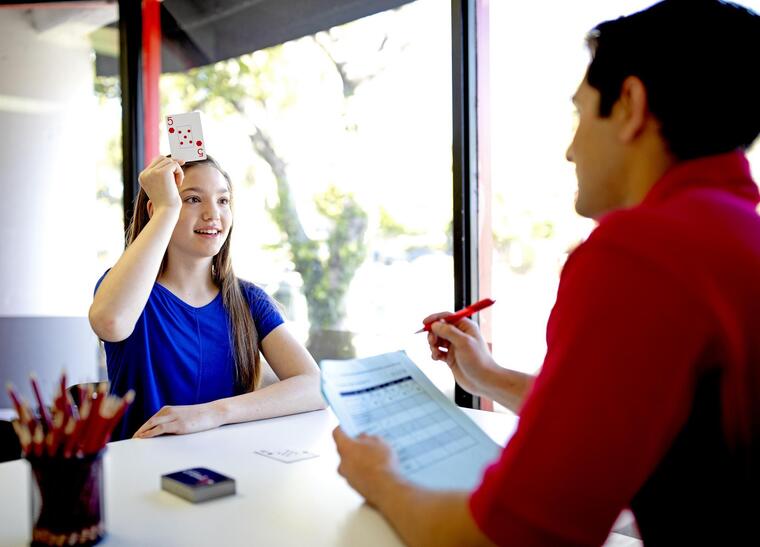 At Mathnasium, we go far beyond traditional tutoring to help children understand and develop a love for maths.
How Mathnasium Helps Children Make Sense of Maths
Mathnasium is a maths-only learning centre dedicated to helping students of all skill levels excel in maths.
Whether your child needs help understanding a maths concept and how it applies in everyday life, has gaps from earlier learning or is ready for more challenge, we can support them.
We deliver that support through the Mathnasium Method™, our proprietary teaching approach designed to help children build maths mastery through deep understanding. Our approach includes:
-
Assessment and customised learning plans. Every child begins their Mathnasium journey with a diagnostic assessment that identifies what they already know and where gaps remain. We use those insights to create a bespoke learning plan that addresses gaps, builds on existing knowledge and provides greater challenge where appropriate.
-
Teaching for understanding. Our specially trained instructors teach children how and why maths works rather than simply asking them to memorise methods. They use mental, verbal, visual, tactile and written techniques to explain concepts in different ways and develop mathematical thinking.
-
Face-to-face instruction. Children work face-to-face with specially trained instructors and follow their own learning plan at a pace that suits them. Families can choose between in-centre and live online instruction, depending on the options available through their centre.
-
Continued progress and confidence. We monitor your child’s progress as they work through their learning plan and continue building from what they understand. As maths becomes clearer, children can feel more comfortable approaching new problems and more confident in their own mathematical thinking.
The results show what this approach can achieve:
-
94% of parents report an improvement in their child's maths skills and understanding
-
93% of parents report their child's improved attitude towards maths after attending Mathnasium
-
90% of students saw an improvement in their school grades
With over 1,250 centres worldwide and over 40 across the UK, there is likely a Mathnasium centre near you.
Families across Claines, St John's, Barbourne, Northwick, Bevere, Droitwich Spa and Malvern trust Mathnasium of Worcester to help their children build lasting maths confidence.
If your child is finding a maths concept difficult or would benefit from seeing how it connects to everyday situations, our team is here to help.
✉️ Click Contact Us to get in touch with Mathnasium of Worcester.
Not near Worcester?
📍 Find a Mathnasium Centre Near You


 01905 672 304