Plano Independent School District (PISD or Plano ISD)’s Geometry curriculum is part of a high school mathematics program aligned with the Texas Essential Knowledge and Skills (TEKS).
These state standards describe what students are expected to learn, while the district’s Geometry curriculum organizes that learning into units of study. The district serves Plano and parts of nearby communities.
At Mathnasium of Plano Legacy West, we serve students from The Colony, Plano Legacy West, and surrounding communities, helping them build the skills and confidence to succeed in any K-12 math class, including Geometry.
Today, we’ll take a closer look at Plano ISD’s Geometry curriculum, the foundational skills the course builds on, and learning resources families in Plano can explore with their student.
Geometry Curriculum Overview in Plano Independent School District
Plano ISD’s high school Geometry course follows the Texas Essential Knowledge and Skills (TEKS). These state standards outline the concepts students are expected to learn, while Plano ISD’s curriculum turns them into:
-
Classroom instruction
-
Assignments
-
Assessments
To support instruction, the district lists SpringBoard Geometry as its Geometry course resource. Students receive a textbook they can write in and can access the digital version through Webdesk, Plano ISD’s online portal for digital textbooks and learning resources.
Geometry follows Algebra 1, and Plano ISD’s published high school course catalog lists the course for grades 9–11. The course asks students to work with diagrams, equations, definitions, and logical reasoning. Instead of only finding an answer, students learn to explain why it is correct.
The following overview summarizes the main skills in the Texas Geometry standards that guide Plano ISD’s course.
1. Coordinate and Transformational Geometry
Students in Plano ISD schools use the coordinate plane to examine geometric figures and relationships. They apply algebraic tools such as slope, distance, and midpoint to solve problems involving points, lines, and shapes.
The course also covers transformations, including translations, reflections, rotations, and dilations. Students describe how a figure moves or changes size, then use coordinates to verify the result.
2. Logical Reasoning and Geometric Constructions
Geometry introduces students to conditional statements, definitions, postulates, and theorems. These tools help students:
-
Identify the information they know,
-
Decide what they need to prove, and
-
Build a logical case for their conclusion.
Students also complete geometric constructions using tools such as a compass and straightedge. A construction follows exact rules, which helps them see how geometric relationships can be created and verified.
3. Proof and Congruence
Students develop geometric proofs using deductive reasoning to justify conclusions about geometric figures. They organize statements and reasons to show that a relationship must be true based on accepted definitions, postulates, and theorems.
Students also study congruence. Congruent figures have the same size and shape, even when they appear in different positions. In triangle problems, students use side and angle relationships to prove whether two triangles are congruent.
📕 You May Also Like: What Is Congruent in Geometry? A Complete Overview
4. Similarity and Right-Triangle Trigonometry
Similar figures have the same shape but may be different in size. Students use proportional relationships to find missing side lengths and compare corresponding angles.
Right-triangle trigonometry applies those ideas to triangles with a right angle. Students use sine, cosine, and tangent to find unknown lengths or angle measures. These skills connect Geometry to applications in design, construction, navigation, and science.
5. Circles, Measurement, and Three-Dimensional Figures
Students examine circle relationships, which include arcs, chords, tangents, and angles. They also calculate perimeter, circumference, area, surface area, and volume.
The course extends beyond flat figures. Students work with prisms, pyramids, cylinders, cones, and spheres, using formulas and geometric reasoning to describe and measure three-dimensional objects.
6. Probability in Geometry
The Texas Geometry standards include probability questions based on area. For example, students may compare the area of a region with the total area of a figure to determine the probability of a randomly selected point falling within that region, assuming every location within the figure is equally likely.
Geometry Acceleration Tracks in Plano ISD
Some Plano ISD students take Geometry Honors as early as eighth grade through the district’s Math Rocks program, after completing Algebra 1 Honors in seventh grade.
Placement is based on multiple measures, including MAP math achievement and CogAT Quantitative and Non-Verbal scores, rather than a single published qualifying score or percentile cutoff.
Students and families may also explore middle-school acceleration through credit-by-exam options. Families considering an accelerated math sequence should contact their student’s school counselor for:
Geometry Foundations: What Should Plano ISD Students Know to Prepare?
Geometry builds on skills students developed before the course, especially in Algebra 1. Solid foundations help them focus on the new parts of Geometry such as:
-
Using definitions precisely
-
Recognizing relationships in diagrams
-
Explaining their reasoning
1. Algebra 1 Skills and Equation Solving
Geometry problems often include unknown lengths, angle measures, or coordinates. Students need to translate a geometric relationship into an equation, then solve it accurately.
For example, if two congruent angles are represented by algebraic expressions, students must set the expressions equal and solve for the variable. Comfort with variables, expressions, linear equations, and the distributive property makes this work more manageable.
2. Coordinate Plane and Linear Relationships
Coordinate geometry connects Algebra 1 to Geometry. Students use ordered pairs to plot figures, identify patterns, and verify relationships between points and lines.
Students should be comfortable finding and interpreting:
These skills come up when students prove that segments are congruent, show that lines are parallel or perpendicular, or describe a transformation on the coordinate plane.
📕 You May Also Like: How Playing with Patterns Boosts Your Child’s Math Skills
3. Fractions, Ratios, and Proportional Reasoning
Similarity and scale drawings depend on proportional reasoning. Students compare corresponding side lengths, write ratios, and solve proportions to find missing measures.
Fraction fluency is important here for a few reasons. A missed sign, an incorrect reciprocal, or difficulty simplifying a ratio can throw off an otherwise correct geometry setup. Students who can move confidently between fractions, decimals, and ratios are better prepared for:
📕 You May Also Like: Ratio vs. Proportion Difference: A Kid-Friendly Guide
4. Angle Relationships and Figure Properties
Before beginning Geometry, students should recognize common angle relationships and basic properties of shapes. This includes complementary and supplementary angles, vertical angles, parallel lines cut by a transversal, and the angle sum of a triangle.
Students also benefit from knowing the defining properties of triangles, quadrilaterals, and circles. Geometry takes that knowledge further by asking students to apply definitions and theorems as evidence in a proof.
Geometry Support Resources Available to Plano ISD Students
Students and families can use several resources for help with Geometry coursework, class assignments, and preparation for the next unit or assessment.
-
Plano ISD teachers and campus support: Start with your student’s Geometry teacher. Teachers can clarify assignment expectations, recommend practice, and direct families to campus-based academic support options.
-
Plano ISD course materials and instructional resources: Students can review district-approved digital materials and course resources assigned through their campus or teacher. Students access digital textbooks and Google Classroom through Webdesk.
-
Texas Education Agency resources: Families can review the Texas Essential Knowledge and Skills (TEKS) for high school Geometry to see the statewide concepts students are expected to learn. The TEA also offers Bluebonnet Learning, a collection of free, state-developed instructional materials that includes secondary math resources.
-
Public library resources: Students can use the Plano Public Library for study space, print and digital learning materials, and research support alongside their Geometry coursework.
-
Mathnasium of Plano Legacy West: Mathnasium provides personalized, face-to-face instruction for students who want to build foundational Geometry skills, address specific gaps, or work toward greater confidence and mastery. Students begin with an assessment, which helps identify the concepts that need the most attention before instruction begins.
FAQs About Geometry in Plano ISD Schools
Geometry can raise practical questions about testing, course placement, and accelerated options. The answers below explain how the course fits into Plano ISD’s math sequence and where families can find reliable information about student progress.
1. What is the difference between Geometry and Honors Geometry?
Both courses cover the Texas Geometry TEKS. Plano ISD describes honors courses as extending and enriching the TEKS through a more academically rigorous curriculum.
Geometry Honors is listed for grades 9–10, while standard Geometry is listed for grades 9–11 in the district’s high school course catalog.
2. How are Plano ISD students performing in Geometry?
Plano ISD does not report a districtwide Geometry STAAR result because Texas does not give a Geometry STAAR EOC.
For broader district performance data, families can review Plano ISD’s annual accountability reports and the Texas School Report Cards, which report district and campus results across state-tested subjects.
3. Is there a STAAR test for Geometry in Plano ISD?
No, Texas requires an Algebra 1 STAAR end-of-course assessment, but Geometry is not a separate STAAR EOC subject. Geometry students still complete district and campus assessments, including semester exams in credit-bearing high school courses.
 Mathnasium is a math-only learning center dedicated to helping students of all skill levels excel in geometry (and math).
Geometry Tutoring at Mathnasium of Plano Legacy West
Mathnasium of Plano Legacy West is a math-only learning center dedicated to helping K–12 students in or near Plano and the Colony.
We help students of all skill levels excel in math and geometry, whether they need to catch up, keep up, or get ahead.
To meet students where they are and guide them forward in geometry step by step, we use the Mathnasium Method™, our proprietary teaching approach.
Here’s how it works.
Every student begins their Mathnasium journey with a diagnostic assessment that helps us understand their current skill level, knowledge gaps, goals, and how they think and feel about geometry and math. For example:
-
For a student preparing to take Geometry, that may include looking closely at fraction and integer skills, equations, proportional reasoning, variables, and other foundations that support the course.
-
For a student already taking Geometry, the assessment may identify gaps affecting current work with coordinate geometry, transformations, proofs, congruence, similarity, or trigonometry.
From these insights, we build a personalized learning plan focused on the skills the student needs most, whether that means reinforcing earlier foundations, making sense of geometric relationships, or preparing for the level of math they will take on next.
Our specially trained tutors follow that plan closely and provide live, face-to-face instruction in a caring and fun group environment. They use mental, verbal, visual, tactile, and written techniques to help students understand why a method works rather than relying on memorized steps alone.
Students also get room to think through problems before tutors step in. They guide them to explain their reasoning instead of simply giving the answers. This way, students build critical thinking, problem-solving skills, and independence they will need as high school math steps up in demands.
Fun is part of the approach, too. We use game-based activities, rewards, and consistent encouragement to keep students engaged as they revisit earlier skills and prepare for Geometry and the math courses that follow it.
The results speak for themselves:
-
94% of parents report an improvement in their child's math skills and understanding
-
93% of parents report their child's improved attitude toward math after attending Mathnasium
-
90% of students saw an improvement in their school grades
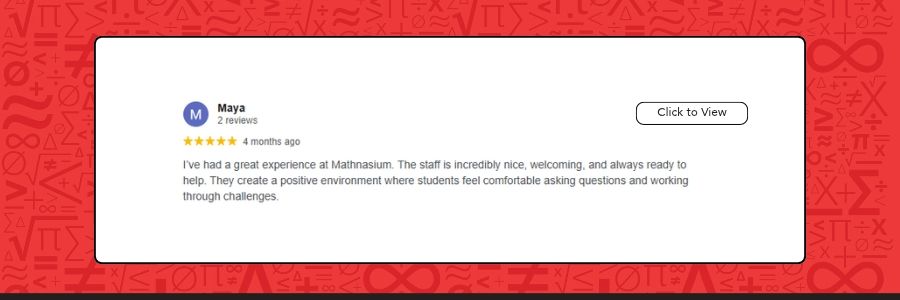
Here's what one parent said about our center.
If your child needs help with geometry foundations or current Geometry coursework, our free diagnostic assessment is a great place to start. Using what we learn, we create a personalized learning plan focused on the skills your child needs next to prepare for the math ahead.
📅 Schedule a Free Assessment at Mathnasium of Plano Legacy West
Not near Plano?
📍 Find a Mathnasium Learning Center Near You


 (214) 618-0558
 (214) 618-0558