













Christmas Maths Activities To Make Learning Fun This December
Dec 14, 2026 |

As the new school year approaches, you may be thinking about how to prepare your child for the maths ahead. After several weeks away from the classroom, it can be difficult to know what needs refreshing and how to support their return to maths.
Back-to-school preparation can look quite different across the school years. The skills children rely on change as they move through the curriculum, and the first weeks back can give you a better sense of how they are adjusting to new work.
We’ll look at what maths skills are useful to refresh at different ages, how you can establish a home routine and how to recognise when your child may need extra help.
You can refresh your child’s maths skills before the new school year by returning to concepts they already know and giving them a chance to use that knowledge again.
Retrieval practice works on this principle by asking your child to recall previously learned information from memory with little prompting, an approach described by the Education Endowment Foundation (EEF).
For a back-to-school refresher, this gives your child a chance to see what they can still work through independently before you step in with a hint or explanation.
Schools across England, Scotland, Wales and Northern Ireland follow different curricula, and children may reach particular topics at different points. We’ve organised the suggestions by age to reflect broad maths progression across the UK, with the emphasis on knowledge children are likely to build on as they move through school.
For ages 4–7, number sense and simple number relationships are useful skills to bring back into use before school starts. Your child may already use counting and number bonds to understand how quantities fit together and support early addition and subtraction.
If your child has already learned number bonds to 10, you might write 6 + ? = 10 and let them work out the missing number. Once they reach 4, ask how they knew. They may count on from 6 or recognise 6 and 4 as a pair that makes 10.
Their explanation can show how they see the connection between the numbers.
📕 You May Also Like: Number Sense: The Foundation of Primary School Maths
Place value and multiplication facts support larger calculations as children move through primary maths. You can connect the two in one short question to see whether your child can use a known fact in a larger calculation.
If your child knows 6 × 7 = 42, ask them to use that fact to work out 6 × 70. Since 70 is 10 times 7, the product will also be 10 times 42, which gives them 420.
How they reach the answer can show whether they understand how place value connects a multiplication fact they already know to a new calculation.
📕 You May Also Like: What Is Place Value and Why Does It Underpin KS2 Maths?
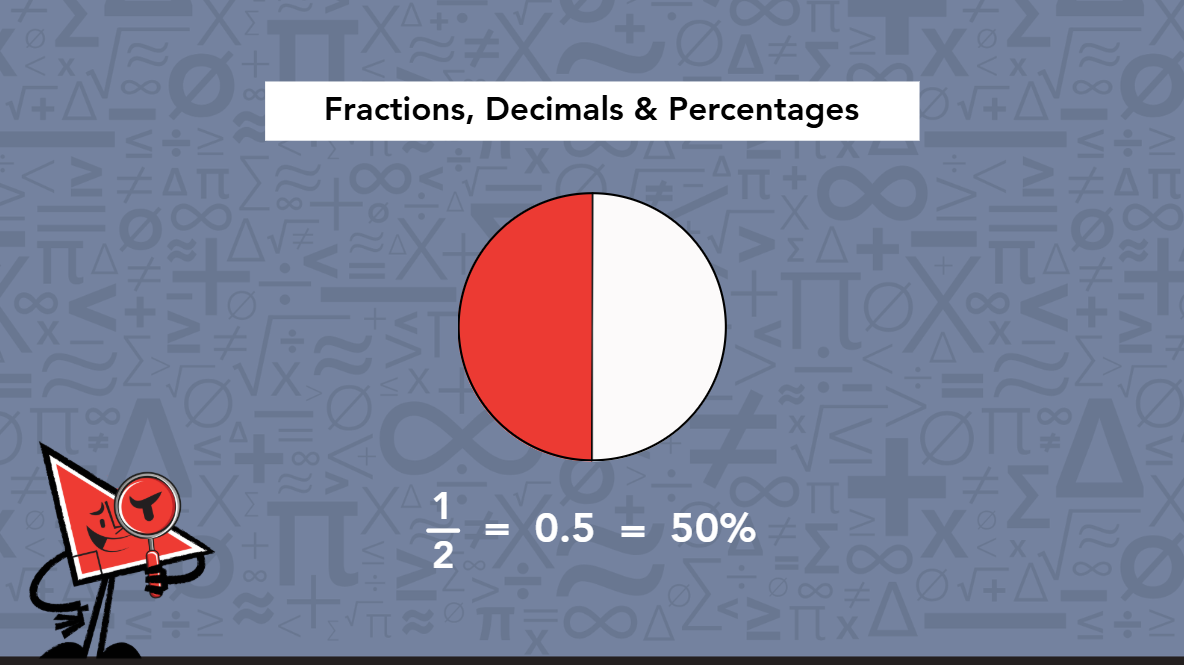
Later primary maths connects fractions, decimals and percentages more closely, and familiar equivalences show whether your child remembers how the different forms represent the same value.
To see how well your child remembers these equivalences, you can start with \(\Large\frac{1}{2}\) and ask how they could express the same value as a percentage. If they need some guidance, remind them that \(\Large\frac{1}{2}\) means one half and ask what half of 100 is. Once they work out 50, they can see that \(\Large\frac{1}{2}\) = \(\Large\frac{50}{100}\), and 50 out of 100 is 50%.
You can then move to the decimal and remind them that the fraction bar means division, which gives them a clue to calculate 1 ÷ 2 = 0.5 before bringing the three equivalent forms together as \(\Large\frac{1}{2}\) = 0.5 = 50%.
📕 You May Also Like: Why Fractions, Decimals & Percentages Confuse Your Child
Secondary maths develops earlier number relationships through algebra, ratio and proportional reasoning, so these areas can provide useful material for a back-to-school refresher.
For example, an equation such as 3x + 5 = 20 can give your child a familiar algebra problem to work through from memory. They need to subtract 5 from both sides to get 3x = 15, then divide both sides by 3 to find x = 5.
Once they reach the answer, ask them why they applied the same operation to both sides, as their explanation can show whether they also remember the idea of keeping an equation balanced.
📕 You May Also Like: How Proportional Reasoning Impacts GCSE Maths Success
Before the new school year starts, you can begin bringing maths back into your child’s routine and decide where regular practice can fit. At first, practice can revisit earlier skills, while new schoolwork can later guide what your child focuses on at home.
EEF recommends building maths into everyday routines for younger children. For older children, its guidance suggests linking practice to the rhythm of the school day, providing a suitable place to work and encouraging more independence in planning their learning.
Here is how those ideas can shape a back-to-school routine at home.
| What to plan | How to approach it |
| Time | Choose a point in the day that still works once school, homework and other activities return. Younger children may need you to set the time, while older children can take more responsibility for planning when they will practise. |
| Place | Use a desk, table or another place where your child can concentrate, with the materials they regularly need within reach. |
| Focus | Start with the maths your child has already refreshed before school starts. Once lessons resume, homework and teacher feedback can show you which skills would be useful to revisit next. |
Your routine should also be realistic for your family once the school year is underway. EEF advises parents to consider what they can reasonably manage, while older children can gradually take more responsibility for organising their own practice.
As the first weeks of term unfold, the routine can also give you a clearer picture of how your child is settling back into maths. You may see some skills return with practice and notice others where your child still relies on prompts or explanations.
📕 You May Also Like: How to Help Your Child Through Their Maths Homework Without the Stress
During the first few weeks of the new school year, you can see how your child manages the maths they are now learning in class. As teachers introduce new work, your child will also need to draw on skills they learned previously, which can make gaps in their understanding easier to recognise.
To see whether extra support may be useful, EEF guidance on maths assessment notes that children may appear to grasp a maths concept in one context but struggle when the same idea appears in another, so it is useful to look for patterns across different tasks.
Your child may:
Need the same prompt each time a skill comes up. Your explanation gets them through the question, but they still need your help to use the same skill again.
Follow an example but struggle to start a similar problem independently. They can work through the steps with you but are unsure which method to use on their own.
Make the same type of mistake in similar questions. If the same mistake keeps causing problems, your child may be missing part of the concept or method behind it rather than making a one-off calculation error.
Get stuck when new work relies on an earlier skill. Gaps in prerequisite mathematical knowledge can make it harder for children to learn new material, so it’s important to identify and address those gaps before later learning builds on them.
Your child’s schoolwork can add useful context to what you notice at home. If homework, teacher feedback and your own observations point to the same skill, speak with their teacher about what your child understands and what they need to work on next.
If your child still needs extra help, the next step is to understand where the difficulty begins. At Mathnasium, we use a diagnostic assessment to identify what each child already knows and where they have knowledge gaps so we can create a customised learning plan based on their needs.
📕 You May Also Like: How to Talk to Your Child's Maths Teacher When You're Worried About Progress
 At Mathnasium, we combine a proprietary teaching method with a comprehensive assessment and bespoke learning plan, all delivered by specially trained maths instructors.
Mathnasium is a maths-only learning centre dedicated to helping students of all skill levels excel in maths.
Whether your child needs to catch up, keep up or get ahead, we meet them at their current level and focus on what they need to learn next. Our programmes support children from early years through secondary school and GCSE, so their learning can continue to develop as the maths they meet at school becomes more complex.
To do so, we use the Mathnasium Method™, our proprietary teaching approach designed to help children build maths mastery through deep understanding. Our approach includes:
Assessment and customised learning plans. Every child begins their Mathnasium journey with a diagnostic assessment that identifies their current skills and any gaps in their maths understanding. We use the results to create a bespoke learning plan that builds on what they already know and focuses on what they need to learn next.
Teaching for understanding. Our specially trained instructors teach children how and why maths works through mental, verbal, visual, tactile and written techniques. They also use Socratic questioning to encourage children to explain their thinking, make connections and work towards solutions. This deeper understanding prepares them for the maths they will meet as the new school year progresses.
Face-to-face instruction. Children work directly with our specially trained instructors and follow their bespoke learning plan at a pace that is right for them, with support and guidance throughout. Sessions are available in-centre, while participating centres also offer live online instruction through Mathnasium@home.
Confidence and continued progress. Children receive instruction based on where they are with maths now, whether they need to close gaps, stay on track or move on to greater challenge. As their understanding develops, they can build confidence and continue making progress throughout the school year.
The impact extends beyond the classroom:
94% of parents report an improvement in their child's maths skills and understanding
93% of parents report their child's improved attitude towards maths after attending Mathnasium
90% of students saw an improvement in their school grades
With over 1,250 centres worldwide, including over 40 across the UK, there is likely a Mathnasium centre near you.
Whether your child needs extra support or is ready for more challenging maths this school year, your local Mathnasium centre can help.
Answer a few questions to see how it works
My Child is:


Mathnasium meets your child where they are and helps them with the customised program they need, for any level of mathematics.
We have over 1,100 centres and we're expanding rapidly in the UK. Get started now.