0203 983 1600










School Pick-Up Programme Continues to Grow at Mathnasium of Ealing
Jun 9, 2026 | Ealing


Language can affect how multilingual children understand, explain and solve maths, particularly when the language of instruction differs from the one they use most often at home.
This is especially relevant in our maths centre’s hometown of Ealing, where more than 170 languages are spoken across the borough’s seven towns, according to Ealing Council. Children who use more than one language can understand maths just as well as anyone else, although some maths tasks place greater demands on language than others.
To understand where that difference comes from, we’ve looked at research into multilingual children’s maths learning alongside our experience supporting students in Ealing’s highly multilingual community.
We’ll look at how language can shape the way children approach maths, where it can create additional difficulty and what can help us distinguish a language gap from a maths gap.
Children use language to connect mathematical quantities and symbols with meaning, understand what a task asks them to do and communicate their reasoning.
Because different maths tasks rely on language to varying degrees, this can influence how easily multilingual children demonstrate their mathematical understanding.
We can see this distinction in a University of Reading study of Year 5 children with English as an Additional Language (EAL) and children with English as their first language. Researchers found a difference between the groups on word-based maths problems but not on wordless problems, which suggests that the way we present a maths task can play a part in how students perform.
Let’s look at some everyday maths tasks and the role language can play in each one.
|
Mathematical task
|
What language helps students do
|
| Count objects | Match spoken number words to the correct quantities |
| Read a number aloud | Connect a written numeral with its spoken number name |
| Compare numbers | Interpret terms such as greater, fewer and between |
| Solve a word problem | Work out what the question is asking and which information is relevant |
| Explain a method | Describe the steps taken and the mathematical relationships involved |
The amount of language involved in a maths task can affect how easily your child demonstrates what they understand. They may solve a calculation confidently but need more time when the same mathematical idea appears in a word problem.
In that situation, we should consider whether it is the maths itself that posed the challenge or whether the wording added another layer to work through.
📕 You May Also Like: Why Maths Confidence Matters More Than Maths Grades
Multilingual students can experience both advantages and challenges when learning maths. The language a student uses can make some mathematical relationships easier to see, while learning maths in English can also mean becoming familiar with new ways of naming numbers and describing concepts.
Maths has its own vocabulary, and students may encounter English terms that do not translate directly from their home language or that carry a more specific meaning in maths.
For example, students who use Mandarin at home may already be familiar with number names that follow a different structure from English.
In Mandarin, 11 and 12 follow a structure closer to “ten-one” and “ten-two”, so the number names themselves reflect 10 + 1 and 10 + 2. In English, the words eleven and twelve do not show that place-value structure directly, so students need to connect a familiar mathematical idea with a new word system.
Studies of mathematical language have examined whether these more transparent number-naming systems can support early number learning. Research that compared numerical language across countries found that the way East Asian number words reflect the base-10 system may contribute to some differences in how children learn whole numbers, although language is only one part of the picture.
For multilingual students, another language can therefore offer a different way of representing a mathematical idea. At the same time, they still need to connect that understanding with the English terminology they meet at school.
English maths vocabulary can create a similar challenge when familiar-looking words carry precise mathematical meanings.
|
Maths vocabulary
|
What it means in maths
|
Example
|
| Difference | The result of subtracting one number from another. | The difference between 12 and 7 is 5. |
| Mean | One type of average found by adding the values and dividing by how many there are. | The mean of 4, 6 and 8 is 6. |
| Product | The answer we get when we multiply two or more numbers. | The product of 4 and 5 is 20. |
| Share equally | Divide a quantity so each group receives the same amount. | 12 shared equally among 3 groups gives 4 in each group. |
| Factor | A number that divides into another number. | 3 is a factor of 12 because 12 ÷ 3 = 4. |
We’ve just seen how much meaning can sit behind a single maths term. Put that term into a full word problem, and students also have to work out what the question is asking and how the information fits together, before choosing an operation or method.
The extra language involved in some maths tasks does not mean multilingualism itself makes students less capable at maths. In fact, two large-scale studies involving children aged 4 to 7 showed that bilingualism positively predicted measures including emergent numeracy, mathematical reasoning and mathematical problem-solving, even after the researchers accounted for English proficiency and demographic factors.
The picture can also vary by student and mathematical skill. Researchers studying third- to fifth-grade students found no overall difference in arithmetic fluency between bilingual and monolingual children, although bilingual students’ fluency in their non-English language was associated with their arithmetic fluency.
Together, these findings give us a more balanced picture. Multilingual students can bring strengths to mathematical learning, while tasks that rely heavily on English may still make it harder for them to demonstrate what they understand.
📕 You May Also Like: Signs Learning Difficulties Might Be Impacting Your Child's Maths Performance
Language and maths difficulties can sometimes overlap, which can make it harder to tell what is getting in the way. We can look for clues in where the difficulty appears, from individual maths words and sentence structure to understanding the whole problem.
No single observation gives us a definite answer, so we need to consider what your child can demonstrate across different situations.
You can start with questions like these:
Does the wording seem to be getting in the way? Your child may understand the maths but get stuck on an unfamiliar term, a phrase such as share equally or the way a word problem is written. If they can explain the same mathematical idea more clearly in their home language, language may be playing a bigger role in the difficulty.
What happens when you present the maths in another way? Try using numbers, symbols, a diagram or a physical model. If your child understands the idea more easily in another form, they may understand the underlying maths but need help accessing it through English. If the concept remains difficult across different representations, the difficulty may lie more with the maths itself.
Language gaps are more likely to affect how children access or communicate the maths, while maths gaps affect their understanding of the mathematical idea itself. That is why it is important to consider what your child can demonstrate in different ways, as one response may not show the full picture.
When a student struggles to express mathematical ideas in English, relying solely on verbal or written instruction can make a language gap look like a maths gap. Multisensory learning can help bridge this gap by combining visual models, tactile tools, and mental techniques alongside spoken explanations.
By offering multiple pathways to engage with a concept, maths can become far more intuitive regardless of a student's primary language.
Even with these observational clues and alternative approaches, pinpointing learning needs at home can still be challenging. Some students benefit more from structured, professional support that evaluates their mathematical reasoning directly to uncover specific strengths and gaps.
📕 You May Also Like: How to Help Your Child Through Their Maths Homework Without the Stress
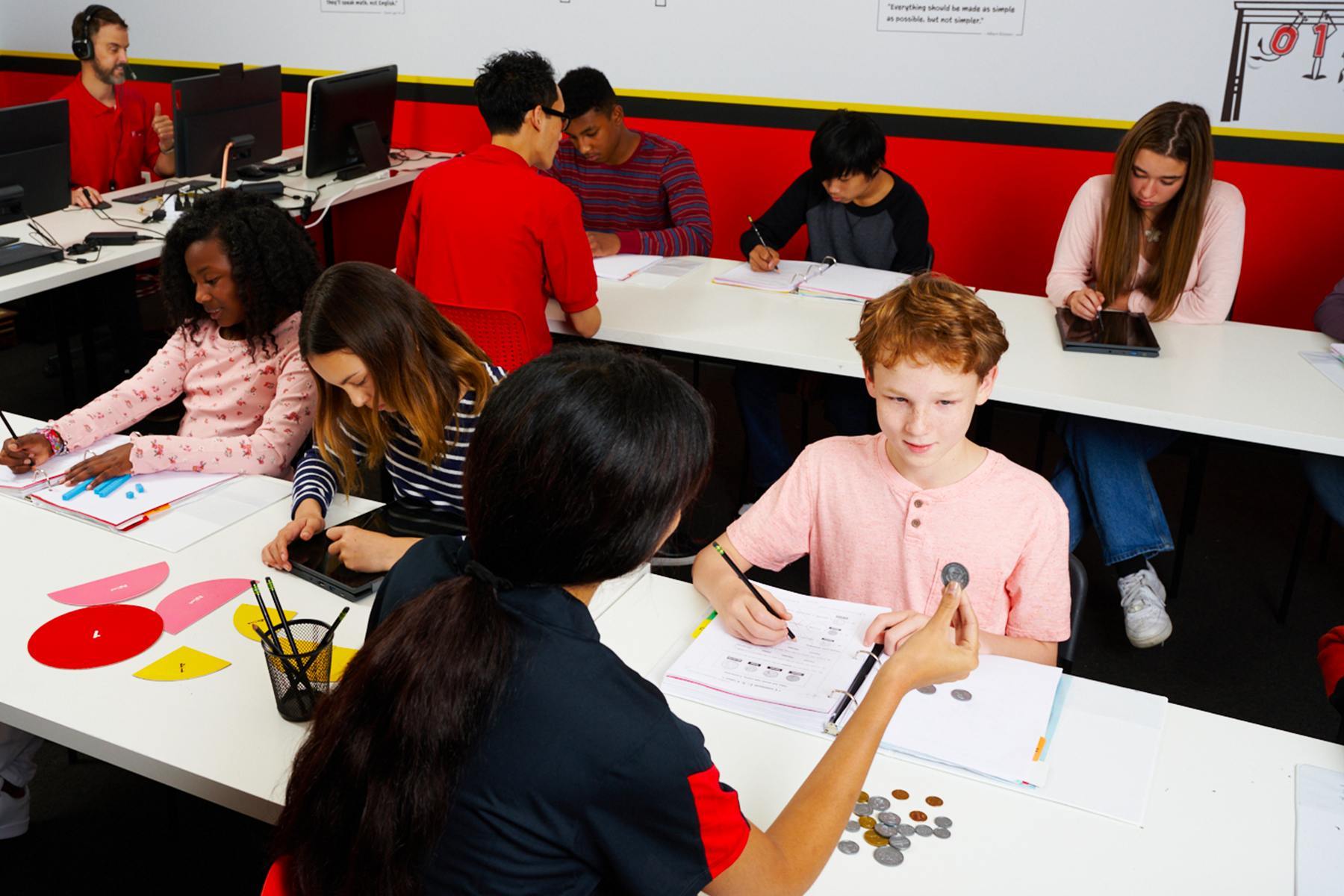 At Mathnasium, we combine personal attention with a proven, maths-only curriculum, taught at the right pace for each child.
Mathnasium is a maths-only learning centre helping students of all skill levels excel in maths.
For multilingual students, understanding how they think about maths and where their knowledge gaps lie can be particularly useful when language may affect how easily they demonstrate what they know.
At Mathnasium, we begin by looking at each student’s individual mathematical understanding and then teach from their current level, rather than relying on a one-size-fits-all approach.
This focus on each student’s mathematical understanding is part of the Mathnasium Method™, our proprietary teaching approach designed to build maths mastery through deep understanding.
Our approach includes:
Assessment and personalised learning plans. Every student begins their Mathnasium journey with a diagnostic assessment. The assessment includes verbal and written components that help us understand their current maths skills, knowledge gaps and how they approach mathematical thinking. We use those insights to create a personalised learning plan around their individual needs and goals.
Teaching for understanding. Our specially trained instructors use mental, verbal, visual, tactile and written techniques. Different ways of presenting a concept give students more than one path to understanding, whether they benefit from visual tools, hands-on activities or verbal explanations.
Face-to-face instruction. Students learn in a supportive and fun environment while following their own personalised learning plans, working with instructors face-to-face at the pace that's right for them, both in-centre and online.
Confidence and engagement. Sessions include games, earned rewards, and consistent celebration of progress, so students actively participate, solve problems, and engage with maths instead of simply listening to a lesson. They build confidence alongside fluency and many develop a more positive relationship with maths over time.
The impact extends beyond the classroom:
94% of parents report an improvement in their child's maths skills and understanding
93% of parents report their child's improved attitude towards maths after attending Mathnasium
90% of students saw an improvement in their school grades
With over 1,250 centres worldwide, including over 40 across the UK, there is likely a Mathnasium centre near you.
Families across Ealing Broadway, West Ealing, South Ealing, North Ealing, Gunnersbury, Perivale, Hanwell and Acton trust Mathnasium of Ealing to help their children build lasting maths confidence.
If language is affecting how your child approaches maths or they need support with maths more broadly, our team can help.
✉️Click Contact Us to get in touch with Mathnasium of Ealing
Not near Ealing?
Mathnasium of Ealing is a math-only learning centre for K-12 students in Ealing, LON. Trusted by over a million parents, Mathnasium uses personalized learning plans and the proprietary Mathnasium Method™ to help students catch up, keep up, and get ahead on their math journey.
Our specially trained tutors deliver face-to-face instruction in a supportive and fun small-group environment, working with students to develop a deep understanding of math, build confidence, and improve academic performance.
Contact Us