Parents choosing a secondary school as their child prepares to move into Year 7 may compare several options, each with its own admissions process and entry requirements.
If you live in Ealing or elsewhere in West London, you may want to understand what those options involve and what your child may need to prepare for.
To help you make an informed decision, we’ll look at the secondary school options available to West London families, how maths features in selective school entry and where Ealing families can find reliable admissions information.
What Types of Secondary School Exist in West London?
West London families can consider local state secondary schools, grammar schools and independent schools when choosing where their child will continue their education. Each route has its own admissions process, which can determine whether your child needs to take an entrance test.
Let’s take a closer look at what each option involves.
1. Local State Secondary Schools
Local state secondary schools provide government-funded education and most admit children without academic selection. West London includes different types of state schools, such as community schools and academies, with admissions criteria that vary by school.
Your home borough also determines where you submit your application. For instance, Ealing residents apply for a Year 7 state-school place through Ealing Council, even if your preferred school is outside the borough.
Schools may consider factors such as distance from home, siblings already attending or faith requirements, depending on their admissions policy. Some schools also offer a limited number of specialist places based on aptitude, such as the music places at Ealing Fields CofE High School.
Ealing has community schools as well as schools that set their own admissions arrangements, so you should check the admissions criteria for every school you are considering.
2. Grammar and Selective State Schools
Grammar schools are state-funded secondary schools that select children based on academic ability, usually through an entrance test. Some state schools are partially selective, which means they fill a proportion of their places by ability or aptitude testing.
Unlike local state secondary schools, this route requires families to consider the selection process as well as each school’s individual admissions criteria.
Although there are no grammar schools within the London Borough of Ealing itself, children living in Ealing may be able to apply to selective schools outside the borough. These include schools within the Slough Consortium and South West Herts Consortium, as well as individual selective schools such as Queen Elizabeth’s School, Barnet.
Each school or consortium has its own entrance test and admissions policy. Being eligible to sit an entrance examination (or achieving a qualifying score) does not necessarily guarantee eligibility or priority for a school place, so parents should check individual school admissions policies carefully.
3. Independent Schools
Independent schools are fee-paying schools that operate outside the state-funded school system. They set their own admissions arrangements, so the application process and entrance requirements vary between schools.
West and South West London have a wide range of independent schools, including several options that Ealing families may consider:
NHEHS, St Augustine’s Priory and Godolphin and Latymer use the shared London 11+ Consortium assessment for 11+ entry, while St Benedict’s, Latymer Upper School, Hampton School and St Paul’s follow their own admissions processes.
📕 You May Also Like: 4 Types of Maths Tutoring & How to Choose the Right Support for Your Child
 Your school shortlist can guide you towards the admissions requirements your child may need to prepare for.
How Does Maths Feature in Secondary School Entry?
Maths forms part of the entrance assessment for several selective secondary school routes in West London and the surrounding area. What children are asked to do depends on the school or admissions system and the assessment it uses.
Here are the main maths assessments parents may encounter across the selective-entry options we’ve covered. Entrance tests for state selective schools, including those in the Slough and South West Herts consortia, differ by school, so parents should check each school’s published information.
A. The London 11+ Consortium Test
The London 11+ Consortium assessment includes maths as one of six components used to assess children applying to participating independent girls’ schools. Children take the assessment once, regardless of how many Consortium schools they apply to, and their results are shared with those schools.
After children sit the assessment, they complete the admissions process of each school they applied to, which may include a further assessment or interview. Because each school sets its own entry requirements, the pass mark varies from school to school.
The Maths section lasts 20 minutes and uses an adaptive format, with questions adapted to each child’s performance. For mathematical knowledge, the Consortium draws on the Year 5 National Curriculum and adds challenge through the style and depth of its questions.
Maths is one part of the wider 100-minute assessment, which also covers Non-Verbal Reasoning, English, Verbal Reasoning, Problem Solving and Creative Comprehension. Parents can also use the official familiarisation materials to introduce their child to the online format beforehand.
B. St Benedict’s Entrance Examination
St Benedict’s School uses its own Mathematics and English entrance examinations for external applicants to Year 7. Most candidates are then invited to an assessment day, where group tasks form another part of the selection process. The school also requests a reference from each child’s current school.
Parents can check the school’s current admissions timetable and access its official 11+ Mathematics sample paper. The sample paper gives children one hour for the Mathematics examination and asks them to show their working so marks can be awarded for method and understanding.
St Benedict’s also uses Mathematics and English entrance examinations for external applicants seeking available places at 12+, 13+ and 14+. Some candidates are then invited to an interview.
C. Independent School Entry Tests
Maths also forms part of the entrance assessments at independent schools in West and South West London. Some set their own tests, while others use the Consortium assessment, so the examples below are a starting point.
Latymer Upper School (Hammersmith) is co-educational and sets its own English and Maths papers. The Maths paper lasts 60 minutes, and the school publishes sample 11+ papers on its website. Selected candidates are then invited back for an interview session. Latymer Upper School is a different school from Godolphin and Latymer.
Godolphin and Latymer (Hammersmith) is a girls’ school and a member of the London 11+ Consortium, so applicants sit the Consortium assessment described above.
Hampton School (Hampton) is a boys’ school that sets its own entrance papers in English, words and reasoning, and maths. Candidates who perform well are invited to interview.
St Paul’s Girls’ School (Hammersmith) is a girls’ school. Candidates take an initial online assessment, followed by written assessments in English, maths and general comprehension at the school.
St Paul’s School (Barnes) is a boys’ school. 11+ entry is into its prep school, St Paul’s Prep, and candidates are admitted by examination.
Parents should use the information that is published for their child’s entry year because test providers and assessment details can change between admission cycles.
📕 You May Also Like: When Should Your Child Start Preparing for the 11+? (Plus Notting Hill Resources)
Secondary School Admissions Resources for Ealing Families
Parents comparing secondary schools can use several official resources to check their options, admissions requirements and important dates.
For families in Ealing, useful resources include:
-
Ealing high school prospectus: Ealing Council publishes a prospectus for each admission year with information about high schools in the borough and the application process. The current Starting High School 2027 prospectus is already available.
-
Ealing school admissions: Here you can check the application timetable, deadline and instructions for applying for a Year 7 place. For September 2027 entry, applications opened on 1 September 2026 and close on 31 October 2026.
-
Compare school performance: The government service lets parents search for schools and compare published performance information.
-
Ofsted inspection reports: Parents can search for current and previous inspection reports for individual schools in England.
For selective and independent schools, parents should also check the school or consortium admissions page directly for the entry year they need.
📕 You May Also Like: Why Being Good at Maths Looks Different in Primary and Secondary School
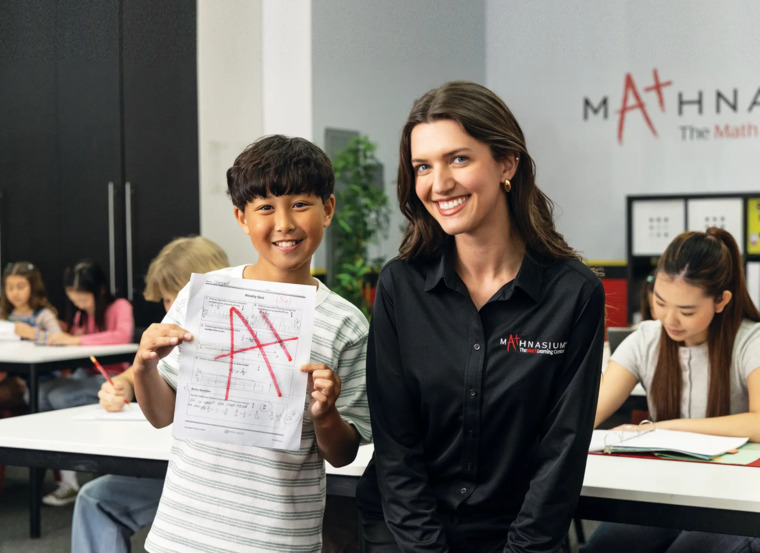 From early years through to secondary school, Mathnasium supports children at every stage of their maths journey, building confidence, understanding and long-term progress.
How Mathnasium of Ealing Supports Secondary School Maths Preparation
Mathnasium is a maths-only learning centre dedicated to helping students of all skill levels excel in maths.
For families considering selective secondary schools, Mathnasium of Ealing offers dedicated 11+ preparation that develops mathematical reasoning, problem-solving and exam technique. Parents can also learn more about our wider approach through the 11+ Test Prep programme.
Our support continues beyond the admissions process with secondary school maths and dedicated GCSE preparation, including work across algebra, geometry, trigonometry, probability and statistics, alongside exam-style questions and practice tests.
We deliver this support through the Mathnasium Method™, our proprietary teaching approach designed to build maths mastery through deep understanding. Our approach includes:
-
Assessment and customised learning plans. Every child begins their Mathnasium journey with a diagnostic assessment that identifies what they already understand and any gaps in their maths knowledge. We use the results to create a bespoke learning plan based on what they need to learn next.
-
Teaching for understanding. Our specially trained instructors use mental, verbal, visual, tactile and written techniques to teach children how and why maths works. Children learn to use their knowledge to solve unfamiliar problems and develop the mathematical reasoning they may need for selective-entry assessments.
-
Face-to-face instruction and exam practice. Children work directly with instructors who can answer questions and provide feedback as they solve problems. For 11+ preparation at Ealing, sessions can also include timed practice and exam-style questions to develop accuracy, speed and exam technique.
-
Confidence and engagement. Sessions combine supportive instruction with games, earned rewards and recognition of progress. As children develop their understanding and practise more challenging questions, they can build confidence for entrance assessments and the maths they will encounter in secondary school.
The results show what this approach can achieve:
-
94% of parents report an improvement in their child's maths skills and understanding
-
93% of parents report their child's improved attitude towards maths after attending Mathnasium
-
90% of students saw an improvement in their school grades
With over 1,250 centres worldwide, including over 40 across the UK, there is likely a Mathnasium centre near you.
Families across Ealing Broadway, West Ealing, South Ealing, North Ealing, Gunnersbury, Perivale, Hanwell and Acton trust Mathnasium of Ealing to help their children build lasting maths confidence.
If secondary school entry, or any other maths topic, is on your mind, our team is ready to help.
✉️ Click Contact Us to get in touch with Mathnasium of Ealing
Not near Ealing?
📍 Find a Mathnasium Centre Near You


 0203 983 1600