Year 7 marks the start of secondary school and Key Stage 3, but maths continues to build on what students learned throughout primary school. Students begin to connect concepts across different problems and take more responsibility for choosing how to approach them.
During the first half-term, teachers may revisit important KS2 knowledge before taking it further at Key Stage 3. Schools have flexibility in how they organise their curriculum, so students may cover the same topics in a different order.
We’ll look at what students can expect in Year 7, how secondary school maths builds on KS2, early signs of a maths gap and a few practical things parents can do during the first half-term.
What Maths Topics Can Students Expect in Year 7?
Year 7 maths covers part of the wider Key Stage 3 curriculum set out in the National Curriculum for mathematics, with individual schools deciding how to sequence that content across Years 7 to 9.
The NCETM guidance on building Year 7 on Year 6 identifies place value, additive and multiplicative structures, fractions and geometric properties as the areas secondary maths departments tend to early in Year 7.
Parents may see Year 7 work such as:
|
Maths topic
|
What students may work on
|
| Number |
Positive and negative numbers, place value, fractions, decimals, percentages, powers and calculation methods |
| Algebra |
Algebraic notation, expressions, equations, sequences and substitution |
| Ratio and proportion |
Ratios, scale and proportional relationships |
| Geometry and measures |
Angles, properties of shapes, perimeter, area, volume, constructions and scale drawings |
| Probability |
Possible outcomes, probability calculations and ways to represent probability |
| Statistics |
Tables, charts, averages and interpreting data |
The bigger change lies in how students are expected to use their mathematical knowledge, since secondary maths places greater emphasis on making connections, choosing suitable methods and explaining mathematical reasoning.
This can make the first half-term a useful window into how students are adjusting to KS3.
📕 You May Also Like: Preparing for Year 7 Maths: A Summer Plan After Year 6 SATs
How Is Secondary School Maths Different From KS2?
The National Curriculum describes KS3 maths as an extension of the knowledge students developed at primary school, with more complex problems and connections across mathematical ideas.
Students also work with a wider range of representations, such as equations, graphs and diagrams, and take more responsibility for selecting suitable methods.
Three changes help show what this can mean during Year 7.
1. Fractions, Decimals and Percentages Become More Connected
Fractions, decimals and percentages continue into KS3, with greater emphasis on how they relate to one another. Students may need to move between these forms within one problem or decide which one will make a calculation easier.
For example, students may need to recognise that \(\Large\frac{1}{2}\) and 0.5 are equivalent before comparing them with a percentage.
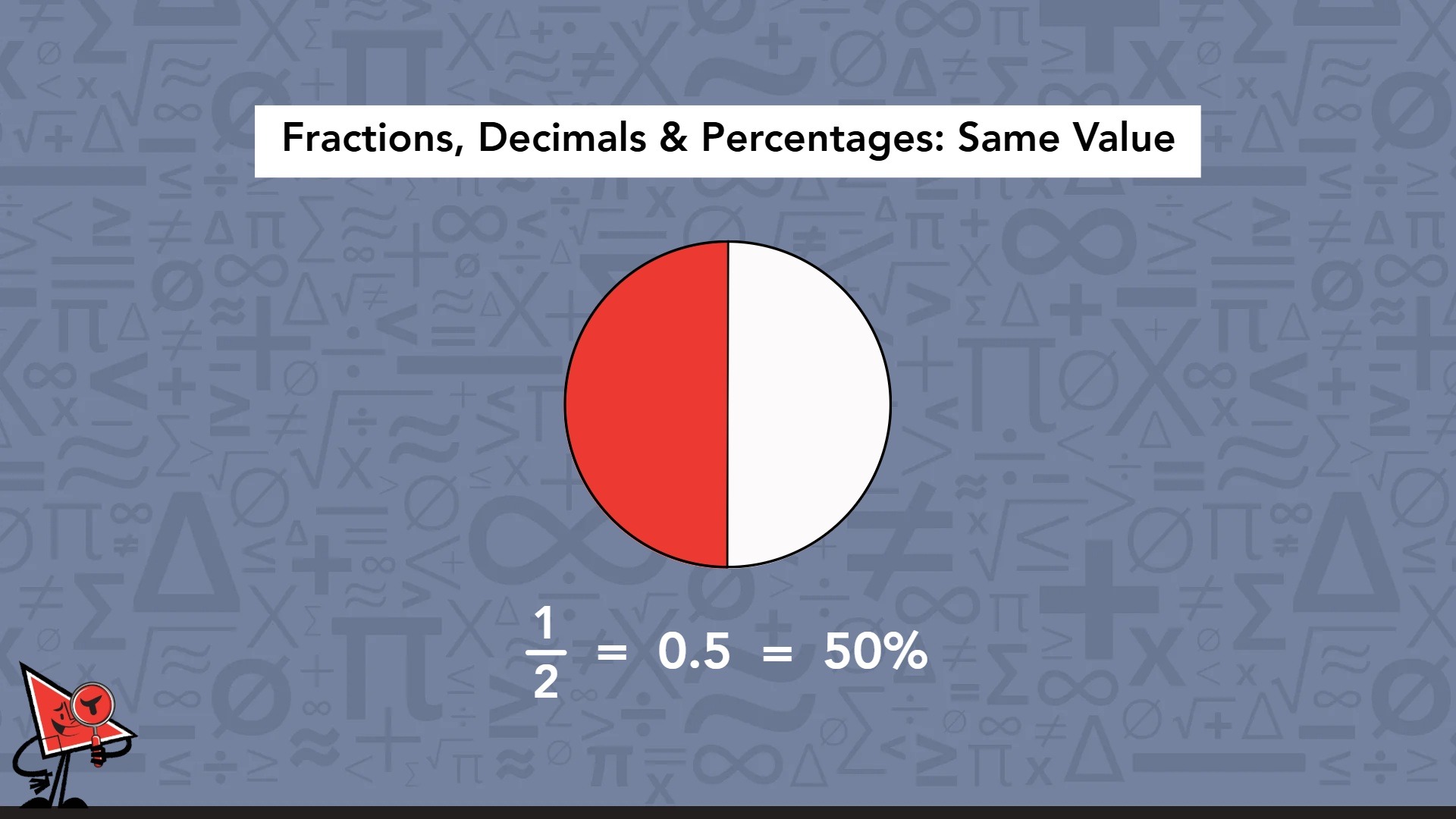 One value, three forms that all represent the same amount: \(\Large\frac{1}{2}\), 0.5 and 50%.
📕 You May Also Like: Why Fractions, Decimals & Percentages Confuse Your Child
2. Algebraic Notation Becomes More Prominent
Algebraic notation becomes more prominent at KS3, although students have already met letters and symbols in Year 6.
Secondary maths takes that earlier knowledge further as students use algebra to generalise number patterns, work with expressions and equations and describe quantities without relying on specific numbers.
For example, in 3x + 4, x represents a variable and 3x means three times its value. Students also learn conventions that make algebra different from ordinary written arithmetic, such as writing 3x instead of 3 × x.
3. Students Take More Responsibility for Choosing a Method
Students take on more responsibility for choosing their own method as problems get harder. The National Curriculum expects them to select appropriate concepts, methods and techniques, including when they encounter unfamiliar or non-routine problems.
Students may need to identify the useful information, decide which mathematical idea applies and explain why their approach works.
Teachers continue to provide guidance as students take greater responsibility for these decisions.
📕 You May Also Like: Why Being Good at Maths Looks Different in Primary and Secondary School
Early Signs of a Maths Gap in Year 7
Maths gaps in Year 7 can become noticeable when earlier knowledge makes it harder for students to keep up with their current work. Parents may notice changes at home, while teachers can see how students respond to the same mathematical ideas across lessons and classwork.
Some signs to look out for include:
-
Earlier maths skills keep causing difficulty. Students may find that times tables, place value, fractions or written calculations slow them down as they work through Year 7 topics.
-
The method makes sense in one question but becomes difficult to use elsewhere. Your child may know what to do with a familiar question but feel less sure when the wording, numbers or context change.
-
Students struggle to keep track of several steps at once. They may complete individual calculations but lose track when they need to use several skills within the same problem.
-
Independent work regularly comes to a halt. In class, students may follow a worked example without trouble but feel unsure where to start when they try a similar question on their own.
Teachers can add useful context because they see students working across a much wider range of questions. NCETM's Year 7 Checkpoints are designed around this principle. They help teachers assess prior learning and explore gaps that become evident as students move into KS3.
Parents can compare what they notice at home with feedback from the maths teacher. Together, those observations can show whether the difficulty is tied to a particular piece of work or keeps returning across different tasks.
📕 You May Also Like: How to Help Your Child Through Their Maths Homework Without the Stress
How Can Parents Support the First Half-Term of Year 7 Maths?
Parents can use the first few weeks of Year 7 to understand what their child's school will cover and how they are settling into secondary maths. You don't need to predict the school's teaching sequence before term begins.
Let’s go over a few practical things you can try during those first weeks.
-
Check the school's Year 7 maths curriculum. Schools in England publish curriculum information for each academic year, so the school's website is a useful place to check which maths topics are planned and how they are organised.
-
Pay attention to homework and teacher feedback. Early classwork can show how comfortably students are using KS2 knowledge in Year 7. If the same difficulty keeps returning, feedback from the maths teacher can add useful context to what you notice at home.
-
For local families, make use of study spaces when needed. Muswell Hill Library provides study space, free Wi-Fi and public computers. The wider Haringey Libraries network offers these facilities across the borough, and Haringey Council specifically recommends its libraries as places where children can do homework. Families can use the council’s library directory to find another convenient location.
-
Consider structured maths support if difficulties continue. Extra support can give students dedicated time to revisit earlier maths, ask questions and work through areas that may be holding them back in their current lessons.
If the first half-term points to an area that needs more attention, the next step is to understand where the difficulty begins.
At Mathnasium, we use a diagnostic assessment to understand a student's current skills and identify knowledge gaps before creating a personalised learning plan around their needs.
📕 You May Also Like: Why Maths Confidence Matters More Than Maths Grades
 At Mathnasium, our instructors help children understand how and why maths works, building confidence along the way.
How Mathnasium Helps Students Adjust to Secondary Maths and Beyond
Mathnasium is a maths-only learning centre dedicated to helping students of all skill levels excel in maths.
Whether your child is settling into the first weeks of Year 7, catching up on earlier knowledge or ready to move ahead, we can support them at every stage of their maths learning.
We do this through the Mathnasium Method™, our proprietary teaching approach designed to build maths mastery through deep understanding. Our approach includes:
-
Assessment and personalised learning plans. Every student begins their time at Mathnasium with a diagnostic assessment that identifies their current skills, strengths and knowledge gaps. We use those insights to create a personalised learning plan around their individual needs and goals.
-
Teaching for understanding. Our specially trained instructors use mental, verbal, visual, tactile and written techniques. Different ways of presenting a concept give students more than one path to understanding, whether they benefit from visual tools, hands-on activities or verbal explanations.
-
Face-to-face instruction. Students learn in an engaging and fun setting while following their own personalised learning plans, working with instructors face-to-face at the pace that's right for them, both in-centre and online.
-
Confidence and engagement. We use games and earned rewards to encourage students to participate actively and engage with maths instead of simply listening to a lesson. They build confidence alongside fluency, and many develop a more positive relationship with maths as they progress.
The impact extends beyond the classroom:
-
94% of parents report an improvement in their child's maths skills and understanding
-
93% of parents report their child's improved attitude towards maths after attending Mathnasium
-
90% of students saw an improvement in their school grades
With over 1,250 centres worldwide, including over 40 across the UK, there is likely a Mathnasium centre near you.
Families across Muswell Hill, East Finchley, Alexandra Park and Highgate trust Mathnasium of Muswell Hill to help their children build lasting confidence in maths.
If the start of Year 7 maths is a big adjustment, or you want to make sure the foundations are secure, our team is ready to help.
✉️ Click Contact Us to get in touch with Mathnasium of Muswell Hill
Not near Muswell Hill?
📍 Find a Mathnasium Centre Near You


 0203 062 5005