When we hear the term “mental maths,” we may assume it means working through calculations entirely in our heads. While the name suggests that, mental maths also connects closely with the written methods children use in primary school.
So, where does mental maths fit into the way children learn to calculate? To answer that question, we’ll clarify what the term means, work through five common strategies and look at how they can develop more flexible mathematical thinking.
What Is Mental Maths in Primary School?
Mental maths is the use of number facts, relationships and calculation strategies to solve problems without relying on a formal written method or calculator.
In other words, children use what they know about numbers to work out an answer mentally, although they may use short jottings to keep track of their thinking.
According to the Department for Education’s Mathematics Guidance, children build fluency with number facts and learn to choose efficient calculation methods as they progress through primary school.
We can see that progression across the two primary key stages:
-
Key Stage 1 (KS1) covers Years 1 and 2. During this stage, children build fluency with whole numbers, counting and place value, while learning number bonds and early addition, subtraction, multiplication and division.
-
Key Stage 2 (KS2) covers Years 3 to 6. As they progress, children work with larger numbers and draw on a wider range of known facts and number relationships to develop efficient mental and written methods.
We can see how mental maths works with a calculation such as 69 + 24. Since 69 is only 1 away from 70, we can first calculate 70 + 24 = 94. We added 1 to turn 69 into 70, so we need to take that extra 1 away again, which gives us the final result of 93.
Mental strategies also support the written methods children learn at school. The DfE guidance explains how mental and written methods develop alongside children’s understanding of number, while the National Curriculum for mathematics in England includes both mental and written calculation as children progress through primary school.
📕 You May Also Like: What Is Place Value and Why Does It Underpin KS2 Maths?
5 Mental Maths Strategies Children Can Use
Children can solve the same calculation in more than one way, and the numbers themselves can give us clues about which approach may work best.
At our centre, we teach children how and why different mental maths strategies work, so they can build a range of approaches to draw on during calculations.
We’ve chosen five common mental maths strategies to show how each one works and when children might use it.
1. The Split Method
The split method separates numbers into place-value parts, such as tens and ones so that we can work with smaller amounts first.
Let’s see how that works with simple addition, such as 58 + 27. We can split 58 into 50 + 8 and 27 into 20 + 7.
Now we add the tens with 50 + 20 = 70, then the ones with 8 + 7 = 15. We bring both parts back together to get 70 + 15 = 85.
Each number keeps its original value when we partition it, so the calculation becomes easier to manage without changing the numbers we started with.
2. Round Then Adjust
Round then adjust uses a nearby round number to simplify a calculation, then corrects for the amount we changed.
Suppose we want to calculate 48 + 27. We can see that 48 is only 2 away from 50, so 50 gives us an easier number to work with.
We first calculate 50 + 27 = 77. Since we added an extra 2 when we changed 48 to 50, we need to take that 2 away again, which gives us 77 − 2 = 75.
Once children understand the adjustment, they can use the same reasoning in other calculations. The main idea is to remember how much we adjusted the original number and account for the same amount at the end.
3. Near Doubles
Near doubles use a known double to solve an addition where the two numbers are close together. We start with a familiar doubling fact, then adjust the answer by the difference between the numbers.
For 7 + 8, we might recognise 7 + 7 = 14 straight away. Our calculation has 8 instead of the second 7, so we need 1 more to calculate 14 + 1 = 15.
We can use the same relationship with larger numbers. If we know 20 + 20 = 40, we can work out 20 + 21 by adding 1 more to get 41.
4. Use Known Facts to Work Out New Facts
Children can use familiar multiplication facts to work out related calculations involving larger numbers or division. The National Curriculum also develops this relationship by asking children to use known multiplication and division facts to derive related facts.
If we know 8 × 4 = 32, for example, we can use place value to work out 80 × 4 = 320 because 80 is ten times 8. The same idea works when we scale the second factor. Since 40 is ten times 4, we calculate 8 × 40 = 320.
We can also use the inverse relationship between multiplication and division, so 8 × 4 = 32 tells us that 32 ÷ 8 = 4 and 32 ÷ 4 = 8.
📕 You May Also Like: Multiplication Tables Check 2026: A Guide to Year 4 Times Tables
5. Make Ten First
Make ten draws on number bonds to turn one part of an addition into 10. Let’s see how that works with 7 + 5.
We know that 7 needs 3 more to make 10, so we can split 5 into 3 + 2. First, we use 3 to calculate 7 + 3 = 10. We still have 2 left from the original 5, so we finish with 10 + 2 = 12.
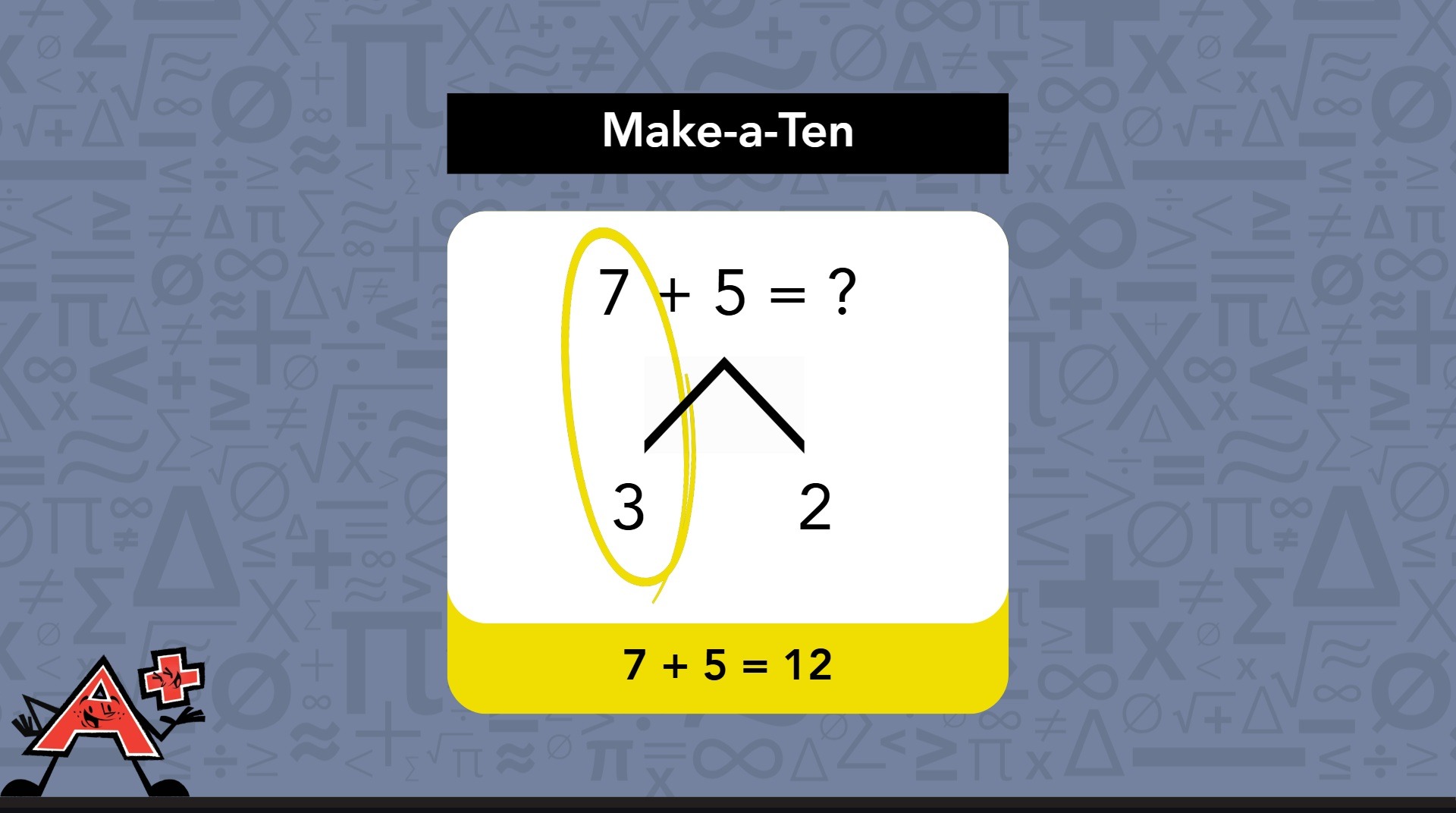
We can use the same idea whenever reaching the next ten makes a calculation easier. As children become more familiar with number bonds, they can recognise when making ten gives them a useful route to the answer.
📕 You May Also Like: Number Sense: The Foundation of Primary School Maths
How Do Mental Maths Strategies Support Flexible Thinking?
Children build flexible thinking by learning different methods and deciding which one works best for a particular calculation.
In practice, flexible thinking can help children:
-
choose an efficient strategy for the numbers in front of them
-
adapt when a calculation changes instead of starting from the same procedure every time
-
explain why their approach works, which shows the reasoning behind the answer
-
approach unfamiliar problems with more confidence because they have more than one possible route
As children become more familiar with number facts and mental strategies, they may also calculate more quickly. Speed can grow from fluency, but the main aim is to understand the numbers well enough to make good mathematical choices.
At our Mathnasium centre, we build flexible mathematical thinking in much the same way. We teach children to see problems from different angles, make mathematical connections and understand how and why different strategies work.
📕 You May Also Like: Why Maths Confidence Matters More Than Maths Grades
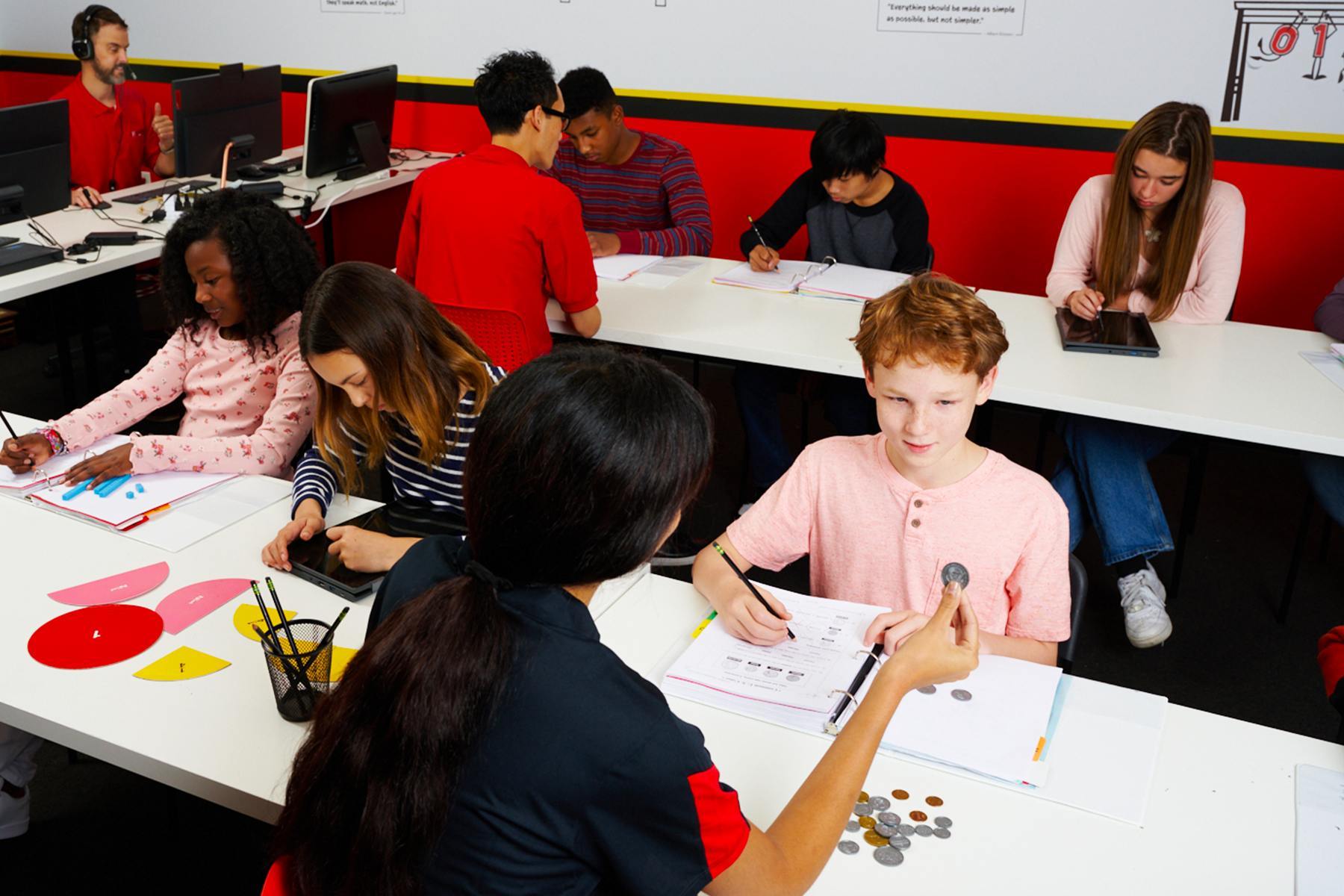 At Mathnasium, our specially trained instructors work patiently and positively with each child, adapting their explanations to help maths make sense.
How Mathnasium Helps Children Develop Mental Maths Skills and Beyond
Mathnasium is a maths-only learning centre dedicated to helping students of all skill levels excel in maths.
Whether your child is still building number facts and mental calculation strategies or is ready to use them with more complex problems, we can meet them at their current level and build from there.
Mental maths forms part of a broader understanding of how numbers work together. Through the Mathnasium Method™, our proprietary teaching approach designed to build maths mastery through deep understanding, we strengthen number sense, mental maths and mathematical thinking so children can make connections between concepts and approach calculations with greater flexibility.
Our approach includes:
-
Assessment and customised learning plans. Your child begins with a diagnostic assessment that identifies their strengths and any gaps in their understanding. We use the results to create a bespoke learning plan based on what they already know and what they need to learn next.
-
Teaching for understanding. Our specially trained instructors explain concepts in different ways and use mental, verbal, visual, tactile and written techniques. Children learn how numbers and concepts work, which gives them a foundation for choosing and using strategies with understanding.
-
Questions that develop mathematical thinking. Our instructors use Socratic questioning to encourage children to think for themselves and explain their reasoning as they work towards solutions independently.
-
Face-to-face instruction at the right pace. Children work directly with specially trained instructors and follow their own learning plan at a pace that suits their needs, both in-centre and online.
The results show what this approach can achieve:
-
94% of parents report an improvement in their child's maths skills and understanding
-
93% of parents report their child's improved attitude towards maths after attending Mathnasium
-
90% of students saw an improvement in their school grades
With over 1,250 centres worldwide, including over 40 across the UK, there is likely a Mathnasium centre near you.
Families across Muswell Hill, East Finchley, Alexandra Park and Highgate trust Mathnasium of Muswell Hill to help their children build lasting maths confidence.
If your child needs support with mental maths strategies or any other area of maths, our team is ready to help.
✉️ Click Contact Us to get in touch with Mathnasium of Muswell Hill
Not near Muswell Hill?
📍 Find a Mathnasium Centre Near You


 0203 062 5005